
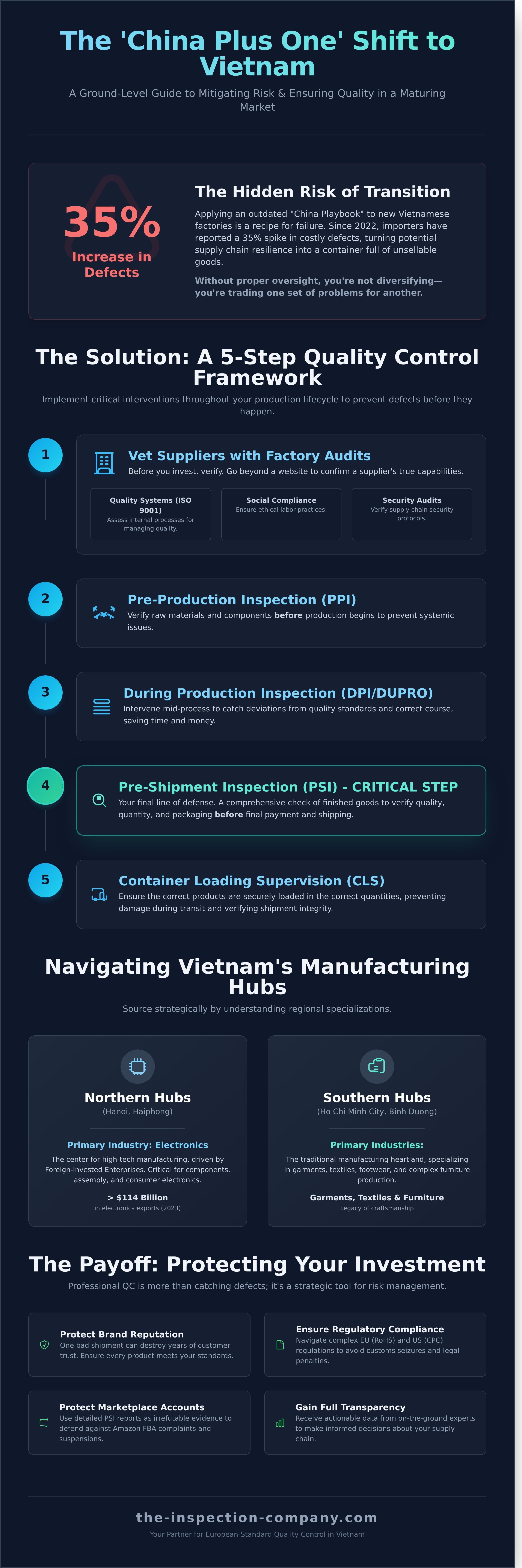
Your 'China-Plus-One' strategy is almost guaranteed to fail without a ground-level risk mitigation plan. Since 2022, importers shifting production have reported a 35% increase in costly defects when they apply an outdated China playbook to new Vietnamese factories. The risk of receiving a container full of unsellable goods isn't just a possibility; it's a predictable outcome without proper oversight.
You're moving to Vietnam to build a more resilient supply chain, not to trade one set of problems for another. The fear of inconsistent quality, complex communication with new suppliers, and the staggering cost of reverse logistics is real. This guide is your solution. We'll provide a clear roadmap for implementing professional quality control services in Vietnam, ensuring you can achieve zero-defect shipments and gain full transparency into your factory's operations. You'll learn the essential inspection frameworks, get crucial insights into regional manufacturing differences, and discover how to secure a reliable local partner with the Western management standards your business demands.
Key Takeaways
- Understand the unique quality risks in Vietnam's maturing market and how to adapt your strategy from the "China model" to prevent costly defects.
- Discover the critical intervention points in your production lifecycle, from vetting a new factory with an audit to approving the final shipment with an inspection.
- Learn how professional quality control services in vietnam provide the framework to mitigate risks, protect your brand, and secure your supply chain.
- Navigate Vietnam’s key manufacturing hubs by identifying whether to source electronics from the North or garments and furniture from the South.
Why Quality Control is Non-Negotiable in Vietnam’s 2026 Market
As the "China Plus One" strategy transitions from a trending concept to a standard operating procedure, Vietnam has cemented its position as a global manufacturing powerhouse. By 2026, its role will be more critical than ever. But this rapid ascent isn't without risk. The explosive growth has created a high-pressure environment where production errors, communication gaps, and compliance oversights can multiply. For international importers, skipping professional inspections is no longer a calculated risk; it's a direct threat to your bottom line and brand integrity.
The hidden costs of neglecting quality control far outweigh the investment in a third-party inspection. Imagine an entire container of goods arriving with a critical defect. The financial damage includes not only the cost of the faulty products but also the non-refundable shipping fees, potential product recall expenses, and the severe brand damage from negative customer reviews. One bad shipment can destroy years of trust. Effective quality control services in vietnam act as your insurance policy against these costly surprises.
The 2026 Manufacturing Landscape in Vietnam
Vietnam's production capabilities have evolved dramatically. The country is no longer just a hub for low-tech assembly. It's a critical link in the global supply chain for high-tech electronics, with exports exceeding $114 billion in 2023, and a growing center for specialized textiles and complex furniture. This shift, driven by Foreign-Invested Enterprises (FIEs) that now account for over 73% of export turnover, has raised the bar on quality expectations. However, this intense growth has led to widespread "factory fatigue," where facilities are stretched thin, leading to a higher risk of production shortcuts and inconsistent output.
Risk Mitigation: Beyond Simple Defect Catching
In Vietnam's 2026 market, professional quality control is a strategic risk-management tool that protects your investment, brand reputation, and market access. It's about more than just catching cosmetic flaws; it's a comprehensive process to verify your products are safe, compliant, and match your exact specifications before they ever leave the factory. This proactive approach is essential for navigating the complexities of modern commerce and international regulations.
- Protecting Your Online Marketplace Accounts: For Amazon FBA sellers, a single "Product Authenticity" or "Product Condition" complaint can trigger an account suspension. A detailed Pre-Shipment Inspection (PSI) report provides irrefutable, time-stamped evidence to defend your business against false claims and protect your seller rating.
- Ensuring Regulatory Compliance: Navigating the web of EU and US import regulations is a significant challenge. Third-party inspectors verify that your products comply with standards like RoHS (Restriction of Hazardous Substances) for electronics sold in the EU and meet CPC (Children's Product Certificate) requirements in the US, preventing costly customs seizures and legal penalties.
Ultimately, an independent inspection service acts as your dedicated team on the ground in Southeast Asia. We bridge the cultural and linguistic gaps, enforce your standards, and provide the transparent data you need to make informed decisions. This is why professional quality control services in Vietnam are no longer a luxury, but a core component of any successful sourcing strategy.
Core Quality Control Services: From Factory Audits to PSI
Effective quality management isn't a single event; it's a strategic process of intervention. Waiting until your products are packed and paid for is a high-risk gamble. The most successful importers leverage professional quality control services in vietnam at critical stages of the production lifecycle, stopping problems before they escalate into costly defects, shipping delays, or brand damage. From vetting a potential partner to ensuring the final container is sealed correctly, each service acts as a vital checkpoint for your investment.
One day of inspection truly can save you months of trouble. Here’s how we protect your supply chain at every step.
Vetting Suppliers with Factory Audits
Before you transfer a single dollar, you must verify your supplier’s legitimacy and capability. A Factory Audit is your on-the-ground due diligence, providing a clear, objective assessment of a manufacturer's operations. It’s not just about a fancy website; it’s about confirming reality. Our auditors assess three core areas:
- Quality Management Systems (QMS): We evaluate the factory’s internal processes against the globally recognized ISO 9001 standard. Do they have documented procedures for handling raw materials, managing production lines, and correcting errors? A robust QMS, verified by our audit, is the best predictor of consistent product quality.
- Social & Ethical Compliance: A factory’s ethical record directly impacts your brand's reputation. Our audits can check for compliance with standards like Sedex (Supplier Ethical Data Exchange) and BSCI (Business Social Compliance Initiative), ensuring fair labor practices and a safe working environment. This is non-negotiable for brands selling in Western markets.
- Production Capacity: Can the factory realistically handle your order volume, especially your 2026 growth forecasts? An audit verifies machinery, workforce numbers, and output records to confirm that a supplier claiming a 50,000-unit monthly capacity can actually deliver without sacrificing quality.
The Pre-Shipment Inspection (PSI) Framework
The Pre-Shipment Inspection (PSI) is the most critical service for most importers. Conducted when at least 80% of your order is produced and packed, it is your final opportunity to identify and fix quality issues before the goods leave the factory. A failed PSI gives you the leverage to demand rework or renegotiate terms before final payment is made.
Our PSI process is built on a foundation of objectivity and speed. We use the internationally recognized AQL (Acceptable Quality Level) standard to provide a clear statistical basis for a "pass" or "fail" result. This replaces subjective opinions with hard data, defining the maximum number of acceptable defects. For example, a common standard is AQL 2.5 for major defects and 4.0 for minor defects in consumer goods.
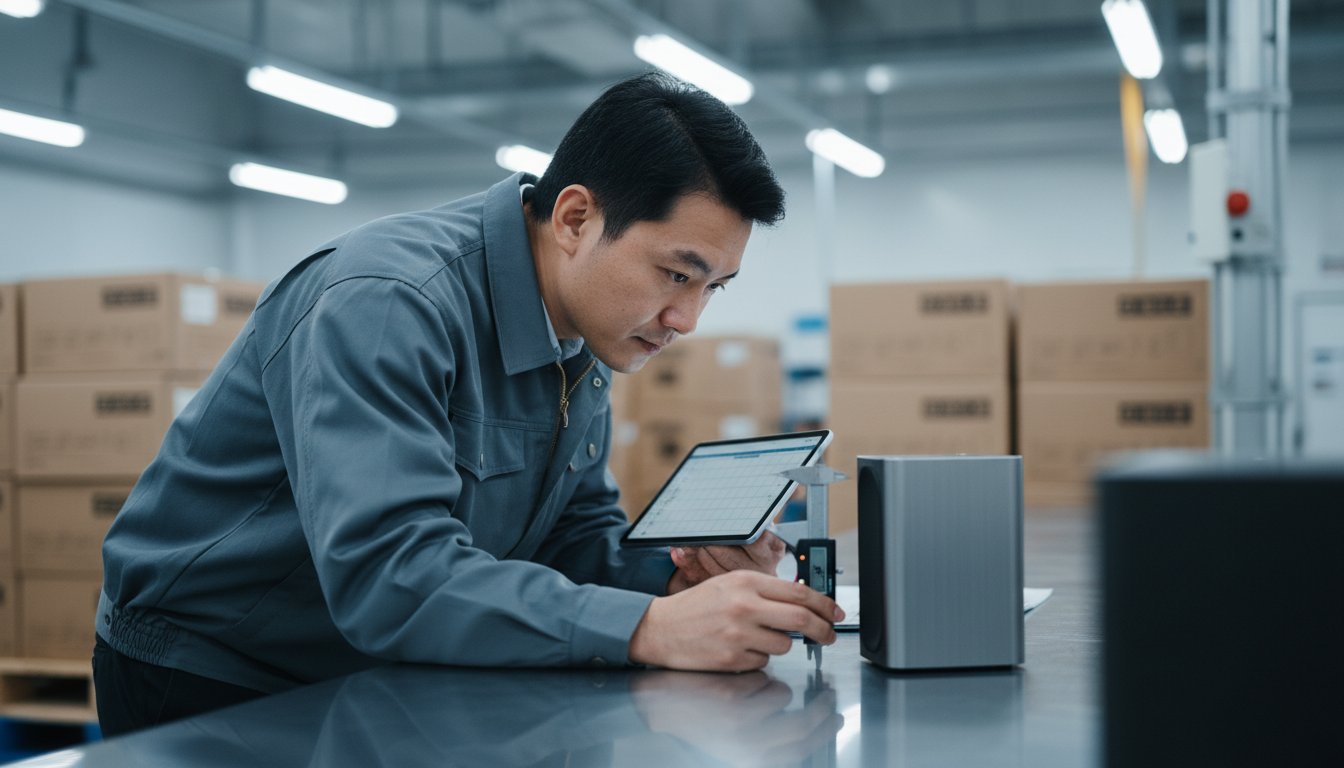
During the inspection, our technicians perform a comprehensive series of checks based on your specifications. This includes visual verification for cosmetic flaws, on-site functional testing, and packaging integrity checks. Our inspectors verify that products not only meet your specific requirements but also comply with Vietnam's national standards system, ensuring a smoother customs process. You receive a detailed report with photos and findings within 24 hours, empowering you to make fast, informed decisions. Understanding the right AQL and inspection points is crucial; our team can help you define a custom PSI checklist for your specific product.
Container Loading Inspection (CLI)
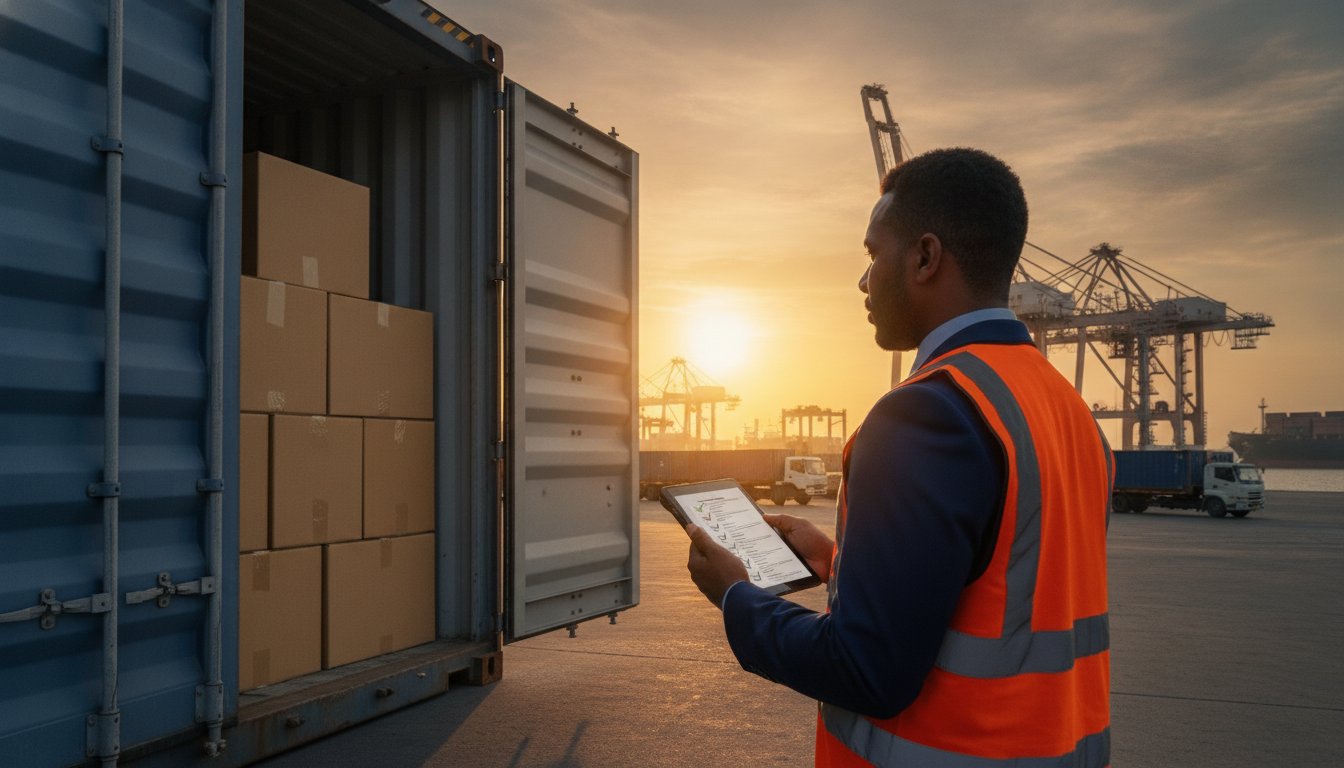
Your products passed the PSI. Now, you need to ensure the exact goods you approved are what get shipped. A Container Loading Inspection (CLI) verifies that the correct quantity and models are loaded securely into the shipping container. An inspector supervises the entire process, preventing common but costly errors like short-shipping, loading the wrong SKUs, or transit damage caused by improper stacking. It’s the final seal of approval that secures your order from the factory floor to the port.
Vietnam vs. China: Managing the Transition and Quality Gaps
Shifting production from China to Vietnam is not a simple "lift and shift" operation. While Vietnam presents a powerful manufacturing alternative, businesses often encounter a significant "experience gap." Chinese factories have, on average, over two decades of experience producing directly for Western markets. In contrast, many Vietnamese facilities are newer to the complexities of global export standards, leading to unforeseen quality risks.
This gap manifests in several critical areas. Vietnamese factory managers may require far more detailed technical specifications and production protocols. What was once understood implicitly by a long-term Chinese partner must now be explicitly documented, from material composition down to the exact Pantone color code and stitching density. Furthermore, Vietnam's supply chain is still developing. As of 2023, Vietnam still imports over 50% of its fabric and production inputs from China, creating a dependency that can introduce unexpected delays and component quality issues. Effective quality control services in vietnam must account for these cross-border risks.
Bridging the Technical Communication Gap
To mitigate these risks, your communication must be flawless and backed by physical standards. A "Golden Sample," an approved pre-production sample, becomes your non-negotiable benchmark. It physically demonstrates your standard, leaving no room for interpretation. A QC partner with European management is critical here; they act as a cultural and technical translator, ensuring your precise requirements are understood and implemented on the factory floor, preventing the common "yes" that means "I heard you" instead of "I understand and will comply."
Establishing Your Quality Standard
You cannot control what you don't define. Your quality standard must be documented in a clear checklist, classifying defects for your specific product.
- Critical Defects: Unsafe for the user or non-compliant with regulations (e.g., sharp edges on a toy, incorrect electrical wiring). Zero tolerance is the standard.
- Major Defects: Likely to result in a customer return (e.g., a non-functioning zipper on a jacket, a deep scratch on a table surface). These failures are visible and impact usability.
- Minor Defects: Small imperfections that don't affect the product's function and are unlikely to cause a return (e.g., a single loose thread, a tiny paint blemish on an unseen area).
For a new Vietnamese supplier, it's prudent to initially tighten your AQL (Acceptable Quality Limit) tables, for example, moving from a 2.5 AQL to a 1.5 AQL for major defects, until a consistent performance record is established. Should an inspection fail, don't just reject the shipment. A professional QC partner will help you implement a formal Corrective Action Plan (CAP). This document identifies the root cause of the defects and outlines the specific, verifiable steps the factory must take within a 30-day period to prevent the problem from happening again. This turns a costly failure into a long-term process improvement.
Regional Expertise: Navigating Vietnam’s Manufacturing Hubs
Vietnam is not a monolithic manufacturing block. It's a collection of distinct industrial regions, each with its own infrastructure, workforce profile, and inherent production risks. Understanding this geography is non-negotiable for effective quality control. A QC strategy designed for a garment factory in Binh Duong will fail in an electronics plant near Hanoi. Success requires on-the-ground knowledge of these hubs.
Choosing the right partner for quality control services in vietnam means selecting a team that understands these regional nuances, from port logistics to climate-specific defects.
The Northern Industrial Corridor
Centered around Hanoi and the port city of Hai Phong, Northern Vietnam is the country's high-tech heartland. Global giants like Samsung and LG have invested billions here, transforming the region into a critical link in the global electronics supply chain. Hai Phong’s Lach Huyen deep-water port is central to this, built to handle the massive volume needed to meet Vietnam's goal of over $100 billion in electronics exports by 2025.
However, this region presents unique challenges:
- Humidity Risks: The North's high humidity, especially from February to April, can be catastrophic for electronics, causing corrosion on printed circuit boards (PCBs) and component failure. Inspections must include stringent checks for moisture damage and proper desiccant use in packaging.
- Workforce Volatility: A significant portion of the factory workforce migrates home for the Tet (Lunar New Year) holiday. The subsequent labor turnover, often exceeding 15% in some factories, can lead to a sharp drop in quality as inexperienced workers are brought onto assembly lines.
- Specialized Testing: A simple visual check is insufficient for electronics. Our inspectors arrive on-site with specialized equipment like Hi-Pot testers for electrical safety and custom-built function testing jigs to verify product performance against specifications.
The Southern Economic Zone
The sprawling industrial parks of Ho Chi Minh City (HCMC), Binh Duong, and Dong Nai form the industrial engine of Southern Vietnam. This zone is the global hub for furniture, footwear, and garment manufacturing. The sheer scale of production here demands a different QC approach. Managing a multi-line furniture audit across a 50,000-square-meter factory in Binh Duong requires immense logistical precision.
Importers must account for the "HCMC effect." While labor costs in HCMC (Region I) are up to 15% higher than in surrounding provinces, the workforce often possesses higher technical proficiency. This can be a critical advantage for complex garment or high-end furniture production. Coordinating inspections across these vast, often congested zones requires careful planning to maximize time on the factory floor and ensure Pre-Shipment Inspections are completed before container loading deadlines at Cat Lai Port.
While the North and South are dominant, Central Vietnam, particularly Da Nang, is rapidly emerging as a viable alternative for specialized manufacturing, offering a skilled workforce and a less congested logistics network.
Don't let regional complexities introduce costly defects or shipping delays into your supply chain. Contact us to align our inspectors with your specific Vietnamese manufacturing hub.
The Inspection Company: Your European Standard Partner in Vietnam
Choosing a partner for quality control in Vietnam is about more than just finding someone on the ground. It’s about securing a team that understands both the nuances of local manufacturing and the non-negotiable standards of your target market. The Inspection Company (TIC) bridges this gap, combining over 25 years of hands-on experience in Asia with the rigorous, process-driven framework of European quality management. This unique fusion provides the reliability and integrity you need to avoid costly surprises and protect your brand's reputation.
Don't let factory location limit your sourcing options. Our extensive network of over 700 professionally trained inspectors provides complete nationwide coverage, from the industrial hubs of Ho Chi Minh City and Hanoi to factories in more remote provinces. This reach ensures consistent quality oversight, no matter where your suppliers are located. But coverage is meaningless without speed. We deliver a detailed, actionable inspection report, complete with high-resolution photos and defect classifications, directly to your inbox within 24 hours of the service. This allows you to make critical, data-driven decisions about your shipment in real-time, preventing delays that can disrupt your entire supply chain.
For Amazon sellers, sourcing from Vietnam introduces a unique set of compliance hurdles. A standard product inspection often overlooks the specific FBA requirements that can lead to costly rejections, chargebacks, or even account suspension. Our specialized Amazon FBA inspection services are designed to prevent these issues. Our inspectors meticulously verify every detail, including:
- FNSKU label accuracy and scannability
- Packaging compliance with Amazon's strict guidelines
- Carton weight and dimension limits
- Correct application of suffocation warnings and other required labels
We stop FBA-related problems before your inventory leaves the factory, saving you from significant financial losses and protecting your seller rating.
Why European Management Matters in Vietnam
Our European management structure is the core of our service integrity. It's a system built to protect your interests, ensuring that every inspection is conducted ethically and to the highest international standards. This approach guarantees unyielding integrity through a zero-tolerance anti-corruption policy, translates complex Western safety standards (like CE or CPSIA) for local factories, and provides you with clear, direct communication and accountability. You get a reliable partner who speaks your language.
Getting Started with Vietnam QC
Integrating professional oversight into your supply chain is a straightforward, three-step process: Request, Coordination, and Reporting. You can book your service online in minutes, and our team coordinates directly with your supplier to handle all logistics. This system is designed to fit seamlessly into your existing workflow, providing the expert quality control services in vietnam you need without adding complexity. Ready to secure your supply chain and ensure your products meet your standards every time? Book your Vietnam factory audit or inspection today.
Master Your Vietnam Sourcing in 2026 and Beyond
As Vietnam's manufacturing landscape evolves toward 2026, the risks for importers are real. Navigating its diverse regional hubs and managing potential quality gaps requires more than a new supplier list; it demands a proactive risk mitigation strategy. The key takeaway is clear: comprehensive, multi-stage inspections are non-negotiable for protecting your bottom line. Engaging professional quality control services in vietnam is the most critical investment you can make to prevent costly defects and shipment delays.
Don't leave your success to chance. The Inspection Company offers the on-the-ground expertise you need, backed by European management and an ISO 9001 certified quality system. You get detailed inspection reports, complete with photos and videos, within 24 hours of completion. Take control of your supply chain with a partner dedicated to your success.
Secure your Vietnam supply chain-Get an instant inspection quote today and build a resilient, profitable future.
Frequently Asked Questions
What is the average cost of quality control services in Vietnam?
The average cost for professional quality control services in Vietnam ranges from $295 to $349 USD per man-day. This all-inclusive price typically covers the inspector's full day of work, travel expenses, and the delivery of a comprehensive inspection report within 24 hours. The final cost depends on the factory's location and the complexity of the product being inspected. Investing one man-day can prevent thousands of dollars in losses from defective goods.
Can I use the same inspection checklist in Vietnam as I do in China?
It's not recommended to use an identical checklist. While universal AQL standards apply everywhere, manufacturing specializations differ. Vietnam's strengths are in garments, footwear, and furniture, which require different quality checkpoints than China's electronics-heavy production. Your checklist must be customized for the specific product and the Vietnamese factory's capabilities to be effective. We help clients adapt their quality standards to ensure all critical risks are covered for each unique production environment.
How long does it take to get an inspection report from a factory in Ho Chi Minh City?
You will receive a complete, detailed inspection report within 24 hours of the inspection's completion. Our system ensures that all findings, including high-resolution photos and defect descriptions, are compiled and reviewed by a technical manager before being sent. This rapid turnaround applies to all major industrial hubs, including Ho Chi Minh City, and allows you to make timely decisions about your shipment before it leaves the port, preventing costly delays.
What is a Pre-Shipment Inspection (PSI) and when should it be performed?
A Pre-Shipment Inspection, or PSI, is your final opportunity to verify product quality before it ships. It should be performed when 100% of the production is complete and at least 80% of the goods are packed for export. During a PSI, our inspector uses AQL sampling to check for defects, verify quantities, and ensure packaging meets your specifications. This is the most crucial step to avoid receiving a shipment of faulty or incorrect products.
Does The Inspection Company cover remote industrial zones in Northern Vietnam?
Yes, our network provides comprehensive coverage across all of Vietnam, including remote industrial zones in northern provinces like Bac Giang, Thai Nguyen, and Vinh Phuc. We have qualified, local inspectors strategically positioned throughout the country to minimize travel costs and ensure we can be on-site at your factory within 48 hours of booking. Our extensive reach is a key component of our reliable services, ensuring no factory is out of reach.
How do you prevent inspectors from being bribed by the factory?
We enforce a zero-tolerance anti-bribery policy through a robust integrity program. Inspectors are rotated between factories regularly so they don't develop overly familiar relationships with factory management. Each inspector signs a strict code of conduct, and our supervisors conduct unannounced spot-checks at factory sites. Any violation results in immediate termination. This multi-layered system protects your interests and guarantees the complete objectivity of every inspection report.
What happens if the factory fails the quality inspection?
If a factory fails, you receive an immediate alert and a full report within 24 hours detailing all defects and issues. This report gives you the clear evidence needed to act. Your primary options are to instruct the factory to rework the defective goods and schedule a re-inspection, or to negotiate a discount on the order. In severe cases, you have the grounds to reject the shipment entirely before making the final payment. We provide the data; you maintain control.
Is a factory audit necessary if I am buying from a verified Alibaba supplier in Vietnam?
Yes, a factory audit is highly recommended. An Alibaba "Verified Supplier" check confirms the factory's legal existence but doesn't validate its quality management system or production capacity for your specific order. Our independent factory audit goes deeper, assessing their equipment, processes, and social compliance to ISO 9001 standards. This gives you a true picture of their capabilities and potential risks before you place a large order, preventing major production surprises.