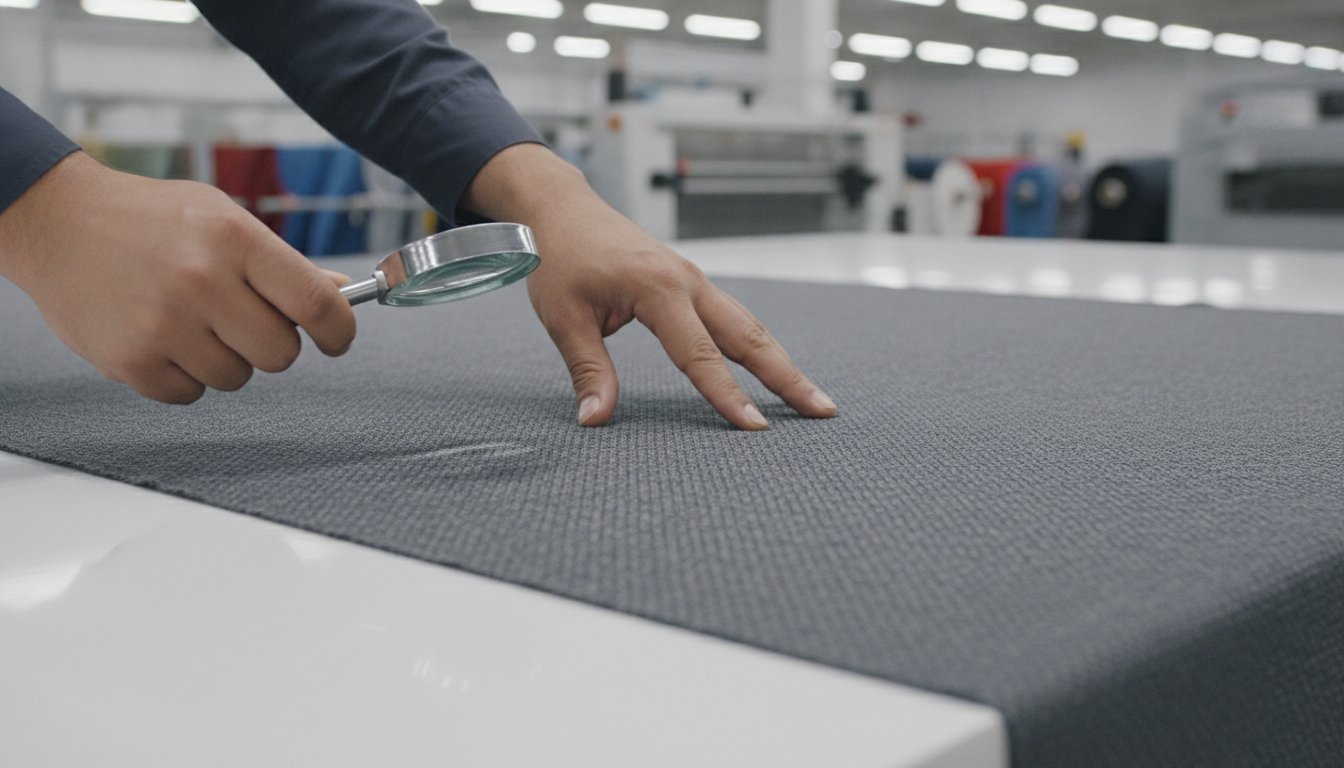

What if 15% of your next shipment is unsellable before it even leaves the port? If you're importing from Asia, these aren't just possibilities; they're expensive realities that occur in roughly one out of every eight shipments without a rigorous audit qualité textile. You likely already know that a single batch of garments with hidden pilling, sizing inconsistencies, or fabric bleeding can erase months of profit and damage your brand reputation. It's a high-stakes environment where "good enough" usually isn't, especially with the rising ethical and social compliance standards expected in 2026.
We've designed this guide to give you back control over your manufacturing process. You'll master a professional textile quality framework that stops defects before they leave the factory floor. By following this checklist, you'll reduce customer complaints and gain total confidence in your supplier's capabilities. We'll examine the critical steps from fabric testing to ethical verification, ensuring your shipment arrives exactly as specified. This systematic approach transforms quality control from a stressful gamble into a predictable, manageable part of your business operations. One day of inspection can save months of trouble.
Key Takeaways
- Understand why a professional audit is the ultimate risk mitigation tool that saves months of supply chain trouble with just one day of inspection.
- Master the technical application of AQL to determine accurate sample sizes and ensure your production meets strict defect thresholds.
- Gain a comprehensive checklist for evaluating fabric quality and workmanship, from GSM consistency to seam strength and needle safety.
- Learn how to execute a rigorous audit qualité textile that evaluates factory storage conditions and raw material sourcing to prevent contamination.
- Discover how to bridge the gap between Western standards and Asian production by integrating professional European management into your supplier strategy.
What is a Textile Quality Audit and Why is it Non-Negotiable in 2026?
A textile quality audit is a rigorous on-site assessment that evaluates both a factory's quality management systems and specific production batches. In 2026, this process is no longer optional. It's a critical safeguard for your supply chain. An audit qualité textile ensures that your supplier doesn't just promise quality but has the infrastructure to deliver it consistently. We view this through a risk mitigation framework: one day of inspection can save months of trouble. By catching errors at the source, you stop problems before your shipment sails.
It's vital to distinguish between a standard factory audit and a product-specific textile inspection. A factory audit focuses on the facility's long-term capability, certifications, and machinery. In contrast, a product inspection involves hands-on textile testing to verify colorfastness, seam strength, and fabric weight against your specifications. Both are essential pillars of a modern sourcing strategy.
The 2026 global trade environment is defined by transparency. New regulations, including the EU Corporate Sustainability Due Diligence Directive, require importers to have full visibility into their manufacturing sites. You're now legally and financially responsible for what happens on the factory floor. A professional audit provides the documented proof of compliance you need to satisfy both regulators and conscious consumers.
The High Cost of Skipping Quality Control in Asia
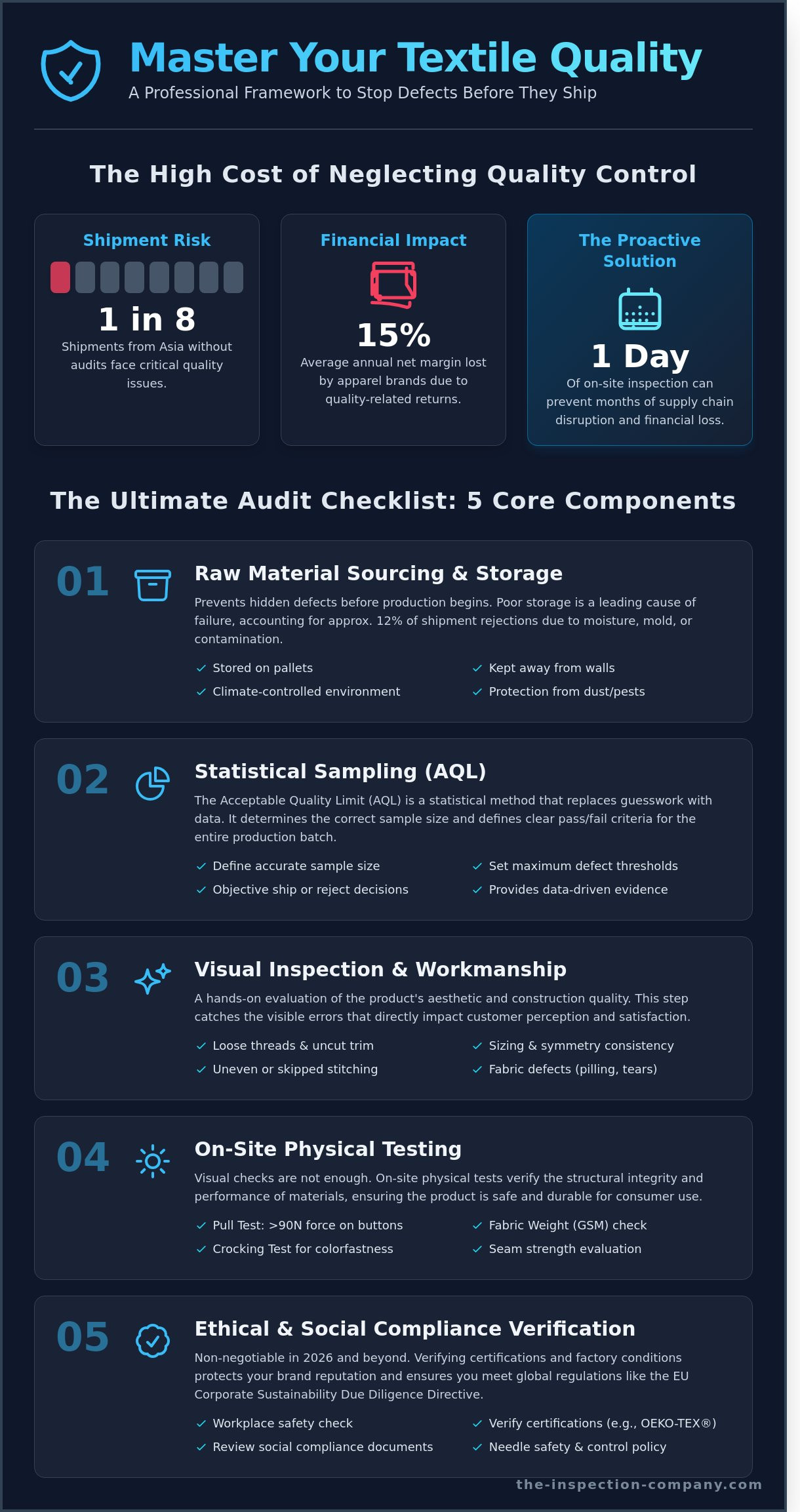
Textile manufacturing is uniquely vulnerable to errors because it remains highly manual and labor-intensive. A single miscalibrated dyeing machine or a week of high humidity can ruin thousands of meters of fabric. Skipping QC often leads to severe product defects that aren't discovered until the goods reach your warehouse. By then, it's too late. Data from 2025 indicates that quality-related returns cost apparel brands an average of 15% of their annual net margin. Beyond the immediate financial loss, the damage to your brand reputation can be permanent. Don't let a 45-day sea transit turn into a total loss because you skipped a one-day audit qualité textile.
Core Components of a Professional Textile Quality Audit
A successful audit qualité textile goes beyond a simple walk-through. It's a technical deep dive into the factory's operational DNA. Our auditors begin by evaluating raw material sourcing and storage conditions. Poor fabric storage leads to moisture damage or contamination, which causes approximately 12% of shipment rejections in the garment industry. We verify that materials are stored on pallets, kept away from walls, and maintained in climate-controlled environments to prevent mold or dust accumulation.
Determining the right sample size is critical for effective risk management. We utilize the AQL (Acceptable Quality Limit) to define exactly how many units to inspect and the maximum number of allowable defects. This statistical approach ensures your decision to ship or reject is based on hard data rather than guesswork. We also scrutinize production capacity and machinery maintenance schedules. A factory running at 98% capacity with no documented downtime for maintenance is a high-risk partner likely to produce inconsistent results.
Ethical manufacturing is no longer optional for modern importers. A comprehensive audit must review social compliance and workplace safety to protect your brand reputation. Verifying certifications like the OEKO-TEX® STANDARD 100 ensures your textiles are free from harmful substances and meet global safety regulations. Executing a rigorous audit qualité textile prevents these costly compliance errors before they reach your warehouse.
Visual Inspection vs. Physical Testing
Visual checks focus on the aesthetics and workmanship of the garment. Auditors look for loose threads, uneven stitching, and poor symmetry. However, visual checks alone don't reveal hidden structural flaws. We conduct on-site physical tests like the 'pull test' to ensure buttons and accessories withstand at least 90 Newtons of force. We also perform crock testing to verify colorfastness against friction, ensuring dyes don't bleed during consumer use. Every finding is compared against the 'Golden Sample' approved during the First Article Inspection. If the mass production deviates by more than 3% from this approved benchmark, it's a signal to halt the line immediately. To secure your supply chain and avoid surprises, consider booking our professional inspection services before your goods leave the factory floor.
The Ultimate Textile Quality Audit Checklist for Importers
Conducting a rigorous audit qualité textile is the only way to catch production errors before they reach your warehouse. A meticulous inspection starts with fabric integrity. Inspectors must verify color shading consistency across different rolls and check for physical damage like holes or snags. Weight consistency is measured in Grams per Square Meter (GSM); a deviation of more than 5% from the approved sample often signals a compromise in material quality. To ensure these results are scientifically valid, our teams utilize AATCC standardized test methods to evaluate colorfastness and shrinkage.
Workmanship focus shifts to the structural durability of the garment. Inspectors test seam strength by applying specific tension levels and use metal detectors to ensure no broken needles remain in the fabric. Every sharp point or loose staple is a major liability. Sizing must be measured against your tech pack for 100% of the size range in the sample. Data shows that a 1cm deviation in a critical measurement, such as the chest or waist, can increase retail return rates by over 12%.
Final packaging and labeling are equally vital for compliance. You must verify RoHS compliance for metal buttons, zippers, or specific dyes to avoid costly customs seizures. Care labels must be present, legible, and accurate to the 2026 regulatory standards of your target market.
Identifying and Categorizing Textile Defects
A professional audit qualité textile categorizes defects based on risk and salability. Critical Defects are safety hazards, such as mold or broken needles, which result in an immediate fail for the entire shipment. Major Defects make the product unsellable or unfit for its intended purpose, including holes, significant stains, or sizing that falls outside of the allowed tolerances. Minor Defects are small aesthetic issues, like loose threads or slight shading variations, that don't affect the garment's function but deviate from the original design standard.
Stop production errors from damaging your brand reputation. Book a professional textile inspection today to secure your supply chain.
Implementing Your Audit Strategy with a Trusted Partner
Success in the 2026 textile market requires moving beyond reactive checks. You must integrate a rigorous audit qualité textile into your broader supplier management process. This creates a loop of continuous improvement instead of a series of isolated hurdles. By utilizing European management based in Hong Kong, you bridge the cultural and technical gap between Western quality expectations and Asian manufacturing realities. Our team applies 25 years of field experience to ensure your specific standards aren't lost in translation.
Managing these global operations is simplified through our proprietary quality platform. This digital hub provides real-time visibility into your supply chain data. You can book an inspection in minutes and receive a comprehensive, data-backed report within 24 hours of the site visit. This speed prevents logistics bottlenecks. It keeps your inventory moving while ensuring every garment meets your specifications. One day of inspection saves months of trouble.
What to Do When a Textile Audit Fails
A failed audit is a risk management trigger. Don't panic; follow a structured protocol. First, issue a Corrective Action Plan (CAP) that requires the factory to identify the root cause of defects. We don't just look for quick fixes. We look for systemic prevention. Re-inspections are essential to verify these changes before goods leave the floor.
Deciding the next step depends on the severity of the findings:
- Pass with conditions: Use this if defects are minor and affect a negligible percentage of the batch, typically under 2%.
- Pending: Hold the shipment until the factory provides proof of rework on a specific sample size.
- Rejection: If critical safety or structural issues appear, reject the shipment. It's the only way to avoid costly recalls and brand damage.
Our inspectors provide the objective data you need to make these high-stakes decisions. We stop problems before your shipment sails, ensuring your 2026 sourcing strategy remains profitable and risk-free.
Secure Your Supply Chain for 2026 and Beyond
Success in the global market requires a systematic approach to quality that addresses evolving standards. By implementing a rigorous checklist, you eliminate the risks of fabric defects and compliance failures before they leave the factory floor. A professional audit qualité textile serves as your final safeguard against the high costs of returns and brand damage. It's the most effective way to ensure your products meet every specification before shipment.
The Inspection Company brings over 25 years of experience in Asian manufacturing directly to your production line. Our European management team maintains ISO 9001 certification to ensure every inspection meets international benchmarks for accuracy. We don't believe in waiting for results; you'll receive a detailed inspection report within 24 hours of the audit. This speed allows you to make informed decisions without delaying your logistics timeline. One day of inspection can save months of trouble.
Avoid costly surprises, book your professional textile quality audit today
Take control of your production quality today and build a more resilient brand for the years ahead.
Frequently Asked Questions
How much does a textile quality audit typically cost in Asia?
A professional textile quality audit in Asia typically costs between $200 and $300 per man-day according to industry price benchmarks. This flat rate generally covers the inspector's travel, the on-site assessment, and the final documentation. Investing in an audit qualité textile at this stage prevents the much larger financial loss of shipping unsellable goods.
What is the difference between a factory audit and a pre-shipment inspection?
A factory audit evaluates the supplier's production capabilities and quality management systems before you place an order, while a pre-shipment inspection (PSI) verifies the actual quality of the finished goods. The audit ensures the facility meets ISO 9001 standards or social compliance requirements. In contrast, the PSI happens when 80% of production is packed. It's your last chance to stop defects from leaving the factory floor.
Can an audit guarantee 100% defect-free textile products?
No audit can guarantee 100% defect-free products because inspections rely on statistical sampling methods like the ISO 2859-1 (AQL) standard. Inspectors examine a representative sample of the lot to determine if the overall quality meets your specific tolerance levels. This method identifies systemic issues and major defects with a 95% confidence level. It's a risk mitigation tool, not a total elimination of every minor stitch error.
How long does a typical on-site textile audit take to complete?
A standard on-site textile audit usually takes one full business day to complete for a single factory location. This timeframe allows the inspector to verify the facility's machinery, review certifications, and interview staff. If the factory employs over 500 workers or has multiple production lines, the process might extend to two or three days. You'll typically receive the comprehensive digital report within 24 hours of the site visit.
What are the most common defects found during textile audits in China and Vietnam?
The most common defects identified during an audit qualité textile in China and Vietnam include shaded fabric, broken stitches, and measurement deviations. Industry data shows that 35% of textile rejections stem from color shading issues between different production batches. Other frequent problems include untrimmed threads and needle holes. Identifying these issues before shipment is essential to avoid the high costs of returns and brand damage.