
Your supplier insists their electronics are "RoHS compliant," but a nagging doubt remains. What happens if they are wrong? For importers, a single non-compliant shipment can trigger a cascade of costly problems: goods rejected by EU customs, forced recalls, significant fines, and irreparable damage to your brand's reputation. This uncertainty is a serious and unnecessary risk in international trade. Understanding the true rohs compliant meaning is not just about ticking a box; it is a critical step in protecting your investment and ensuring smooth market access.
This comprehensive guide is designed to eliminate that uncertainty. We will break down exactly what RoHS compliance entails, which specific hazardous substances are banned, and how to determine if your products are affected. More importantly, we provide a practical framework for verifying compliance within your supply chain. By the end of this article, you will have the knowledge and tools to confidently manage RoHS requirements, avoid costly surprises, and ensure your shipments sail through customs without issue.
Key Takeaways
- Understanding the rohs compliant meaning is the first step to avoiding market access issues, as it restricts 10 specific hazardous substances in electronics.
- Determine if your goods classify as Electrical and Electronic Equipment (EEE), as the directive's scope is broader than many importers initially assume.
- Relying solely on a supplier's declaration is a major business risk; a proactive verification process is essential to ensure your products are genuinely compliant.
- The consequences of non-compliance extend beyond fines to include shipment seizures, mandatory recalls, and severe damage to your brand's reputation.
What Does 'RoHS Compliant' Actually Mean? A Simple Definition
For any business manufacturing or importing electronics, understanding the rohs compliant meaning is not optional-it is a critical requirement for market access. At its core, RoHS stands for the Restriction of Hazardous Substances. It is a directive originating from the European Union (EU) designed to protect human health and the environment from the risks posed by certain dangerous materials used in electrical and electronic equipment (EEE).
In practical terms, if a product is labeled "RoHS compliant," it means the concentration of a specific list of hazardous materials is below the maximum permitted levels. Achieving this compliance is mandatory for most EEE intended for sale within the EU. Failure to comply can result in your shipment being blocked at customs, leading to costly delays, fines, and significant damage to your brand's reputation.
The Core Goal: Why These Substances are Restricted
The directive's primary objective is to mitigate the serious health and environmental risks associated with electronics manufacturing and disposal. The restrictions target materials that are problematic at every stage of a product's lifecycle, from production to its end-of-life as e-waste. Key goals include:
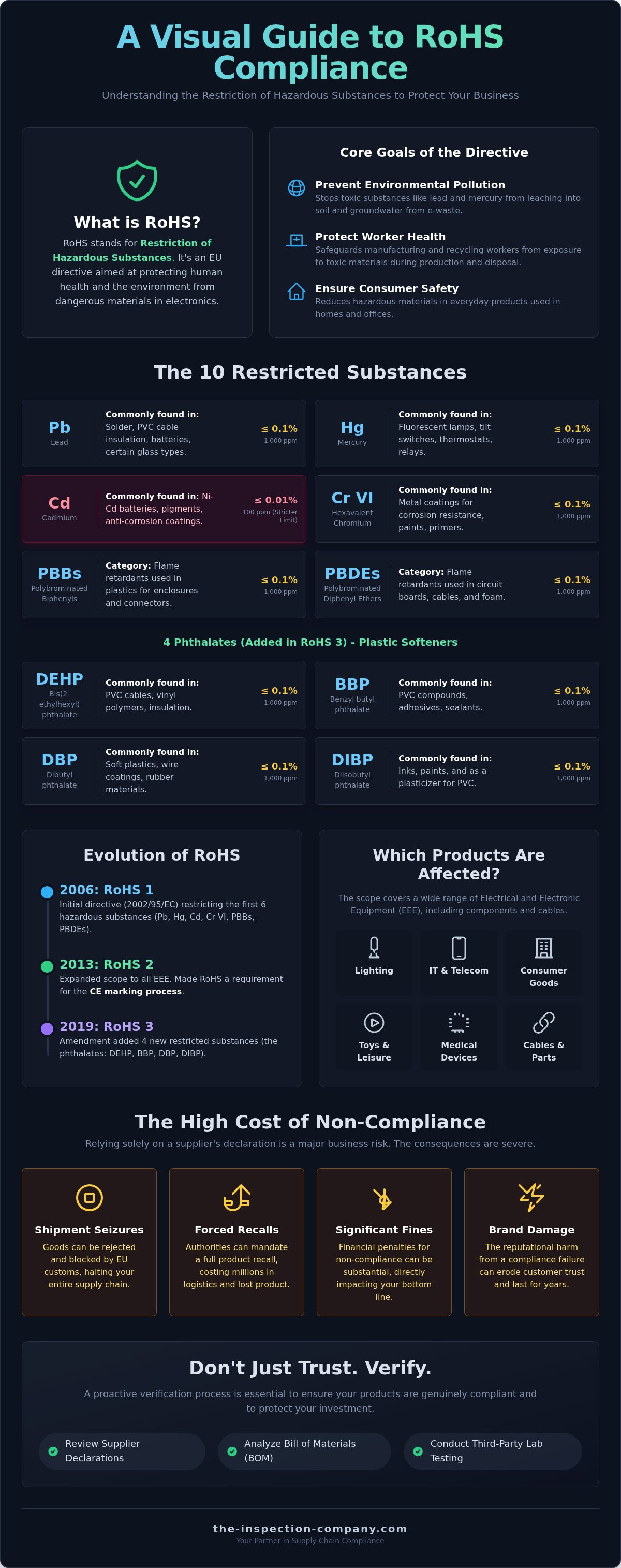
- Preventing environmental pollution: Restricted substances like lead and mercury can leach from landfills into the soil and groundwater, causing long-term ecological damage.
- Protecting worker health: Individuals involved in manufacturing and recycling electronics are protected from exposure to toxic materials that can cause severe health problems.
- Ensuring consumer safety: Reducing hazardous materials ensures that the products people use in their homes and offices are safer during everyday handling and operation.
RoHS 1, 2, and 3: A Quick History of the Directive
The directive has evolved significantly since its inception to expand its scope and effectiveness. The original Restriction of Hazardous Substances Directive, known as RoHS 1, came into effect in 2006, restricting six substances. Since then, it has been updated to keep pace with industry and environmental science.
- RoHS 1 (2006): The foundational directive (2002/95/EC) restricted the first six hazardous substances: lead, mercury, cadmium, hexavalent chromium, PBBs, and PBDEs.
- RoHS 2 (2013): This recast of the directive (2011/65/EU) expanded its scope to include all electrical and electronic equipment, cables, and spare parts. Crucially, it also made RoHS compliance a requirement for the CE marking process.
- RoHS 3 (2019): An amendment (EU 2015/863) to RoHS 2, this update added four new restricted substances-all of which are phthalates commonly used to soften plastics.
The 10 Restricted Substances and Where They Hide in Your Products
To truly understand the rohs compliant meaning, you must know which specific substances are regulated and to what degree. The directive is not an outright ban but imposes strict maximum concentration levels for ten hazardous materials. For a product to be compliant, each of its individual homogeneous materials-such as the plastic casing or a specific wire coating-must not exceed these limits.
For most substances, the maximum allowed concentration is 0.1% (or 1,000 parts per million) by weight. The one exception is Cadmium, which has a much more stringent limit of 0.01% (100 ppm). The full list of these materials is detailed in the official RoHS Directive from the European Commission. Understanding where these substances are commonly found is the first step to identifying high-risk components in your supply chain.
The Heavy Metals: Lead (Pb), Mercury (Hg), Cadmium (Cd), and Hexavalent Chromium (Cr VI)
These four toxic metals were the initial focus of RoHS due to their environmental impact and risk to human health. They are often found in core electronic components.
- Lead (Pb): Traditionally used in solder for circuit boards, lead can also be found in PVC cable insulation, certain types of glass (like in CRT screens), and batteries.
- Mercury (Hg): Most common in fluorescent lamps and bulbs, but also present in tilt switches, relays, and older thermostat sensors.
- Cadmium (Cd): A key component in some rechargeable batteries (Ni-Cd), pigments, and anti-corrosion coatings. Its presence requires extra diligence due to its lower threshold.
- Hexavalent Chromium (Cr VI): Primarily used as a chromate conversion coating on metals to prevent corrosion and improve paint adhesion.
The Flame Retardants: PBBs and PBDEs
Polybrominated Biphenyls (PBBs) and Polybrominated Diphenyl Ethers (PBDEs) are families of chemicals added to materials to reduce flammability. While effective for fire safety, they are persistent environmental pollutants. They are commonly found in plastic enclosures for electronics, insulation for cables, and on printed circuit boards (PCBs).
The Phthalates (Plasticizers): DEHP, BBP, DBP, and DIBP
Added under the RoHS 3 amendment, these four phthalates are used to soften plastics and make them more flexible and durable. Verifying their absence is now a critical part of the modern rohs compliant meaning. Their most common application is in electrical and electronic equipment, especially in PVC components like power cords, wire insulation, gaskets, and vinyl enclosures.
Which Products Must Be RoHS Compliant? Understanding the Scope
A critical part of understanding the rohs compliant meaning is identifying which products fall under its extensive scope. The directive applies broadly to Electrical and Electronic Equipment (EEE). A simple rule of thumb is: if a product depends on electric currents or electromagnetic fields to perform its main function, it must be evaluated for RoHS compliance. This includes products that generate, transfer, or measure such currents and fields.
For businesses aiming to sell in the European Union, verifying RoHS compliance is a mandatory step. It is a prerequisite for affixing the CE mark, which declares that your product meets all relevant EU health, safety, and environmental protection legislation. Failure to comply can result in costly product recalls, fines, and denial of market access.
The 11 Official Product Categories
The scope of the directive is organized into 11 broad categories. These are formally defined in Annex I of the official RoHS Directive from the European Commission. Crucially, the directive now operates under an 'open scope' provision, meaning any EEE that does not fall into a specific exemption is covered.
- Category 1: Large household appliances (e.g., refrigerators, washing machines)
- Category 2: Small household appliances (e.g., vacuum cleaners, toasters)
- Category 3: IT and telecommunications equipment (e.g., computers, smartphones)
- Category 4: Consumer equipment (e.g., televisions, cameras)
- Category 5: Lighting equipment (e.g., LED lamps, fluorescent bulbs)
- Category 6: Electrical and electronic tools (e.g., drills, saws)
- Category 7: Toys, leisure, and sports equipment (e.g., video game consoles, electric trains)
- Category 8: Medical devices
- Category 9: Monitoring and control instruments including industrial instruments
- Category 10: Automatic dispensers (e.g., vending machines)
- Category 11: Other EEE not covered by any of the categories above
Real-World Examples of Covered Products
The categories cover nearly every electronic product imaginable. Common examples include computers, smartphones, printers, and their associated cables and power supplies; home appliances like refrigerators and microwave ovens; consumer electronics such as LED lights and televisions; and even complex items like medical devices, electronic toys, and power tools. Components like wires, casings, and circuit boards are also within scope.
Key Exemptions and Exclusions
While the scope is vast, certain product types are explicitly excluded from the directive. It is essential to verify if your product qualifies, as exemptions are specific and subject to periodic review. Key exclusions include:
- Equipment for military and national security purposes.
- Large-scale stationary industrial tools.
- Products specifically designed for aerospace applications.
- Active implantable medical devices.
- Batteries and packaging materials (covered by separate directives).
How to Ensure and Verify RoHS Compliance: A Practical Guide
Simply accepting a supplier's claim of compliance is a significant business risk. While understanding the theoretical rohs compliant meaning is the first step, proactive verification is essential to protect your investment, brand reputation, and market access. Relying on trust alone can lead to seized shipments and costly fines. Integrating a robust verification process into your standard quality control procedures is not just best practice-it's a necessity for any serious importer. This process involves a multi-layered approach combining documentation review, on-site screening, and definitive lab testing.
Step 1: Get the Right Documentation from Your Supplier
Your verification process starts with a thorough documentation check. Before production begins, demand clear evidence from your supplier to establish a paper trail. This initial step helps gauge their professionalism and commitment to compliance. Insist on receiving:
- A formal Declaration of Conformity (DoC) specific to the product, which is the manufacturer's official statement of compliance.
- Material datasheets for critical components, especially plastics, coatings, and electronics.
- Any existing lab test reports from accredited, third-party laboratories that support their claims.
Step 2: Use On-Site Screening During Inspections
Documentation can be falsified or may not apply to your specific production batch. That's why on-site checks are a critical layer of security. During a pre-shipment inspection, our inspectors can use a portable X-Ray Fluorescence (XRF) analyzer to screen high-risk materials. This allows for a rapid check of solder points, cables, and plastic casings for restricted substances. This technology provides a quick and cost-effective initial assessment, flagging potential non-compliance before the shipment ever leaves the factory.
Step 3: Conduct Third-Party Lab Testing for Confirmation
For definitive proof, nothing replaces accredited laboratory testing. Sending randomly selected production samples to a certified lab provides a precise chemical analysis and a formal, legally defensible report. This is the ultimate way to verify compliance, manage your risk, and ensure the rohs compliant meaning is truly met in your finished goods. Lab testing provides the concrete evidence needed to confidently place your product on the market and protect your business from recalls or penalties.
Need to verify your supplier's claims? We can help.
The High Cost of Non-Compliance: Business Risks You Can't Ignore
Failing to meet RoHS standards is far more than a technical oversight; it is a significant business liability with severe and lasting consequences. Market surveillance authorities across the European Union are actively testing products on the market, making compliance a critical component of your risk management strategy. Simply knowing the rohs compliant meaning is not enough-you must actively ensure and document it for every shipment.
Financial Consequences: Fines, Recalls, and Seized Goods
The direct financial penalties for non-compliance are severe and immediate. While each EU member state sets its own penalties, the consequences are universally damaging to your bottom line. Your business could face:
- Substantial fines that can reach thousands of euros per non-compliant unit sold, quickly accumulating into a crippling sum.
- Forced product recalls at your own expense. This includes the high costs of reverse logistics, customer refunds, and environmentally sound disposal.
- Seized and destroyed shipments at customs. If your goods are stopped at the border and found to be non-compliant, they can be impounded and destroyed, resulting in a total loss of inventory and revenue.
Loss of Market Access
A single compliance failure can result in your products being banned from the entire EU market-a devastating blow for any business. This risk extends globally. Authorities in other regions with similar laws, such as the UK (UK RoHS), California, and China, often share information. A violation in one jurisdiction can trigger intense scrutiny and potential bans in others, effectively closing off major international markets to your products.
Damage to Your Brand Reputation
The long-term damage to your brand can be even more costly than the initial fines. Product recalls and safety alerts are public information, quickly eroding customer trust and loyalty. Your brand becomes associated with unsafe or low-quality products. Furthermore, major retail partners will not risk their own reputation and may immediately drop your entire product line, leading to a permanent loss of critical distribution channels.
Ultimately, understanding the technical rohs compliant meaning is the first step, but proactive verification is the only way to protect your business. These risks are not theoretical; they are real-world consequences that can cripple a company's finances and reputation. Verifying RoHS compliance before your shipment sails is an essential investment to avoid these costly surprises.
From Understanding to Action: Securing Your RoHS Compliance
Navigating the complexities of the RoHS directive is a critical task for any successful importer. As we've covered, it's not just about knowing the ten restricted substances, but also understanding the significant business risks of non-compliance, from costly shipment rejections to lasting brand damage. Ultimately, the rohs compliant meaning extends beyond a simple checklist; it signifies a commitment to safety, market access, and your brand's integrity.
Ensuring your products meet these stringent standards before they leave the factory is the only way to mitigate risk. With a team of over 700 inspectors across Asia and European management with over 25 years of experience, we provide the independent verification you need. You'll receive detailed reports within 24 hours, giving you the data-driven confidence to approve your shipment. Don't leave compliance to chance. Secure your supply chain. Get an instant quote for your product inspection.
Take control of your quality and import with confidence.
Frequently Asked Questions
What is the difference between RoHS and REACH?
RoHS (Restriction of Hazardous Substances) and REACH (Registration, Evaluation, Authorisation and Restriction of Chemicals) are both EU regulations but have different scopes. RoHS specifically restricts ten hazardous substances in electrical and electronic equipment. In contrast, REACH is a much broader regulation that applies to nearly all products sold in the EU, managing the risks posed by thousands of different chemical substances. Verifying compliance for both is critical to avoid costly rejections at EU customs.
Is RoHS compliance required in the USA?
While there is no federal law in the USA equivalent to the EU's RoHS directive, some states have enacted their own substance restrictions, such as California's "RoHS law." Furthermore, many US-based companies require RoHS compliance from their suppliers to ensure their products can be sold globally without issue. Proactive compliance is a key risk mitigation strategy to ensure broad market access and prevent supply chain disruptions for your electronic products.
How do I get a RoHS certificate for my product?
A RoHS certificate, or more accurately a Declaration of Conformity (DoC), is a self-declaration process. You must first ensure your product is compliant by collecting data from suppliers and performing third-party laboratory testing on components. This evidence is compiled into a technical file. Once you have sufficient proof, you can issue the DoC yourself, formally declaring that your product meets the RoHS directive's requirements and assuming liability for that claim.
What is a 'homogeneous material' in the context of RoHS?
In the context of RoHS, a 'homogeneous material' is a material of uniform composition that cannot be mechanically separated into different materials. For example, the plastic insulation on a wire is one homogeneous material, while the copper conductor inside is another. Each of these distinct materials must individually meet the RoHS substance concentration limits. This precise definition is crucial for accurate testing and verification of your product's compliance.
Can a product be RoHS compliant if it contains lead?
Yes, a product can contain lead and still be compliant. The fundamental rohs compliant meaning is that the concentration of lead must not exceed 0.1% by weight in any single homogeneous material. Additionally, the RoHS directive includes specific exemptions for certain applications where a substitute for lead is technically impractical, such as in some alloys or glass. It is essential to verify if your product's use of lead falls within these strict limits or an official exemption.
How much does RoHS testing and certification cost?
The cost of RoHS testing varies significantly based on product complexity. A simple component might cost a few hundred dollars for X-ray fluorescence (XRF) screening. A complex electronic device requiring detailed chemical analysis on numerous materials could cost several thousand dollars. While this is a direct expense, it is a critical investment to avoid the far greater financial risks of product recalls, customs rejection, and loss of market access due to non-compliance.