

A single defective shipment from an Asian factory can wipe out 15% of your annual profit margin in just 48 hours. While most importers believe they've done their due diligence, the reality is that a weak supplier management process often hides critical flaws until the cargo reaches your warehouse. You've likely felt the anxiety of waiting for a container, wondering if the product quality matches the golden sample or if a factory's hidden financial instability will disrupt your entire next quarter.
We agree that these costly surprises are unacceptable for a professional operation. This guide provides the strategic blueprint to eliminate quality risks and secure your supply chain through 2026. You'll learn how to build a robust system that ensures zero defective shipments and grants you significantly stronger leverage during every negotiation. We'll break down the exact steps to achieve total transparency and transform your sourcing from a high-stakes gamble into a predictable, high-performance asset.
Key Takeaways
- Understand why global volatility in 2026 makes a proactive strategy essential for securing your supply chain against unforeseen disruptions.
- Master the 5 pillars of a robust supplier management process to move beyond unit pricing and focus on long-term provider reliability.
- Identify the "Point of No Return" in your production cycle to catch critical defects before final payment and shipment.
- Learn how to use data-driven scorecards and Corrective Action Plans (CAP) to transform failed audits into measurable performance gains.
- Discover how to leverage European management standards and local Asian expertise to eliminate costly surprises before your goods leave the factory.
What is the Supplier Management Process and Why is it Critical?
A professional supplier management process is a systematic lifecycle designed to qualify, monitor, and optimize third-party providers. It moves beyond simple purchasing. It's an active shield for your capital. In 2026, global trade volatility has made the traditional "set it and forget it" sourcing model a recipe for bankruptcy. With logistics costs shifting by as much as 200% in single quarters and geopolitical shifts altering trade routes, your supply chain requires constant vigilance. This process integrates the broader principles of Supplier Relationship Management to ensure that every partner aligns with your specific quality standards and financial goals.
Successful importers distinguish between strategic intent and operational reality. A signed contract is just paper. What happens on the factory floor determines your actual profit. If a factory promises a 35-day lead time but lacks the raw material feedstock, your marketing budget is wasted on out-of-stock items. The high cost of failure is the most sobering metric in procurement. One single shipment of defective goods can outweigh five years of hard-won price negotiations. If 15% of a $100,000 container is unsellable, you haven't just lost $15,000; you've lost the shipping costs, the customs duties, and the trust of your customers. We stop these problems before your shipment sails.
The Core Objectives of Modern Supplier Management
Risk mitigation is your first priority. You must identify red flags before you pay a 30% deposit. This involves verifying factory capacity and legal standing. Quality consistency is the second pillar. Many Asian factories suffer from "quality fade," where the first two orders are perfect, but the third uses cheaper components to pad the manufacturer's margin. Finally, compliance ensures your brand isn't destroyed by unethical labor practices or environmental violations that could trigger heavy fines or port seizures.
Common Pitfalls in Asian Sourcing Processes
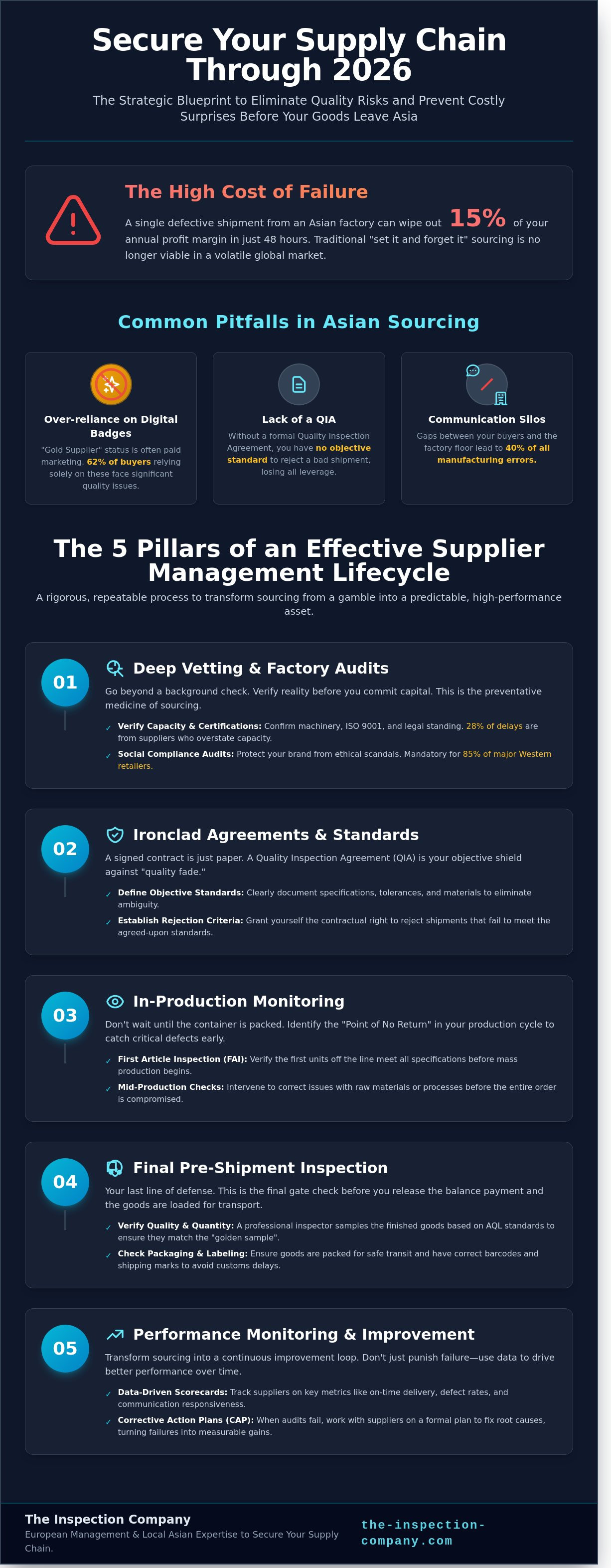
- Over-reliance on digital badges: "Gold Supplier" status on B2B platforms is often a paid marketing feature, not a verified quality rating. 62% of buyers who rely solely on online profiles experience significant quality discrepancies.
- Lack of a QIA: Without a formal Quality Inspection Agreement, you have no objective standard to reject a bad shipment.
- Communication silos: Procurement teams often talk to sales agents, while the actual production manager has a different set of instructions. This gap leads to 40% of all manufacturing errors.
Managing a supplier management process requires a boots-on-the-ground approach. You can't manage what you don't measure. Relying on factory-provided photos is a gamble that most businesses can't afford. Professional audits and inspections are the only way to get the ground-truth data needed for informed decision-making. One day of independent inspection can save you months of legal and financial trouble. It's about taking control of your supply chain rather than being a victim of it. Our European management team ensures that Western quality expectations are met in every factory, every time.
The 5 Pillars of an Effective Supplier Management Lifecycle
A successful supply chain isn't built on luck; it's built on a rigorous, repeatable supplier management process. This lifecycle transforms a simple transaction into a strategic partnership that mitigates risk and protects your bottom line. Without these five pillars, you're essentially gambling with your capital every time you place a purchase order. Professional importers understand that oversight is the only way to prevent the 15% profit margin erosion typically caused by poor quality control.
Phase 1: Deep Vetting and Factory Audits
A basic background check or a quick look at an Alibaba gold profile isn't enough when you're committing to high-volume orders. In 2023, industry data revealed that 28% of manufacturing delays were caused by suppliers who lacked the actual capacity they claimed during negotiations. You need to verify that the factory exists, owns its machinery, and holds valid ISO 9001 certifications for quality management systems.
Social compliance audits are equally vital to protect your brand from ethical scandals. These audits check for safety violations and fair labor practices, which are now mandatory for 85% of major Western retailers. Factory audits are the preventative medicine of sourcing. By conducting a professional factory audit before signing a contract, you identify red flags before they become expensive legal or logistical nightmares.
Phase 2: Setting the Standard with AQL
You can't hold a supplier accountable if your quality standards are vague. Defining Acceptable Quality Levels (AQL) is a mandatory step in the supplier management process. AQL is a statistical sampling method that determines how many defects are permissible in a batch before the entire lot is rejected. For most consumer goods, the industry standard is a 0/2.5/4.0 limit for critical, major, and minor defects.
It's vital to integrate these AQL standards directly into your supplier contracts. If the factory knows their payment is tied to a specific statistical threshold, their attention to detail increases. Over time, you should link this AQL data to your long-term supplier performance scorecards. This allows you to track if a factory's quality is improving or if their defect rate has climbed by more than 5% year-over-year, signaling a need for intervention.
- Step 2: Selection & Negotiation. Look beyond the per-unit price. Factor in the Total Cost of Ownership (TCO), including shipping, duties, and the cost of potential defects. A $1.20 unit with a 4% defect rate is more expensive than a $1.30 unit with a 0.5% defect rate.
- Step 3: Onboarding & Integration. Set clear quality KPIs from day one. Establish communication protocols and ensure the factory understands your technical specifications. 60% of production errors stem from simple misunderstandings during the onboarding phase.
- Step 4: Performance Monitoring. Regular inspections are the backbone of this pillar. Use Pre-Shipment Inspections (PSI) to catch errors while the goods are still in the factory. It's much cheaper to fix a mistake in the workshop than to handle a product recall in your home country.
- Step 5: Optimization or Termination. Use your data to make hard decisions. If a supplier consistently meets KPIs, reward them with more volume. If their performance drops by 10% across three consecutive shipments, it's time to initiate a termination plan and pivot to a backup partner.
Managing suppliers is a continuous loop of verification and adjustment. It's about maintaining control over your production environment. When you treat the lifecycle as a data-driven system, you stop reacting to crises and start preventing them. This methodical approach is what separates professional importers from those who struggle with "costly surprises" every quarter.
Risk Management: Stopping Problems Before Your Shipment Sails
The "Point of No Return" in your supplier management process occurs the moment you authorize that final 70% wire transfer. Once the funds leave your account, your leverage to demand repairs or re-work vanishes. You can't fix a structural defect or a functional failure once the container is on the water. Effective risk management requires identifying critical, major, and minor defects while the goods are still on the factory floor. According to 2023 industry data, 15% of all consumer goods shipments from Asia contain at least one major defect that requires correction before export. If you don't find it, your customers will.
We classify defects into three strict categories based on ISO 2859-1 standards. A critical defect is a safety or legal failure, such as a lithium battery that overheats or a lead paint violation, which results in an immediate 0% tolerance rejection. Major defects involve functional failures, like a power tool that won't turn on, while minor defects are aesthetic issues like small scratches or color variations. Without a physical presence at the factory, you're relying on the supplier's self-reporting. This is a dangerous gamble. A single product recall can cost a mid-sized importer over $150,000 in logistics, legal fees, and lost brand equity.
The psychology of supplier accountability is simple: presence changes behavior. When a factory manager knows an independent auditor will arrive to check AQL (Acceptable Quality Level) limits, they prioritize your order's accuracy. This is often referred to as the "observer effect" in manufacturing. Internal data shows that 92% of suppliers improve their internal quality control checks the moment an external inspection is booked. It creates a culture of precision because the factory knows they won't get paid until the report comes back "Passed."
Don't fall for the common trap of relying on a long-term relationship. Many importers say, "My supplier has been good for years, I don't need to check anymore." This is exactly when "quality fade" happens. In 2024, 64% of quality failures occurred with established suppliers who had worked with the buyer for more than three years. Suppliers often switch to cheaper sub-component providers or move your order to a less experienced production line when they believe oversight has relaxed. Consistent auditing is the only way to maintain the integrity of your supplier management process over the long term.
Pre-Shipment Inspection (PSI) as a Process Gateway
The PSI is your final gatekeeper. We conduct this when at least 80% of the order is packed and ready for transport. A professional 24-hour inspection report provides a procurement manager with a clear "Pass" or "Fail" based on your specific requirements and safety standards. It's the most cost-effective insurance policy in international trade. In 2026, one day of inspection can save months of trouble.
During Production Inspection (DuPro)
For orders with complex lead times exceeding 45 days, a DuPro is vital for staying on schedule. We step onto the factory floor when production is 20% to 50% complete. If the first 500 units have a systemic alignment error or a wrong color tone, we catch it before the remaining 4,500 are ruined. Integrating DuPro into your project management timeline ensures you don't miss critical retail launch dates due to last-minute mass-production failures. It transforms the process from reactive to proactive, saving the entire batch from the scrap heap.
Performance Monitoring: Audits and Continuous Improvement
Monitoring performance is the most critical phase of the supplier management process. You can't manage what you don't measure. Relying on gut feelings leads to 12% higher operational costs on average. Instead, professional importers use a Supplier Scorecard to track hard data. Focus on three primary pillars: Quality (AQL levels), Lead Time (on-time delivery rates), and Compliance (adherence to safety standards). A high-performing supplier should maintain a defect rate below 1.5% and an on-time delivery rate of at least 95%. If these numbers slip, you have the objective proof needed to demand changes.
A failed audit isn't the end of a partnership. It's a prompt for a Corrective Action Plan (CAP). When a factory fails an ISO 9001 or social audit, you must issue a formal CAP within 48 hours. This document identifies the root cause of the failure and sets a 30 day deadline for remediation. Professionalism here is key. You aren't just pointing out flaws; you're protecting your investment. If a supplier refuses to implement a CAP, it's a clear signal to diversify your sourcing immediately.
Audit frequency depends on the risk level. For established partners with a three year history of passing grades, an annual audit is sufficient. For new vendors or those producing high complexity electronics, a bi-annual cadence is safer. In 2024, 68% of leading global brands increased their audit frequency to mitigate post-pandemic logistics volatility. Use this data during price negotiations. If your third party reports show a 10% decrease in factory efficiency, you have the leverage to negotiate better terms or demand equipment upgrades.
Social Compliance and Ethical Sourcing
ESG (Environmental, Social, Governance) standards will be mandatory for most EU and US importers by 2026. Social audits protect your brand from the 24/7 news cycle and potential legal seizures. We monitor key standards like Sedex (SMETA), BSCI, and SA8000 to ensure no forced labor enters your supply chain. One failed social audit can result in a 30% drop in brand equity overnight. Don't risk it.
Specialized Processes for Amazon FBA Sellers
Amazon FBA sellers face unique pressures. A single labeling error or a crushed carton can lead to account suspension or hefty "prep" fees. Since you often never touch the product, a 100% inspection process is your only defense. This involves checking every unit for FNSKU accuracy, packaging durability, and carton weight limits. Ensuring 100% compliance before the goods leave Asia is the only way to protect your seller central health and avoid the "Stranded Inventory" trap.
The Inspection Company: Your Partner in Asian Supplier Management
Managing a global supply chain requires more than just spreadsheets; it demands eyes on the ground. The Inspection Company bridges the gap between European quality standards and the complexities of Asian manufacturing. With a network of over 700 professional inspectors across China, Vietnam, India, and Thailand, we provide the local presence your business needs to mitigate risk. Our European management team ensures that every audit follows strict ISO 9001 protocols, giving you the same level of oversight you expect from an in-house team without the overhead costs.
A robust supplier management process relies on speed and accuracy. We deliver comprehensive inspection reports within 24 hours of the site visit. This rapid turnaround allows you to make data-driven decisions in real-time. If a batch of consumer electronics shows a 5% soldering defect rate during a Pre-Shipment Inspection (PSI), you know it before the container is sealed. You don't have to wait for a shipment to cross the ocean to discover a disaster. We stop problems before your shipment sails, saving you from the logistical nightmare of returns and refunds.
We integrate directly into your existing procurement workflow to reduce friction. Our team handles the coordination with your factory, booking the site visit and managing the logistics of the inspection day. This seamless integration ensures that quality control becomes a standard, automated part of your supplier management process rather than a recurring headache. By acting as your independent third party, we provide the objective truth about production status and product quality.
Transparency and Technology
Our proprietary online platform transforms how you interact with your supply chain. You can book inspections, track progress, and analyze performance data across your entire supplier base from a single dashboard. This level of transparency is vital in a global market where distance often obscures reality. Independent, third-party verification is the only way to ensure that the samples you approved match the mass production sitting in the warehouse. Don't leave your brand reputation to chance. Book your first factory audit or inspection today to secure your next shipment.
Scaling Your Sourcing with Confidence
We help both agile startups and established retailers grow their Asian operations by removing the fear of the unknown. Scaling requires repeatable results, and our standardized checklists ensure every factory meets your specific requirements. In one notable case, we helped a mid-sized electronics retailer reduce their average defect rate from 12% to less than 1% within six months of implementing our systematic inspection routine. This shift saved the client over $140,000 in replacement costs and shipping fees in the first year alone. Reliability is the currency of international trade. Don't just manage suppliers; master the process with TIC.
Future-Proofing Your Supply Chain for 2026
Navigating global trade in 2026 requires more than a handshake; it demands a robust supplier management process that prioritizes transparency and meticulous performance monitoring. By implementing the five pillars of the supplier lifecycle and conducting regular on-site audits, you eliminate the defects that lead to costly financial losses. One day of inspection can save months of trouble. You don't have to manage these high-stakes risks alone. The Inspection Company brings over 25 years of experience in Asia directly to your production line. Our ISO 9001 certified operations and European management ensure that Western quality standards are met at every stage of production. We stop problems before your shipment sails, giving you total control over your inventory and protecting your brand's reputation. It's time to replace uncertainty with verifiable data and professional oversight. Secure your supply chain with professional inspections and audits today to ensure your next shipment arrives exactly as expected. Your business deserves the security of a reliable, risk-free sourcing strategy.
Frequently Asked Questions
What are the 7 steps of the supplier management process?
The 7 steps include identification, evaluation, selection, onboarding, performance monitoring, risk management, and relationship development. These phases create a structured framework to ensure your partners meet specific quality standards. Utilizing a defined supplier management process reduces the risk of receiving shipments with defect rates exceeding 15%. It's about maintaining total control from the initial search through the final delivery at your warehouse.
How do I evaluate a new supplier in China or Vietnam?
You must conduct an on-site factory audit to verify their business license, production capacity, and ISO 9001 compliance. In 2023, data showed that 30% of suppliers in these regions misrepresent their actual manufacturing capabilities. We send independent auditors to the facility within 48 hours to check machinery, labor conditions, and export records. This verification prevents you from sending deposits to ghost factories or trading companies posing as manufacturers.
What is the difference between supplier management and vendor management?
Supplier management focuses on long-term strategic partnerships for raw materials or manufacturing, while vendor management deals with short-term, transactional purchases of finished goods. Supplier relationships often involve multi-year contracts and deep integration into your supply chain. In contrast, vendor interactions are typically based on price and immediate availability. Managing a supplier requires 100% visibility into their production line to ensure consistent quality over time.
How often should I conduct a factory audit for an existing supplier?
You should schedule a full factory audit at least once every 12 months to ensure continued compliance with safety and quality standards. If a supplier's defect rate exceeds 2% in a single quarter, you must increase the frequency to every 6 months until they prove stability. Regular audits prevent quality fade, where a manufacturer slowly replaces high-quality components with cheaper alternatives to save 5% on their production costs.
What should be included in a supplier management policy?
Your policy must include specific quality benchmarks, ethical sourcing requirements, and clear protocols for dispute resolution. It should state that a 10% failure rate on a Pre-Shipment Inspection (PSI) triggers an automatic production halt. Include a Right to Audit clause that allows your independent inspectors to enter the facility with 24 hours' notice. This document sets the professional standard for every transaction and protects your capital.
Can a supplier management process help reduce shipping delays?
Yes, a robust supplier management process identifies production bottlenecks during the During Production (DuPro) phase to prevent late shipments. By monitoring the manufacturing schedule weekly, you can catch a 3-day delay before it turns into a 3-week disaster. Our data indicates that proactive monitoring reduces unplanned shipping delays by 22% on average. You gain the foresight needed to adjust your logistics before your stock levels hit zero.
How do I handle a supplier that fails a quality inspection?
You must issue a formal corrective action plan (CAP) and refuse to authorize the shipment until the factory reworks the defective units. Never pay the final 70% balance if the inspection report shows critical defects. We recommend a re-inspection within 7 to 10 days to verify that the factory fixed the specific issues identified. This firm approach protects your brand reputation and prevents the 10x cost associated with handling customer returns.
Is software necessary for a small business supplier management process?
Software isn't strictly necessary for businesses managing fewer than 5 suppliers, but it becomes essential once you scale beyond $500,000 in annual procurement. You can start with detailed spreadsheets to track KPIs and audit dates. However, using a centralized platform reduces administrative errors by 35% compared to manual tracking. The goal is to maintain a transparent record of every inspection and communication to mitigate financial risk effectively.