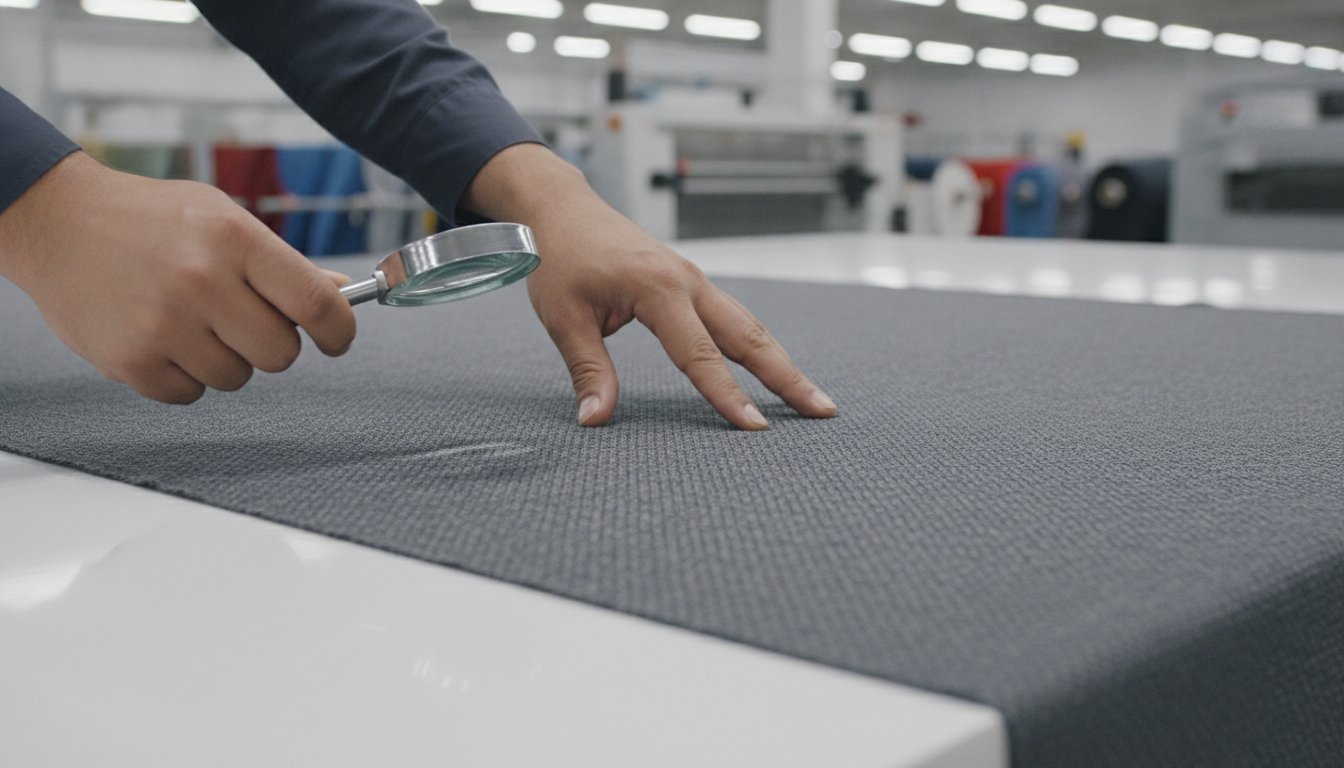

The success of a new product launch hinges on the start of mass production. A single miscommunication with a factory can multiply into thousands of defective units, leading to catastrophic financial loss and reputational damage. To prevent these costly surprises, a first article inspection (FAI) is one of the most vital quality control steps you can take. This critical process verifies that your supplier fully understands your specifications and is capable of producing your product correctly before you commit to a full order. It’s your best defense against errors that could derail your entire project.
In this complete guide, we demystify the FAI. You will learn exactly what this inspection covers, when it is absolutely necessary, and how it locks in quality from the very first unit off the line. By the end, you’ll have the confidence and knowledge to ensure your next production run is a success, protecting your investment and your brand.
Key Takeaways
- Understand that an FAI is not a prototype review, but a formal verification of the first units from actual mass production tooling.
- Identify the specific triggers-like design or supplier changes-that make a first article inspection an absolute necessity to prevent quality drift.
- Master the step-by-step FAI process and the required documentation to ensure your quality standards are locked in with your factory.
- Learn how the First Article Inspection Report (FAIR) serves as a critical legal and technical record to avoid costly production errors down the line.
What is a First Article Inspection? Setting the Gold Standard
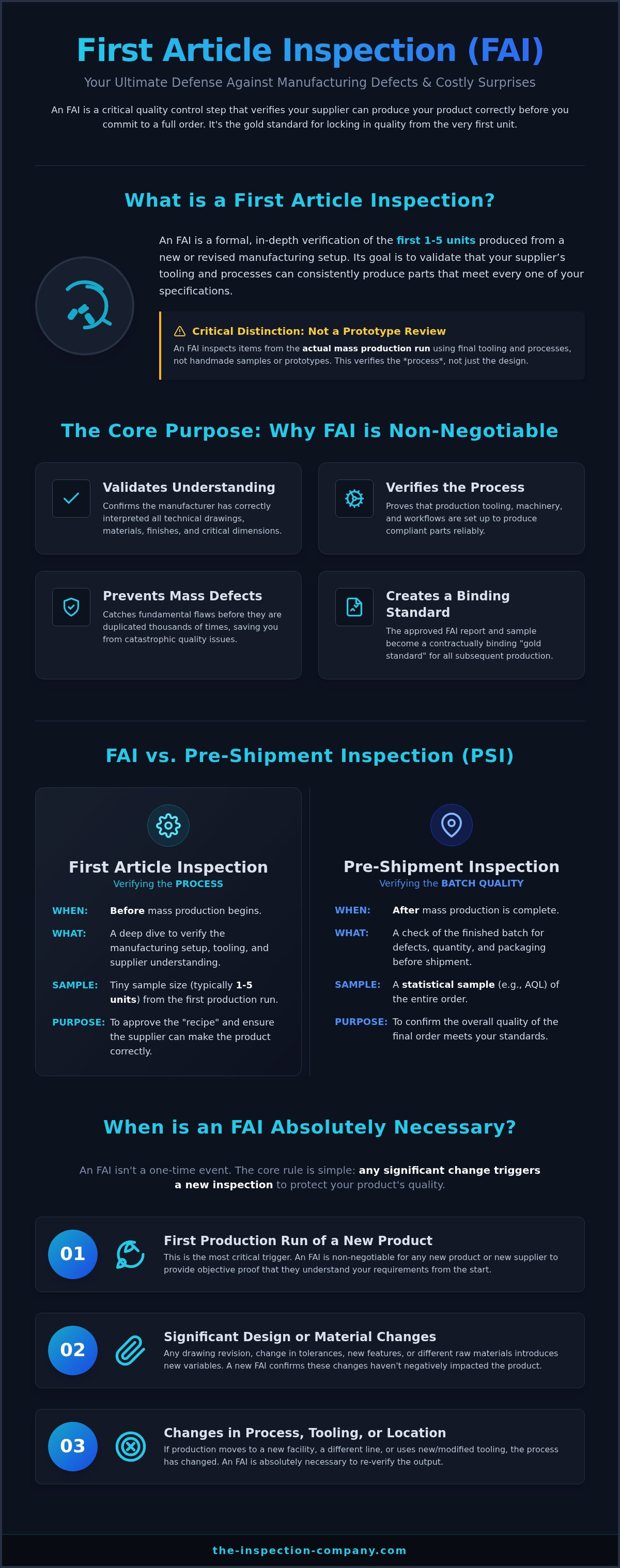
A First Article Inspection (FAI) is a formal, in-depth verification process conducted on the very first units produced from a new or revised manufacturing setup. It's a common misconception to confuse this with a prototype review. An FAI does not examine a handmade sample; it meticulously inspects a small number of items-typically one to five pieces-taken directly from the initial mass production run. The central objective is to validate that your supplier’s tooling and manufacturing processes are capable of consistently producing parts that meet every one of your specifications. This process, as detailed in the formal definition of what a First Article Inspection is, establishes an approved "gold standard" part that serves as the benchmark against which all subsequent production will be measured.
The Core Purpose: Why FAI is Non-Negotiable for New Products
Implementing an FAI is a critical risk mitigation strategy. It is your first and best opportunity to confirm that your design has been translated perfectly from paper to production, preventing costly errors from being replicated across an entire order. An FAI serves several crucial functions:
-
Validates Understanding: It confirms your manufacturer has correctly interpreted all technical drawings, materials, finishes, and critical dimensions.
-
Verifies the Process: It proves that the production tooling, machinery, and workflows are set up to produce compliant parts reliably.
-
Prevents Mass Defects: It catches fundamental misunderstandings and process flaws before they are duplicated thousands of times, saving you from catastrophic quality issues.
-
Creates a Binding Standard: The approved FAI report and sample become a contractually binding quality agreement between you and your supplier.
FAI vs. Pre-Shipment Inspection (PSI): Understanding the Critical Difference
While both are essential quality control tools, a first article inspection and a Pre-Shipment Inspection (PSI) serve entirely different purposes at different stages. Confusing them can lead to significant supply chain risks. The FAI is a deep dive on a few units before mass production begins, designed to verify the manufacturing process itself. In contrast, a PSI is a statistical sampling of a finished batch after production is complete to verify overall batch quality and check for defects before shipment.
Think of it this way: the FAI is like a chef asking you to approve the recipe and taste the first perfect cookie from the oven. The PSI is when you randomly sample a few boxes of cookies from the final shipment to ensure they all taste just as good.
When is a First Article Inspection Absolutely Necessary?
A First Article Inspection (FAI) is not a one-time event. Its purpose is to create a "gold standard" for all future production, but this standard is only valid as long as the manufacturing conditions remain identical. Any significant change introduces new risks and can invalidate the original approval. This principle is so critical that highly regulated industries formalize it in standards like the AS9102 Aerospace First Article Inspection Requirement. For any importer or product manager, the core rule is simple: change triggers inspection.
Understanding these triggers is the first step in protecting your investment and avoiding costly production errors. An FAI is required in the following common scenarios:
Trigger 1: The First Production Run of a New Product
This is the most common and critical time to conduct a first article inspection. When you engage a new supplier or launch a completely new product, an FAI is non-negotiable. It provides objective proof that the supplier fully understands your requirements and can produce a part that meets every specification on your technical drawings. This initial verification prevents fundamental misunderstandings from escalating into a full-blown production disaster, ensuring the partnership starts on solid ground.
Trigger 2: Significant Design or Material Changes
If your product's design has been updated, you need to validate that the change was implemented correctly. This includes any drawing revision, such as adding a new feature, adjusting a tolerance, or altering a finish. Similarly, changing the raw material or sourcing a critical component from a new sub-supplier introduces new variables. A new FAI is essential to confirm that these changes have not negatively impacted the product's form, fit, or function.
Trigger 3: Changes in Process, Tooling, or Location
A product's quality is a direct result of the process that creates it. Therefore, any change to that process requires re-verification. An FAI is absolutely necessary if production moves to a new facility or even a different production line within the same factory. The use of new or modified tooling, molds, or dies also mandates a new inspection. Furthermore, if a product has been out of production for an extended period (typically two years or more), an FAI is a prudent step to ensure equipment and processes are still capable of meeting the original standard.
The FAI Process: A Step-by-Step Breakdown for Importers
A successful First Article Inspection is not a single event but a structured process designed to eliminate ambiguity and prevent costly production errors. It requires meticulous preparation from you, the importer, and expert execution by the on-site inspector. Understanding each phase is crucial for ensuring your supplier’s manufacturing process is truly capable of meeting your quality standards.
Step 1: Preparation - Gathering Your Technical Dossier
Your preparation is the foundation of a successful inspection. Before our inspector can visit the factory, you must provide a complete technical file. This dossier serves as the ultimate source of truth against which the product will be judged. Any missing or inaccurate information creates risk. Your file must include:
-
The 'Ballooned' Drawing: An engineering drawing where every single dimension, tolerance, and note is numbered for clear, systematic verification.
-
Bill of Materials (BOM): A complete list of all components, sub-assemblies, and raw materials used, allowing the inspector to verify that the correct inputs are being used.
-
Material & Process Specifications: Documentation and certificates for all materials (e.g., steel grade, plastic resin type) and special processes (e.g., heat treatment, plating), including any compliance requirements like RoHS or REACH.
-
Purchase Order (PO): The PO confirms quantities, packaging, and other contractual quality requirements that must be checked.
Step 2: The On-Site Inspection and Verification
Once the technical dossier is confirmed, our inspector conducts the physical inspection at your supplier’s facility. The inspector randomly selects a sample (or samples, as specified) from the very first production run. This is not a hand-picked "golden sample" from the supplier. The on-site process is methodical: the inspector performs a full dimensional verification, measuring each characteristic on the ballooned drawing. They conduct a thorough visual inspection for workmanship, finish, color, and cosmetic defects, and verify all material certificates and special process documentation provided by the factory.
Step 3: The First Article Inspection Report (FAIR)
Following the on-site work, you will receive a comprehensive First Article Inspection Report (FAIR). This document is your objective evidence of the supplier's capabilities. It details every characteristic checked, providing a clear pass/fail status for each dimension, test, and specification. The report includes high-resolution photographic evidence of the product, its packaging, and any defects or measurement setups. If the report is a "Pass," you can confidently authorize mass production. If it is a "Fail," the supplier must implement corrective actions and may need to conduct another first article inspection to prove the issues are resolved before you proceed.
Decoding the First Article Inspection Report (FAIR)
The First Article Inspection Report (FAIR) is the primary deliverable of the entire process. It is not merely a summary; it is a formal, legal record providing objective evidence that your supplier's production methods can produce a part that conforms to all specifications. A comprehensive FAIR mitigates significant risk by stopping non-conforming products before mass production begins.
While formats can vary, many industries follow standardized templates like the AS9102 standard used in aerospace. These benchmarks ensure every critical detail is captured. Understanding the key sections of your report is essential for making an informed decision to approve production.
Part Accountability and Traceability
This initial section establishes the identity and origin of the inspected part, creating a clear and unbroken chain of accountability. It prevents costly mix-ups and ensures the report is tied to a specific manufacturing event. Verification includes:
-
Part Identification: Confirming the part number, revision level, and part name match the engineering drawings exactly.
-
Production Run Details: Linking the first article inspection to a specific purchase order (PO), manufacturing job number, and production date.
-
Assembly Breakdown: Identifying all sub-assemblies, components, and standard hardware used in the final part.
Material & Special Process Verification
A product can be dimensionally perfect but still fail if made from the wrong materials or processed incorrectly. This section confirms that the foundational elements of your product meet specifications. It verifies that all required certifications are present and valid, confirming:
-
Raw Materials: The correct grade and specification of materials were used, supported by Certificates of Conformity (CoC) or material test reports.
-
Special Processes: Any required processes like heat treatment, plating, chemical coating, or anodizing were performed by approved suppliers and meet the required standards.
Dimensional and Performance Verification
This is the most detailed part of the FAIR. It meticulously compares every feature on the engineering drawing to the actual measurements of the sample part. The drawing is typically "ballooned," with each dimension, tolerance, and note assigned a unique number. The report presents this data in a clear table, listing the design requirement, the measured result, and a clear pass/fail judgment. This section also includes the results of any required functional, electrical, or performance tests, providing the ultimate proof of compliance.
Navigating this level of detail is critical to ensuring product quality from the very first run. Need help with your first production run? Contact us.
How FAI Prevents Costly Disasters and Builds Supplier Trust
While the technical process of a First Article Inspection is detailed, its true value lies in the significant business risks it mitigates. Viewing an FAI as a line-item expense is a critical mistake; it is a strategic investment in quality assurance that delivers a substantial return by preventing catastrophic financial and reputational damage. It is the definitive step that transforms your product specifications from a document into a verified, physical reality before mass production begins.
The Financial Impact: Calculating the ROI of an FAI
The cost of a single rejected shipment can dwarf the expense of an entire quality control program. Consider a scenario where a critical dimension on a component is off by just 0.5mm. A first article inspection identifies this error immediately. Without it, you risk manufacturing 10,000 units that are fundamentally flawed. The resulting financial damage extends far beyond the production cost, including:
-
The full cost of the manufactured goods.
-
Expensive rework or disposal fees.
-
Air freight costs for replacement parts.
-
Production line shutdowns and project delays.
-
Irreparable damage to your brand's reputation.
One day of inspection truly saves months of trouble and protects your bottom line.
Beyond a Single Run: Building a Foundation for Quality
An approved FAI report does more than just approve a single production run; it establishes an unambiguous "golden standard" for all future orders. This objective, data-backed record serves as the foundation for a strong, transparent supplier relationship. It demonstrates your commitment to quality, encouraging suppliers to maintain high standards. This clarity minimizes future disputes over product specifications, leading to more consistent manufacturing, fewer long-term issues, and a more reliable supply chain. When quality standards are clear and verified from the start, trust is built on a foundation of evidence, not assumptions. Ensure your standards are met from day one by working with a professional inspection partner.
Secure Your Production with a Strategic First Article Inspection
Ultimately, a first article inspection is more than a procedural step-it is your master blueprint for quality. It validates your design against the initial production unit, serving as the definitive proof that your supplier can meet every specification before you commit to a full run. By implementing this critical quality control measure, you proactively eliminate the risk of miscommunication, costly re-tooling, and brand-damaging defects. It transforms ambiguity into certainty, ensuring your product vision becomes a reality without expensive surprises.
When the success of your launch is on the line, you need a partner with uncompromising standards. The Inspection Company provides that assurance. Guided by European management and backed by a network of over 700 inspectors across Asia, we deliver the on-the-ground expertise to protect your investment. You receive detailed, actionable reports fast, giving you the clarity needed to approve production with confidence.
Secure your new product launch. Book a First Article Inspection today.
Start your production journey on the right foot and launch with absolute confidence.
Frequently Asked Questions
How is a First Article Inspection (FAI) different from a PPAP?
An FAI is a component of the broader Production Part Approval Process (PPAP). The FAI focuses specifically on verifying that the first production sample conforms to all engineering design and specification requirements. In contrast, a PPAP is a comprehensive package of documentation that validates the entire manufacturing process, not just the part itself. It includes the FAI report along with process flow diagrams, control plans, and other quality evidence to ensure the supplier can consistently produce compliant parts.
How many parts are typically inspected during an FAI?
The quantity depends on the product's complexity and specific industry standards, but it is typically a very small sample. For most applications, one to five pieces taken from the first significant production run are sufficient for a complete inspection. The goal is not to check a large volume but to meticulously verify that the production process itself is capable of producing a conforming part. This prevents systemic issues from affecting your entire order.
What happens if a product fails the First Article Inspection?
A failed FAI immediately halts the approval for mass production. This is a critical control point designed to prevent costly, large-scale defects. The supplier must identify the root cause of each non-conformance, implement corrective actions, and document the changes made. Once the issues are resolved, a new part must be produced and submitted for another complete first article inspection. Only after a successful FAI can the supplier proceed with the full production run, ensuring defects are stopped early.
Is an FAI only necessary for complex industries like aerospace and medical?
While mandatory in high-stakes industries like aerospace and medical, an FAI is a valuable quality assurance tool for any company introducing a new product or working with a new supplier. It is a best practice that prevents significant financial risk and production delays. Whether you are manufacturing consumer electronics or simple components, verifying the process upfront ensures your specifications are met before you commit to a full production run, saving you from costly surprises down the line.
Can my supplier perform their own FAI, or should I use a third party?
While suppliers can perform their own internal FAI, using an independent third-party inspector provides objective, unbiased verification. This eliminates any potential conflict of interest and gives you a true, transparent assessment of the product's compliance. An independent report ensures that the results are reliable and focused solely on protecting your interests. It is a crucial step to confirm your supplier’s claims and secure your investment before mass production begins.
What is a 'ballooned drawing' and why is it essential for an FAI?
A "ballooned drawing" is an engineering drawing where every single dimension, tolerance, note, and specification has been assigned a unique, sequential number inside a circle (a "balloon"). This document is essential for a first article inspection because it functions as a master checklist. The inspector uses it to systematically verify and record a measurement for every single feature, ensuring nothing is overlooked. It guarantees a meticulous and complete inspection, creating a clear and traceable record of compliance.