

The moment of truth for any business sourcing from Asia is when a new shipment arrives. Will the quality meet your standards, or will you uncover costly defects that damage your brand's reputation and bottom line? Vague discussions about "good quality" with your supplier are not enough to protect your investment. To avoid these risks, you need an objective, internationally recognized standard. This is where a clear understanding of the Acceptable Quality Limit, or AQL, becomes your most powerful tool for risk mitigation.
This comprehensive guide is designed to eliminate the confusion surrounding quality control. We will walk you through exactly what AQL is, how to use AQL charts to determine a statistically valid inspection sample, and how to set the right defect limits for your specific products. By the end, you will have the confidence to establish clear quality expectations, communicate them effectively to your suppliers, and make data-driven decisions to accept or reject a shipment-ensuring every order meets your standards before it ever sails.
Key Takeaways
- Understand how statistical sampling allows you to verify shipment quality efficiently without inspecting every single unit.
- Learn to read and apply industry-standard AQL charts to determine the correct sample size and defect limits for your products.
- Define your brand's quality promise by strategically setting the right aql levels, balancing production costs with customer satisfaction.
- Discover your options and the critical next steps to take after a failed inspection to maintain control over your supply chain.
What is AQL (Acceptable Quality Limit) and Why Does It Matter?
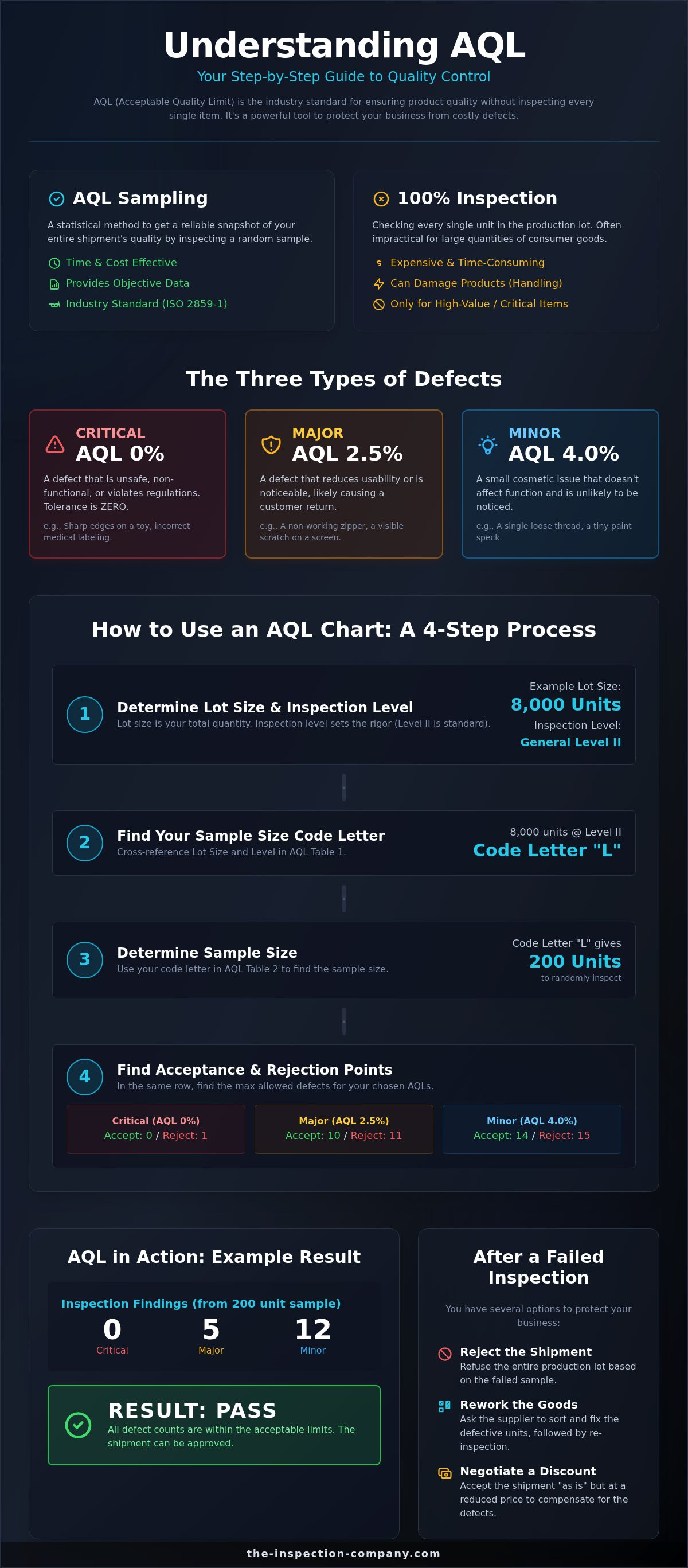
The Acceptable Quality Limit (AQL) is a statistical sampling method used to determine the maximum number of defective units that can be considered acceptable during a random inspection of a product batch. In simple terms, it's the worst tolerable quality level. Instead of inspecting every single item-a process that is often costly and impractical-importers use AQL to get a reliable snapshot of their shipment's overall quality. This industry-standard approach, formally defined as the Acceptable Quality Limit (AQL), provides a data-driven benchmark for product acceptance.
Crucially, AQL serves as a formal agreement between you (the importer) and your supplier. It removes subjectivity from quality control, replacing vague discussions with a clear, numerical standard. This ensures both parties understand the quality expectations before production begins, preventing costly arguments and rejections after the goods are finished. Using an established aql standard is a fundamental step in minimizing import risk.
The Problem AQL Solves for Importers
Without a clear quality standard, you risk receiving an entire shipment riddled with unacceptable defects, leading to customer returns and financial loss. Inspecting 100% of your order is often too expensive and time-consuming. AQL provides the perfect balance: a cost-effective method to verify quality and mitigate risk, allowing you to confidently approve or reject a shipment based on objective statistical data rather than guesswork.
Defining the Three Types of Defects
During an AQL inspection, defects are typically categorized by severity to assess the overall risk:
- Critical Defects: The most severe. A defect that renders a product unsafe, non-functional, or non-compliant with regulations (e.g., sharp edges on a children's toy). The tolerance for critical defects is almost always zero.
- Major Defects: Defects that are likely to cause product failure, reduce usability, or be noticed by the end-user, leading to a return (e.g., a non-working zipper on a jacket).
- Minor Defects: Small cosmetic issues that do not affect the product's function or form and are unlikely to be noticed by the customer (e.g., a single loose thread).
AQL vs. 100% Inspection: Making the Right Choice
For most consumer goods produced in large quantities, AQL sampling is the most efficient and standard practice. It saves significant time and money while providing a reliable measure of quality. However, 100% inspection may be necessary for high-value products (like industrial machinery) or items where a single failure is catastrophic (like medical devices). For the vast majority of importers, AQL is the smarter, more pragmatic choice to ensure consistent quality without incurring prohibitive costs.
How to Use an AQL Chart: A Step-by-Step Guide
Navigating an AQL chart may seem intimidating at first, but it is a highly logical and standardized process designed for clarity. The system relies on two main tables to give you a statistically significant inspection plan. This method is the global standard for quality sampling, detailed in specifications like ISO 2859-1 and ANSI/ASQ Z1.4, ensuring you and your supplier are speaking the same language.
Follow these four simple steps to determine your sample size and define clear pass/fail criteria for your product inspection. This process removes guesswork and empowers you to make objective decisions about your shipment's quality.
Step 1: Determine Your Lot Size and Inspection Level
First, identify your 'Lot Size,' which is the total number of units in the production batch you need to inspect. Next, choose an Inspection Level. There are three General Inspection Levels:
- Level I: Requires inspecting a smaller sample size, used when you have high confidence in your supplier.
- Level II: The most common industry standard, offering a balanced and reliable assessment of quality.
- Level III: A larger sample size for more stringent testing, ideal for high-value goods or new suppliers.
Step 2: Find Your Sample Size Code Letter (Table 1)
Using the first AQL table, cross-reference your lot size with your chosen inspection level. This will give you a specific code letter. For example, a lot size of 8,000 units inspected at General Level II corresponds to the code letter 'L'. This letter is not your sample size; instead, it's a key that unlocks the next step in the process, telling you which row to use in the second table.
Step 3: Choose Your AQL Percentage
Now, you must define your tolerance for defects, expressed as a percentage. This is your Acceptable Quality Limit (aql). While you can set these limits with your supplier, the following are widely accepted industry standards:
- 0% for Critical Defects: Defects that could harm a user.
- 2.5% for Major Defects: Defects that affect the product's function or saleability.
- 4.0% for Minor Defects: Small cosmetic issues that don't impact the product's use.
Step 4: Find Your Acceptance and Rejection Points (Table 2)
With your code letter and AQL percentages, turn to the second table. Find the row corresponding to your code letter (e.g., 'L'). Reading across that row, you will find the acceptance (Ac) and rejection (Re) numbers under your chosen AQL columns. For code 'L' at a 2.5% AQL, the numbers are Ac=10 and Re=11. This is your final instruction: if the inspector finds 10 or fewer major defects, the shipment passes. If 11 or more are found, the shipment fails.
Setting Your AQL: A Strategic Decision for Your Business
Defining your Acceptable Quality Limit (AQL) is more than a technical step in the quality control process; it is a direct reflection of your brand's promise to your customers. This decision creates a critical balance between your quality standards, production costs, and market expectations. The right aql framework ensures you don’t overspend preventing minor flaws on low-cost goods, nor do you accept critical failures in high-value products. It is a strategic choice that protects your reputation and your bottom line.
How Product Type and Value Influence Your AQL
Your product’s nature and market position are the primary drivers for setting AQLs. A high-value electronic device, for instance, demands a very strict AQL for both major and minor defects, as functionality and finish are paramount. In contrast, a batch of low-cost promotional items can tolerate a higher percentage of minor cosmetic issues without impacting their intended use. For products where safety is non-negotiable-such as children's toys or medical equipment-the standard is absolute: a 0% tolerance for critical defects. Accepting anything less exposes your business to severe financial and legal risk.
Balancing Quality Standards with Supplier Relationships
Clear communication is essential for effective quality control. Your AQL standards must be explicitly stated and agreed upon in your Purchase Order (PO) to eliminate ambiguity and set a clear benchmark for your supplier. A reasonable, industry-standard AQL signals that you are a professional buyer and is readily achievable for any competent factory. However, setting unrealistically strict limits can be counterproductive, leading to inflated prices, production delays, or even a supplier’s refusal to take on the order. A collaborative approach yields the best results.
When to Adjust Your Inspection Level
The General Inspection Level determines your sample size and the overall rigor of the inspection. This level should be adjusted based on your confidence in the supplier and the risk associated with the product. A flexible approach allows you to manage risk effectively.
- Use Level III (largest sample size) for new suppliers, the first production run of a new product, or for high-risk shipments where quality is critical.
- Use Level I (smallest sample size) for trusted, long-term suppliers with a consistent and proven track record of meeting your quality standards.
Choosing the correct inspection level is a vital risk management decision. Need help defining your quality standards? Talk to our experts.
AQL in Action: A Real-World Inspection Example
Understanding the theory behind Acceptable Quality Limits is essential, but seeing the process in action makes the concept truly click. Let's walk through a standard pre-shipment inspection to demonstrate how an objective Pass/Fail decision is reached using the aql framework. This systematic approach removes guesswork and provides the clear, data-driven results needed to protect your investment.
Scenario: Pre-Shipment Inspection of 10,000 Polo Shirts
Imagine you have ordered a large batch of polo shirts from a supplier in Asia. The goods are manufactured and ready for shipment. Before you approve the final payment and shipping, you arrange for an independent quality control inspection. The key parameters for the inspection are set as follows:
- Lot Size (Quantity): 10,000 polo shirts
- Inspection Level: General Level II (the most common industry standard)
- Acceptable Quality Limits: 0% for Critical defects, 2.5% for Major defects, and 4.0% for Minor defects.
Applying the AQL Tables to Find the Sample Size
With the parameters defined, the inspector refers to the AQL tables. The first step is to cross-reference the lot size with the inspection level to find the correct code letter.
- Following the chart, a lot size of 10,000 units at General Level II corresponds to the Code Letter 'M'.
- The inspector then looks up Code Letter 'M' in the second table, which reveals the required sample size: 315 units.
From the total shipment of 10,000 shirts, our inspector will now randomly select and meticulously check 315 units against your quality standards.
Determining the Pass/Fail Result
The final step is to establish the maximum number of defects allowed within the 315-unit sample. Using the same AQL table, Code Letter 'M' provides the following acceptance points for our chosen AQL percentages:
- Critical Defects (AQL 0%): The acceptance limit is 0. If even one critical defect is found, the entire shipment fails.
- Major Defects (AQL 2.5%): The acceptance limit is 14. If the inspector finds 14 or fewer major defects, the shipment passes. If 15 or more are found, it fails.
- Minor Defects (AQL 4.0%): The acceptance limit is 21. If 21 or fewer minor defects are found, the shipment passes. If 22 or more are found, it fails.
This clear, statistical method ensures an objective verdict. The fate of the entire 10,000-unit shipment is decided by the results from this 315-piece sample, saving you the immense time and cost of a 100% inspection. This process is fundamental to how we minimize risks for our clients, stopping problems before a shipment sails.
Beyond the AQL Result: Next Steps and Best Practices
Receiving a 'Fail' result from your product inspection is not a disaster; it is a critical decision point. A failed inspection means the AQL sampling process has worked, successfully identifying a quality issue before the shipment leaves the factory. This gives you the leverage to take corrective action, protecting your investment and brand reputation from costly defects.
What to Do When a Shipment Fails Inspection
An official inspection report provides the evidence you need to act. Based on the severity and type of defects found, you have several options:
- Reject the entire shipment. For critical failures or widespread major defects, you can refuse the order and request a full refund or a new production run. This is your strongest leverage against poor quality.
- Request a rework and re-inspection. Ask the supplier to sort through the batch, fix the defective goods, and then schedule a second inspection (often at their expense) to verify the corrections have been made.
- Negotiate a discount. If the defects are minor and do not impact the product's function, safety, or core aesthetics, you may choose to accept the shipment as-is in exchange for a price reduction.
Common AQL Mistakes to Avoid
The effectiveness of your quality control program depends on proper implementation. Avoid these common mistakes that can undermine your aql strategy and expose your business to risk:
- Vague Defect Classification: Failing to provide your inspector with a clear, detailed quality checklist. Without it, defect classification becomes subjective and may not align with your standards.
- Letting the Factory Choose Samples: Allowing the supplier to pre-select the cartons or units for inspection invalidates the random sampling process and can easily hide widespread issues.
- Relying on Internal QC Reports: A factory's internal report is not an objective assessment. It represents a clear conflict of interest; you need unbiased verification.
Why Use an Independent Inspection Partner?
Engaging a third-party inspection service is the most reliable way to mitigate risks in your supply chain. An independent partner works exclusively for you, ensuring the inspection process is impartial and the results are objective. Professionals bring expertise in international standards, proper defect classification, and rigorous testing protocols. You receive a detailed, transparent report with photographic evidence, empowering you to make a fully informed decision about your shipment.
Don't leave quality to chance. One day of inspection can save you from months of trouble and financial loss. Secure your shipment. Get an instant inspection quote today.
Beyond the Chart: Making AQL Work for You
Mastering the Acceptable Quality Limit transforms quality control from a guessing game into a strategic process. As this guide has shown, it is the industry-standard framework that empowers you to define clear quality benchmarks and make data-driven decisions about your shipments. This knowledge is your first line of defense against costly defects, delays, and damage to your brand's reputation.
But theory is only as powerful as its application. A well-defined aql standard requires precise, on-the-ground verification to be effective. As an ISO 9001 certified partner with over 25 years of European management experience in Asia, we translate your quality standards into actionable results. Our experts deliver detailed inspection reports with photos within 24 hours, giving you the clarity needed to approve a shipment with total confidence.
Protect your investment. Book your product inspection in 5 minutes.
Take control of your quality standards today and build a more resilient, profitable supply chain.
Frequently Asked Questions About AQL
What is a good AQL to use for consumer products?
For most consumer goods, a standard and widely accepted AQL is 2.5% for major defects and 4.0% for minor defects. Critical defects should always be set at 0%, meaning even one critical defect results in a failed inspection. These levels provide a practical balance between quality assurance and cost. However, for high-value items or products with significant safety risks, you may choose a stricter AQL, such as 1.0% for major defects, to further minimize risk.
What is the difference between AQL and LTPD (Lot Tolerance Percent Defective)?
AQL represents the producer's risk-it's the maximum percentage of defects considered acceptable as a process average. It answers, "What quality level will be accepted most of the time?" In contrast, LTPD represents the consumer's risk-it's the defect level you, the buyer, are willing to tolerate in an individual lot. LTPD answers, "What quality level will be rejected most of the time?" AQL focuses on accepting good lots, while LTPD focuses on rejecting bad lots.
Can I set a 0% AQL for all defects?
You can and should set a 0% AQL for critical defects. However, setting a 0% level for major and minor defects is impractical and cost-prohibitive. This would require inspecting 100% of the production lot, defeating the purpose of statistical sampling. The AQL system is designed to provide a high degree of confidence about an entire shipment's quality by inspecting only a fraction of it, saving both time and money while effectively managing quality risks.
How is the sample size for inspection determined?
The sample size is not arbitrary; it is determined using the AQL standard tables. First, you identify your total lot size (the total number of units in the production run). Second, you select a General Inspection Level-Level II is the most common standard for consumer goods. The intersection of your lot size and inspection level on the AQL chart gives you a code letter, which directly corresponds to the specific sample size required for the inspection.
Does AQL sampling guarantee a 100% defect-free shipment?
No, AQL sampling does not guarantee a shipment will be 100% free of defects. It is a statistical tool designed to manage and minimize risk, not eliminate it entirely. By inspecting a random sample, it provides a high level of confidence that the defect rate of the entire lot is below your pre-defined limit. It is the industry-standard method to verify quality and avoid accepting a shipment with an unacceptably high number of defects before it sails.
What is single sampling vs. double sampling in AQL?
In single sampling, a decision to pass or fail the entire lot is made based on the results from one single sample group. It's straightforward and the most common method. Double sampling is a two-stage process. If the results from the first small sample are inconclusive (neither clearly passing nor failing), a second sample is inspected. A final decision is then made based on the combined results. This can sometimes reduce inspection time if the lot quality is very high.
How do I include AQL requirements in my purchase order?
Your AQL requirements must be clearly and unambiguously stated in your purchase order (PO) and any supplier agreements. Specify the levels for each defect class. For instance, you should write: "Inspection to be based on AQL standard ANSI/ASQ Z1.4-2008. Defect levels: Critical 0%, Major 2.5%, Minor 4.0%." This creates a binding agreement and ensures your supplier is fully aware of your quality expectations, preventing disputes if an inspection fails.