

Relying on a random 10% inspection rule in 2026 is essentially gambling with your entire production budget. You already know that checking every single item is financially impossible, but the risk of receiving 5,000 unsellable units is a threat that could end a business relationship overnight. It's a difficult balance to strike. Most importers feel the pressure of rising logistics costs while struggling to decipher complex ISO 2859-1 tables. Using an AQL calculator for quality inspection removes the guesswork from your supply chain. It provides a statistically sound method to verify your goods without overspending on labor.
We've spent over 25 years helping businesses stop problems before their shipments sail. This guide will teach you to master the math of quality control and determine the precise number of units to inspect to avoid costly shipping errors. You'll move beyond confusion to find a clear sample size and a defined pass/fail limit for your factory. We're going to break down the technical jargon into a simple process that gives you the confidence to authorize final payments. One day of inspection can save months of trouble; let's ensure your next container meets your standards.
Key Takeaways
- Understand why random sampling is the most effective way to manage quality for mass-produced goods without the prohibitive costs of 100% inspection.
- Learn how to use an AQL calculator for quality inspection to determine the exact sample size needed to protect your brand from shipping errors.
- Define strict limits for critical, major, and minor defects to ensure your suppliers meet professional industry standards before products are loaded.
- Discover how to adapt sampling plans for different product categories to address the unique risks associated with textiles, electronics, or hard goods.
- Identify why technical tools must be supported by experienced inspectors to provide the professional oversight required for reliable Asian sourcing.
Understanding the AQL Calculator for Quality Inspection in 2026
In the fast-paced 2026 global market, checking every single item in a 10,000-unit production run isn't just slow; it's financially impossible. For most mass-produced consumer goods, 100% inspection costs more than the profit margins allow. This is why professional importers rely on an Acceptable Quality Limit (AQL) to manage risk effectively. AQL is the maximum defect percentage considered acceptable during a random sampling process. By using an AQL calculator for quality inspection, you identify the exact number of units to test to ensure your shipment meets your standards.
We stop problems before your shipment sails. Without a clear sampling plan, you're guessing. A single batch of defective electronics or poorly stitched garments can lead to thousands of dollars in returns and permanent brand damage. An AQL calculator protects your bottom line by providing a mathematical shield against these costly surprises. It moves the conversation from vague "quality" to hard data.
The Mathematical Foundation: ISO 2859-1 Standards
Modern international trade runs on the ISO 2859-1 standard. This system replaced the old MIL-STD-105E and provides the statistical confidence levels needed for high-stakes buying. In 2026, supply chains use these tables to balance speed with accuracy. The standard offers three main inspection levels that adjust based on factory performance:
- Normal: The default starting point for most new production runs or established suppliers.
- Tightened: Used when a factory's recent history shows a 15% or higher defect rate; this increases the sample size to find more errors.
- Reduced: Applied when 10 consecutive batches have passed without issues, allowing for smaller samples and lower costs.
Why Importers Trust the AQL Sampling Plan
Efficiency is the primary driver. Inspecting a sample of 80 units instead of a full batch of 5,000 saves roughly 85% in labor costs while maintaining high reliability. This statistical sampling provides a 95% confidence interval, meaning you're mathematically certain the batch matches your requirements. Using an AQL calculator for quality inspection also creates a common language. When the buyer, the factory, and the third-party inspection company all use the same ISO standards, there's no room for "misunderstandings" about quality levels. One day of inspection can save months of trouble. It's the most dependable way to ensure your supplier is meeting their contractual obligations before the goods leave the factory floor.
How to Use the AQL Sampling Plan to Determine Your Sample Size
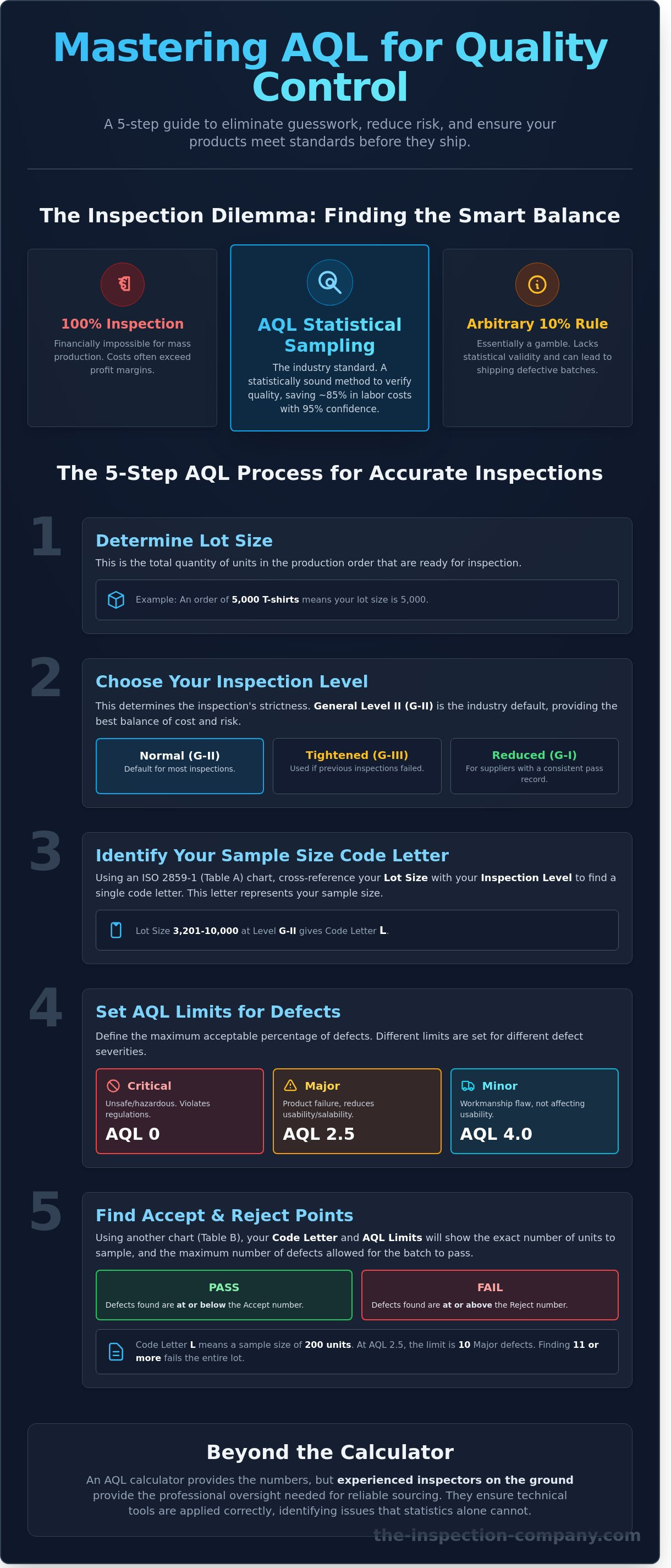
Determining the correct sample size is the most critical step in preventing a shipment of defective goods. You can't inspect every single item; it's too slow and expensive. Instead, follow these five steps to use an AQL calculator for quality inspection effectively.
- Step 1: Determine your total Lot Size. This is the total quantity of the order ready for inspection.
- Step 2: Choose your Inspection Level. General Level II is the industry standard for most consumer goods, balancing cost and risk.
- Step 3: Identify your Code Letter using Table A. Cross-reference your lot size with your chosen inspection level to find a single letter.
- Step 4: Select your AQL limits. Importers typically set different limits for Critical (0), Major (2.5), and Minor (4.0) defects.
- Step 5: Find the 'Accept' and 'Reject' points in Table B. These numbers tell you exactly how many defects are allowed before the shipment fails.
Following these steps ensures your inspection aligns with the U.S. Standards for Sampling Plans (7 CFR Part 43), which provides the legal and technical basis for statistical quality control. If you're unsure about which level to choose, our team can help you define the right inspection strategy based on your product's specific risks.
Finding Your Code Letter (Table A)
Navigating Table A requires precision. You find your lot size on the vertical axis and your inspection level on the horizontal axis. Where they intersect is your code letter. If you're performing destructive testing, such as a fabric pull test or high-voltage check, use Special Inspection Levels (S-1 to S-4). These levels yield smaller sample sizes to avoid destroying too much inventory. A common mistake for small lot sizes, like orders under 50 units, is assuming you only need to check one or two pieces. In reality, the AQL table might require a 100% check for very small quantities to maintain statistical validity.
Reading the Sampling Results (Table B)
Table B translates your code letter into actionable data. You'll see two primary columns: 'Ac' (Accept) and 'Re' (Reject). If your AQL calculator for quality inspection shows an arrow pointing up or down, you must follow it to the next available sampling plan. This happens when the sample size required by the letter is larger than the lot itself or when the AQL limit is too tight for the sample size. The Acceptance Number is the maximum number of defects allowed to pass the lot. If your 'Ac' is 5 and the inspector finds 6 defects, the lot is rejected. There's no middle ground; it's a binary decision based on 25 years of proven statistical models.
Setting Your Acceptance Quality Limit: Critical, Major, and Minor Defects
Quality control isn't about finding every single flaw. It's about strategic risk management. Not all production errors carry the same weight. A scratched shipping carton is a minor nuisance, but a frayed power cord is a legal liability. Using an AQL calculator for quality inspection allows you to categorize these risks systematically before your goods leave the factory floor. Industry data indicates that misclassifying a single major defect as minor can increase your total procurement costs by 15% due to returns, replacements, and brand damage.
Standard industry settings typically follow a 0/2.5/4.0 hierarchy. This means zero tolerance for safety issues, a 2.5% limit for functional failures, and a 4.0% limit for aesthetic flaws. While these are common benchmarks, our European management team often advises clients to tighten these limits. Relying on factory "defaults" usually leads to shipments that fail to meet Western retail expectations. One day of professional inspection prevents months of logistical trouble and financial loss.
Defining Defect Classifications
- Critical Defects: These are 0% tolerance issues. They include safety hazards like sharp metal edges or legal non-compliance such as failed RoHS testing. A single critical defect means an automatic fail for the entire lot.
- Major Defects: These issues make the product unsellable or likely to be returned by the consumer. Examples include a zipper that jams or a kitchen appliance that won't power on. These are typically set at a 2.5% limit.
- Minor Defects: These are aesthetic issues that don't affect function but deviate from your specifications. Small surface scratches or slight color variations fall here. To ensure your team knows what to look for, you should learn How to Create an Effective Inspection Checklist for clear defect definitions.
Customizing Limits for Your Brand
You don't have to stick to industry averages. If you're importing high-end luxury goods, a 2.5% major defect rate is often too high. In these cases, we recommend tightening your AQL calculator for quality inspection settings to 1.0 or 1.5. This ensures a higher level of craftsmanship and protects your brand's reputation in competitive markets.
You must balance the desire for perfection with the reality of Asian mass production. Most textile and plastic injection molding processes carry a natural 2% variance. Demanding a 0% minor defect rate will lead to constant rejections and strained supplier relationships. We help you find the "sweet spot" where quality meets cost-efficiency, ensuring you avoid costly surprises before your shipment sails.
Strategic AQL Sampling for Different Product Categories
Applying a single AQL standard to every product type is a recipe for shipping errors. A high-end circuit board can't be judged by the same criteria as a promotional t-shirt. The Inspection Company utilizes over 700 inspectors across Asia to ensure your specific product category gets the specialized attention it requires. Using an AQL calculator for quality inspection helps you define these boundaries before production ends, but you must know which limits to set to avoid costly surprises.
Electronics and High-Value Hard Goods
Electronics demand a higher level of scrutiny due to safety risks and functional complexity. We recommend a strict AQL of 0 Critical, 1.5 Major, and 2.5 Minor defects. Functional reliability is the priority here. Our inspectors integrate functional testing directly into the sampling process. We use S-level (Special) testing for battery performance and voltage safety. These tests are performed on a smaller subset of the sample to avoid destructive testing costs while maintaining strict safety standards.
Soft Lines and Textiles
Apparel and home decor typically follow an AQL of 0 / 2.5 / 4.0. Precision here focuses on measurement tolerances and visual cloth defects like skipped stitches or shading issues. In the textile industry, a Major defect such as a large hole or incorrect sizing often leads to a full batch rejection. We ensure your tolerances are met within a 1% to 3% margin, depending on the fabric type. This prevents you from receiving inventory that doesn't fit your customers.
Amazon FBA Inspection Nuances
Amazon sellers face the highest stakes. A failure in packaging or a single unreadable barcode can lead to warehouse rejections and account suspensions. Using an AQL calculator for quality inspection allows you to set tighter limits for labeling and barcoding specifically for FBA requirements. A "Fail" result on your report is your signal to stop the shipment before it hits a fulfillment center. This proactive approach saves you from the 20% to 50% fees often associated with Amazon's unplanned prep services.
Don't risk your account health on a guess. Explore our specialized Amazon FBA Service to secure your supply chain today.
Our European management team ensures that these standards are applied consistently across all 700+ inspectors. Whether you're manufacturing in China, Vietnam, or India, we provide the transparent data you need to make an informed "Ship" or "Don't Ship" decision. One day of inspection can truly save months of trouble.
Beyond the Calculator: Professional Pre-Shipment Inspections with TIC
An AQL calculator for quality inspection provides the mathematical framework for your sampling plan, but numbers alone don't catch defects. A calculator can't identify a weak solder joint, a structural crack, or a subtle color mismatch. It's a roadmap; the real value lies in the eyes of a trained inspector on the factory floor. The Inspection Company (TIC) bridges the gap between digital calculations and physical reality. We combine European management standards with a local presence in over 20 Asian countries to ensure your products meet global expectations.
The TIC Inspection Process
Our workflow is designed for speed and precision. After you book, we coordinate directly with your factory within 24 hours to confirm production status. When our team arrives on-site, they follow a strict protocol. They don't just count boxes; they perform function tests, verify labels, and pull samples based on the exact AQL levels you've selected. By the end of the next business day, you'll have a comprehensive report in your inbox. This document features high-resolution photos and objective data, allowing you to stop problems before they sail.
If your results show a "Reject" status, you've just saved your business from a major financial hit. A failed report is your strongest leverage. You can demand the factory sort the batch, repair defects, or reproduce the goods before you release the final payment. This proactive approach prevents the 15% to 30% loss in revenue often associated with high return rates and customer dissatisfaction.
Schedule Your Inspection Today
One day of inspection can save months of trouble. Don't leave your brand reputation to chance or rely solely on a digital AQL calculator for quality inspection. Our independent eyes provide the transparency you need to manage remote supply chains with confidence. We offer fixed pricing and a professional network that covers the major manufacturing hubs of Asia. Contact us for a free quote tailored to your specific product category and order volume.
Take the next step in securing your supply chain:
- Eliminate the risk of receiving sub-standard goods.
- Protect your Amazon, Shopify, or retail seller ratings.
- Gain peace of mind with 24-hour reporting.
Secure Your Supply Chain for 2026 and Beyond
Mastering the AQL calculator for quality inspection is the first step toward eliminating supply chain uncertainty. By accurately determining your sample sizes and strictly defining critical, major, and minor defect thresholds, you gain control over your production quality before goods leave the factory floor. These calculations transform vague expectations into actionable data that protects your brand from expensive returns and customer dissatisfaction. It's about moving from hope to a strategy rooted in statistical reality.
Calculations alone aren't enough when your reputation is on the line. The Inspection Company leverages over 25 years of experience in Asia to turn these sampling plans into reality. As an ISO 9001 Certified firm and Sedex Member, we maintain the highest industry standards for every client. Our network of 700+ professional inspectors operates across 10+ countries to ensure your specifications are met exactly. We identify risks early so you don't have to deal with the fallout of a sub-par shipment. One day of inspection saves months of trouble; it's the most reliable investment you'll make in your logistics process.
Avoid costly surprises; get an instant inspection quote based on your AQL needs
Take the guesswork out of your next order and move forward with total confidence in your product quality.
Frequently Asked Questions
What is the most common AQL level used for consumer goods?
Most consumer goods importers use AQL 0 for critical defects, 2.5 for major defects, and 4.0 for minor defects. These benchmarks serve as the standard for 90% of retail inspections conducted across Asia. Using these specific levels ensures you identify non-compliant products before they leave the factory. It's a proven method to mitigate risk and avoid the 15% return rate often seen with uninspected shipments.
Can I use an AQL calculator for 100% inspection?
No, you don't use an AQL calculator for quality inspection when performing a 100% check of the goods. AQL is specifically designed for statistical sampling, which means testing a representative portion of the lot. If your project requires every single unit to be verified, you should request a Full Inspection service instead. This approach is common for high-value electronics where a 0% defect rate is mandatory for safety.
What happens if the number of defects found exceeds the AQL limit?
If the defect count surpasses the Acceptance (Ac) number, the entire shipment fails the inspection. You should immediately issue a rejection report to the supplier and demand a full re-work or sorting of the batch. Statistics show that 1 in 4 failed inspections lead to significant savings by preventing the delivery of unsellable stock. Don't ship a failed lot without a written corrective action plan from the manufacturer.
How do I choose between General Inspection Level I, II, and III?
Level II is the standard default for 95% of consumer product inspections because it balances cost and risk effectively. You should choose Level I if you have a high-performing supplier and need a smaller sample size to reduce costs. Switch to Level III for new suppliers or high-risk items where you need a larger sample to ensure 99% confidence in the batch quality. This decision directly impacts the reliability of your data.
Is an AQL calculator the same as a MIL-STD-105E chart?
Yes, modern AQL calculators are digital versions of the MIL-STD-105E tables, which were replaced by the ANSI/ASQ Z1.4 standard in 2008. These tools use the same statistical algorithms to determine sample sizes and acceptance points. Using an AQL calculator for quality inspection replaces the manual look-up process; it reduces human error by 100% and provides instant results for your quality control team on the ground.
Does the AQL calculator account for shipping damage?
The AQL calculator doesn't account for damage that occurs during transit. It's a tool used during Pre-Shipment Inspection (PSI) to evaluate the manufacturing quality of the goods at the factory. To address transit risks, you must include a separate Container Loading Supervision (CLS) service. This ensures the container is packed correctly to prevent the 5% average breakage rate seen in sea freight due to poor palletization.
What is the difference between AQL and LTPD?
AQL (Acceptable Quality Level) focuses on the producer's risk and defines the maximum defect rate considered acceptable. LTPD (Lot Tolerance Percent Defective) represents the consumer's risk and identifies the worst quality level a buyer is willing to accept. While AQL ensures 95% of good lots are accepted, LTPD ensures that 90% of bad lots are rejected. Balancing these two metrics is vital for maintaining 100% brand integrity in competitive markets.
How often should I update my AQL standards with my supplier?
You should review and update your AQL standards at least once every 12 months or whenever you launch a new product line. If a supplier fails three consecutive inspections, you should tighten your levels from Normal to Tightened inspection as per ISO 2859-1 rules. Regular updates prevent quality drift and ensure your manufacturer remains accountable for the 0.5% to 2% defect tolerances you've established in your purchase agreement.