

For importers sourcing from Asia, the arrival of a new shipment is a moment of both anticipation and apprehension. A single misunderstanding with your supplier about quality standards can result in costly defects, damaging customer reviews, and significant financial loss. Relying on a generic inspection template often fails to cover your product's unique features, leaving your investment exposed to unnecessary risk. The difference between a successful product launch and a logistical nightmare often hinges on one critical document: a comprehensive quality control checklist.
This guide is designed to remove that uncertainty. We will provide a step-by-step framework for building a customized checklist from the ground up-one that your supplier and inspector can clearly understand and execute. By the end of this article, you will have the tools to create a formal document that ensures accountability, minimizes defects, and protects your investment, guaranteeing your products meet the high standards your customers expect.
Key Takeaways
- A comprehensive quality control checklist is your most critical tool for communicating exact product specifications to your supplier, preventing costly misunderstandings.
- Learn to structure your checklist into specific sections-covering everything from packaging to on-site tests-to ensure a thorough and effective product inspection.
- Understand how to integrate your checklist with AQL inspection standards to make objective, data-driven decisions on whether to accept or reject a shipment.
- Identify and avoid common but critical mistakes that can render your checklist ineffective and put your investment at risk.
What is a Quality Control Checklist (and Why It's Non-Negotiable for Importers)
A quality control checklist is far more than a simple to-do list; it is a comprehensive, technical document that serves as a formal agreement between you and your supplier. It details all your product specifications, quality standards, and testing procedures in clear, actionable terms. Before creating one, it's vital to understand what is quality control? in its essence-a system for verifying that manufactured goods meet a defined set of quality criteria.
Think of this document not as a suggestion, but as a contractual tool. It removes ambiguity and sets clear expectations, ensuring both you and your factory manager are aligned on what constitutes an acceptable product. Its primary purpose is to identify and prevent costly defects before your goods are shipped, saving you from major financial and logistical problems down the line. It is the essential foundation for any professional product inspection.
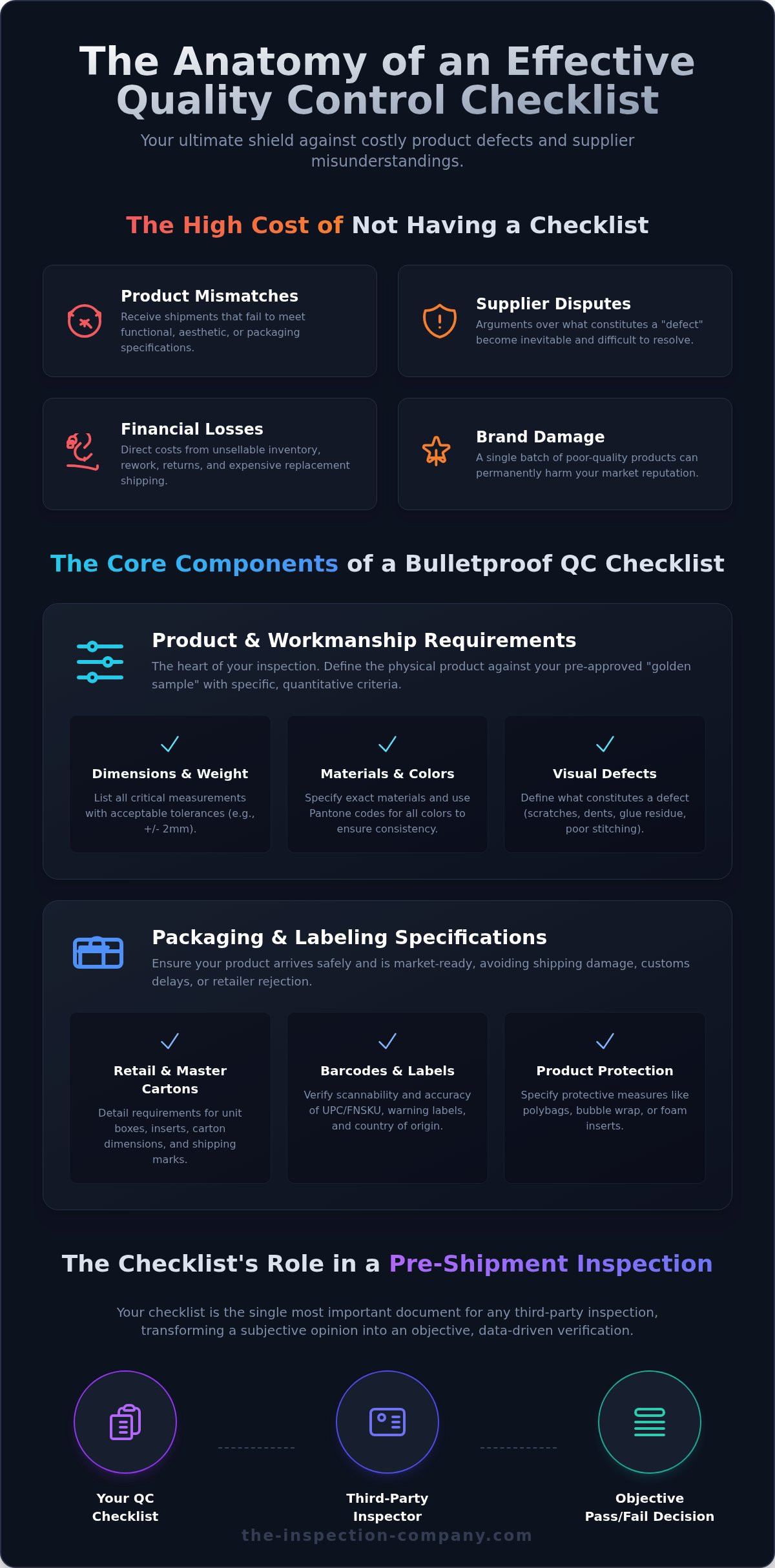
The Cost of Not Having a Checklist
Operating without a detailed checklist exposes your business to significant and avoidable risks. When quality standards are not clearly defined and documented, you create an environment ripe for misunderstandings and errors, leading directly to:
- Product Mismatches: Receiving an entire shipment that fails to meet your functional, aesthetic, or packaging specifications.
- Supplier Disputes: Without agreed-upon criteria, arguments over what constitutes a "defect" are inevitable and difficult to resolve.
- Financial Losses: The direct costs of unsellable inventory, expensive rework, customer returns, and potential air freight for replacements.
- Brand Damage: A single batch of poor-quality products reaching your customers can permanently harm your market reputation.
Your Checklist's Role in a Pre-Shipment Inspection (PSI)
For any professional third-party inspection, your quality control checklist is the single most important document. It serves as the inspector's roadmap, guiding them through every on-site check and test required. This ensures the inspection is objective, consistent, and thorough, regardless of which inspector is on site. It transforms the process from a subjective opinion into a data-driven verification by providing concrete pass/fail criteria for the entire production run.
The Core Components of an Effective QC Checklist
A powerful quality control checklist is not a random list of notes; it is a structured, methodical document designed for clarity and precision. To ensure a thorough inspection, organize your checklist into logical sections, each targeting a different aspect of your product, its packaging, and its function. This framework is your primary tool to prevent ambiguity and ensure that your inspector and supplier are perfectly aligned on your standards.
Crucially, use simple, direct language and avoid technical jargon that could be misinterpreted. Your goal is to create a universally understood document that leaves no room for error, protecting your investment and brand reputation before the shipment ever leaves the factory.
Product & Workmanship Requirements
This section forms the heart of your inspection, defining the physical product against your standards. It must be specific and quantitative to eliminate subjective judgments. Your inspector will use these points to verify that every unit meets your exact specifications, comparing them directly against the pre-approved "golden sample."
- Dimensions & Weight: List all critical measurements with acceptable tolerances (e.g., 15cm x 10cm x 5cm, +/- 2mm).
- Materials & Colors: Specify exact materials and use Pantone codes for all colors to ensure consistency (e.g., "100% Cotton, Body Color: Pantone 19-4052 Classic Blue").
- Visual Defects: Define what constitutes a defect, such as scratches, dents, glue residue, or poor stitching.
Packaging & Labeling Specifications
Your product's quality is also judged by its packaging. This section ensures your product arrives safely and is ready for market. Neglecting these details can lead to shipping damage, customs delays, or rejection by retailers.
- Retail & Master Cartons: Detail requirements for the unit box (artwork, material, inserts) and the master carton (dimensions, weight limits, shipping marks).
- Barcodes & Labels: Verify the scannability and accuracy of all barcodes (e.g., UPC, FNSKU), warning labels, and country of origin markings.
- Product Protection: Specify protective measures like polybags, bubble wrap, or foam inserts to prevent damage during transit.
On-Site Tests & Functional Checks
A product that looks perfect but doesn't work is a critical failure. This part of your quality control checklist defines the specific tests required to verify the product functions as intended. Procedures must be clear, with defined pass/fail outcomes.
- Performance Tests: For electronics, this may include powering on the device, testing all buttons, and verifying connectivity.
- Abuse & Durability Tests: Include simple checks like a carton drop test or a joint stress test to simulate real-world use and shipping stress.
- Fitting Tests: For apparel, specify a fitting test on a correctly sized mannequin or model to check for proper drape, fit, and seam alignment.
Step-by-Step: How to Build Your Custom Checklist from Scratch
A reactive approach to quality control is a recipe for costly delays and returns. Building a custom checklist is a proactive strategy that forces you to think through every critical aspect of your product before production begins. This process is essential for clarifying your own standards, ensuring nothing is left to interpretation.
A comprehensive quality control checklist serves as a clear and objective agreement between you and your supplier. It minimizes misunderstandings, streamlines the inspection process, and ultimately saves you significant time and money by preventing problems before your shipment ever leaves the factory.
Step 1: Gather All Product Specifications
Your checklist must be built on a foundation of precise technical details. Start by consolidating all relevant documents, including your tech pack, CAD files, purchase order, and any approved samples. Meticulously list every product requirement, paying close attention to:
- Materials, colors (with Pantone codes), and finishes
- Dimensions, weight, and critical tolerances
- Functions, features, and performance standards
- Packaging, labeling, manuals, and any included accessories
Step 2: Define Your Defect Classification
Not all defects are equal. To manage quality effectively, you must classify potential issues to determine your tolerance level. This is crucial for setting your Acceptable Quality Limits (AQL). The industry standard includes three categories:
- Minor: A small discrepancy that does not affect product usability, like a slight scratch in an inconspicuous area.
- Major: A defect that could affect the product's function, performance, or saleability, such as incorrect stitching or a faulty button.
- Critical: A defect that renders the product unsafe, non-compliant with regulations, or completely unusable.
Always provide clear visual examples for each defect type to avoid ambiguity.
Step 3: Collaborate With Your Supplier
Your checklist is a communication tool, not just a set of demands. Before finalizing the document and starting mass production, share a draft with your supplier. This collaborative step is vital to confirm they fully understand your expectations and have the capability to meet every requirement. This alignment builds a stronger partnership and prevents disputes or production halts down the line.
Creating a professional checklist from scratch can be a detailed process. If you need to ensure every risk is covered, let our experts help you build a professional checklist.
Integrating Your Checklist with AQL Inspection Standards
A detailed checklist is the foundation of quality control, but it doesn't tell an inspector how to apply it. Inspecting every single unit in a large shipment is impractical and cost-prohibitive. To solve this, you must pair your checklist with a statistically valid sampling method. The global industry standard for this is the Acceptable Quality Limit (AQL).
Think of it this way: your quality control checklist defines what constitutes a defect, while the AQL standard defines how many defects are permissible in a given shipment. Together, they create an objective, data-driven system to accept or reject a production lot, minimizing your financial risk before the goods are shipped.
What is AQL and How Does It Work?
AQL is an international standard (ISO 2859-1) that dictates the number of units to be randomly selected and inspected from a production batch. Based on the lot size and your chosen inspection level, the AQL chart provides a specific sample size. The inspector then uses your checklist to check this sample for defects. The results are compared against pre-set limits for critical, major, and minor defects to determine if the entire shipment passes or fails.
Setting Your AQL Levels in the Checklist
For your inspection to be effective, it is essential to specify your chosen AQL levels directly on your quality control checklist. This ensures your factory, inspector, and internal team are all aligned on the same quality standard. Defects are typically categorized with corresponding AQLs:
- Critical Defects (AQL 0%): Defects that are hazardous or unsafe. These are completely unacceptable, and finding even one results in a failed inspection.
- Major Defects (AQL 2.5%): Defects that affect the product's function, performance, or appearance, making it likely a customer would return it.
- Minor Defects (AQL 4.0%): Small cosmetic issues that do not affect the product's usability and are unlikely to result in a return.
These percentages are common starting points, but you should adjust them based on your product's value and risk. For example, medical devices or high-end electronics will require much stricter (lower) AQLs than promotional giveaways. By clearly defining these tolerances, you create an enforceable standard for your supplier to meet. Defining the right AQL levels is a critical step, and our experts can help you create a robust inspection framework. Contact us to ensure your quality standards are met.
Top 5 Mistakes to Avoid When Creating Your Checklist
A poorly constructed quality control checklist can be more damaging than having no checklist at all. It creates a false sense of security, leading you to approve a shipment while major defects go unnoticed. Learning to avoid common pitfalls is essential for creating a document that genuinely protects your investment. Based on insights from thousands of importers, these are the critical mistakes to steer clear of.
Mistake 1: Being Too Vague or Ambiguous
The most common error is using subjective language. Terms like 'good quality,' 'nice finish,' or 'durable' are open to interpretation and can mean different things to you and your supplier. Your checklist must be built on objective, measurable criteria. Instead of vague instructions, specify your exact requirements:
- No scratches longer than 3mm are permitted.
- Product color must match Pantone 18-3838 TCX.
- Stitching must be uniform at 8 stitches per inch.
Including clear reference photos and diagrams is the best way to eliminate any room for error and ensure your standards are met.
Mistake 2: Forgetting About Packaging and Labels
Many importers focus exclusively on the product, completely overlooking its packaging. This is a costly oversight. A product that is perfect when it leaves the factory can arrive damaged if its packaging is insufficient for international transit. Furthermore, incorrect barcodes, suffocation warnings, or country-of-origin labels can lead to massive fines or rejection by retailers like Amazon FBA, causing significant delays and financial loss.
Mistake 3: Using a Generic, Non-Specific Template
Downloading a generic template is a start, but using it without customization is a recipe for failure. A checklist for 'kitchen appliances' is useless for verifying the specific functions of your Bluetooth-enabled coffee maker. Every product has unique materials, components, and potential failure points. Your quality control checklist must be tailored to address these specific risks, from the grade of stainless steel used to the firmware version installed. A customized checklist ensures your inspector knows exactly what to verify. A detailed checklist is your first line of defense, but professional verification is the final guarantee. Stop problems before your shipment sails. Book an inspection.
Transform Your Checklist into Your Strongest Defense
Mastering international sourcing begins with one indispensable tool: your quality control checklist. As we've detailed, a comprehensive checklist is not just a document-it's your first line of defense against costly defects, shipping delays, and brand damage. By customizing its core components and avoiding common pitfalls, you create clear, actionable standards that leave no room for error.
But a plan is only as powerful as its execution. Verifying these standards on the factory floor is the critical next step. With over 700 inspectors across 20+ countries in Asia, The Inspection Company provides the on-site expertise you need. Our European management ensures international quality standards are met, delivering detailed inspection reports with photos and videos directly to you within 24 hours.
Stop problems before your shipment sails. Take control of your production and ensure your products meet your exact specifications. Protect Your Shipment: Get a Free Inspection Quote and build a more secure, reliable supply chain today.
Frequently Asked Questions About Quality Control Checklists
What is the difference between a quality control checklist and a factory audit checklist?
A quality control checklist focuses specifically on your product. It details the specifications, appearance, function, and packaging requirements an inspector must verify. In contrast, a factory audit checklist evaluates the supplier. It assesses the factory's quality management systems, production capacity, and overall operational competence to determine if they are a reliable and capable manufacturing partner. One verifies the product; the other vets the producer.
How detailed does my QC checklist need to be for a simple product?
Even for simple products, detail is essential to avoid costly errors. Your checklist must clearly define all critical-to-quality points, including materials, dimensions, weight, color codes, and packaging standards. While it may have fewer checkpoints than a checklist for complex electronics, it must leave no room for ambiguity on the attributes that matter to your customer. A lack of detail is a primary cause of quality fade and unexpected defects.
Can I use the same quality control checklist for different suppliers of the same product?
The core product requirements on your quality control checklist should remain consistent to ensure a uniform quality standard across all suppliers. However, it is wise to adapt the checklist to address supplier-specific risks. For instance, if one supplier has a history of poor packaging, you may add more rigorous carton drop tests or packaging checks for them. Use a master checklist as your standard, but treat it as a dynamic document.
Who is ultimately responsible for creating and approving the quality control checklist?
As the buyer, you are ultimately responsible for creating and approving the checklist. While your supplier can provide input on manufacturing feasibility, the final document must reflect your brand's quality standards and your customers' expectations. Approving the checklist signifies that it is the definitive standard for production. Delegating this crucial task can lead to misunderstandings that result in defective products and costly delays.
How do I update my checklist after receiving feedback from an inspection?
Treat every inspection report as an opportunity to refine your quality standards. If an inspector identifies a new or recurring defect, analyze whether the issue stemmed from an unclear or missing point in your checklist. Update the document immediately with more precise specifications, clearer images, or new testing procedures to prevent the problem from happening again. This iterative process makes your quality control more robust over time.
Should my checklist include points about the factory's working conditions?
No, a product quality control checklist should focus exclusively on the product itself-its specifications, workmanship, and packaging. Assessing a factory’s ethical practices, labor laws, and safety standards is the function of a Social Compliance Audit. Mixing these two distinct objectives can dilute the focus of the product inspection. Keep your checklist dedicated to verifying product quality for a clear and effective result.