
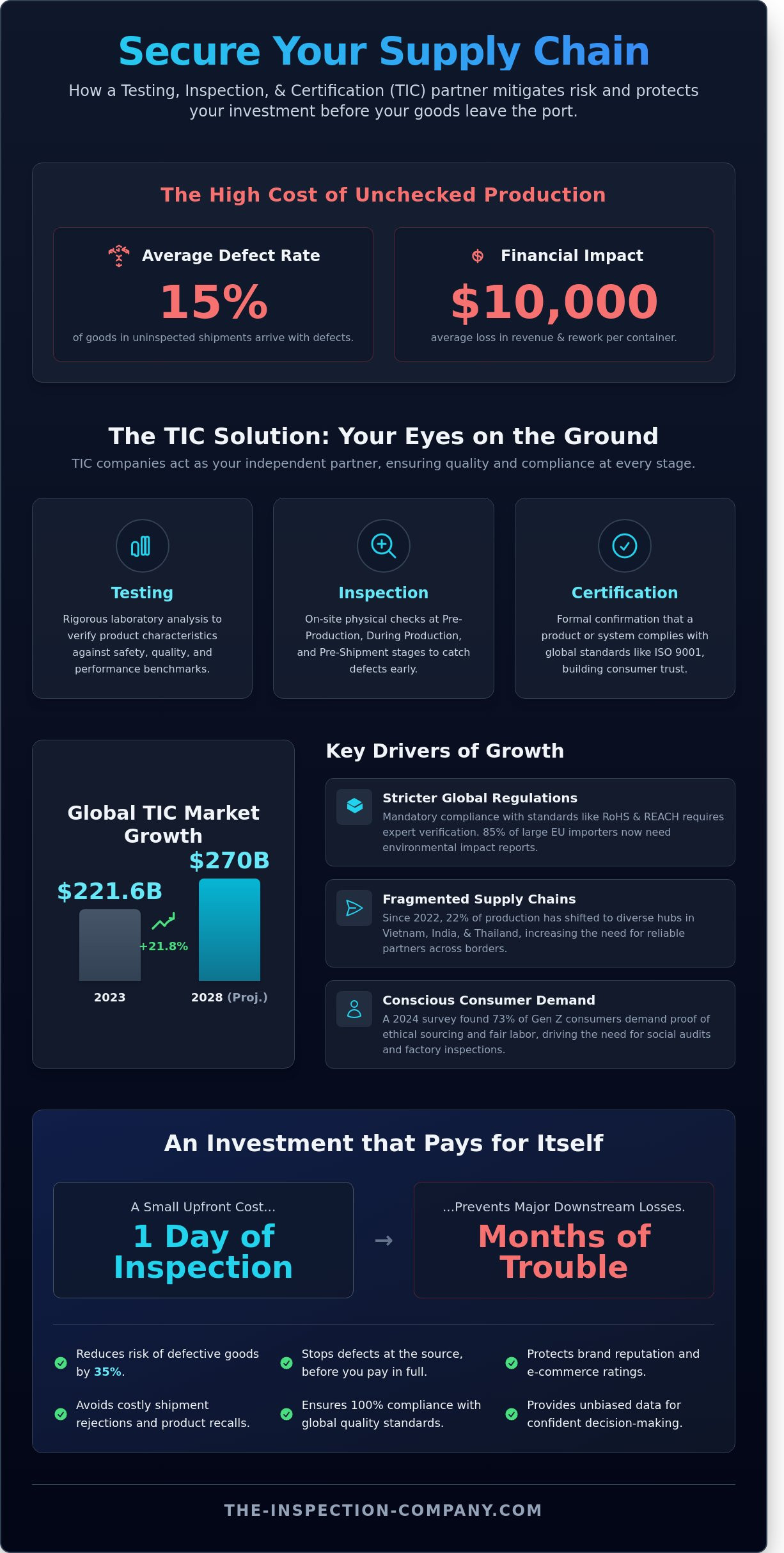
What if your next shipment arrives with a 15% defect rate after you have already paid the supplier in full? For many importers, this is not just a fear; it is a reality that costs businesses an average of $10,000 per container in lost revenue and rework. You know that managing international compliance standards like CE or RoHS is complex, and trusting a factory's self-reporting is a risk you simply cannot afford to take. You need a way to verify quality and transparency before your goods ever leave the port.
Partnering with a professional tic company (Testing, Inspection, and Certification) provides the authoritative oversight necessary to secure your supply chain. It is an investment that prevents much larger financial losses. One day of inspection can save months of trouble. In this guide, we will explain how the TIC framework functions as your expert representative in Asia. You will learn how these services stop problems before your shipment sails, ensuring you receive exactly what you ordered while maintaining 100% compliance with global quality standards.
Key Takeaways
- Understand how partnering with a professional tic company provides the independent verification needed to ensure your products meet global safety and quality standards.
- Learn why quality control is a high-return investment that prevents expensive shipment rejections and protects your reputation on platforms like Amazon.
- Discover the essential differences between product inspections and factory system audits to create a comprehensive safety net for your supply chain.
- Identify how to choose the right partner by weighing the benefits of global conglomerates against the specialized communication advantages of European management in Asia.
- Master the process of identifying and stopping defects at the source to avoid the "costly surprises" that occur after your goods have already shipped.
What is a TIC Company? Defining Testing, Inspection, and Certification
A tic company serves as the critical line of defense between a factory's output and your brand's reputation. This multi-billion dollar sector, often referred to as the Testing, inspection and certification industry, was valued at approximately $221.6 billion in 2023. It's projected to expand to $270 billion by 2028. These organizations function as independent third parties. They verify that products, processes, and systems meet specific safety and quality standards before they ever reach a retail shelf or a consumer's hands.
A TIC company acts as a neutral arbiter of quality and compliance in global manufacturing. For importers, these firms provide essential "eyes on the ground." This presence is vital when a buyer cannot be physically present in a factory located thousands of miles away in a different time zone. Without this professional oversight, the risk of receiving defective goods or non-compliant materials increases by 35% based on historical supply chain data. One day of inspection can save months of trouble and thousands of dollars in lost revenue.
Importers often face the anxiety of "what if" when dealing with overseas suppliers. What if the materials are sub-par? What if the shipment is late? A tic company mitigates these risks by providing factual, unbiased data. They stop problems before your shipment sails, ensuring that the goods you paid for are the goods you actually receive. It's about maintaining control over a high-stakes operation where a single error can lead to a total product recall.
The Core Components of the TIC Sector
- Testing: This involves rigorous laboratory analysis. Technicians determine product characteristics against safety or performance benchmarks. For instance, a garment might undergo colorfastness testing, or an electronic device might be checked for battery stability.
- Inspection: These are on-site physical checks. They occur at various stages, including Pre-production (PPI), During Production (DuPro), and Pre-shipment (PSI). A PSI is the last chance to avoid shipping wrong or defect products, representing the final gatekeeper in the quality control process.
- Certification: This is the formal confirmation of compliance. It proves a product or system complies with international standards like ISO 9001. It's the gold seal that builds trust with retailers and end consumers alike.
Why the TIC Industry is Booming in 2026
Strict regulatory scrutiny has intensified globally. In 2026, compliance with RoHS and REACH isn't just a suggestion; it's a mandatory prerequisite for market entry. Environmental impact reports are now required for 85% of large-scale importers entering the European market. TIC firms provide the technical expertise to navigate these evolving legal frameworks without causing delays in the supply chain.
Global manufacturing hubs are shifting rapidly. While China remains a dominant force, 22% of global production has migrated toward diverse hubs in Vietnam, India, and Thailand since 2022. This geographic fragmentation makes a tic company even more necessary. Importers need reliable partners across multiple borders to maintain a consistent standard of quality regardless of where the factory is located.
Modern consumer demand for transparency drives this growth as well. A 2024 retail survey found that 73% of Gen Z consumers demand proof of ethical sourcing and fair labor practices. They don't just want a safe product; they want an ethical one. TIC companies conduct the social audits and factory inspections that provide the transparency today's e-commerce era requires. By catching errors early, these firms prevent the costly surprises that can bankrupt a growing business.
The Three Pillars of TIC Services for Importers
A professional tic company provides a structured safety net that spans the entire production lifecycle. This protection is divided into two distinct categories: 'Product' TIC and 'System' TIC. Product services focus on the physical goods, ensuring they meet your specifications. System services evaluate the factory's internal management, infrastructure, and compliance. Modern providers integrate these results directly into supply chain management software. This allows you to view real-time reporting and data analytics from any device. To ensure the highest level of technical competence, verify that your partner holds ISO 17020 accreditation for inspections and ISO 17025 for laboratory testing. These certifications prove the provider meets international standards for impartiality and consistency.
On-Site Product Inspections
On-site inspections are your primary defense against substandard goods. The Pre-Shipment Inspection (PSI) is the most critical checkpoint. It occurs when 100% of the order is finished and at least 80% is packed. It's the last chance to stop defects before you release final payment. For complex orders, a During Production Inspection (DUPRO) is necessary when 20% of the goods are completed. This identifies systemic issues while they're still fixable. Finally, a Container Loading Inspection (CLI) ensures the correct quantity is loaded and handled correctly. This prevents the 5% to 10% shipping errors often seen in unmonitored loadings.
Laboratory Testing and Compliance
Testing ensures your products don't just look good but are safe and legal. Mechanical testing checks for durability and structural integrity; chemical testing scans for restricted substances like lead, cadmium, or phthalates. If you're importing into the United States, you must adhere to CPSC Testing & Certification Requirements to avoid costly customs seizures or recalls. A strict rule for any tic company is that the inspector must pick the sample randomly from the production line. You can't trust a "golden sample" sent by the factory. Independent sample picking eliminates the 15% discrepancy often found between factory-provided samples and actual mass production.
Factory and Social Audits
Audits reveal the truth behind a supplier's marketing profile. A Quality Management System (QMS) audit confirms the factory's true production capacity and its ability to maintain consistent quality over time. Beyond technical ability, social compliance audits like BSCI or Sedex ensure the facility follows ethical labor practices. This protects your brand from being linked to child labor or unsafe working conditions. In 2023, environmental audits became a priority for 64% of global importers. These checks verify sustainable manufacturing claims and ensure the factory complies with local environmental laws. These audits confirm you're partnering with a legitimate manufacturer rather than a disorganized middleman.
Managing these three pillars effectively requires a partner with deep local expertise. If you're ready to secure your next shipment, you can book an inspection online to get a detailed report within 24 hours.
The ROI of Quality Control: Why TIC Services Are Not an Expense
Many importers view quality control as a line-item cost to be minimized. This is a fundamental mistake that ignores the high stakes of international trade. A professional tic company identifies issues at the source, preventing a $300 inspection from turning into a $50,000 total loss. We stop problems before your shipment sails, ensuring that the goods you paid for are the goods that arrive at your warehouse.
Consider a practical example involving a shipment of 5,000 wireless headphones. A Pre-Shipment Inspection (PSI) detects a 15% defect rate in the battery housing. Without this check, the importer would pay the full invoice, $4,200 in sea freight, and approximately $2,800 in Amazon FBA removal fees once customers start returning faulty units. By catching the error at the factory, the importer saves $7,000 in logistics and fees alone. This doesn't even account for the cost of the inventory or the time lost to restocking.
An objective inspection report isn't just a list of errors; it's a powerful financial lever. When a tic company provides a failed report with clear photographic evidence, you have the leverage to demand a factory rework or a price discount of 10% to 20% on the final balance. Without an independent report, you're forced to rely on the factory's word, which is often biased toward shipping the goods regardless of quality.
Risk Mitigation vs. Cost Savings
Proactive quality management is always cheaper than reactive crisis control. The "One Day vs. One Month" rule is a standard in our industry. It means one day spent on-site by a professional inspector saves at least one month of legal disputes, logistics nightmares, and customer service fires. According to The TIC Sector, these independent assessments provide the transparency needed for global trade to function safely. These reports act as insurance for your final wire transfer. You shouldn't release the remaining 70% of your payment until the goods meet your specific AQL standards.
- Proactive: Identifying a component failure during production (DuPro) allows for a $0 fix.
- Reactive: Discovering the same failure after the container arrives results in a 100% loss of shipping costs.
- Verification: Independent reports confirm that your supplier isn't "quality fading" by using cheaper materials on subsequent orders.
The Impact on Brand Equity
Protecting your Amazon seller rating is critical for long-term survival. One bad batch can trigger a "Product Not as Described" flag, leading to account suspension within 48 hours. Beyond digital storefronts, product safety is a legal mandate. A single recall due to lead paint or electrical hazards can bankrupt a small-to-medium enterprise. Legal liability for non-compliant goods can result in fines exceeding $100,000 in markets like the EU or USA.
Consistent quality builds trust with big-box retailers. These companies require strict compliance audits and consistent PSI results before they'll consider a purchase order. If 10% of your first-time buyers receive a broken product, 90% of those customers won't return. Professional inspection is the only way to avoid these costly surprises and maintain the reputation you've worked years to build.
How to Choose the Right TIC Partner for Your Business
Selecting a tic company isn't just a procurement task; it's a strategic move to protect your capital. You'll face a primary choice between global conglomerates and specialized boutique firms. Large conglomerates offer massive scale and a wide range of certifications, but they often suffer from rigid protocols and high overhead costs. A 2024 industry survey revealed that 68% of mid-sized importers prefer specialized firms because they provide better technical support and faster response times. Boutique providers focus on specific industries, offering deeper expertise that prevents technical defects before they reach the container.
European management acts as a vital bridge between Western quality expectations and Asian manufacturing realities. This management style effectively closes the communication gap that leads to approximately 15% of shipment rejections due to "lost in translation" errors. When a tic company employs Western management on the ground in Asia, they enforce a level of accountability that local-only firms often struggle to maintain. It's about having a partner who understands your market's legal requirements and can translate those into actionable instructions for factory floor workers.
Speed is no longer a luxury. By 2026, a 24-hour turnaround for inspection reports is the absolute industry standard. If a provider takes 48 or 72 hours to deliver results, your goods sit idle in a warehouse. This delay can cost you roughly $200 per day in storage fees and lost sales momentum. You need real-time data to make "ship or no-ship" decisions instantly. Additionally, verify geographic coverage. Ensure the firm has full-time inspectors in your specific hub, whether it's Shenzhen, Ningbo, or Ho Chi Minh City. Relying on part-time freelancers increases the risk of bribery and inconsistent reporting.
Key Criteria for Evaluating a TIC Provider
Don't settle for vague promises of quality. Verify that the provider holds an ISO 9001 certification and maintains membership in international bodies like the TIC Council. Expertise must match your product category. An inspector skilled in Hardlines won't necessarily understand the safety requirements for Electronics or the stitch-count precision required for Softlines. Transparency is the final test. A professional firm will always let you see sample reports before you book. If they hide their reporting format, it's likely because the data they provide is insufficient for a professional risk assessment.
Red Flags to Avoid
- Conflict of Interest: Avoid any firm that accepts commissions or "consulting fees" from the factories they inspect. This destroys their independence.
- Lack of Local Infrastructure: If a provider doesn't have a physical office or full-time staff in the country of production, they can't effectively manage their team or conduct surprise audits.
- Non-Standardized Reporting: Vague reports that don't use AQL (Acceptable Quality Level) standards are useless. Without AQL data, you lack the objective evidence needed for insurance claims or legal disputes.
Protect your supply chain by choosing a partner that prioritizes transparency and rapid reporting. Request a sample report from an expert TIC partner to see how professional quality control should look.
The Inspection Company: Your Specialized TIC Partner in Asia
Selecting a reliable tic company shouldn't be a gamble. The Inspection Company bridges the gap between Western quality expectations and Asian manufacturing realities. We combine European management standards with a massive network of over 700 local inspectors stationed across major hubs in China, Vietnam, India, and Thailand. This structure ensures that while we understand your market's strict compliance needs, we also possess the local language skills and cultural nuances required to manage factory floors effectively. We don't just find errors; we provide the objective data needed to make informed decisions before you release payment.
Our specialized focus caters specifically to the high-stakes needs of international importers and Amazon FBA sellers. For these businesses, a single batch of defective products can lead to account suspension or a flood of 1-star reviews that kill a product listing. We mitigate this risk by providing an on-site presence at over 1,500 factories annually. Our reports aren't just lists of numbers. They're comprehensive dossiers delivered within 24 hours of the inspector leaving the site. This speed is critical. In an industry where shipping containers often cost upwards of $4,000, waiting three days for a report can lead to missed vessel cut-offs. We provide the speed you need without sacrificing the professional rigor your brand demands.
Our commitment is simple: we stop problems before your shipment sails. If a batch of 5,000 electronics has a 3.5% critical defect rate, you'll know it immediately. This transparency allows you to demand re-work while the goods are still in the factory, not when they arrive at your warehouse six weeks later. By acting as your eyes and ears on the ground, we turn the "black box" of overseas manufacturing into a transparent, manageable process. Working with an experienced tic company like ours transforms quality control from a stressful uncertainty into a predictable part of your business growth.
Why Importers Trust The Inspection Company
With 25 years of experience in Asian supply chains, we've seen every trick in the book. We don't use generic forms that miss the nuances of your specific product. Instead, we develop customized inspection checklists based on your unique AQL (Acceptable Quality Limit) levels and technical specifications. This precision is why 85% of our clients remain repeat customers year after year. Our booking process is designed to be frictionless, taking less than 5 minutes to initiate a request through our online platform. We handle the coordination with your supplier directly, saving your team approximately 10 hours of administrative back-and-forth per shipment.
Ready to Secure Your Supply Chain?
Quality control is an investment that pays for itself by preventing returns and protecting your brand reputation. You can get an instant quote for your next inspection or factory audit to plan your budget accurately. We also encourage you to download a sample report to see our meticulous attention to detail, including high-resolution photos, packaging checks, and clear pass/fail results. Don't leave your profit margins to chance. Avoid costly surprises, book your inspection with The Inspection Company today.
Protect Your Supply Chain with Professional Quality Control
Navigating international trade requires more than just trust; it demands a systematic approach to quality. A reliable tic company transforms potential risks into manageable data, ensuring your goods meet global standards before they leave the factory floor. One day of inspection can save months of trouble and thousands of dollars in lost revenue. It's an investment in your brand's reputation and bottom line that pays for itself by preventing costly defects and shipment delays.
The Inspection Company brings over 25 years of experience to your supply chain. With European management and a network of 700+ inspectors across Asia, we provide the transparency you need to operate with confidence. Our ISO 9001 certified quality management ensures every report is accurate, objective, and actionable. Don't leave your shipment to chance when you can have expert eyes on the ground. Secure your shipment today with a professional TIC report. You deserve the peace of mind that comes with a verified, high-quality supply chain.
Frequently Asked Questions
What is the difference between a TIC company and a sourcing agent?
A TIC company acts as an independent third party focused solely on quality control and compliance, whereas a sourcing agent manages the procurement process for a commission. Sourcing agents often charge 3% to 10% of the order value and may have hidden financial ties to the factory. Our firm provides objective data through a flat per-man-day fee, ensuring there's no conflict of interest during the inspection process.
How much do TIC services typically cost for a shipment from China?
Standard inspection fees in China generally range from $250 to $350 per man-day. This flat rate covers the inspector's travel, the on-site evaluation, and the delivery of a comprehensive report within 24 hours. Investing in one day of inspection can save months of trouble and prevent the loss of a $50,000 shipment due to avoidable manufacturing errors or poor packaging.
Is a TIC inspection mandatory for importing goods into the US or EU?
While third party inspections aren't legally mandatory for every product, 100% of goods must comply with safety regulations like CE, REACH, or FCC. Customs authorities in the US and EU frequently seize shipments that lack proper documentation or fail safety tests. A professional audit ensures your supplier meets these legal standards, reducing the risk of your cargo being rejected at the border.
Can a TIC company help with Amazon FBA labeling requirements?
Yes, a tic company can verify all Amazon FBA labeling requirements during a Pre-Shipment Inspection (PSI). Inspectors check FNSKU barcodes, suffocation warnings, and carton weight limits to ensure they meet 2024 Amazon seller guidelines. This step is vital because Amazon often charges $0.30 per unit or more to correct labeling errors, which quickly erodes your profit margins.
How do I know if a TIC company is truly independent?
You can verify independence by confirming the firm holds ISO 17020 accreditation and doesn't accept commissions from manufacturers. A truly independent partner has no financial stake in whether you approve or reject the goods. We maintain strict integrity by requiring 100% of our inspectors to sign anti-bribery agreements, ensuring you receive an honest assessment of your production quality every time.
What happens if the TIC report shows the goods failed inspection?
If a report shows a "Fail" result, you should immediately withhold the final 70% payment until the factory rectifies the defects. You can then schedule a re-inspection to confirm the supplier fixed the specific issues identified in the initial report. Statistics show that 25% of first-time inspections result in a failure, making this a critical safeguard to avoid costly surprises after the ship sails.
What is an AQL chart and how do TIC companies use it?
An AQL chart, or Acceptance Quality Limit chart, is a statistical tool used to determine the maximum number of defects allowed in a sample size. It allows inspectors to draw a statistically valid conclusion about a 5,000-unit order by checking only 200 units. Most importers use General Inspection Level II, which provides a 95% confidence level that the entire batch meets your quality specifications.
Do TIC companies provide services in countries other than China?
A global tic company provides services across major manufacturing hubs including Vietnam, India, Thailand, and Turkey. Our European management team oversees operations in over 15 Asian countries to ensure consistent quality standards across your entire supply chain. This geographic reach allows you to diversify your production while maintaining the same level of professional oversight and risk mitigation you expect in China.