

Navigating the world of international manufacturing presents significant challenges for any importer. From language barriers and cultural differences to the daunting task of verifying a supplier's legitimacy from thousands of miles away, the risks are substantial. The fear of costly production errors, shipping delays, or receiving a shipment that fails to meet your quality standards is a constant concern for businesses looking to grow.
This is where many businesses turn to a sourcing agent-an on-the-ground partner promising to streamline the entire process, from finding factories to negotiating prices. But how do you find a reliable agent, and what exactly should you expect from them? This guide provides the answers. We will break down the precise role of a sourcing agent, offer a clear process for vetting and hiring the right partner, and explain why independent quality control remains your most critical safety net. Our goal is to equip you with the knowledge to build a secure, transparent, and profitable international supply chain.
Key Takeaways
- Define the core role of a sourcing agent as your local partner for finding, vetting, and negotiating with international suppliers.
- Learn a practical framework for hiring a reliable agent to minimize common import risks and build a secure supply chain.
- Weigh the critical pros and cons to determine if using an agent aligns with your business's budget and risk tolerance.
- Understand why separating sourcing from quality control is essential to ensure unbiased inspections and protect your investment from costly defects.
What is a Sourcing Agent? The Fundamentals Explained
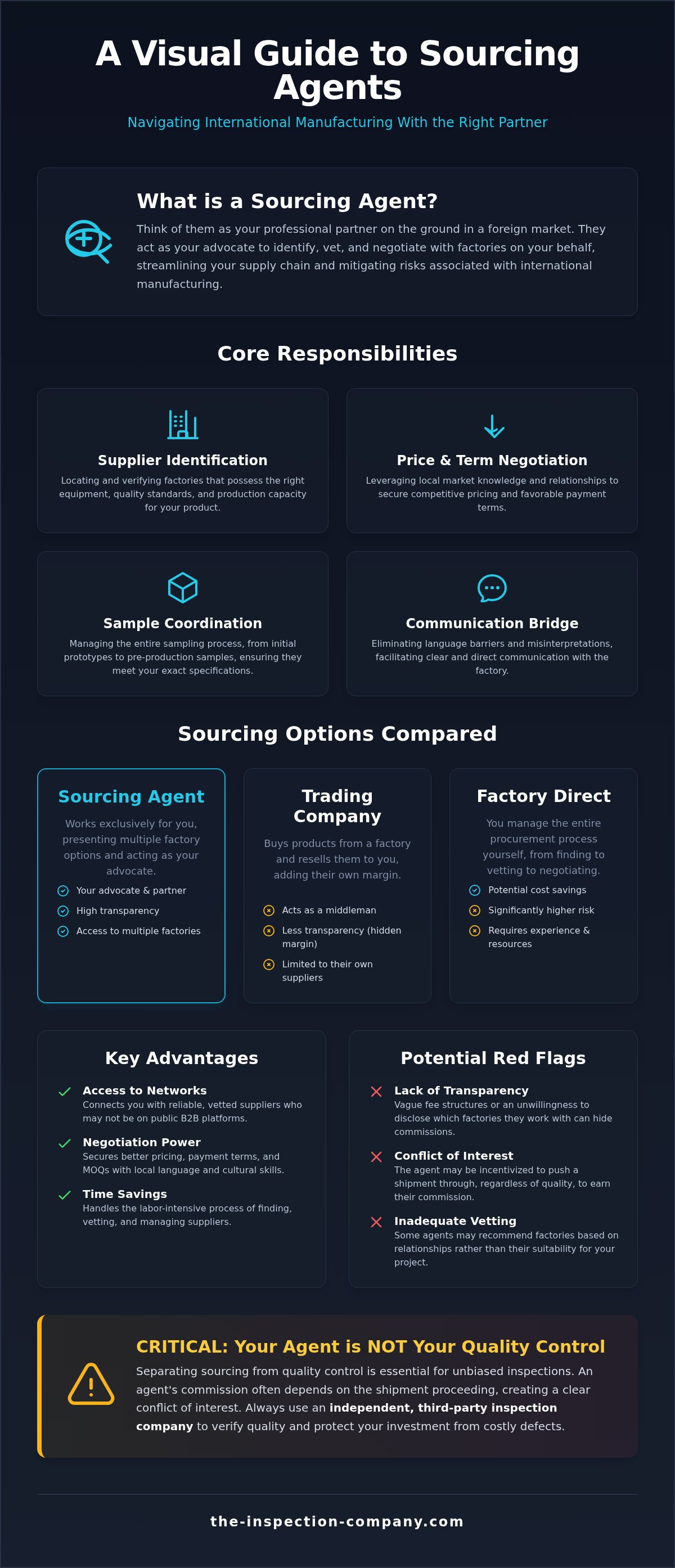
A sourcing agent is your professional partner on the ground in a foreign manufacturing market. Think of them as a real estate agent for product manufacturing; instead of finding properties, they identify, vet, and negotiate with factories on your behalf. Their primary role is to streamline your supply chain, mitigate risks, and secure the best possible terms for your product needs. For businesses new to importing or those developing products with complex technical requirements, leveraging this expertise is a critical step toward avoiding costly errors and production delays.
Core Responsibilities and Duties
An effective agent manages several critical functions to protect your interests and ensure a smooth production cycle. Their duties are designed to bridge the geographical, cultural, and linguistic gaps between you and your potential suppliers. Key responsibilities include:
-
Supplier Identification: Locating and verifying factories that possess the right equipment, quality standards, and production capacity for your product.
-
Price & Term Negotiation: Leveraging local market knowledge and relationships to secure competitive pricing and favorable payment terms.
-
Sample Coordination: Managing the entire sampling process, from initial prototypes to pre-production samples, ensuring they meet your exact specifications before mass production begins.
-
Communication Bridge: Eliminating language barriers and misinterpretations, facilitating clear and direct communication between you and the factory management.
Sourcing Agent vs. Trading Company vs. Factory Direct
Understanding the difference between your sourcing options is crucial. A sourcing agent works exclusively for you, presenting multiple factory options and acting as your advocate. In contrast, a trading company buys products from a factory and resells them to you, adding their own margin. Going factory direct means you manage the entire procurement process yourself, which offers potential cost savings but carries significantly higher risks, especially for inexperienced importers. An agent provides transparency and alignment with your goals, a service a trading company cannot offer.
When Does It Make Sense to Hire a Sourcing Agent?
While not every business requires one, a sourcing agent provides immense value in specific situations. Engaging one is a strategic decision to minimize risk and maximize efficiency. Consider hiring an agent if:
-
You are new to importing from a particular country like China, Vietnam, or India and are unfamiliar with the local business culture and risks.
-
Your product requires complex technical specifications, custom tooling, or multiple components from different suppliers.
-
You want to access a wider network of vetted suppliers beyond what is available on public B2B platforms.
-
You lack the internal resources, time, or language skills to manage overseas supplier relationships effectively.
The Pros and Cons: A Balanced View of Using Sourcing Agents
Engaging a sourcing agent can be a strategic move to streamline your supply chain, but it's a partnership that requires careful consideration. The right agent acts as your trusted representative on the ground, saving you time and money. However, the wrong one can introduce new risks and complexities. Understanding both sides is essential to making an informed decision and protecting your investment.
Key Advantages: Why Businesses Use Them
A professional sourcing agent provides immediate value by leveraging their local market expertise. They are tasked with managing many of the critical functions involved in overseas procurement, a role detailed in SCORE's guide to importing. Key benefits include:
-
Access to Networks: They connect you with reliable, vetted suppliers who may not be listed on public B2B platforms, giving you a competitive edge.
-
Negotiation Power: With local language skills and an understanding of negotiation culture, agents can often secure better pricing, payment terms, and MOQs than you could achieve alone.
-
Time Savings: They handle the labor-intensive process of finding suppliers, collecting quotes, vetting factories, and managing samples, freeing you to focus on your core business.
-
Cultural Expertise: An agent helps navigate complex business customs and communication styles, preventing misunderstandings that could delay production or compromise quality.
Potential Risks and Red Flags to Watch For
While the benefits are significant, importers must be aware of the potential downsides. A lack of proper oversight can lead to costly problems. Be vigilant for these red flags:
-
Lack of Transparency: Vague fee structures or an unwillingness to disclose which factories they are working with can hide hidden commissions or markups.
-
Factory Bias: The agent may push you toward a preferred factory that benefits them personally, even if it isn't the best fit for your product's quality or price point.
-
Poor Communication: Instead of facilitating communication, a disorganized agent can become a bottleneck, delaying answers and causing production friction.
-
Inadequate Quality Checks: The agent's idea of "good quality" may not align with your brand standards, leading to a shipment of goods you cannot sell.
The Inherent Conflict of Interest: Quality vs. Commission
It is critical to understand that most sourcing agents work on a commission-based fee, typically a percentage of your total order value. This creates a fundamental conflict of interest. Their primary financial incentive is to ensure the order is completed and shipped so they can collect their commission. This can put them at odds with your primary goal: ensuring the product meets your quality standards. An agent may be less motivated to report defects that could cause a shipment to be delayed or rejected. For this reason, their quality check is not a substitute for an independent, third-party inspection focused solely on your interests.
How to Find, Vet, and Hire a Reliable Sourcing Agent
Identifying and onboarding the right sourcing partner is one of the most critical decisions you will make in your international trade operations. A great agent is a strategic asset; a poor one introduces significant risk. This process demands rigorous due diligence to ensure you find a competent and trustworthy professional who will protect your interests.
Where to Find Potential Sourcing Agents
A systematic search is the most effective way to build a list of qualified candidates. Focus your efforts on these proven channels to find professionals with established track records:
-
Industry Referrals: Ask for direct recommendations from trusted contacts within your professional network or trade associations. A firsthand endorsement is invaluable.
-
Online Platforms: Utilize professional marketplaces like Upwork or specialized sourcing directories. These platforms often provide reviews and work histories.
-
Trade Shows: Attend industry-specific trade shows to connect with agents who specialize in your product category and have deep connections in that market.
-
LinkedIn: Use targeted searches to find professionals with verified sourcing experience and credentials in your target country.
The Vetting Process: Critical Questions to Ask
Once you have a shortlist, the vetting process must be methodical. This is a non-negotiable step to mitigate risk and avoid costly production errors. Your questioning should be thorough, covering their expertise, communication practices, and supplier network. For a comprehensive approach, the U.S. International Trade Administration offers a detailed framework for vetting a foreign representative that can serve as an excellent starting point. At a minimum, ensure you receive clear answers to these questions:
-
What is your specific experience sourcing our product type?
-
How do you identify, qualify, and audit potential suppliers?
-
Can you provide 2-3 references from current or past clients in our industry?
-
What is your complete fee structure, including all potential charges and payment terms?
Understanding Sourcing Agent Fee Structures
Transparency in fees is a hallmark of a professional sourcing agent. To avoid surprises, clarify their compensation model upfront. Most operate on one of three common structures:
-
Commission-Based: The agent earns a percentage of the total order value (typically 3-10%). This model is best for ongoing, high-volume relationships as it incentivizes the agent to secure favorable pricing.
-
Flat Fee: A fixed price per project, order, or a monthly retainer. This is often suitable for complex, one-time projects or initial supplier discovery and qualification.
-
Hybrid Models: A combination of a fixed fee and a smaller commission. This can balance the agent's workload compensation with performance incentives.
Why Your Sourcing Agent Is NOT Your Quality Control Department
A capable sourcing agent is an invaluable partner for navigating supplier landscapes and negotiating terms. However, relying on that same agent for final quality control introduces a fundamental conflict of interest and exposes your business to significant risk. The most successful importers operate on a core principle of risk management: separation of duties. Sourcing products and verifying their quality are two different, highly specialized jobs.
Viewing independent inspection as a standard business practice, rather than a sign of distrust, is key to protecting your investment and your brand's reputation.
The Importer's Golden Rule: Never Let the Agent Inspect Their Own Sourcing
Asking your agent to perform the quality inspection on goods they helped source is like letting a student grade their own test. A sourcing agent's primary goal is to get the product manufactured and shipped so they can earn their commission. This creates an inherent bias toward approving the shipment. An independent inspector, in contrast, has no financial stake in the transaction. Their sole purpose is to serve as your eyes and ears in the factory, providing objective, data-driven reports so you can make an informed decision.
What a Third-Party Inspector Verifies
A professional Pre-Shipment Inspection is a systematic process that verifies the critical details that determine your product's success. Unlike a quick check, a dedicated inspector uses established methodologies to assess:
-
Quantity & Specifications: Ensuring you receive exactly what you paid for, from the number of units to the precise colors, materials, and dimensions.
-
Workmanship & Defects: A thorough visual examination using AQL standards to identify and classify any critical, major, or minor defects before they reach your customers.
-
On-Site Testing: Performing crucial functionality, safety, and durability checks right at the factory to confirm the product performs as expected.
-
Packaging & Labeling: Verifying that all cartons, barcodes, and shipping marks comply with your specific requirements, including strict standards for Amazon FBA.
How Pre-Shipment Inspection Protects Your Investment
An inspection is your last chance to find and fix problems before you release final payment and the goods are shipped. A detailed inspection report gives you concrete evidence and powerful leverage to negotiate with the supplier for rework or corrections. By catching issues at the source, you avoid the devastating costs of international returns, product recalls, and damage to your brand. One day of inspection can save you months of trouble.
Don't leave your quality to chance. Get a free quote for an independent inspection.
Your Sourcing Agent and Quality Control: The Winning Combination
Navigating the complexities of international manufacturing requires a strategic approach. As this guide has shown, a skilled sourcing agent is an invaluable asset for finding reliable suppliers and managing logistics. However, it's crucial to remember their primary role is procurement, not quality assurance. Relying on them for final product verification introduces a significant risk to your investment and brand reputation.
To truly protect your business, you need an independent partner dedicated solely to quality. With over 25 years of European management experience and a network of 700+ inspectors across Asia, we provide the independent verification you need. We stop problems before they ship, delivering detailed inspection reports with photos within 24 hours. Secure Your Production: Get a Free Quote for Pre-Shipment Inspection and avoid costly surprises.
By pairing a great sourcing partner with independent quality control, you're not just buying products-you're building a resilient and profitable international business.
Frequently Asked Questions About Sourcing Agents
How much do sourcing agents typically charge?
Sourcing agent fees vary based on the service model. The most common method is a commission, typically 5-10% of the total order value. For smaller or more complex projects, agents may charge a flat fee or an hourly rate. It is crucial to clarify all costs upfront, including any potential charges for travel or sample shipping. Always ensure the fee structure is transparent and documented in your agreement to avoid costly surprises during the process.
Are sourcing agents in China different from those in Vietnam or India?
Yes, there are key differences based on market maturity and local culture. Agents in China often operate in a highly developed market with deep expertise in specific categories like electronics. In emerging manufacturing hubs like Vietnam or India, agents may have broader, more generalist knowledge. Cultural nuances, negotiation styles, and local regulations also vary significantly. Vetting an agent’s specific experience within your target country and product niche is essential for mitigating risks.
Can a sourcing agent also handle shipping and logistics?
Some can, but it is not their primary function. A sourcing agent typically coordinates with trusted freight forwarders to manage the shipping process on your behalf. Larger, full-service sourcing agencies are more likely to offer comprehensive logistics services as part of a complete package. However, most agents focus on supplier verification, negotiation, and quality control. Always clarify the scope of their services to determine if you need to hire a separate logistics provider.
What is the difference between a sourcing agent and a freight forwarder?
A sourcing agent focuses on the pre-production and production phases. Their primary role is to find and vet suppliers, negotiate prices, manage quality control, and oversee manufacturing. In contrast, a freight forwarder is a logistics specialist focused on post-production. They handle the physical transportation of your goods from the factory to your final destination, managing customs clearance, documentation, and the actual shipment. One finds the supplier; the other moves the product.
How do I protect my intellectual property (IP) when working with an agent and factory?
Protecting your IP is a critical step. Before sharing any sensitive designs, sign a comprehensive Non-Disclosure, Non-Use, and Non-Circumvention (NNN) agreement with both your agent and the factory-this is especially important in China. An NNN provides more robust protection than a standard NDA. Additionally, you should register your trademarks and patents in the country of manufacture. A reliable agent will understand these risks and help implement these protective measures.
Should I pay the sourcing agent or the factory directly?
This depends on your agreement, but paying the factory directly typically provides greater transparency and control. When you pay the agent to then pay the factory, it can sometimes hide inflated costs or undisclosed commissions. Paying the factory directly while paying the agent's fee separately ensures you know the true cost of goods. Whichever method you choose, demand complete transparency with clear, itemized invoices to verify all costs and mitigate financial risk.
Is it better to use an individual agent or a larger sourcing agency?
The choice depends on your needs and risk tolerance. An individual sourcing agent can offer a personalized, flexible service and may be more cost-effective, but you risk a single point of failure if they become unavailable. A larger sourcing agency provides a team, established processes, and broader resources, which enhances reliability and risk mitigation. For complex projects or businesses that prioritize stability and comprehensive support, an agency is often the more secure and professional choice.