
You've spent weeks vetting suppliers and found one that looks perfect on paper. But before you place that first large purchase order, a critical question remains: can you be certain their factory is as capable, ethical, and reliable as they claim? This uncertainty represents a significant risk to your investment and brand reputation. This is where professional factory audits become an essential tool for due diligence, providing the on-the-ground verification needed to move beyond a supplier's promises and assess their actual capabilities.
In this complete guide, we demystify the audit process. You will learn precisely what a factory audit entails, the different types available-from simple verification to in-depth social compliance checks-and how each one protects your business when sourcing from new suppliers in Asia. By the end, you will understand how to use this powerful tool to minimize supply chain risks, ensure product consistency, and gain the confidence to partner with manufacturers who can truly support your growth.
Key Takeaways
- Understand how a factory audit acts as your first line of defense, verifying a supplier's capabilities before you commit to an order.
- Learn to select the right type of audit to address specific risks, from assessing technical competence to ensuring social compliance.
- Demystify the process of conducting factory audits, from initial booking to receiving a comprehensive, actionable report.
- Gain the confidence to interpret audit results effectively, turning complex data into a clear decision on a potential supplier.
What is a Factory Audit? Your First Line of Defense in Sourcing
A factory audit is a systematic, on-site evaluation of a potential or existing supplier's manufacturing facilities. It goes beyond a simple handshake or email exchange to assess their processes, systems, and overall capability to meet your specific quality, ethical, and production standards. The core purpose is to verify a supplier's legitimacy and competence before you commit financially.
Unlike a one-time product check, this assessment investigates the producer's long-term operational health, ensuring they are a reliable partner for your business, not just for a single order.
Factory Audit vs. Product Inspection: Understanding the Key Difference
Importers often confuse these two critical quality control tools, but they serve different purposes. An audit evaluates the factory-the 'who' and 'how' of production. An inspection evaluates the product-the 'what' you are actually buying. Think of it this way: a factory audit is a comprehensive health check-up on your supplier, while a product inspection is checking their finished homework. Both are essential, but they provide different insights at different stages of your supply chain.
The High Cost of Skipping an Audit: Real-World Risks for Importers
Failing to conduct professional factory audits is a gamble that exposes your business to significant and avoidable risks. A small investment in due diligence can save you from catastrophic financial and reputational damage. Key risks include:
-
Financial Risks: Paying a substantial deposit to a supplier who is disorganized, ill-equipped, or simply incapable of fulfilling your order to specification.
-
Quality Risks: Partnering with a factory that lacks a documented Quality Management System (QMS). A proper audit verifies if their processes align with internationally recognized standards, such as the ISO 9000 quality management principles, which is fundamental to ensuring consistent output.
-
Reputational Risks: Unknowingly associating your brand with a supplier engaged in unethical practices, such as child labor or unsafe working conditions, leading to severe brand damage.
-
Operational Risks: Facing unexpected production delays and communication breakdowns caused by poor management, insufficient capacity, or disorganized internal systems.
The 4 Key Types of Factory Audits and When to Use Them
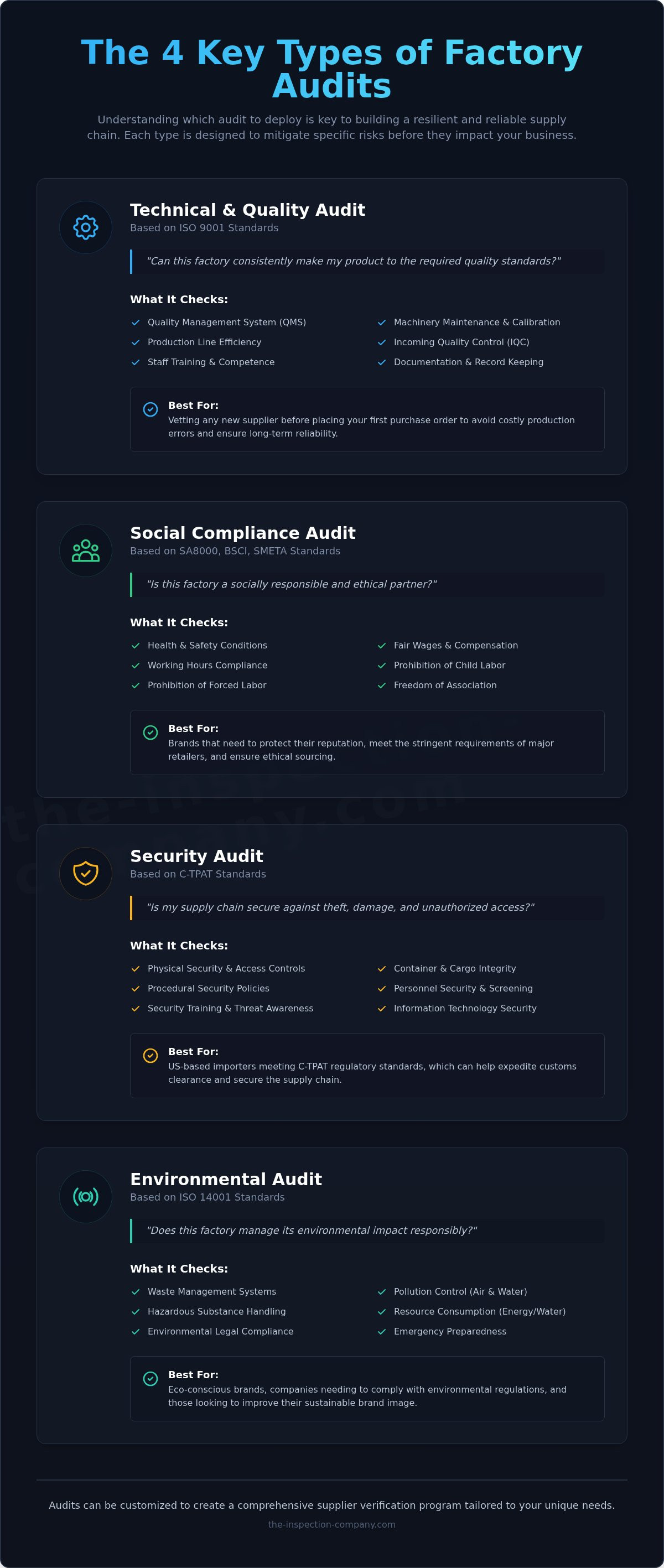
Not all factory audits are the same. Each type is designed to answer a critical question about a potential supplier, helping you mitigate specific risks before they impact your business. Understanding which audit to deploy-and when-is key to building a resilient and reliable supply chain. While these audits target specific areas, they can often be customized to create a comprehensive supplier verification program tailored to your unique needs.
Technical & Quality Management Audit (ISO 9001)
Purpose: To answer the fundamental question, 'Can this factory consistently make my product to the required quality standards?'
This audit is a deep dive into a factory's operational capabilities. Auditors verify the existence and implementation of a robust Quality Management System (QMS), ensuring the supplier has the processes in place to prevent defects. It is the essential first step before committing to any new manufacturing partner.
-
What it checks: Production line efficiency, machinery maintenance, quality control checkpoints, staff training protocols, and raw material handling.
-
Best for: Vetting any new supplier before placing your first purchase order to avoid costly production errors and delays.
Social Compliance Audit (SA8000, BSCI)
Purpose: To answer the ethical question, 'Is this factory a socially responsible and ethical partner?'
In today's market, brand reputation is paramount. A social compliance audit verifies that a supplier adheres to local labor laws and international standards, protecting your brand from association with unethical practices like child labor or unsafe working conditions. This is a non-negotiable for most major retailers.
-
What it checks: Working hours, fair wages, health and safety conditions, and policies against child or forced labor.
-
Best for: Brands that need to protect their reputation and meet the stringent requirements of major retailers.
Security Audit (C-TPAT)
Purpose: To answer the logistical question, 'Is my supply chain secure against theft, damage, and terrorism?'
This audit assesses a factory's security protocols to ensure the integrity of your cargo from production to shipment. For US-based importers, programs like C-TPAT security audits are crucial for meeting regulatory standards and can help expedite customs clearance, saving both time and money.
-
What it checks: Physical site security, access controls, container loading procedures, and employee background screening.
-
Best for: Importers shipping to the US or those dealing with high-value goods susceptible to theft.
Environmental Audit (ISO 14001)
Purpose: To answer the sustainability question, 'Does this factory operate in an environmentally responsible manner?'
This audit evaluates a supplier's impact on the environment, ensuring compliance with international standards like ISO 14001 and local regulations. It is essential for brands committed to sustainability or those selling into markets with strict environmental laws, such as the EU.
-
What it checks: Waste management systems, pollution controls, safe handling of chemicals, and energy consumption.
-
Best for: Eco-conscious brands and businesses selling in highly regulated international markets.
The Factory Audit Process: A Step-by-Step Walkthrough for Clients
An independent factory audit can seem complex, but a professional third-party firm follows a meticulous, transparent process designed to give you clarity and confidence. Understanding this procedure from start to finish demystifies the experience and highlights how we manage every detail of our factory audits to protect your interests. Here is what you can expect when you partner with us to vet a potential supplier.
Step 1: Booking and Defining Your Audit Scope
This initial phase is a collaboration to ensure the audit targets your specific needs. You provide the essential information, and we build the framework for a successful evaluation. We handle all direct communication with the factory to schedule the audit, ensuring an independent and unbiased process.
-
Provide necessary documents: We require your supplier’s full contact information and factory address, along with your product specifications and quality standards.
-
Select the right audit type: We work with you to determine the most suitable audit, whether it’s a Technical Quality Audit, a Social Compliance Audit, or another specialized assessment.
-
Establish a clear checklist: Based on your concerns, we develop a comprehensive audit checklist that our auditors will follow on-site.
Step 2: The On-Site Evaluation
On the scheduled day, our professional auditor arrives at the factory to conduct a thorough, on-the-ground assessment. The process begins with an opening meeting to outline the day's agenda with factory management. The auditor then conducts a comprehensive tour, evaluating everything from raw material intake to production lines, quality control stations, and finished goods warehousing. This includes a review of essential documents like business licenses, certifications, and quality control records. For social compliance audits, confidential worker interviews are conducted to verify fair labor practices, a critical component of modern supply chain audits.
Step 3: Receiving and Understanding Your Audit Report
Speed and clarity are paramount. Within 24-48 hours of the on-site visit, you will receive a detailed digital report. This document is more than just a checklist; it's a comprehensive overview of the factory's capabilities and risks, complete with high-resolution photos and objective findings. The report clearly identifies any non-conformities, categorizing them as minor or major, and concludes with a summary and an overall assessment of the supplier's risk level. This actionable intelligence empowers you to make an informed decision about the partnership.
See the level of detail for yourself. Request a sample factory audit report to see what you get.
Making the Right Decision: How to Use Your Factory Audit Results
An audit report is more than a pass/fail grade; it is a powerful decision-making tool. The objective data from independent factory audits empowers you to move forward with clarity and confidence. Instead of guessing about a potential partner's capabilities, you have a detailed roadmap for your supply chain. This final step is about translating those findings into a strategic, risk-averse business decision.
Analyzing Non-Conformities and Assessing Risk
Your report will categorize findings, typically as Minor or Major non-conformities. A Minor issue might be disorganized paperwork, while a Major one could be a critical safety violation. You must evaluate these findings against your business's risk tolerance. Look for patterns to determine if the problems are:
-
Isolated Incidents: A one-time mistake that is easily corrected.
-
Systemic Failures: Deep-rooted issues in their quality management or ethical standards that signal a high-risk partner.
Identifying these patterns is crucial to understanding the true operational risk.
Developing a Corrective Action Plan (CAP)
If the identified issues are correctable, the next step is to request a Corrective Action Plan (CAP) from the factory. This formal document should outline precisely how and when they will resolve each non-conformity. A strong CAP demonstrates a supplier's commitment to improvement and partnership. To ensure accountability, a follow-up audit is highly recommended to verify that the promised changes have been effectively implemented.
Making the Final 'Go' or 'No-Go' Decision
Armed with objective data, you can now make a final, evidence-based decision. A comprehensive audit provides the proof you need to confidently approve a supplier or the justification to walk away, avoiding a potentially disastrous partnership. The findings also serve as a valuable leverage point in negotiations, allowing you to discuss terms or timelines based on the factory's current state. This data-driven approach minimizes risk and protects your investment.
Ultimately, the goal is to build a reliable and transparent supply chain. If you are ready to gain this level of clarity, we can help. Have questions about a supplier? Get a free audit quote today.
From Uncertainty to Confidence: Your Next Step in Sourcing
Navigating the complexities of international sourcing requires more than just a good product price. As we've explored, an audit is your essential first line of defense, providing a clear, on-the-ground verification of a supplier's capabilities, quality systems, and ethical standards. By understanding the different audit types and how to interpret the results, you transform potential risks into calculated, confident business decisions.
Don't leave your investment to chance. Professional factory audits are a small, proactive step that prevents costly surprises and production delays. With our ISO 9001 certified quality management, European management overseeing 700+ local inspectors, and comprehensive reports delivered within 48 hours, you gain the clarity needed to partner with the right supplier from the start.
Protect Your Investment: Schedule a Factory Audit Today
Take control of your supply chain and build partnerships you can trust.
Frequently Asked Questions About Factory Audits
How much does a factory audit typically cost?
A standard factory audit in Asia typically costs between $300 and $700 per man-day. The final price depends on the factory's location, the required scope, and its overall complexity. A more comprehensive technical or social compliance audit may require more time or specialized auditors, affecting the total investment. This cost is a critical step to avoid the significant financial risks associated with partnering with an unvetted supplier, saving you from costly problems later.
How long does a factory audit take to complete?
Most factory audits are completed within one full working day on-site. Following the physical assessment, you can expect to receive a comprehensive, detailed report with our findings within 24 hours. More extensive audits, such as in-depth technical or social compliance evaluations, may require two or more days to thoroughly investigate all required checkpoints. Our efficient process ensures you get the critical information you need to make decisions without delay.
What happens if a factory fails an audit?
If a factory fails an audit, you will receive a detailed report that clearly outlines all non-conformities and critical issues discovered by our auditor. The next step is to request a Corrective Action Plan (CAP) from the supplier, which details how and when they will resolve each issue. We strongly recommend a follow-up audit to verify that the necessary improvements have been implemented effectively before you proceed with any production orders.
Do I need to be present during the factory audit?
No, your presence is not required during the audit. The primary purpose of using an independent third-party service is to have a professional, unbiased expert act as your eyes and ears on the ground. Our auditors are trained to manage the entire process and will provide a comprehensive report with photographic evidence and detailed findings. This allows you to save on travel costs and time while still gaining complete visibility into your potential supplier's operations.
Can you perform a factory audit on a supplier I found on Alibaba?
Yes, absolutely. Performing an audit on suppliers found on Alibaba or other B2B sourcing platforms is a crucial part of your due diligence. An independent audit is the most reliable method to verify the claims a supplier makes on their online profile, from their production capacity and quality systems to their business licenses. It is an essential step to ensure the online profile matches the reality on the ground and that they are a capable partner for your business.
How often should I audit my existing suppliers?
For any new supplier, an initial audit is essential before placing your first large order. For existing, long-term suppliers, we recommend conducting a follow-up audit every 12 to 24 months. This regular verification ensures that quality standards and operational procedures have not declined over time. Regular audits help maintain product consistency, manage evolving risks, and reinforce your quality expectations with your manufacturing partners, protecting your brand and investment.
What is the difference between an audit and a C-TPAT audit?
While both are on-site evaluations, standard factory audits assess a manufacturer's overall capabilities, including quality management systems (like ISO 9001) and production capacity. In contrast, a C-TPAT (Customs-Trade Partnership Against Terrorism) audit is highly specialized. It focuses exclusively on supply chain security to meet U.S. Customs and Border Protection standards, evaluating areas like container security, physical access controls, and procedural security to prevent terrorism.