
For importers of children's products, the risk of a shipment being detained by US Customs or an Amazon account being suspended is a constant concern. A single compliance error can trigger costly delays, product seizures, and significant damage to your business. This uncertainty often stems from one critical, and frequently misunderstood, document. If you're asking yourself, what is a CPC and do I really need one, you are not alone. This certificate is a mandatory declaration that your products meet all applicable US safety rules, and failure to produce a valid one can stop your import operations in their tracks.
This comprehensive guide removes the guesswork and minimizes your risk. We will explain exactly what a Children's Product Certificate is, which products legally require one, and the specific safety tests you must complete. Follow our clear, step-by-step process to obtain a valid CPC, avoid costly penalties, and confidently sell your products in the US market without fear of compliance issues. Let’s ensure your business is protected.
What is a Children's Product Certificate (CPC)? The Official Definition
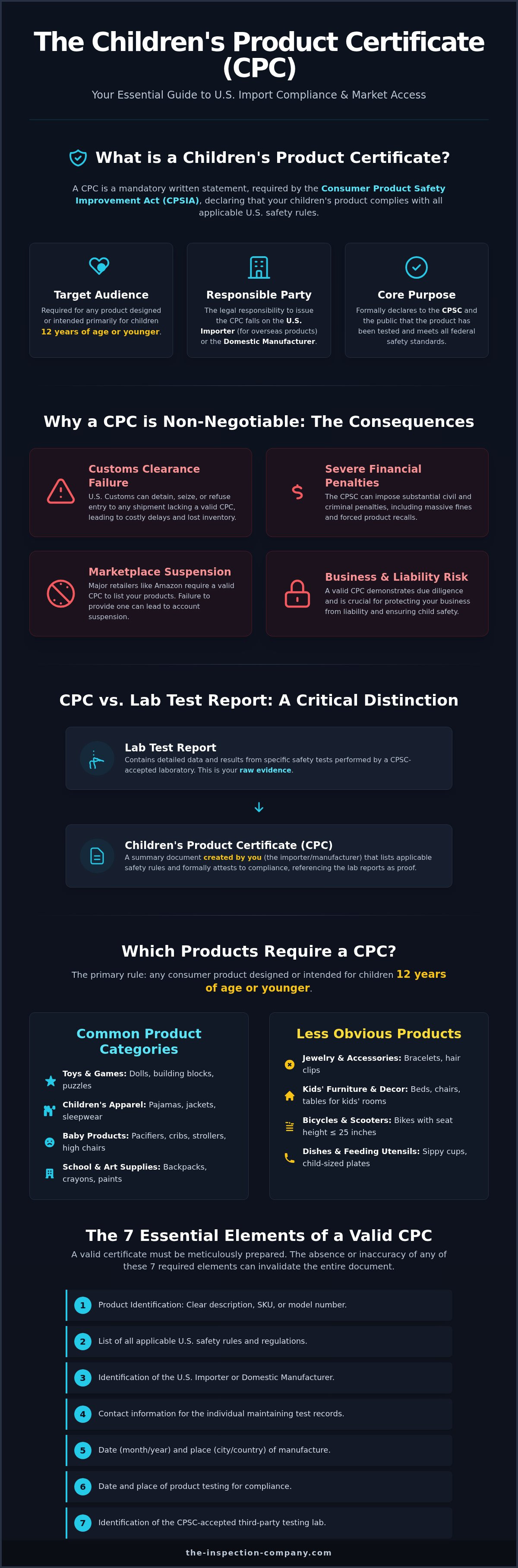
First, let's clarify a common point of confusion: a Children's Product Certificate (CPC) is related to product safety compliance, not medical coding. If you're asking what is a cpc in the context of importing or manufacturing, this is the definition you need. A CPC is a mandatory written statement declaring that your children's product complies with all applicable U.S. children's product safety rules. This requirement is a cornerstone of the Consumer Product Safety Improvement Act (CPSIA).
The legal responsibility for issuing this certificate falls on the U.S. importer for products made overseas or the domestic manufacturer for products made in the United States. It is a formal declaration to the Consumer Product Safety Commission (CPSC) and the public that your product has been tested and meets all federal safety standards.
Why a CPC is Non-Negotiable for Importers and Amazon Sellers
Failing to produce a valid CPC is not a minor oversight; it is a significant compliance failure with severe consequences. For any business involved in children's products, this document is an absolute requirement to:
- Gain Customs Clearance: U.S. Customs and Border Protection (CBP) can detain, seize, or refuse entry to shipments lacking a valid CPC.
- Sell on Major Platforms: Amazon and other large retailers demand a CPC before they will list and sell your children's products.
- Avoid Severe Penalties: The CPSC can impose substantial civil and criminal penalties for non-compliance, including fines and product recalls.
- Protect Your Business: A CPC demonstrates due diligence, minimizes liability, and, most importantly, ensures the safety of the children using your product.
Distinguishing Between a CPC and Lab Test Reports
It is crucial to understand that a CPC and a third-party lab test report are not the same document, though they are fundamentally linked. A lab test report contains the detailed results and data from specific safety tests performed by a CPSC-accepted laboratory. The CPC, on the other hand, is a summary document that you, the importer or manufacturer, create. This certificate lists all the mandatory safety rules that apply to your product and formally attests that it passed, referencing the specific lab reports as proof. You must have both the underlying test reports and the CPC to achieve full compliance.
Which Products Require a CPC? A Detailed Compliance Checklist
Understanding which products require a Children's Product Certificate is the first step toward ensuring market compliance and avoiding costly shipment rejections. The U.S. Consumer Product Safety Commission (CPSC) defines a "children's product" as any consumer product designed or intended primarily for children 12 years of age or younger. This definition is broad and serves as the primary filter for determining your obligations. If your product meets this age criteria, you must be prepared to provide a Children's Product Certificate (CPC) that certifies its safety based on third-party lab testing.
Failure to correctly classify your product can lead to severe consequences, including seized goods, mandatory recalls, and financial penalties. Answering the question of what is a CPC requirement for your specific item is not a step to be taken lightly.
Common Product Categories Requiring a CPC
While the list is extensive, certain categories are almost always classified as children's products. If you manufacture or import items in these segments, you must assume a CPC is mandatory. These include:
- Toys and games: Dolls, action figures, building blocks, puzzles, and any item intended for play.
- Children's apparel and sleepwear: Pajamas, t-shirts, jackets, and other clothing sized for children 12 and under. Sleepwear has particularly stringent flammability testing requirements.
- Baby products: Pacifiers, teething rings, cribs, strollers, high chairs, and infant carriers.
- School supplies and art materials: Backpacks, lunch boxes, crayons, and paints designed for use by children.
Examples of Less Obvious Products That Need a CPC
The CPSC's definition extends beyond obvious toys and apparel. Many importers are caught off guard by products that, due to their design or marketing, fall under these regulations. It is critical to verify compliance for:
- Children's jewelry and accessories: Bracelets, necklaces, and hair clips marketed to children.
- Kids' furniture and room decor: Beds, chairs, tables, and lamps specifically designed for a child's room.
- Bicycles and scooters: Any bicycle with a seat height of 25 inches or less, as well as scooters intended for children.
- Dishes and feeding utensils: Sippy cups, plates, bowls, and cutlery with child-friendly themes or sizes.
Crucially, the compliance requirement is not limited to the final product. Individual components, materials, and even the product's packaging can trigger the need for testing and certification if they are accessible to a child. In cases of uncertainty or for products with borderline appeal to adults and children, the most prudent course of action is to assume a CPC is necessary. This risk-averse approach protects your investment and ensures smooth entry into the U.S. market.
The 7 Essential Elements of a Valid Children's Product Certificate
A Children's Product Certificate is a legally binding document that must be meticulously prepared. It is not a generic form but a specific declaration based on actual testing results. According to the U.S. Consumer Product Safety Commission, a complete Children's Product Certificate (CPC) must contain seven specific elements. The absence or inaccuracy of even a single element can invalidate the entire certificate, leading to shipment delays, customs seizure, or costly penalties. Understanding what is a CPC at its core means understanding these non-negotiable components.
To ensure full compliance and avoid unnecessary risk, verify your certificate includes the following information with absolute accuracy.
Sections 1-4: Product, Rules, and Importer Information
- Product Identification: Provide a detailed description of the product covered by the certificate. This must be specific enough to match the certificate to the product, including the exact name, model number, and other unique identifiers.
- List of Applicable CPSC Safety Regulations: You must cite every CPSC children's product safety rule that applies to your product. This list must be comprehensive and accurate, as this is where many importers make critical errors.
- Importer or Domestic Manufacturer Information: Include the full legal name, mailing address, and telephone number of the U.S. importer or domestic manufacturer responsible for the product's compliance.
- Contact Information for the Records Keeper: Provide the name, full mailing address, email address, and phone number of the individual who maintains the test results and records that support the certification. This person is the CPSC's point of contact.
Sections 5-7: Manufacturing, Testing, and Lab Details
- Manufacturing Details: State the month and year of the product's manufacture. You must also list the location of production, including the city, state/province, and country where the product was assembled.
- Testing Compliance Information: Clearly list the date (month and year) and location (city, state/province, country) where the product was tested for compliance with the safety rules cited in section #2.
- Third-Party Laboratory Identification: Provide the full name, address, and telephone number of the CPSC-accepted laboratory that conducted the required third-party testing. The lab’s CPSC registration number should also be included.
Where to Find the Official Safety Rules for Your Product
Identifying every applicable regulation for your specific product can be a complex task. The CPSC offers a tool called the 'Regulatory Robot' on its website, which can help you begin your search. By answering a series of questions about your product, the tool can help narrow down the relevant safety rules in the CPSC database.
However, navigating these technical requirements demands expertise. Misinterpreting a rule can lead to incorrect testing and an invalid CPC. To ensure complete accuracy and minimize your business risk, professional guidance is essential.
Our experts can identify the exact tests your product needs.
How to Get a CPC in 3 Steps: A Guide for Importers
Obtaining a Children's Product Certificate is a mandatory, multi-step process that requires careful management from the importer. While it may seem complex, breaking it down into a clear, repeatable workflow ensures you can achieve compliance and avoid costly shipment delays or rejections. Once you understand what is a cpc and its legal importance, you can follow this three-step framework for every children's product you import into the United States.
Step 1: Identify All Applicable CPSC Safety Rules
Your first responsibility is to conduct thorough due diligence. You must determine every mandatory safety rule that applies to your specific product. The CPSC website is the authoritative source for this information. For example, a painted wooden toy may be subject to rules for lead in paint, while a stuffed animal may require testing for small parts and flammability. Create a comprehensive list of all required standards to provide clear instructions for testing.
Step 2: Arrange for Third-Party Laboratory Testing
All safety tests used to support a CPC must be performed by a CPSC-accepted third-party laboratory. This is non-negotiable; test results from an unaccredited lab are invalid for certification. You can find a list of approved laboratories on the CPSC's online portal. As the importer, you are responsible for selecting the lab, sending production samples for evaluation, and commissioning the specific tests you identified in Step 1. Do not rely on your supplier to manage this critical process.
Step 3: Draft the Children's Product Certificate
After receiving the passing test reports from the laboratory, you must draft the CPC document itself. The lab provides the evidence; you, the importer, provide the certification. The CPC must contain seven specific elements, including your company's information, a detailed product description, and a list of the safety rules to which the product was certified. You are legally required to keep the CPC and all supporting test reports on file for at least five years. This entire process, from research to documentation, is essential for demonstrating compliance and minimizing risk in your supply chain.
Ensuring the samples sent for testing are representative of your final production is a critical control point. For assistance with production monitoring and sample selection, visit The Inspection Company.
Common CPC Mistakes and How to Avoid Costly Surprises
Understanding what is a CPC is the first step, but navigating the compliance process is where importers face expensive delays and financial risk. A single oversight can lead to seized shipments at US Customs, CPSC fines, or a mandatory recall. To protect your business, it is critical to avoid these common, yet costly, mistakes.
Mistake #1: Relying on a Supplier's Certificate or Test Report
A frequent misconception is that a CPC or test report provided by an overseas supplier is sufficient. These documents can be outdated, fraudulent, or for a product made with entirely different materials. The CPSC is clear: the legal responsibility for the accuracy and validity of a Children's Product Certificate lies exclusively with the US importer of record, not the foreign manufacturer.
Solution: Always commission your own product tests through an independent, CPSC-accepted third-party laboratory. This is the only way to verify compliance and obtain a legitimate test report to support your CPC.
Mistake #2: Using an Incomplete or Incorrect CPC
The CPC is a formal legal document that must contain seven specific elements, from the importer's contact information to the exact date and location of production. Any missing information will invalidate the certificate. A particularly critical error is citing the wrong safety rules. For example, listing a general toy standard when the product also contains small parts that require specific testing is a major compliance failure.
Solution: Use a standardized CPC template and meticulously double-check every detail. Cross-reference each safety rule you cite with the CPSC's official requirements for your specific product category to ensure complete accuracy.
Mistake #3: Not Testing the Final Production Batch
A test report from a pre-production sample is not valid for your final CPC. Suppliers may change materials or processes during mass production to cut costs, potentially introducing non-compliant chemicals or creating new safety hazards. The product you test must be identical to the product you ship.
Solution: A Pre-Shipment Inspection (PSI) is essential to confirm that the goods in your final production run match the "golden sample" that passed safety testing. This verification step prevents you from paying for and shipping an entire order that could be rejected upon arrival. Don't let a last-minute production change create a compliance nightmare. Verify your production run is compliant before it ships.
Secure Your Shipments with a Compliant CPC
Navigating U.S. import regulations is a critical part of your business success. As we've covered, a Children's Product Certificate is not merely a formality; it is a legally required document that proves your products meet stringent safety standards. Understanding what is a cpc is the first step, but ensuring every one of its seven essential elements is accurate-backed by verifiable third-party testing-is what truly protects your investment from costly delays, fines, or customs rejections.
Managing this process from afar can be daunting, but you don't have to do it alone. With a network of over 700 inspectors across Asia and ISO 9001 certified quality management, we provide the independent verification you need to issue your CPC with total confidence. We deliver detailed reports within 24 hours, giving you the clarity and assurance to move forward without risk.
Don't leave your compliance to chance. Need help with CPC testing and compliance? Get a free quote today. Take control of your supply chain and ensure every shipment meets the required safety standards.
Frequently Asked Questions About the Children's Product Certificate (CPC)
Can my supplier in China issue the Children's Product Certificate (CPC)?
While your supplier can provide the necessary test reports, the legal responsibility for issuing the CPC falls on the US importer or domestic manufacturer. Understanding what is a cpc is the first step: it's your formal declaration that the product complies with US safety rules. You must use the lab reports to create the certificate yourself, verifying all information. Relying solely on a supplier-provided CPC is a significant compliance risk and can lead to costly rejections.
How much does the required CPSC-accepted lab testing cost for a CPC?
Costs for CPSC-accepted lab testing vary significantly based on the product's materials, complexity, and the number of required tests. A simple toy made of one material might cost a few hundred dollars. However, a complex product with multiple materials, paints, and electronic components could cost several thousand dollars. It is essential to get a detailed quote from the lab based on your specific product to avoid unexpected expenses and ensure full compliance.
Do I need a new CPC for every shipment of the same product?
You must issue a CPC for each shipment you import. However, you do not necessarily need to re-test the product for every shipment if it is from the same production batch and there have been no material or design changes. The CPC must accurately reference the specific production batch and date for that shipment. If you change suppliers or your supplier changes materials, new testing and an updated CPC are mandatory to ensure continued compliance.
What is the difference between a CPC and a General Certificate of Conformity (GCC)?
The primary difference lies in the product category. A Children's Product Certificate (CPC) is required for products designed primarily for children 12 years of age or younger. It certifies compliance with all applicable children's product safety rules. A General Certificate of Conformity (GCC) is required for general-use (non-children's) products that are subject to CPSC regulations. Both documents serve a similar purpose but apply to different product types and corresponding safety standards.
What happens if US customs or Amazon finds I don't have a valid CPC?
The consequences of not having a valid CPC are severe and costly. US Customs (CBP) can detain, seize, or refuse entry of your shipment, leading to significant delays and financial loss. Amazon will suspend your product listing and may even suspend your seller account. Furthermore, the CPSC can impose civil and even criminal penalties. Ensuring you have a complete and accurate CPC is not just a formality; it is essential for market access and risk mitigation.
Can The Inspection Company help me with the testing needed for a CPC?
While The Inspection Company does not operate testing labs, we play a critical role in the compliance process. We can help you identify the necessary CPSC-accepted tests for your product and facilitate the process with accredited partner laboratories. More importantly, our inspectors can perform sample collection directly at the factory, ensuring the samples sent for testing are from your actual production run. This crucial step verifies authenticity and stops problems before your shipment sails.