
In international shipping, one document holds the power to make or break your entire import operation. A single error can lead to customs seizing your cargo, payment disputes with your supplier, or weeks of costly delays at the port. For any business sourcing from Asia, the anxiety surrounding this paperwork is real and can have severe financial consequences. This critical document is the bill of lading, and understanding it is non-negotiable for protecting your investment.
This comprehensive guide is designed to remove that uncertainty. We will walk you through everything you need to know, from the different types of B/Ls and which one is right for your shipment, to its crucial role as a legal title to your goods. By the end, you will have the confidence to verify every detail, ensure your cargo is secure, and manage the process to avoid the common pitfalls that trap other importers. You'll learn how to protect your payment and guarantee a smooth release of your goods, turning a point of stress into a position of strength.
Key Takeaways
- Understand the B/L's three core functions as a receipt, contract, and document of title to gain full control over your shipment.
- Select the correct type of B/L for your transaction to ensure a smooth payment process and cargo release.
- A 'Clean' bill of lading is your proof of quality; learn how a pre-shipment inspection is essential to securing it.
- Identify and avoid common, costly errors that can lead to customs delays, unexpected fees, or even loss of your cargo.
What is a Bill of Lading (B/L) and Why is it Critical for Your Business?
In international trade, managing risk is paramount. The single most important document in this process is the bill of lading (B/L). Put simply, it is a legally binding document issued by a carrier, such as a shipping line, to a shipper, detailing the type, quantity, and destination of the goods being carried. However, for your business, its practical functions are what matter most. Unlike a commercial invoice or packing list, the B/L governs the transportation agreement, receipt, and ownership of your shipment.
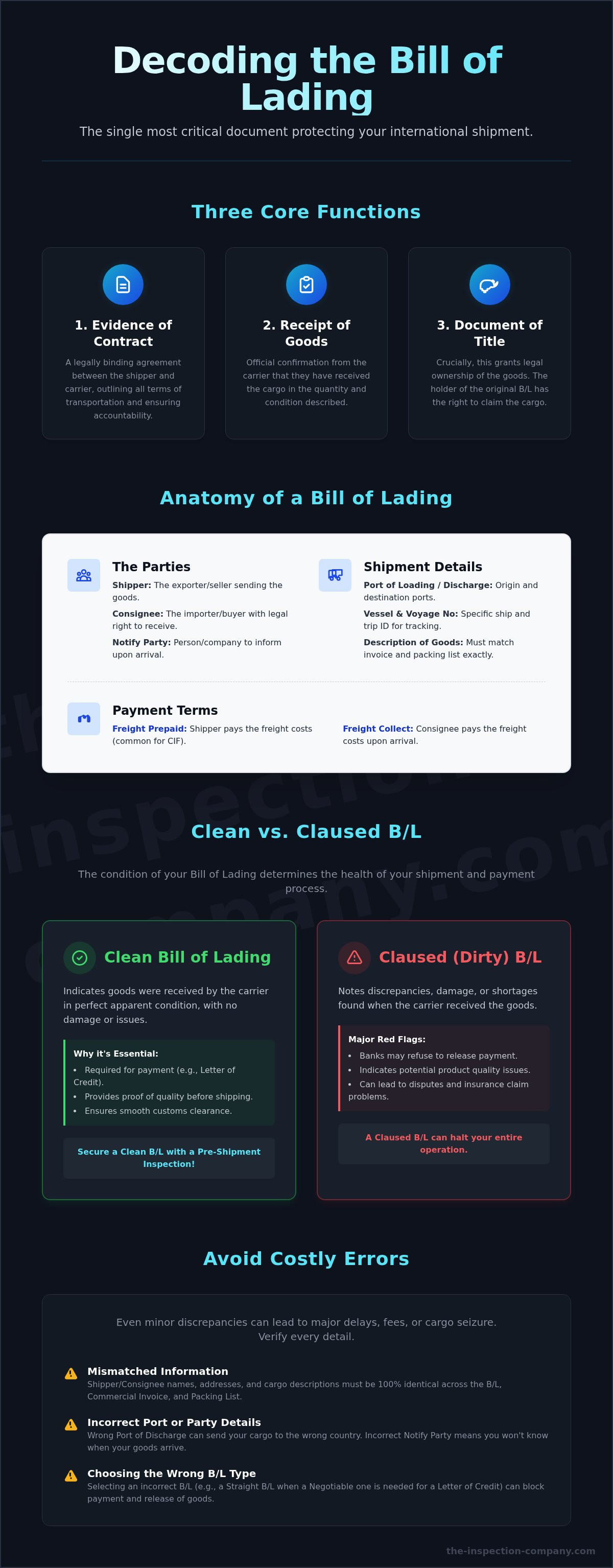
To fully grasp its importance, you must understand its three distinct and critical functions. Neglecting any one of these can expose your business to significant financial loss, delays, and legal disputes.
Function 1: Evidence of a Contract of Carriage
First, the B/L serves as formal evidence of the contract between the shipper and the carrier. It outlines all the terms and conditions for the transportation of goods from the port of loading to the port of discharge. This legally obligates the carrier to deliver your cargo to the specified destination according to the agreed-upon route and handling instructions, ensuring accountability throughout the journey.
Function 2: Receipt of Goods
Second, the B/L acts as the carrier's official receipt, confirming they have taken possession of your goods. Crucially, it notes the apparent condition and quantity of the cargo at the time of loading. A "Clean" B/L indicates the goods were received without any visible damage or issues. A "Claused" or "Dirty" B/L, however, notes discrepancies, which can create major problems for payment and insurance claims.
Function 3: Document of Title to the Goods
Finally, and most critically, the bill of lading functions as a document of title. This means that the legal owner of the goods is the person who holds the original B/L. This feature is essential for securing payment through methods like a Letter of Credit, as banks will not release funds until the correct B/L is presented. Because ownership can be transferred by endorsing the document, it is considered a negotiable instrument, central to the flow of global commerce.
Decoding the Bill of Lading: Key Information Explained
A bill of lading is far more than a simple shipping receipt; it is a legally binding contract between the shipper and the carrier. Understanding the legal definition of a bill of lading is the first step in recognizing its power as a document of title, giving the holder the right to claim the goods. Accuracy is paramount. Every field serves a critical purpose, and any discrepancy can halt your shipment in its tracks.
[Visual Example: A sample Ocean Bill of Lading with key sections like Shipper, Consignee, Port of Loading, and Goods Description clearly annotated.]
To mitigate risk, importers must meticulously verify the information presented. Let's break down the essential components you will find on this critical document.
The Parties: Shipper, Consignee, and Notify Party
These fields identify the key stakeholders in the shipment. It is essential that the names and addresses are spelled correctly and match all other commercial documents.
-
Shipper (or Exporter): The party sending the goods. This is typically the seller or manufacturer.
-
Consignee: The party who has the legal right to receive the goods. This is usually the importer or buyer. The goods will not be released to anyone else.
-
Notify Party: The person or company to be informed when the shipment arrives at its destination. This is often the consignee or their customs broker.
The Shipment Details: Ports, Vessel, and Cargo
This section provides the logistical and physical details of the shipment. Any mismatch with the actual cargo can lead to customs inspections and severe penalties.
-
Port of Loading & Port of Discharge: The origin and destination ports that define the shipment's journey.
-
Vessel and Voyage Number: The specific ship and its unique trip number used for tracking the cargo.
-
Description of Goods, Weight, and Dimensions: This information must be an exact match to the details on the Commercial Invoice and Packing List.
The Terms: Freight Prepaid vs. Freight Collect
This indicates who is responsible for paying the shipping costs. This term is directly linked to the Incoterms agreed upon in your sales contract.
-
Freight Prepaid: The shipper has paid for the freight costs. This is common for Incoterms like CIF (Cost, Insurance, and Freight).
-
Freight Collect: The consignee is responsible for paying the freight costs upon arrival. This is often used with Incoterms like FOB (Free On Board).
A single typo in a container number or an incorrect weight can trigger a customs hold, leading to costly demurrage fees and significant supply chain disruptions. Verifying every detail on your bill of lading isn't just paperwork; it's an essential act of risk management to ensure your goods arrive without costly surprises.
Types of Bills of Lading: Which One Do You Need?
A bill of lading is not a one-size-fits-all document; its form dictates control, ownership, and financial risk for your shipment. Selecting the correct type is a critical decision that depends on your relationship with the supplier, your payment terms, and whether you intend to sell the goods while they are in transit. Understanding the various Types of Bills of Lading is essential for any importer to ensure their shipment is secure and their commercial interests are protected. The most common types can be grouped by consignee, carrier method, and release method.
Based on Consignee: Straight vs. Order Bill of Lading
This distinction determines who can legally receive the cargo and is fundamental to managing risk, especially when sourcing from Asia.
-
Straight Bill of Lading (Non-negotiable): This B/L is issued to a specific, named consignee. The cargo can only be released to this party upon proof of identity. It offers maximum security but no flexibility, making it ideal when goods are fully paid for and there is no plan to resell them during transit.
-
Order Bill of Lading (Negotiable): Issued "to the order of" a specific party, this document is a title of goods that can be endorsed and transferred to a third party. This flexibility is crucial for trade financing or for selling goods while they are still at sea. However, it requires careful handling to prevent loss or fraud.
Based on Carrier Method: Ocean, Air Waybill, Multimodal
The transport mode dictates the type of document used:
-
Ocean Bill of Lading: The standard document for goods transported by sea, serving as a contract, receipt, and potentially a document of title.
-
Air Waybill (AWB): Used for air freight. Unlike an Ocean B/L, an AWB is always non-negotiable and does not confer title to the goods.
-
Multimodal Bill of Lading: Covers a shipment across two or more modes of transport (e.g., sea and then rail) under a single contract.
Based on Release Method: Original B/L vs. Express Release
This choice balances speed against security. For importers, this is a frequent point of negotiation with suppliers.
-
Original Bill of Lading: The carrier issues three original B/Ls. To claim the cargo, the consignee must present at least one of these physical documents at the destination port. This method provides the highest level of security, as it ensures the goods are not released until the documents (and often, final payment) are in the right hands.
-
Express Release (or Telex Release): A digital instruction from the carrier's origin office to the destination office, authorizing cargo release to the consignee without needing an original B/L. It is faster and avoids courier fees. However, it should only be used when you have a high level of trust with your supplier and have already paid for the goods in full. Using an Express Release before payment is complete removes your primary leverage over the shipment.
Clean vs. Claused Bill of Lading: The Link to Pre-Shipment Inspection
Not all Bills of Lading are created equal. The condition of your goods when they are handed to the carrier directly determines the type of bill of lading you receive, which can have significant financial consequences. For importers, the goal is always to secure a 'Clean' B/L. Understanding the difference is essential to protecting your investment and ensuring a smooth supply chain.
What Makes a Bill of Lading 'Clean'?
A Clean Bill of Lading is issued by a carrier when the goods are received in apparent good condition, with no damage or shortages observed. It is the gold standard in international shipping. A Clean B/L confirms:
-
The goods were loaded in good order and condition.
-
The quantity and packaging match the description.
-
There are no clauses or negative remarks noted by the carrier.
This document is critical for hassle-free customs clearance and, most importantly, for securing payment. Banks financing a transaction under a Letter of Credit (L/C) will almost always require a Clean B/L to release funds to the supplier.
How a Failed Inspection Leads to a 'Claused' B/L
A 'Claused' or 'Dirty' Bill of Lading is a major red flag. It indicates that the carrier observed problems with the shipment upon receipt. If a Pre-Shipment Inspection (PSI) fails but the supplier ships the goods anyway, the carrier is obligated to note these defects. Examples of such clauses include:
-
"15 cartons crushed"
-
"Inadequate packaging"
-
"Quantity discrepancy noted"
Receiving a Claused B/L creates immediate problems. It signals that you are about to receive damaged or non-compliant goods, and a bank will almost certainly reject it under an L/C, halting payment and creating a severe dispute with your supplier.
Using Your Inspection Report to Ensure B/L Accuracy
A professional Pre-Shipment Inspection is your most effective tool to prevent a Claused B/L. Your detailed inspection report serves as objective proof of the shipment's condition before it leaves the factory. This gives you the leverage to demand your supplier fix any issues or to reject the shipment outright. By verifying quality at the source, you stop problems before your shipment sails.
This proactive step ensures that only compliant, quality goods are handed to the carrier, securing the Clean B/L you need for a successful import. Ensure a Clean B/L with a Pre-Shipment Inspection .
Common Bill of Lading Mistakes and How to Avoid Them
The bill of lading is the single most critical document for claiming your imported goods. An error on this document can transform a routine shipment into a costly logistical nightmare, leading to delays, fees, and even the total loss of your cargo. Mitigating these risks is essential for protecting your investment and ensuring a smooth supply chain.
Here are the most common and costly mistakes importers face and the practical steps you can take to avoid them.
Mistake 1: Inaccurate Information and Typos
Even a minor error-a single wrong digit in a container number or a misspelling of the consignee's name-can cause your shipment to be held by customs. The details on your bill of lading must perfectly match all other shipping documents, such as the commercial invoice and packing list. Correcting this information after the vessel has sailed is a complex and expensive process.
How to Avoid It: Implement a mandatory final document check before the shipment departs. Verify the draft B/L against your purchase order and packing list, paying close attention to:
-
Consignee and Notify Party names and full addresses.
-
Port of Loading and Port of Discharge.
-
Accurate cargo description, weight, and dimensions.
-
Correct container and seal numbers.
Mistake 2: Losing the Original Bill of Lading
A negotiable Original Bill of Lading is a document of title. Losing it is like losing the deed to your property. Without presenting the full set of originals to the carrier at the destination port, you cannot legally claim your cargo. The process to secure a replacement is incredibly slow and expensive, often requiring a bank guarantee for 150-200% of the cargo's value to indemnify the carrier against risk.
How to Avoid It: Treat original B/Ls with the same security as cash. Always use a reliable, tracked courier service. For established relationships with trusted suppliers, consider using a Telex Release or Sea Waybill to eliminate the need for physical documents entirely.
Mistake 3: Supplier Fraud and Withholding the B/L
An unscrupulous supplier may withhold the B/L to demand last-minute payments or force you to accept goods that failed inspection. They use the document as leverage, knowing that without it, your goods are stuck at the port and you are losing money every day.
How to Avoid It: Your best defense is proactive due diligence.
-
Clear Payment Terms: Structure your payment terms to release the final balance after you receive a copy of the B/L, proving the goods have shipped as agreed.
-
Supplier Vetting: The most effective way to prevent this is to verify your partners from the start. A comprehensive supplier audit before you place an order confirms the legitimacy, financial stability, and track record of a factory, significantly minimizing your risk of fraud.
Secure Your Shipment: From Bill of Lading to Final Delivery
Mastering the bill of lading is a non-negotiable skill for any successful importer. As this guide has shown, this document is far more than a simple shipping receipt-it is the legal title to your goods and a binding contract with your carrier. Understanding its nuances, from the different types to the critical importance of accuracy, is your first line of defense against costly delays, customs issues, and commercial disputes. Ultimately, the goal is always to secure a Clean Bill of Lading, which serves as proof that your goods were shipped in perfect condition.
But how can you be certain of that condition before it's too late? One day of inspection can save you months of trouble. Our independent Pre-Shipment Inspections provide the assurance you need. Backed by European management with over 25 years of experience and a network of 700+ inspectors across Asia, we deliver detailed reports within 24 hours so you can make informed decisions-fast. Don't risk your shipment. Book an inspection today and protect your investment .
Take control of your supply chain and import with confidence.
Frequently Asked Questions About the Bill of Lading
Who is responsible for issuing the Bill of Lading?
The carrier, which is the shipping line or vessel operator, or their authorized agent, is responsible for issuing the Bill of Lading. This critical document is provided to the shipper after the cargo has been loaded onto the vessel. It serves as an official receipt and the contract of carriage. To prevent costly customs delays and commercial disputes, it is essential to verify that all details on the bill of lading are accurate before the ship departs.
Can a Bill of Lading be changed after it has been issued?
Yes, but amending a Bill of Lading after it has been issued is a complex and often expensive process. Changes require formal approval from all parties involved, including the shipper and carrier, and carriers charge significant fees for amendments. To avoid these unnecessary costs and operational delays, you must ensure all information, such as consignee details, port names, and cargo descriptions, is 100% accurate before the document is finalized.
What is the difference between a negotiable and a non-negotiable Bill of Lading?
A negotiable Bill of Lading, also known as an "Order B/L," functions as a document of title to the goods. Ownership can be transferred to a third party by endorsing and delivering the original document. In contrast, a non-negotiable or "Straight B/L" consigns the goods to a specific named party who is the only entity that can claim them. A straight B/L cannot be used to transfer ownership to another party during transit.
What should I do if I lose the original Bill of Lading?
Losing an original, negotiable Bill of Lading is a serious problem that will prevent the release of your cargo. You must notify the carrier immediately. To get a replacement, the carrier will require a court order or a Letter of Indemnity (LOI) backed by a bank guarantee, often for 150-200% of the cargo's value. This process is expensive and slow, underscoring the importance of securely managing original shipping documents to mitigate financial risk.
What is a telex release or express release, and when should I use it?
An express release, often called a telex release, is a digital message sent by the carrier's origin office to its destination office. This message authorizes the release of cargo to the consignee without the need to present an original paper Bill of Lading. This method is faster and eliminates courier fees. It is ideal for situations where the shipper has already received full payment and a negotiable document is not required to secure the transaction.
How is a Bill of Lading different from a Sea Waybill?
The key difference is that a Bill of Lading can function as a document of title, while a Sea Waybill cannot. A negotiable B/L represents ownership and must be physically surrendered at destination to claim the cargo. A Sea Waybill, on the other hand, is simply a receipt and contract of carriage. Cargo is released to the named consignee upon proof of identity, making it a faster but less secure option for shipments between trusted parties.
Does the Bill of Lading prove ownership of the goods?
A B/L serves as strong evidence of the right to possession rather than absolute proof of ownership. A negotiable bill of lading acts as a "document of title," meaning the person who holds the original, properly endorsed document is entitled to claim the goods from the carrier. True legal ownership, however, is ultimately determined by the sales contract between the buyer and seller. The B/L is the key that controls the physical release of the cargo.