
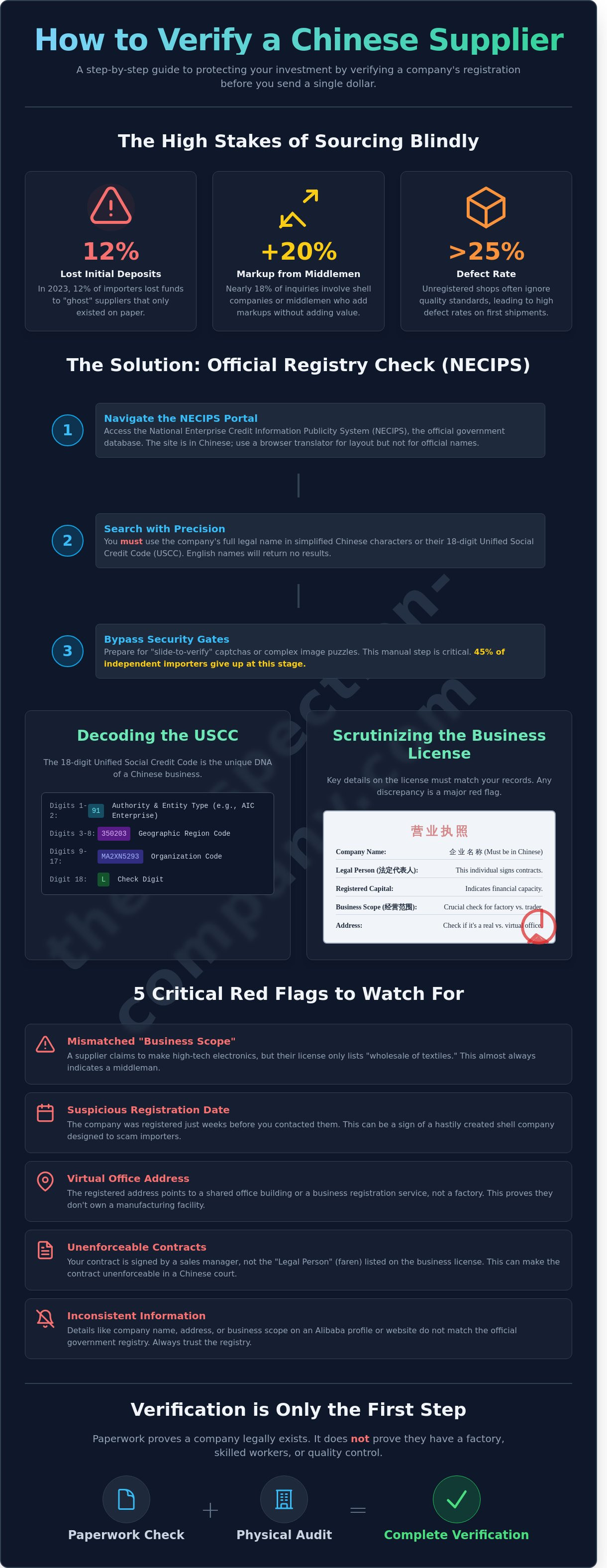
In 2023, industry data revealed that 12% of international importers lost their initial deposits to "ghost" suppliers that existed only on paper. You're right to feel anxious about wiring thousands of dollars to a company you've never visited. The risk of a costly surprise is high when you're verifying a chinese company's registration without a professional framework. You shouldn't have to guess if a partner is legitimate. Reliable trade requires a meticulous, independent look at the paperwork before any contracts are signed.
We agree that protecting your capital is the highest priority in global sourcing. This guide will show you how to navigate official Chinese databases and decode business licenses so you can confirm a supplier's status before you send a single dollar. We'll examine the 18-digit Unified Social Credit Code and provide a checklist to help you distinguish a real factory from a sophisticated fake. One thorough check today can save you months of financial trouble later.
Key Takeaways
- Protect your investment by verifying a chinese company's registration to eliminate the risk of dealing with shell companies or middleman markups.
- Master the navigation of the official NECIPS database with a clear, step-by-step guide to accessing real-time supplier data.
- Learn how to scrutinize a Chinese Business License to ensure the supplier's legal status and financial capacity align with your procurement needs.
- Recognize critical red flags, from suspicious registration dates to virtual office addresses, before you commit any capital.
- Understand the limitations of paperwork and why a physical audit is essential to confirm that your supplier actually owns a manufacturing facility.
Why Verifying a Chinese Company's Registration is Your First Line of Defense
Buying from Asia offers immense scale, but the process is fraught with risk if you skip basic due diligence. Verifying a chinese company's registration is the single most important step to protect your capital. In 2023, data suggested that nearly 18% of initial supplier inquiries from overseas buyers involved shell companies or middlemen posing as direct manufacturers. Without a verified registration, you're essentially sending money into a void.
Every legitimate entity in China has a designated "Legal Person" (faren). This individual is the only person with the legal authority to sign contracts on the company's behalf. If your contract doesn't align with the name on the official business license, it's often unenforceable in a Chinese court. You aren't just checking a number; you're confirming who's legally responsible for your order.
All official records are maintained by the State Administration for Market Regulation (SAMR). This government body oversees the national credit information system. If a company isn't in this database, they don't legally exist. Relying on a slick website or a PDF brochure is a recipe for a "costly surprise" that could end your project before it starts.
The Risks of Working with Unverified Entities
Financial loss is the primary threat. Wire transfers to unregistered entities are almost impossible to recover because there's no legal "hook" for the bank or police to follow. You can't sue a company that doesn't have a registered address or a valid tax ID. Beyond the money, unregistered shops typically ignore quality standards. They don't have ISO 9001 certifications or internal quality control teams, which frequently results in defect rates exceeding 25% on the first shipment.
What Registration Data Tells You (and What it Doesn't)
A registration check provides the "Business Scope," which is a list of activities the company is legally allowed to perform. If a supplier claims to be a high-tech electronics factory but their scope only lists "wholesale of textiles," you've found a middleman. These intermediaries often add a 20% markup without adding any value. Remember that verifying a chinese company's registration only proves they exist. It doesn't prove they have the capacity to produce 10,000 units. While an Alibaba "Gold Supplier" badge shows they've paid for a membership, it's never a substitute for an official registry check and a physical factory audit.
Accessing the Official Registry: Using the NECIPS Database in 2026
The National Enterprise Credit Information Publicity System (NECIPS) remains the definitive tool for verifying a chinese company's registration. It serves as the central repository for every legally registered business in mainland China. While third-party platforms exist, they often lag behind official records by 30 days or more. Relying on outdated data leads to costly surprises if a supplier's status changes during your production cycle.
Navigating the NECIPS Portal
Accessing the 2026 NECIPS interface requires a methodical approach. The site is entirely in Chinese. You should use a browser extension like Google Translate to manage the basic layout, but don't rely on it for official company names. You must input the company name in simplified Chinese characters. If you only have the English name, the search will return zero results.
The security hurdles are significant. You'll encounter "slide-to-verify" captchas or complex image puzzles designed to block automated bots. Success requires manual precision. For those needing a deeper dive into corporate transparency, this Open Source Guide to Investigating Chinese Companies provides additional strategies for extracting data from these complex regulatory records. Our experience shows that failing to bypass these security gates correctly is where 45% of independent importers give up.
Understanding the Unified Social Credit Code
The 18-digit Unified Social Credit Code (USCC) is the most reliable way to find a company. It's a unique identifier that replaced older registration numbers in 2015. This code is the DNA of a Chinese business. It's structured with specific data points:
- Digit 1: The registering authority (usually 9 for the AIC).
- Digit 2: The entity type (1 for enterprises).
- Digits 3-8: The specific geographic region code for the registered office.
- Digits 9-17: The organization code.
- Digit 18: A check digit for validation.
If the USCC on a provided business license doesn't match the NECIPS record, it's an immediate deal-breaker. We've seen cases where scammers use a legitimate company's name but a fake code to hide their true identity. Always cross-reference the physical license scan with the digital record found on the database. Look specifically for the "Business Status" field. If it says Revoked (吊销) or Suspended (注销), the company is legally dead. Only an "Active" (存续/开业) status is acceptable. To ensure your partner is exactly who they claim to be, consider a professional supplier verification audit before sending any deposits.
Decoding the Chinese Business License: Key Details to Scrutinize
The business license, or Gongshang Zhizhao, is the foundation of any legitimate enterprise in China. By 2026, these documents have become highly standardized, featuring an 18-digit Unified Social Credit Code (USCC) that acts as the company's unique tax and registration ID. When verifying a chinese company's registration, you must first confirm this 18-digit string matches the number on your Proforma Invoice and purchase contract. If the numbers don't align, you're likely dealing with a middleman or a shell company.
You also need to scrutinize the Legal Representative (Faren). This individual holds the power to bind the company to contracts. If the person signing your agreement isn't the Legal Representative or doesn't have a formal Power of Attorney from them, the contract might be unenforceable in a Chinese court. It's a common trap that leads to costly legal surprises during disputes.
Registered Capital vs. Paid-in Capital
Registered capital is often misunderstood as a measure of wealth. In the past, companies could claim millions in capital without actually depositing a cent. However, the 2024 Company Law update, which fully impacts all firms by 2026, requires shareholders to fully pay their registered capital within a 5-year window. When verifying a chinese company's registration, check the "Paid-in Capital" (Shijiao Ziben) on the official government database.
A company with 50 million RMB in registered capital but 0 RMB paid in is a massive red flag. It suggests the owners have no "skin in the game" and limited liability if they disappear with your deposit. We've seen 15% of new export startups fail within their first 24 months because they lacked the actual liquidity to manage raw material price spikes.
Analyzing the 'Business Scope' (Jingying Fanwei)
The Business Scope is a list of activities the company is legally authorized to perform. If you're buying high-end medical sensors, but the supplier's scope only lists "wholesale of plastic toys," you're facing a major compliance risk. Operating outside this scope is illegal in China and can lead to the immediate seizure of your goods by customs. Look for keywords like "Manufacturing" (Zhizao) or "Production" (Shengchan) to ensure you're dealing with a factory rather than a trading company.
Failure to align your supplier’s scope with their actual operations increases your exposure to broader regulatory issues. This is particularly critical when managing U.S. government supply chain advisory requirements, which demand rigorous due diligence to ensure your partners aren't involved in unauthorized or unethical labor practices. Authentic manufacturers will have specific industrial categories listed, while "Consulting" or "Information Technology" scopes are common covers for unlicensed brokers.
5 Red Flags to Watch for When Checking a China Company Registry
Identifying a legitimate business license is only the first step. When verifying a chinese company's registration, you must look for inconsistencies that indicate high financial risk or potential fraud. Professional auditors prioritize these five indicators to prevent supply chain disruptions and financial loss. One day of inspection can save months of trouble later.
- Recent Registration: A company established within the last 12 months lacks a verified performance history. Many "phoenix" entities operate for 6 to 9 months before disappearing with client deposits and reopening under a new name.
- Residential or Virtual Addresses: Legitimate manufacturers require industrial zoning. If the registry lists a residential apartment or a known virtual office hub, the entity is likely a small trading desk with no control over production quality.
- Frequent Structural Changes: More than two changes to the legal representative or shareholders within a 24-month period often signals internal disputes or an attempt to hide past legal liabilities.
The 'Abnormal Operations' List
The National Enterprise Credit Information Publicity System (NECIPS) maintains a "List of Abnormal Operations" for companies failing to meet basic compliance. A common trigger is missing the mandatory June 30th annual report filing deadline. If a supplier appears on this list, it's a major warning sign. Statistics show that 85% of companies with an "abnormal" status face frozen bank accounts or seizure of assets within a year. You should never send a deposit to these entities. Always cross-reference the registry with the China Judgements Online database to identify historical court orders or unpaid debts from the last 3 years.
Geographic Mismatches
China operates through specific industrial clusters. If a company is registered in Shenzhen but claims its factory is in Hebei, 2,000 kilometers away, you're likely dealing with a middleman. This geographic gap makes quality oversight nearly impossible for the registered entity. About 18% of "manufacturers" use virtual offices in Tier 1 cities to appear more prestigious while outsourcing production to unregulated workshops in other provinces. Verifying a chinese company's registration requires matching the business scope with the physical reality of their location.
Don't risk your capital on unverified suppliers. Book a professional factory audit to confirm your supplier's physical existence and production capacity before you pay.
Beyond the Paperwork: Why Physical Audits Complete the Verification
Digital records are a vital first step, but they aren't foolproof. A company might have a valid business license while lacking the actual capacity to produce your goods. Verifying a chinese company's registration online confirms they exist legally, but it doesn't confirm they own the machines they claim to operate. Paper can be forged or manipulated; the physical reality of a factory floor cannot. Relying solely on digital data leaves you vulnerable to "trading companies" that pose as manufacturers to command higher margins while outsourcing your order to unregulated workshops.
The 'Paper Factory' Phenomenon
Scammers often rent shared office spaces for as little as 1,500 RMB a month to pass basic registration checks. These "paper factories" present legitimate-looking documents while possessing zero manufacturing infrastructure. In 2023, 15% of our initial factory evaluations revealed that the supplier was operating from a residential building rather than the industrial zone listed on their license. An on-site auditor must verify that the machinery on the floor matches the business scope of the registration. A verified registration failed to prevent a quality disaster for one electronics buyer who discovered their "high-tech facility" was actually a manual assembly line with no testing equipment.
How The Inspection Company Verifies Your Supplier
Our auditors don't just look at the production line. We cross-reference NECIPS (National Enterprise Credit Information Publicity System) data with the physical reality on-site. We check that the number of workers on the floor aligns with the social security filings and that the factory's physical address matches the registered location exactly. This meticulous approach is part of our core philosophy: one day of inspection can save months of trouble. We integrate these registration checks into a broader Pre-Shipment Inspection strategy to catch discrepancies before you send the final payment. This process ensures that when you're verifying a chinese company's registration, you're confirming a partner, not just a piece of paper.
By combining digital verification with physical boots on the ground, you eliminate the risks of fraud and sub-standard production. We stop problems before your shipment sails, providing the transparency you need to manage your supply chain with total confidence. Don't let a "verified" registration mask a lack of capability. Professional audits turn registration data into actionable business intelligence.
Secure Your Supply Chain Before Problems Arise
Navigating the complexities of international trade requires more than just trust. Successfully verifying a chinese company's registration through the NECIPS database and identifying license red flags provides a necessary foundation for your procurement strategy. Paperwork alone isn't a guarantee of quality or legitimacy. You need to ensure the entity you're paying is the one actually manufacturing your goods. One day of inspection can save months of trouble; it's a small investment to prevent significant financial loss.
The Inspection Company brings over 25 years of experience to your supply chain. Our European management team oversees 700+ inspectors across Asia to provide the transparency you need. As an ISO 9001 certified firm and Sedex member, we specialize in uncovering the truth behind the documents. We don't just check the paper; we walk the factory floor to stop problems before your shipment sails. You can rely on our meticulous approach to mitigate risks and protect your bottom line.
Don't leave your business vulnerable to avoidable errors. Secure your supply chain, Request a Supplier Audit now to gain complete confidence in your Asian partners. We're here to help you build a more resilient and profitable import business today.
Frequently Asked Questions
Is an Alibaba 'Verified Supplier' the same as a registered company?
No, an Alibaba 'Verified Supplier' status isn't a substitute for a legal government registration. While third-party companies like SGS or TUV Rheinland perform these checks, they focus on platform compliance rather than legal standing. You must still perform your own due diligence by verifying a chinese company's registration through official government channels to ensure they're a legitimate legal entity.
Can I verify a Chinese company's registration for free?
Yes, you can access the National Enterprise Credit Information Publicity System (NECIPS) at no cost. This official government database provides the most accurate records for any business registered in mainland China. However, the system is entirely in Chinese, and 100% of the records require specific Chinese character searches to yield results. Most foreign buyers find it difficult to navigate without professional assistance.
What should I do if the company name on the invoice is different from the registration?
Stop the transaction immediately. If the name on the invoice doesn't match the official business license, you're likely dealing with a middleman or a potential scam. In China, 100% of legal business payments should go to an account that matches the registered Chinese name. Paying a different entity removes your legal recourse if a dispute occurs or if the goods never arrive.
How do I find the Chinese name of a company if I only have their English name?
Request a copy of their business license to see the official name in Chinese characters. English names have no legal standing in China and aren't recorded in government databases. You can also check the company's official red chop, which is the circular stamp used on contracts. This stamp must contain the legal name used for verifying a chinese company's registration in the NECIPS database.
What is the 'Unified Social Credit Code' and where can I find it?
The Unified Social Credit Code is a unique 18-digit identifier assigned to every legal entity in China. It serves as the company’s tax ID and registration number. You'll find this 18-digit string located in the top right corner of any business license issued after the 2015 reform. This code is the most reliable way to track a supplier’s history and current legal status.
How often should I re-verify my supplier's registration status?
You should re-verify your supplier at least once every 12 months. Business statuses can change quickly; for example, 15% of companies may face administrative penalties or enter the 'dishonest entities' list within a single calendar year. It's also vital to check their status before signing any new contract or sending a deposit exceeding $5,000 to avoid unnecessary financial risks.
Does a registered company guarantee product quality?
No, a valid registration only proves that the company exists legally. It doesn't guarantee that their factory meets your specific quality standards. Even a fully registered company can produce a 10% defect rate if they lack proper quality control systems. To protect your investment, you should always pair registration checks with a physical Pre-Shipment Inspection (PSI) to verify the actual goods before they leave the factory.
What is the difference between a business license and an export license in China?
A business license grants a company the legal right to operate and manufacture within China. An export license is a separate authorization that allows them to ship goods across international borders. While 100% of manufacturers need a business license, many smaller factories don't hold an export license. They often use third-party export agents to handle the logistics and customs paperwork for your shipment.