
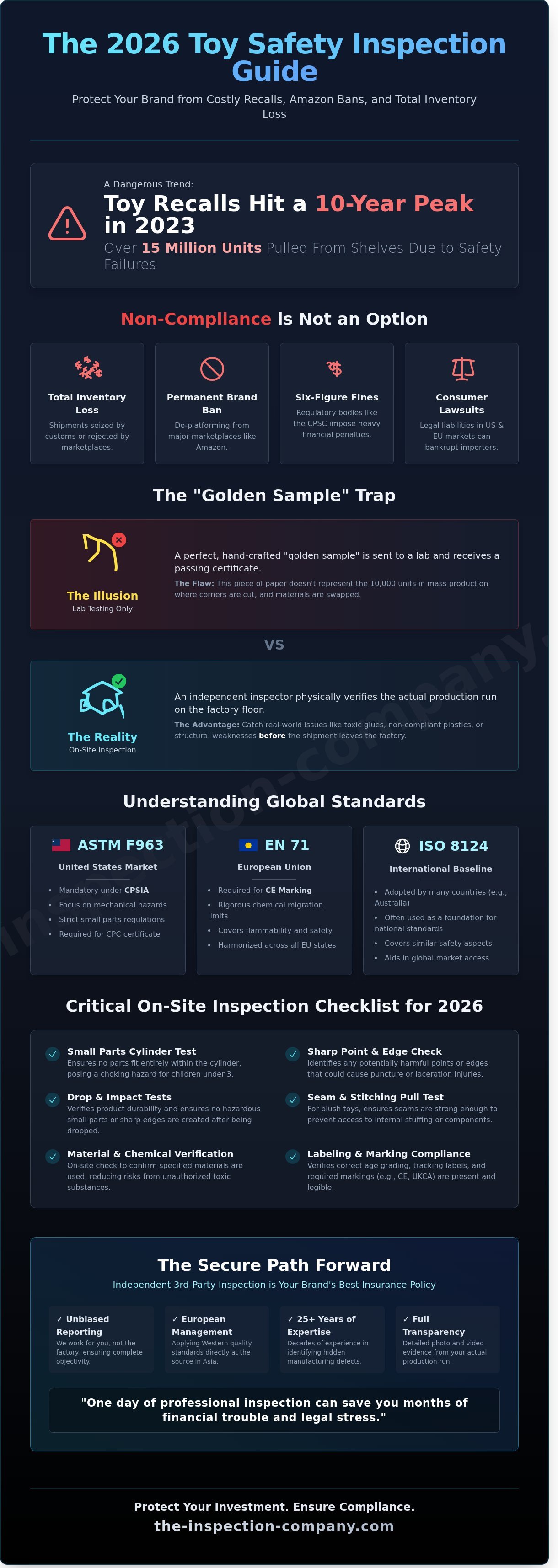
What if the compliance certificate your supplier just emailed is the exact reason your shipment gets rejected by Amazon FBA? In 2023, toy recalls hit a 10-year peak with over 15 million units pulled from shelves due to safety failures. It's a high-stakes environment where a single error in toy safety inspection requirements can lead to total inventory loss or a permanent brand ban. You likely feel the pressure of balancing tight deadlines with the fear of unreliable factory self-reporting.
We'll help you master the complex 2026 regulatory landscape to ensure your products reach the market safely. This guide provides a clear checklist of mandatory physical and chemical tests, an explanation of CPC and CE marking, and a reliable verification process. You'll learn how to stop problems before your shipment sails and secure your brand's reputation. One day of professional inspection can save you months of financial trouble and legal stress.
Key Takeaways
- Protect your business from total de-platforming by understanding why strict compliance is the only way to safeguard your brand in 2026.
- Navigate the complexities of international standards like ASTM F963 and EN71 to ensure your products meet mandatory benchmarks for global markets.
- Identify the critical gap between laboratory testing and factory-floor reality to prevent passed lab samples from becoming failed shipments.
- Master the essential toy safety inspection requirements through a comprehensive 2026 checklist that includes vital on-site physical tests like the small parts cylinder analysis.
- Streamline your path to market by learning how to coordinate Children’s Product Certificates (CPC) and supplier logistics for seamless Amazon compliance.
Why Toy Safety Inspection Requirements Are Non-Negotiable in 2026
Toy safety inspection requirements define the legal and technical benchmarks for any product intended for children under 14. These aren't optional guidelines; they're mandatory protocols that dictate whether your inventory reaches the customer or ends up in a landfill. By 2026, global regulators have tightened the screws on importers. A single shipment found with high lead content or small parts violations can trigger an immediate account suspension on platforms like Amazon, where 70% of toy searches begin. You can't afford to treat compliance as an afterthought when one non-compliant shipment can lead to total brand de-platforming.
Many sellers fall into the "Golden Sample" trap. They send a perfect, hand-crafted prototype to a lab and receive a passing certificate. This doesn't guarantee the safety of mass-produced goods. During a production run of 10,000 units, factory workers might swap a compliant glue for a cheaper, toxic alternative to save 2% on costs. Without on-site verification, you're gambling your brand's future on a piece of paper that doesn't represent the actual cargo. Mass production is where the real risks live.
Current 2026 regulatory trends show a 40% increase in scrutiny regarding chemical migration and sustainable materials. The transition to bio-plastics and recycled resins introduces new risks. These materials often behave differently under heat or stress, potentially leaching chemicals that violate Toy safety standards such as EN 71 or ASTM F963. To stay competitive, you must ensure your toy safety inspection requirements cover these evolving chemical benchmarks.
The High Cost of Non-Compliance
Ignoring the law isn't a defense when US Customs and Border Protection (CBP) seizes your container at the border. In 2025, the CPSC reported a 15% rise in toy-related recalls, often resulting in six-figure fines and total loss of inventory. Beyond the immediate financial hit, a recall destroys retailer trust. Once a brand is flagged for safety violations, getting back into major retail chains or onto digital marketplaces becomes nearly impossible. Legal liabilities from consumer lawsuits in the US and EU markets can bankrupt a mid-sized importer within months. It's a risk that isn't worth taking.
Risk Mitigation Through Independent Inspection
Factory "self-inspections" are a conflict of interest that savvy importers don't accept. A manufacturer's priority is meeting shipping deadlines, not finding defects that require rework. Independent third-party inspectors provide the unbiased data you need to make an informed "ship or no-ship" decision. We provide a clear path to security through:
- Unbiased Reporting: We work for you, not the factory.
- European Management: Western quality standards applied directly to Asian manufacturing hubs.
- Expertise: Over 25 years of experience identifying hidden defects.
- Transparency: Detailed photo and video evidence of your actual production run.
One day of inspection can save months of trouble. We stop problems before your shipment sails, ensuring your products meet every toy safety inspection requirements metric before you pay the final balance. Avoid costly surprises by putting a professional pair of eyes on the factory floor. It's the only way to protect your investment and your customers.
Understanding Global Standards: ASTM F963, EN71, and ISO 8124
Global trade requires a clear grasp of three regulatory pillars. ASTM F963 governs the United States; EN71 dictates access to the European Union; and ISO 8124 serves as the international baseline. Failing to meet these specific toy safety inspection requirements leads to seized shipments, heavy fines, and irreparable brand damage. Each framework addresses physical, mechanical, chemical, and flammability risks with varying levels of stringency. Professional importers don't view these as optional suggestions; they're the minimum barrier to entry for any viable consumer market.
The ASTM F963 standard is the gold standard for US compliance. It became a mandatory federal rule under the Consumer Product Safety Improvement Act (CPSIA) of 2008. While ASTM F963 focuses heavily on mechanical hazards and small parts, EN71 is often cited for its rigorous chemical migration limits. ISO 8124 acts as a bridge, frequently adopted by markets like Australia or used as a foundation for national standards in emerging economies. One day of inspection can save months of trouble by identifying non-compliant components before they reach the port.
US Market: CPSC and ASTM F963 Requirements
Success in the US market hinges on CPSC (Consumer Product Safety Commission) oversight. All toys intended for children aged 12 and under must undergo mandatory third-party testing at a CPSC-accepted laboratory. This process verifies that lead content in accessible substrates stays below 100 ppm, while lead in paint or surface coatings is capped at a strict 90 ppm. Additionally, the law restricts eight specific phthalates to concentrations no higher than 0.1%.
- Tracking Labels: Section 14(a)(5) of the CPSA requires a permanent tracking label on the product and packaging. It must display the manufacturer name, production location, and date.
- Small Parts: Any toy for children under 3 must pass the "small parts" cylinder test to prevent choking hazards.
- Battery Safety: Battery compartments for button cells must be secured with a screw or similar tool to prevent accidental ingestion.
EU Market: CE Marking and the Toy Safety Directive
Selling in the EU requires the CE Mark, which signals compliance with Directive 2009/48/EC. This framework is famously strict regarding chemical composition. EN 71-3 regulates the migration of 19 restricted heavy metals, including aluminum, antimony, and arsenic. If your plush toy or costume fails the EN 71-2 flammability test, it's considered a high-risk defect. Under this standard, flames must not spread faster than 30 mm per second across the material surface.
Importers must maintain a comprehensive technical file for 10 years after the toy is placed on the market. This file includes the EC Declaration of Conformity and detailed test reports for every component. It's a heavy administrative burden, but it's the only way to avoid costly surprises during customs audits. Sellers should verify their compliance and quality control protocols with an independent partner before goods leave the factory floor.
ISO 8124 provides the international benchmark for markets without unique national codes. It mirrors many ASTM and EN requirements, covering mechanical properties and flammability. This standard is updated frequently, with the most recent physical property changes occurring in 2023. By aligning production with these three frameworks, you ensure your toy safety inspection requirements are met regardless of the destination. Reliability in this sector isn't about luck; it's about meticulous adherence to these established global benchmarks.
Lab Testing vs. On-Site Inspection: Why You Need Both
Sellers often mistake a laboratory test report for a final guarantee of quality. While a lab certificate proves your design meets toy safety inspection requirements, it only reflects the specific samples sent to the technician. It does not account for the 5,000 units currently moving down a high-speed assembly line. You need both lab testing and on-site inspection to bridge the gap between a perfect prototype and a compliant shipment.
The laboratory acts as the scientific gatekeeper. It identifies microscopic risks that no human eye can detect. Conversely, the on-site inspector acts as your eyes and ears on the factory floor, ensuring the mass-produced goods match the approved gold sample. Relying on one without the other creates a blind spot that leads to customs seizures or, worse, consumer injury lawsuits.
What Lab Testing Covers
Laboratories focus on the "invisible" compliance factors. Using specialized equipment like mass spectrometers, technicians verify chemical limits. For instance, the Consumer Product Safety Improvement Act (CPSIA) mandates that lead content in accessible parts must not exceed 100 ppm. A lab also conducts advanced flammability tests in controlled chambers and simulates long-term aging to see if plastic becomes brittle and breaks into sharp shards after 180 days of simulated use. These tests require environments and equipment that simply don't exist in a standard manufacturing facility.
What On-Site Inspectors Catch
On-site inspectors focus on the "visible" execution of the production run. They catch workmanship defects like loose seams on plush toys or sharp metal burrs on plastic edges. According to 2023 CPSC recall data, approximately 15% of toy recalls were caused by mechanical hazards that developed during mass production, not during the design phase. Inspectors also perform carton drop tests to ensure the packaging survives the 45-day transit from Asia to your warehouse. They verify that the mandatory tracking labels and age-grading icons are printed correctly, avoiding costly re-labeling fees at the port of entry.
Material substitution is a frequent risk in high-volume manufacturing. A factory might submit a high-quality, phthalate-free sample to the lab for certification but then use cheaper, recycled plastic for the actual production to save 8% on material costs. An on-site inspector prevents this by pulling random samples from the finished lot and comparing them directly to the lab-tested specifications. This ensures the toy safety inspection requirements are met by the entire batch, not just the "showcase" items.
Think of it through this lens: the lab confirms the recipe is safe, while the inspector confirms the chef didn't burn the meal. If an inspector finds a 4% defect rate in the battery compartments of electronic toys, you can stop the shipment before it leaves the dock. Once the goods are on the water, your leverage over the supplier disappears. This is why we maintain that one day of inspection can save months of trouble. It's a small investment that protects your brand's reputation and your bottom line from the catastrophic costs of a product recall or a permanent ban from major retail platforms.
- Lab Testing: Validates chemical composition and design safety.
- On-Site Inspection: Validates consistency, workmanship, and packaging.
- The Result: Total risk mitigation and full regulatory compliance.
Don't leave your compliance to chance. A lab report is a snapshot of potential, but an inspection report is a snapshot of reality. By integrating both into your supply chain, you ensure that every toy you sell is as safe as the one you tested.
The 2026 Toy Safety Inspection Checklist: Critical On-Site Tests
The 2026 regulatory landscape for toy safety inspection requirements demands zero tolerance for manufacturing errors. Our inspectors arrive at the factory with calibrated equipment to ensure your shipment meets international standards before it leaves the dock. We focus on the most common causes of recalls: physical hazards and electrical failures. One day of inspection can save months of trouble and protect your brand from devastating liability claims.
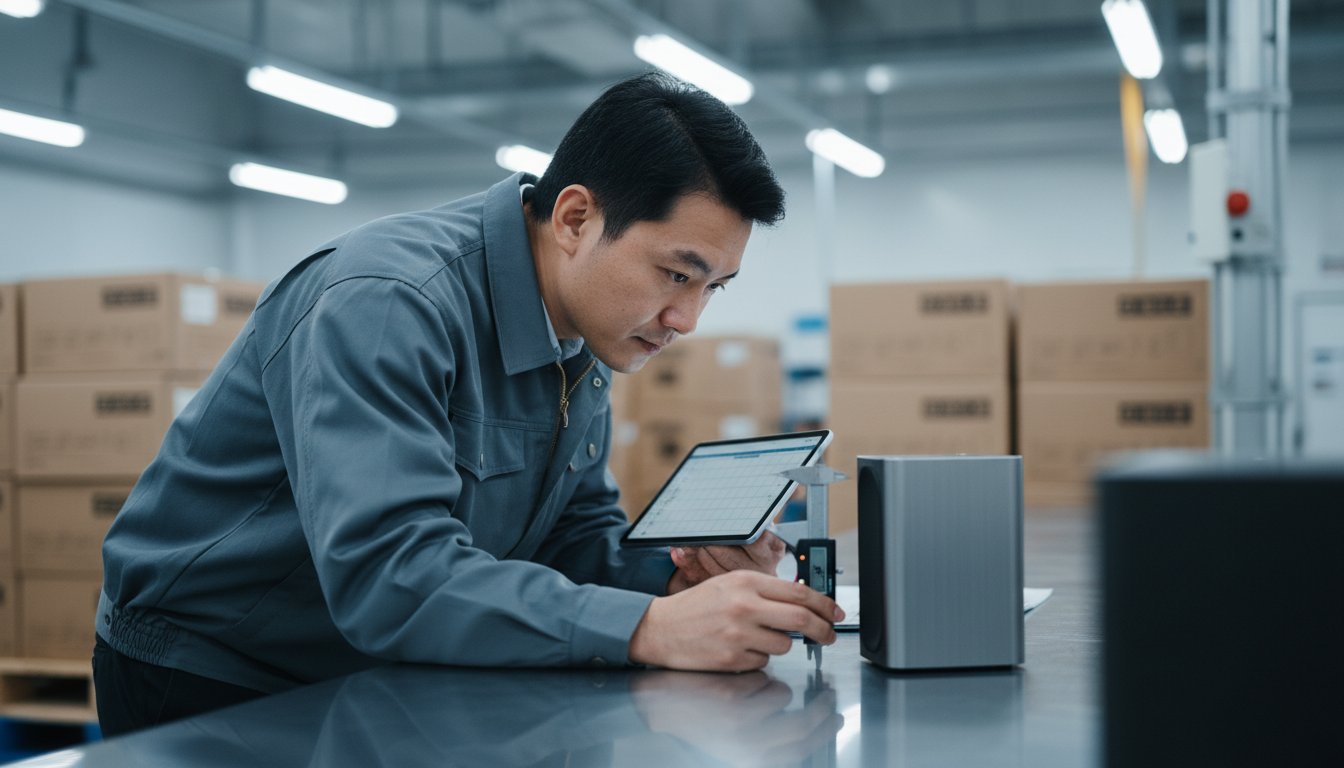
Our on-site protocols are designed to identify defects that a factory's internal QC might overlook. We use standardized testing equipment to simulate years of play in just a few minutes. If a product fails any of these critical tests, we document the defect with high-resolution photos and detailed descriptions in your report.
- Small Parts (Choke Tube) Test: We use a 31.7mm (1.25 inch) truncated cylinder to simulate a child's throat. If any component, or a part broken during "abuse" testing, fits entirely inside this tube, the product fails. This is a non-negotiable safety standard for toys intended for children under 36 months.
- Tension and Torque Tests: We verify that eyes, buttons, and limbs can't be pulled off. Our inspectors apply a force of 70 Newtons (15.7 lbs) for 10 seconds. For protruding parts, we apply a torque of 0.45 Newton-meters. If a component detaches, it's a choking hazard that leads to immediate shipment rejection.
- Drop Test: We simulate the "abuse" a toy takes by dropping it 10 times from a height of 137cm (4.5 feet) onto a tile-over-concrete surface. This test is mandatory for toys weighing less than 1.4kg. We don't just look for cracks; we check for sharp shards or exposed internal mechanisms that could cut a child.
Mechanical and Physical Property Tests
Compression tests apply 136kg (300 lbs) of pressure to ride-on toys to simulate a child sitting or jumping on the product. For toys with metallic frames, we perform flexure testing by bending the tubing through 30 cycles to ensure the metal doesn't snap or create jagged points. We also use a sharp edge tester, which is a rotating mandrel covered in specialized TFE tape, to verify that no point or edge can pierce a child's skin during normal use.
Electrical and Battery Safety Checks
Battery safety is a primary concern for 2026 compliance. We verify that all battery compartments are secured by a locking mechanism that requires a tool, like a screwdriver, to open. Our inspectors perform short-circuit tests by running the toy at maximum capacity for 4 hours. If temperature rises exceed 25°C above the room's ambient temperature, the design is flagged as a fire risk. We also confirm that polarity (+/-) and battery types are permanently engraved or embossed on the casing to prevent user error.
Navigating Compliance for Amazon Sellers and Importers in Asia
Amazon's compliance algorithms are unforgiving. If you're importing toys from China, Vietnam, or India, meeting the toy safety inspection requirements isn't a suggestion; it's a survival tactic. Sellers often find their listings deactivated because they lack the proper documentation or their physical goods don't match the submitted lab reports. You can't afford to wait until the goods arrive at a California port to find a defect. By then, you've already paid the supplier and covered the freight costs. Professional oversight on the factory floor is the only way to protect your investment.
The CPC and GCC Documentation Process
The Children’s Product Certificate (CPC) is the most critical document for U.S. toy sellers. You don't just "get" a CPC; you issue it yourself based on third-party test results from a CPSC-accepted laboratory. First, ensure your lab is accredited for the specific age grade of your toy. Second, verify that the manufacturer and importer details are identical across all forms. A single typo in a batch number can trigger an Amazon account suspension. Data from 2024 suggests that 35 percent of documentation rejections occur because the test reports are older than one year or the lab wasn't properly certified. You're legally required to maintain these records for 10 years under federal law.
Managing the Pre-Shipment Inspection (PSI) timeline is where most importers fail. You should schedule your inspection when production is at least 80 percent complete. This gives you a narrow window to identify failures before the final 70 percent payment is wired. If our inspectors find a 5 percent major defect rate in your plush toys, you have the leverage to demand a full rework or a price reduction before the container is sealed. It's much easier to negotiate when the money is still in your bank account. Coordinating between your Asian supplier and an independent firm ensures that the factory knows they're being watched by a professional third party.
How The Inspection Company Simplifies Toy Safety
We provide an on-the-ground presence across major manufacturing hubs in China, Vietnam, and India. Our inspectors use customized checklists that cover everything from small parts pull tests to heavy metal detection. Speed is our priority. We deliver digital reports within 24 hours of the site visit, allowing you to make "ship or no-ship" decisions instantly. This fast turnaround prevents your goods from sitting in a warehouse while you wait for paperwork. We act as your eyes and ears, ensuring your supplier follows the exact toy safety inspection requirements you've paid for.
- On-site presence: Local experts in China, Vietnam, and India who understand regional manufacturing nuances.
- 24-hour reporting: Same-day or next-day digital reports to keep your supply chain moving.
- Customized checklists: Tailored testing protocols for electronic toys, plush items, or wooden sets.
- Risk mitigation: European management standards applied to every Asian factory audit.
Don't risk your Amazon reputation on a supplier's word. Schedule your toy safety inspection today to secure your 2026 shipments and stop problems before they leave the factory floor. One day of inspection can save months of trouble with customs and marketplace compliance teams.
Secure Your Supply Chain for 2026 Compliance
Navigating the 2026 landscape requires more than just paperwork. You've seen how global standards like ASTM F963 and ISO 8124 demand rigorous oversight. Relying solely on lab reports isn't enough when manufacturing variables change during mass production. Meeting toy safety inspection requirements ensures your products satisfy every legal threshold before they leave the factory floor. It's the only way to protect your investment and your customers in a tightening regulatory environment.
The Inspection Company brings over 25 years of experience in Asian quality control to your business. Our European management team coordinates more than 700 local inspectors to verify your shipments on-site. As an ISO 9001 Certified firm and Sedex Member; we provide the transparency needed to satisfy Amazon's strict compliance protocols. One day of inspection saves months of financial trouble. We stop problems before your shipment sails.
Avoid costly surprises, book your professional toy safety inspection now. Your path to a compliant and profitable 2026 starts with reliable data and expert oversight.
Frequently Asked Questions
What is the most common reason for toy safety inspection failure?
The most common reasons for failure are physical and mechanical defects, specifically small parts that pose choking hazards. Data from the CPSC 2023 report shows that 32% of toy recalls stem from these issues. Our inspectors frequently find detached buttons or poorly secured eyes on plush toys during onsite checks. These defects lead to immediate rejection because they violate fundamental toy safety inspection requirements for children under 3 years old.
Does every toy shipment need a Children’s Product Certificate (CPC)?
Every shipment of children's products destined for the US must have a Children’s Product Certificate. This legal requirement, established by the Consumer Product Safety Improvement Act in 2008, applies to all toys intended for children aged 12 and under. You can't clear customs without this document. It proves your products passed third party testing at a CPSC accepted laboratory. We recommend keeping digital copies for at least 5 years to satisfy potential audits.
How many samples does an inspector check during a toy safety audit?
Inspectors use the ISO 2859-1 (AQL) standard to determine the sample size for each audit. For a typical shipment of 3,200 toys, an inspector will pull 125 units for physical examination under General Inspection Level II. This statistical method ensures a 95% confidence level in the results. If the number of defects exceeds the acceptance limit, usually 2.5 for major defects, the entire lot fails. This systematic approach stops problems before your shipment sails.
What is the difference between ASTM F963 and EN71?
ASTM F963 is the mandatory federal standard for the United States, while EN71 is the equivalent safety standard for the European Union. While they share 80% of the same testing methodologies, they differ in chemical limit thresholds and labeling requirements. For instance, EN71-3 regulates 19 specific heavy elements, whereas ASTM focuses heavily on lead and phthalates. You must test for the specific standard of your destination country to avoid costly surprises at the border.
Can I use a lab report from my supplier instead of ordering my own test?
You shouldn't rely on a supplier's lab report because it's often outdated or doesn't represent your specific production batch. Internal data shows that 45% of factory provided reports are either expired or issued for different materials. To ensure full compliance with toy safety inspection requirements, you need an independent test report in your company's name. This protects your brand from liability and ensures the report accurately reflects the 5,000 units you're actually shipping.
What happens if my toy shipment fails the on-site inspection?
If a shipment fails, you must put the goods on hold and demand a root cause analysis from the factory. You'll then need to negotiate a re-work schedule to fix the identified defects, which can cost up to 15% of your total order value. Once the factory claims the issues are resolved, we conduct a second inspection to verify the fixes. One day of inspection can save months of trouble and legal fees associated with defective products.
Are there specific safety requirements for electronic toys in 2026?
Electronic toys in 2026 must comply with the EU Cyber Resilience Act and updated EN 62115 standards for battery safety. These regulations require toys with internet connectivity to have security by design to prevent data breaches. Additionally, new 2026 mandates require button cell batteries to be secured behind a double action locking mechanism. Manufacturers must provide 5 years of security support for any smart toy sold in the European market.
How much does a professional toy safety inspection cost in Asia?
A professional toy safety inspection in Asia typically costs between $250 and $350 per man-day. This flat rate covers the inspector's travel, the onsite audit, and the delivery of a comprehensive report within 24 hours. For a standard 20 foot container, one man-day is usually sufficient to perform a thorough AQL check. Investing $300 today is a small price to pay to avoid a $50,000 shipment being rejected by customs or recalled by regulators.