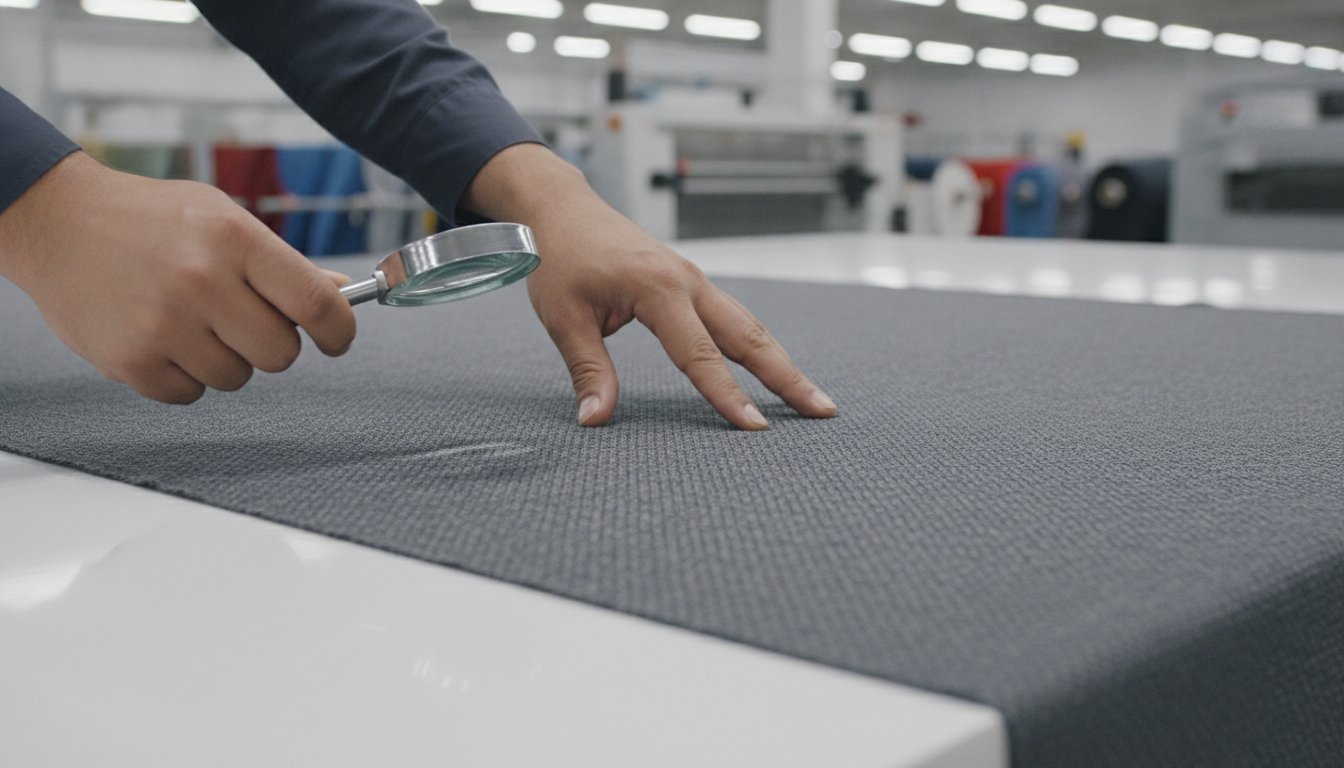

A single container of defective products can erase an entire year's profit. For importers buying from Asia, this isn't just a risk; it's a constant, costly concern. Inconsistent quality across batches and communication gaps with suppliers only amplify the financial exposure. This is precisely why a comprehensive product quality control checklist is not just a document-it is your most critical line of defense against these costly surprises. It is the tool that transforms your quality standards from a hopeful wish into a non-negotiable requirement for your factory.
This ultimate guide for 2026 will equip you to master the art of creating that foolproof checklist. We will provide a clear, actionable framework to define precise quality standards, establish defect classifications, and create an unambiguous document for your inspectors. The result? A significant reduction in defect rates, a more secure supply chain, and the professional peace of mind you need before releasing final payment. Stop problems before your shipment sails and protect your investment.
Key Takeaways
- Understand why a detailed checklist is your best insurance against costly defects and shipment delays when importing from Asia.
- Master the five essential pillars of a professional product quality control checklist, covering everything from core specifications to transit-safe packaging.
- Learn to apply AQL (Acceptable Quality Level) principles to make objective, data-driven pass/fail decisions for your entire production run.
- Follow a clear, step-by-step process to build your checklist by gathering technical files and identifying critical regulatory compliance needs.
What is a Product Quality Control Checklist and Why is it Your Best Investment?
A product quality control checklist is far more than a simple to-do list. It is a detailed technical document that serves as your agreement with a supplier, defining exactly what constitutes an acceptable product. This document outlines every specification, test, function, and aesthetic requirement that your goods must meet before they leave the factory. Think of it as your most critical insurance policy; a single day of professional inspection guided by this checklist can prevent months of costly legal disputes, rework, and shipping delays.
In the current global landscape, this "insurance" is more critical than ever. With material costs in Asia projected to rise through 2026, factories face increasing pressure on their margins. This can lead to substituting cheaper materials or cutting corners in production. Your checklist is the final barrier against these risks. It's crucial to distinguish this from a Standard Operating Procedure (SOP). An SOP tells the factory how to build your product; an inspection checklist is used to verify that the final output meets your standards. It is the core tool for effective Quality control (QC), ensuring nothing is left to interpretation.
The ROI of a Meticulous QC Checklist
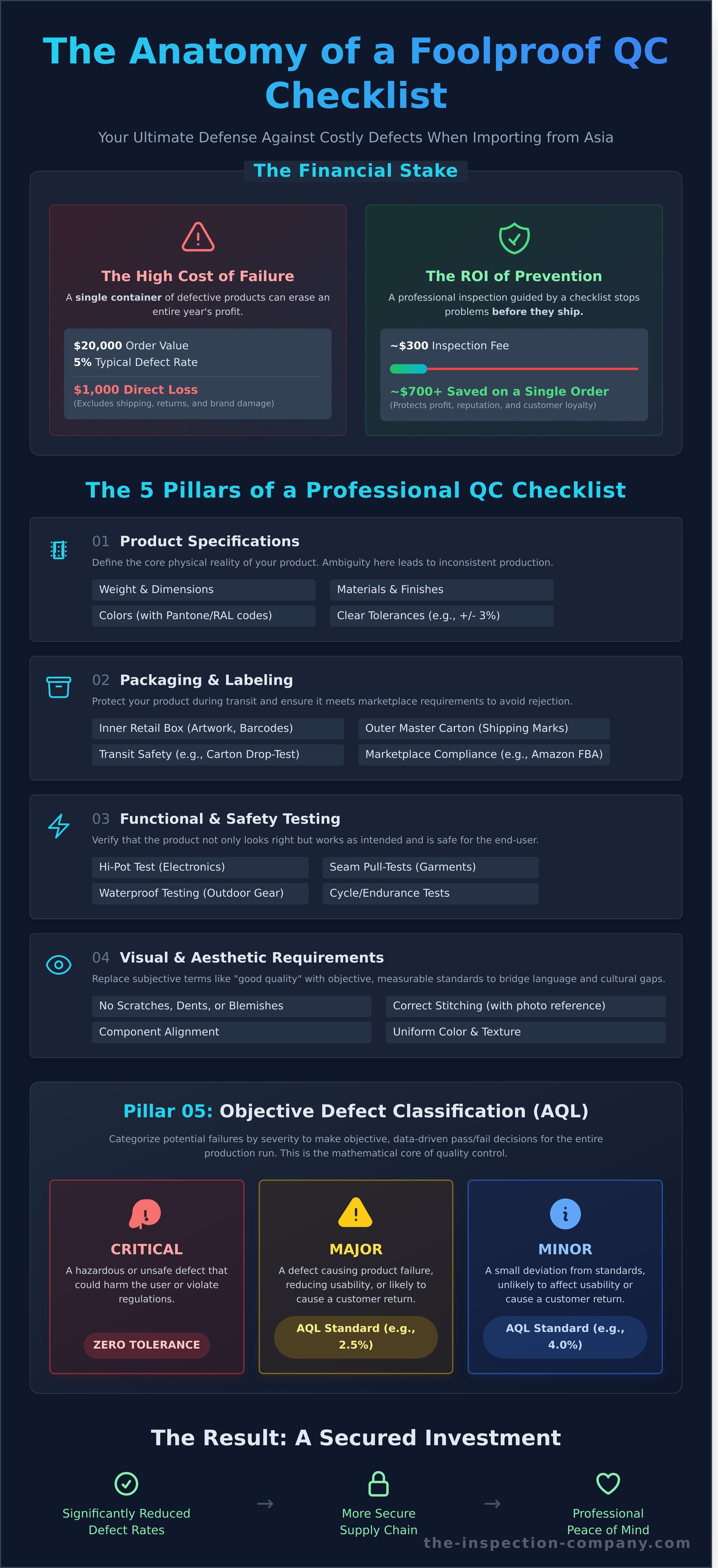
The financial argument is undeniable. Consider a $20,000 order with a 5% defect rate-a direct loss of $1,000 before you even account for shipping unsellable goods. Compare that to a typical $300 inspection fee that would have caught the issue. Beyond direct costs, a checklist protects your brand's reputation on platforms like Amazon and Shopify, where a few negative reviews can destroy a product's ranking. It systematically reduces the hidden costs of returns, wasted marketing spend, and irreversible customer churn.
How Checklists Bridge the Cultural and Language Gap
Terms like "good quality" are dangerously subjective and often lead to disputes. A well-crafted checklist replaces this ambiguity with objective facts. By using clear metrics (e.g., "zipper must withstand 50 open/close cycles") and visual aids (e.g., photos of correct stitching), you eliminate errors lost in translation. This document becomes the "Single Source of Truth" for your Asian suppliers, creating a universally understood standard that protects both you and the factory by setting clear, objective expectations from the start.
The 5 Essential Pillars of a Professional QC Checklist
A vague checklist invites costly errors. A professional product quality control checklist is more than a simple to-do list; it's a structured data collection tool. As defined by the American Society for Quality, a quality control check sheet is designed to systematically record facts, preventing ambiguity that leads to shipment defects. To be effective, your document must be built upon five essential pillars that leave no room for interpretation by your supplier or inspector.
Pillar 1 & 2: Product Specifications and Packaging
These sections define the physical reality of your product and how it must be protected. Ambiguity here results in inconsistent production and shipping damage. Your checklist must clearly state:
- Core Product Requirements: Exact weight, dimensions, materials, and colors with clear tolerance levels (e.g., weight must be 250g +/- 3%).
- Packaging and Labeling: Define requirements for both the inner retail box (barcodes, artwork) and the outer master carton (shipping marks, weight limits). Specify standards for transit safety, such as carton drop-tests.
- Marketplace Compliance: Include specific requirements for your sales channels, like Amazon FBA's suffocation warnings or Transparency codes, to avoid costly rejection at the warehouse.
Pillar 3 & 4: Functional Testing and Defect Categorization
Verifying that your product looks correct is only half the battle; it must also work as intended. This requires defining both the tests and the acceptable outcomes. This part of your product quality control checklist must detail:
- On-Site Functional Tests: List the specific, non-negotiable tests to be performed. Examples include Hi-pot tests for electronic safety, pull-tests on garment seams, or waterproof testing for outdoor gear.
- Defect Classification: Objectively categorize potential failures based on severity using AQL (Acceptable Quality Limits) standards:
- Critical: A hazardous or unsafe defect. (Zero tolerance)
- Major: A defect that could cause product failure or a customer return.
- Minor: A small deviation unlikely to affect the product's use.
- Shipment Threshold: Clearly state the "Total Allowable Defect" count that determines if a shipment passes or fails inspection.
Finally, the fifth pillar is your Special Instructions. This section captures your unique brand "deal-breakers"-the critical details like precise logo placement, specific Pantone color matching, or a particular assembly step that defines your product's quality and sets it apart from the competition. Without these custom instructions, an inspector can only check for generic quality, not your brand standard.
AQL and Pass/Fail Criteria: The Mathematics of Quality
For large production runs, inspecting every single item is not commercially viable. It's too slow, too expensive, and prone to human error. This is where the industry standard of Acceptable Quality Level (AQL) becomes essential. AQL is a statistical sampling method that determines the maximum number of defective units acceptable in a randomly selected sample size. It provides a fact-based, internationally recognized framework for making a Pass/Fail decision on an entire shipment.
Using a standard AQL table, you cross-reference your total order quantity (lot size) with your desired inspection level (typically General Level II for consumer goods) to find the correct sample size to inspect. This data-driven approach is a critical part of any serious product quality control checklist.
For example, let’s consider a 5,000-unit order with a standard AQL of 0/2.5/4.0. The AQL table indicates a sample size of 200 units. The numbers 0/2.5/4.0 represent the acceptance points for different defect types:
- 0% Critical Defects: If even one critical defect is found, the entire shipment fails.
- 2.5% Major Defects: The shipment fails if more than 10 major defects are found in the sample.
- 4.0% Minor Defects: The shipment fails if more than 14 minor defects are found.
Setting Your Quality Standards (AQL)
Your AQL is not just a number; it's a statement of your brand's commitment to quality. Critical defects, which pose safety risks to the end-user, must always have a zero-tolerance policy. Major and Minor defect limits should be set based on your product's price point and customer expectations. A clearly defined AQL gives you undeniable leverage, providing objective proof to a supplier if a shipment must be rejected or reworked, preventing costly arguments.
The Role of the Independent Inspector
Relying on a factory's internal QC report is a significant business risk. Factory-led inspections are inherently biased, as their primary goal is to ship the product, not protect your interests. An independent, third-party inspector provides impartial verification, ensuring the AQL sampling process is conducted correctly and that results are reported without bias. This is the only way to get a true picture of your product quality before it leaves the factory. This verification is a core component of a What is Pre-Shipment Inspection (PSI)?
Step-by-Step: Creating Your Checklist for Asian Manufacturing
A vague specification is an invitation for costly errors. When manufacturing in Asia, a detailed product quality control checklist is the single most critical document for ensuring your standards are met. It is not merely a list; it is a binding agreement and a technical communication tool that protects your investment. Follow these five steps to build a checklist that prevents defects before your shipment sails.
Step 1: Assemble Your Foundation. Gather all technical specifications, including CAD drawings, Pantone color codes, material requirements, approved "Golden Samples," and the original purchase order. These documents provide the objective, measurable criteria that form the backbone of your inspection.
Step 2: Define Compliance Requirements. Identify all mandatory regulatory standards for your target market. This includes critical certifications like CE (Europe), CPC (USA, for children's products), and substance regulations like RoHS. Failure to comply can result in seized shipments and financial penalties.
Step 3: Refine with an Expert Partner. On-the-ground realities require specialized testing protocols. Consult with a third-party inspection partner like The Inspection Company to define appropriate tests for function, durability, and safety. An experienced team can identify potential failure points you might overlook.
Step 4: Ensure Clarity on the Factory Floor. Bridge the language barrier to avoid misinterpretation. Translate critical checklist points into the local language or, even better, use clear visual diagrams and photographs to specify how to measure and what constitutes a defect.
Step 5: Iterate and Improve. After every production run and inspection report, update your product quality control checklist with lessons learned. This continuous refinement tightens your quality standards and helps your supplier improve their processes over time, reducing defects in future orders.
Avoid These Common Checklist Mistakes
A weak checklist creates ambiguity and leads directly to quality issues. Avoid these frequent and costly errors:
- Being Too Vague: "Product should look nice" is subjective. Instead, specify "No scratches, dents, or blemishes visible from 30cm under 500-lux lighting." Always quantify your standards.
- Ignoring the "Transit Reality": Your product's quality is worthless if it arrives damaged. Your checklist must include checks for export carton durability, proper sealing, correct shipping marks, and inner packaging integrity.
- Failing to Specify the "Golden Sample": Always reference the approved pre-production "Golden Sample" as the ultimate benchmark for comparison in aesthetics, feel, and finish during the inspection.
Collaborating with Your Supplier
Your checklist should be a tool for partnership, not a weapon for disputes. Effective collaboration is key to preventing problems before they start.
- Share Early and Often: Provide the checklist to your supplier before production begins. This allows them to understand your expectations and price their work accordingly.
- Require a Sign-Off: Have your supplier formally sign and stamp the checklist. This creates accountability and prevents them from claiming ignorance of the standards during a failed inspection.
- Use it for Improvement: Frame inspection results and checklist criteria as a way to help the supplier improve their processes. A good supplier will appreciate the clarity and use it to reduce their own rework costs.
Executing the Checklist: How The Inspection Company Stops Problems
A well-defined checklist is your first line of defense, but its power lies in flawless execution. With over 700 inspectors on the ground across Asia, we deploy your specific criteria directly at the source. Our unique European management structure ensures that Western quality expectations are not just understood, but rigorously enforced by our local teams. This combination stops quality issues before they become costly shipping problems.
When a shipment fails inspection, our service extends beyond simply delivering a report. Our on-site presence and experience allow us to act as your trusted intermediary, facilitating clear communication with the factory to address defects, negotiate rework, and resolve disputes. We help find solutions, not just problems.
Our Technology-Driven Inspection Process
Our inspectors use a proprietary mobile app that transforms your product quality control checklist into a step-by-step, verifiable process. This technology guarantees:
- On-Site Verification: Every point is checked, photographed, and confirmed in real-time.
- Data Transparency: Digital data capture eliminates the risk of "pencil-whipping" or incomplete reports.
- Product-Specific Customization: Checklists are tailored to your needs, whether for complex electronics or detailed textile inspections.
With our 2026-ready digital platform, you receive a comprehensive inspection report-complete with high-resolution photos and videos-within 24 hours of the inspection. This speed and clarity give you the critical information needed to make an immediate go/no-go decision on your shipment.
Ready to Secure Your Shipment?
Remember, one day of inspection can save months of trouble. The most effective way to protect your investment is to ensure your standards are met before your products leave the factory. Getting started is simple: upload your existing checklist or build a new one on our user-friendly booking platform.
Take control of your supply chain and avoid costly surprises. Get a Free Instant Inspection Quote Today.
Your Checklist: The Key to Controlling Quality and Costs
In today's global market, leaving quality to chance is a risk no importer can afford. As we've explored, your checklist is the essential blueprint for success, transforming subjective standards into objective, measurable criteria. From defining AQLs to specifying packaging requirements, a comprehensive product quality control checklist is your most powerful tool against defects, delays, and damage to your brand's reputation.
However, a plan is only as effective as its execution. With over 25 years of experience in Asian quality management, The Inspection Company's team of 700+ professional inspectors provides the on-the-ground expertise to enforce your standards. As an ISO 9001 certified and Sedex member company, we provide the reliable oversight you need to prevent issues before they ship.
Don’t let errors and defects erode your profits. Avoid costly surprises-Book your professional inspection now and secure your supply chain with confidence.
Frequently Asked Questions
What is the difference between a quality control checklist and a quality plan?
A quality plan is a high-level, strategic document that outlines the overall quality standards, procedures, and responsibilities for a product. In contrast, a quality control checklist is a tactical, operational tool used by an inspector on the factory floor. It lists the specific checkpoints, tests, and criteria to verify during an inspection. Your checklist is a critical component that executes the goals defined in your quality plan.
Do I need a different checklist for Pre-Shipment and During Production inspections?
Yes, using different checklists is essential for effective oversight. A During Production (DuPro) inspection checklist focuses on raw materials, semi-finished goods, and production processes to catch issues early. A Pre-Shipment Inspection (PSI) checklist concentrates on finished products, functionality, packaging, labeling, and final quantity counts. Each checklist is tailored to the specific risks present at that stage of production to avoid costly errors before shipment.
How do I define "Major" vs. "Minor" defects for my specific product?
A Minor defect is a small discrepancy that most customers would not notice or that would not cause a return, like a single loose thread. A Major defect is a noticeable flaw that would likely lead to a customer complaint or return, such as a visible stain or incorrect stitching. These definitions must be based on your brand's quality standards and customer expectations, as what is minor for one brand may be major for another.
Can I use a generic template for my QC checklist?
While a generic template can be a starting point, it is insufficient to protect your business from specific risks. Every product has unique materials, functions, and potential failure points that a generic list will miss. A customized product quality control checklist tailored to your exact specifications is the only reliable way to ensure your standards are met and to avoid costly surprises when the shipment arrives. Relying on a generic template is a significant risk.
What happens if the factory refuses to follow my checklist?
A factory's refusal to accept or follow your quality control checklist is a serious red flag. It signals a lack of commitment to your quality standards and a high potential for future disputes and product defects. This issue must be addressed immediately with the supplier. Your checklist is a non-negotiable part of your agreement; if they will not comply, you should seriously consider halting production and finding a more reliable manufacturing partner.
How often should I update my quality control checklist?
Your checklist should be a living document, not a static one. It is critical to review and update it before every new production run. Updates are essential when you change product designs or materials, or after discovering new types of defects from past inspections or customer feedback. Regularly refining your checklist is a proactive measure to prevent recurring problems and continuously improve final product quality, protecting your brand reputation.
Is a digital checklist better than a paper-based one for Asian factories?
A digital checklist is far superior for managing inspections. It ensures consistency and provides real-time data, including photos and notes, directly from the factory floor. This minimizes the risk of miscommunication, lost paperwork, or unclear information. Digital reporting allows for faster, more transparent communication, enabling you to make informed decisions about your shipment without delay. It is the professional standard for reliable and efficient quality control.
What are the most common defects found during a PSI?
During a Pre-Shipment Inspection (PSI), the most common defects found are typically cosmetic issues like scratches, dirt, dents, or poor painting. Functional failures, such as a product not turning on or a part not fitting correctly, are also frequent. We often identify problems with packaging, incorrect labeling, and quantity discrepancies. A comprehensive product quality control checklist is designed to systematically find these common issues before they ship.