
In international sourcing, a supplier's promise is not enough. How can you be certain their production line can consistently deliver the quality you specified, order after order? The answer lies in verifying their process, not just their final product. This is where a robust quality assurance framework becomes essential for minimizing risk. The Production Part Approval Process, or PPAP, is that framework. While it originated in the demanding automotive industry, the ppap process provides a powerful structure for any importer serious about preventing defects, verifying supplier claims, and avoiding costly production delays.
But the process can seem complex, filled with jargon that leaves many importers feeling uncertain. This simple guide cuts through the confusion. We will explain exactly what PPAP is, why it matters beyond the automotive sector, and when you should request one from your supplier. By the end, you’ll have the clarity and confidence to use PPAP to ensure your supplier’s manufacturing process is reliable, reducing the risk of defects and securing your supply chain.
Key Takeaways
- Understand PPAP as a critical "dress rehearsal" before mass production, providing documented evidence that your supplier can meet quality standards consistently.
- Learn to identify the key triggers-beyond just a new product launch-that require you to request a PPAP to prevent costly production errors.
- Determine which of the 5 PPAP submission levels is appropriate for your product to ensure sufficient oversight without unnecessary cost or complexity.
- Effectively integrate the ppap process into your broader quality assurance system to verify supplier capabilities and minimize manufacturing risks from the start.
What is PPAP and Why Should You Care as an Importer?
Think of the Production Part Approval Process (PPAP) as the final, full-dress rehearsal before mass production begins. It’s the critical step where you verify that your supplier is not just capable of making your product, but that they are ready for the main event: full-scale, consistent manufacturing.
In business terms, the Production Part Approval Process (PPAP) is a standardized framework used to provide documented proof that a supplier's manufacturing methods can consistently produce a part according to your design specifications. The primary goal is to establish objective confidence in the supplier and their systems before you commit to a large order.
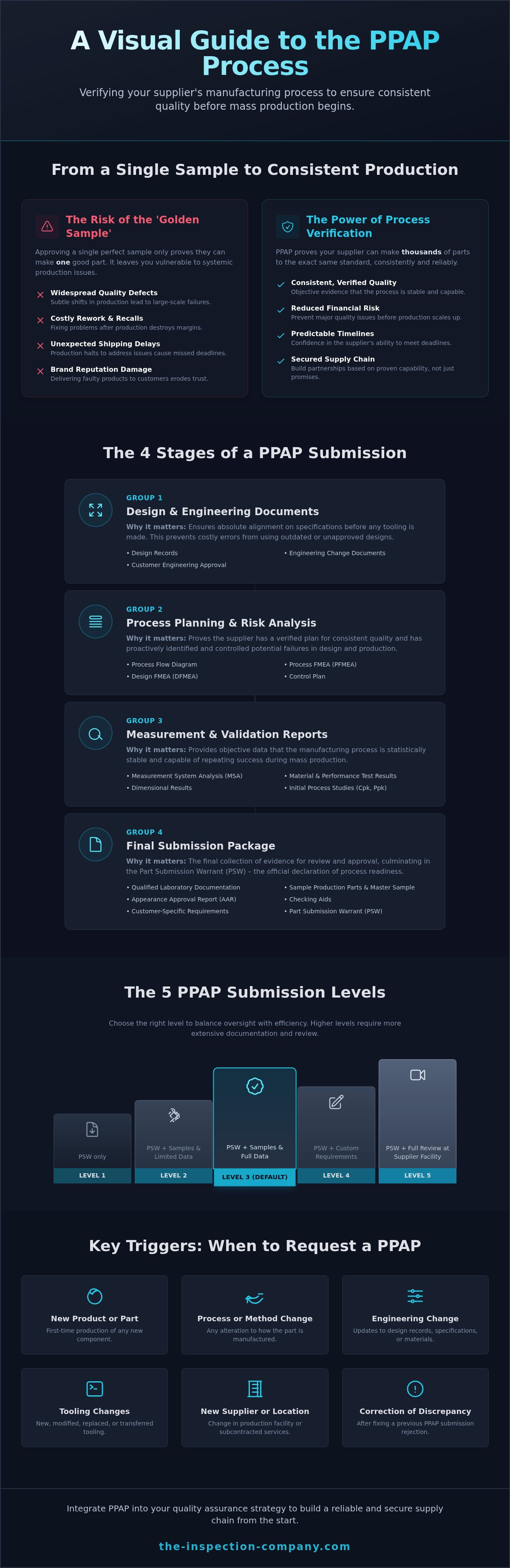
This goes far beyond approving a single "golden sample." A perfect sample proves your supplier can make one good part; the ppap process proves they can make thousands of them to the exact same standard. For an importer, engaging in this process is a non-negotiable step to mitigate risk and secure your investment. It directly helps you avoid:
- Widespread quality defects in your final shipment.
- Costly rework, sorting, or product recalls.
- Unexpected and damaging shipping delays.
- Harm to your brand’s reputation.
The Core Purpose: Moving from 'Can They Make It?' to 'Can They Make It Consistently?'
A great product design is only half the battle; a supplier must also have a robust process design. PPAP focuses entirely on verifying this process. Originating in the automotive industry, where component failure is not an option, this methodology ensures every machine, operator, and material input works in harmony to deliver consistent quality, part after part. A stable process is the only true guarantee of a reliable supply chain.
The Business Case for PPAP: Avoiding Catastrophic Production Failures
Imagine approving a flawless sample and placing an order for 10,000 units. Two months later, a container arrives, but 30% of the products are out of tolerance due to a subtle shift in production. The costs are immediate: wasted materials, missed sales deadlines, and a damaged relationship with your customers. PPAP is the upfront investment in due diligence that prevents this exact scenario, stopping major problems before your shipment ever sails.
The 18 PPAP Elements, Demystified for Buyers
The 18 elements of the Production Part Approval Process can seem overwhelming. But a successful ppap process isn't about ticking boxes; it's a structured narrative that tells the story of a supplier's production readiness. Each document provides a critical piece of evidence, confirming their ability to meet your quality standards consistently. To simplify this, we group the elements into four logical stages, moving from initial design to final approval.
Group 1: Design and Engineering Documents
This initial group confirms that you and your supplier are working from the exact same blueprint. It includes the Design Records, any authorized Engineering Change Documents, and formal Customer Engineering Approval.
Why it matters: This foundational step prevents the most basic and costly of errors-manufacturing parts based on outdated or unapproved specifications. It ensures absolute alignment before any tooling is made or materials are ordered, minimizing the risk of expensive rework and delays.
Group 2: Process Planning and Risk Analysis
Here, the supplier presents their detailed plan for manufacturing your part. This includes a Process Flow Diagram, a Design Failure Mode and Effects Analysis (DFMEA), a Process FMEA (PFMEA), and the resulting Control Plan.
Why it matters: This documentation proves the supplier has proactively identified potential failures in both design and production and has implemented robust controls to prevent them. It's your assurance that they have a verified plan for consistent quality, not just a hope for success.
Group 3: Measurement and Validation Reports
This is where data replaces claims. This group provides the objective evidence that the supplier's process works as planned. It contains Measurement System Analysis (MSA), Dimensional Results from the initial sample run, Material and Performance Test Results, and Initial Process Studies (like Cpk and Ppk).
Why it matters: These reports give you hard proof. They verify that the sample parts meet every specification and, more importantly, that the manufacturing process is statistically stable and capable of repeating that success consistently during mass production.
Group 4: The Final Submission Package
This final group bundles the key evidence for sign-off. It includes Qualified Laboratory Documentation, the Appearance Approval Report (AAR) for cosmetic items, Sample Production Parts for your review, and the capstone document: the Part Submission Warrant (PSW).
Why it matters: The PSW is the most critical summary document. By signing it, the supplier formally declares that the parts meet all customer requirements. It is your official record and the final green light to authorize full-scale production.
The 5 PPAP Submission Levels: What to Ask For and When
A common misconception about the Production Part Approval Process is that it requires an exhaustive, 18-element submission for every component. This is not the case. The Automotive Industry Action Group (AIAG) established five distinct submission levels to provide flexibility, allowing you to match the level of documentation to the part's risk and complexity.
Understanding these levels is a critical risk management tool. It enables you to communicate clear, unambiguous expectations to your supplier, ensuring you receive the right degree of verification without creating unnecessary work. Choosing the correct level from the outset prevents costly misunderstandings and production delays down the line.
Level 1: The Bare Minimum
This level requires the supplier to submit only the Part Submission Warrant (PSW). It is reserved for very simple parts or minor updates, such as a color change on a non-critical component from a long-term, trusted supplier with a flawless quality record. While efficient, this level carries a high degree of risk, as it relies entirely on the supplier's self-certification without any supporting data for your review.
Level 3: The Industry Standard
This is the default level for most new parts, new suppliers, or any significant engineering change. It requires the supplier to submit the PSW along with product samples and the complete set of supporting data for all 18 elements. Level 3 provides your quality team with a full package of objective evidence to review and approve, offering a comprehensive baseline of assurance that the supplier's process is capable and repeatable.
Level 5: The Ultimate Assurance
Level 5 includes a PSW, product samples, and a full documentation review conducted at the supplier's manufacturing facility. This is the most rigorous level of the ppap process and is essential for critical components where failure could have severe consequences, such as safety systems or core functional parts. It is also the prudent choice when qualifying a new or unproven supplier or following a major quality failure, as it allows for direct, on-site verification of their processes, controls, and records.
Key Triggers: When Do You Need to Request a PPAP?
A common misconception is that the Production Part Approval Process is a one-time event conducted only for a new product launch. In reality, the ppap process is a dynamic quality assurance tool that should be triggered throughout a product's lifecycle. You must request a new PPAP submission whenever a change occurs that could potentially affect the part's fit, form, function, or reliability.
Proactively monitoring for these triggers empowers you to manage supplier quality and prevent production issues before they impact your final shipment. Failing to re-validate a process after a significant change introduces unacceptable risk into your supply chain.
Initial Production and New Suppliers
The most obvious trigger is the initial production run of a new part or component. Equally critical is when you engage a new supplier to manufacture an existing part. In both scenarios, a full PPAP submission is non-negotiable. It establishes a comprehensive quality baseline and formally verifies that the new supplier's processes are capable of meeting your engineering specifications repeatably and reliably from the very beginning of the relationship.
Changes in Production or Materials
Any modification to the established manufacturing process is a red flag that warrants a new PPAP submission. These changes introduce variables that can lead to defects if not properly controlled and validated. Key changes to watch for include:
- Tooling and Equipment: New or modified tools, molds, dies, or patterns. This also includes the refurbishment or rearrangement of existing tooling.
- Material Specifications: A change in the raw material used for the part or a switch to a different sub-supplier for a critical component.
- Production Location: Moving the manufacturing process to a different facility, or even to a different production line within the same factory.
Corrections and Process Inactivity
A PPAP is also a crucial tool for verification after a problem has occurred or after a long period of dormancy. You should request a new submission following a correction for a previously identified quality discrepancy to ensure the root cause was properly addressed. Furthermore, if tooling has been inactive for 12 months or more, a new PPAP is required to re-validate the process and confirm that no degradation has occurred during the idle period.
Verifying these changes is an essential step to avoid costly returns and delays. If you need to confirm a supplier's process capability, our factory audits and inspection services can provide the independent verification you need to protect your investment.
How PPAP Fits Into Your Broader Quality Control Strategy
The Production Part Approval Process is a cornerstone of manufacturing quality, but it does not operate in a vacuum. To truly minimize risk and ensure consistent quality, it must be integrated into a comprehensive quality assurance strategy. While the ppap process provides the initial proof of capability, other essential activities provide the ongoing verification and oversight needed to protect your investment and brand reputation.
PPAP vs. First Article Inspection (FAI)
While often discussed together, it is crucial to understand the distinct functions of PPAP and First Article Inspection (FAI). They are related but not interchangeable.
- First Article Inspection (FAI): This validates the product. An FAI is a detailed verification of a sample from the first production run, ensuring it conforms to all engineering drawings and design specifications.
- Production Part Approval Process (PPAP): This validates the process. A comprehensive PPAP submission proves that the supplier's entire manufacturing system is stable, repeatable, and capable of consistently producing compliant parts at the required rate.
Think of it this way: an FAI report is often a key component within the overall PPAP package, but it is not a substitute for full process validation.
The Role of Factory Audits in Verifying PPAP Capability
Before you even request a PPAP from a new supplier, a factory audit is an essential due diligence step. An audit provides a clear assessment of the supplier’s fundamental capabilities. Does their Quality Management System (QMS) meet required standards? Is their equipment properly calibrated and maintained? This proactive verification prevents a common and costly pitfall: requesting a complex approval process from a factory that lacks the systems to execute it properly, saving you from months of potential delays and wasted resources.
Using Third-Party Inspections to Validate PPAP Claims
A PPAP submission is a set of documents and claims provided by your supplier. Independent verification is the only way to be certain these claims are accurate. A third-party inspection provides objective, on-site validation of the data presented in the PPAP report.
For example, an inspector can take parts directly from the production line and cross-reference their measurements against the dimensional reports submitted in the PPAP package. This confirms that the data isn't just theoretical but reflects the reality of what is being produced. Ultimately, a robust quality strategy relies on trust built through verification. Ensure your supplier's process is robust from the start. Verify their capabilities with a factory audit.
Securing Your Supply Chain with a Robust PPAP Process
Navigating the Production Part Approval Process is a critical step for any serious importer. As we've explored, understanding its core elements and submission levels empowers you to verify your supplier’s capabilities, ensuring they can meet your specifications consistently. This isn't merely a compliance exercise; a well-managed ppap process is your first line of defense against production errors, costly delays, and quality fade. It establishes a clear, documented standard for quality that protects your investment from the very beginning.
But a robust process on paper must be backed by a reliable partner on the ground. Verifying your supplier's systems and overall capabilities is a crucial step that PPAP documentation alone can't cover. With over 25 years of QC experience under European management, our team of 700+ inspectors across Asia provides the on-site verification you need to make confident decisions. We deliver detailed reports within 24 hours, giving you a clear view of your supplier's operations.
Don't leave supplier quality to chance. Contact us to discuss a factory audit today. Take control of your supply chain and build a foundation for long-term success.
Frequently Asked Questions About the PPAP Process
Is PPAP only for the automotive industry?
While originating in the automotive sector, PPAP is no longer exclusive to it. Its rigorous framework for supplier validation is now a best practice in aerospace, defense, and medical device manufacturing. Any industry where component failure leads to significant safety risks or costly recalls can benefit from its principles. Adopting PPAP ensures a supplier's production methods are robust, repeatable, and capable of meeting your precise engineering specifications, minimizing downstream quality issues before they impact your business.
Who is responsible for creating the PPAP package and who pays for it?
The supplier is unequivocally responsible for creating and compiling the complete PPAP package. This is a non-negotiable part of demonstrating their ability to meet your quality and engineering requirements. The cost of preparing the submission is typically borne by the supplier as a standard cost of doing business and securing your contract. It is an investment on their part to prove their process capability and should be factored into their pricing from the outset.
How long does a typical PPAP process take?
The timeline for a typical ppap process can vary significantly, from a few weeks to several months. The duration depends on part complexity, the availability of materials, and the supplier's experience with the requirements. A simple component from an experienced supplier might take 2-4 weeks, whereas a complex assembly requiring extensive testing and new tooling could extend to 3-6 months. Clear communication and established milestones are critical to avoid unexpected and costly delays in your production schedule.
What happens if a part fails the PPAP submission?
A PPAP failure stops the process immediately. The customer issues a rejection, and no parts can be shipped for mass production. The supplier must then conduct a thorough root cause analysis to identify why the part or process failed to meet specifications. They will implement corrective actions, document the changes, and re-run parts of the production trial. A new, complete PPAP submission is then required for customer review and approval, preventing defective components from entering your supply chain.
Can I use a simplified PPAP for products from China or Vietnam?
While PPAP has five submission levels, simplifying the requirements based on a supplier's location, including China or Vietnam, introduces significant risk. The PPAP level should be determined by the part's criticality, not its country of origin. Using a lower level for a critical component to save time or cost can lead to severe quality escapes later. It is essential to base the PPAP level on a proper risk assessment to ensure the supplier's process is robust and capable.
How does PPAP relate to quality standards like ISO 9001?
ISO 9001 and PPAP are complementary but serve different functions. ISO 9001 certifies that a company has a robust Quality Management System (QMS) in place-it's about the overall system. In contrast, the ppap process is a specific, product-focused procedure used to prove that a particular part can be manufactured consistently to the customer's exact specifications by that system. An ISO 9001 certification provides confidence, but PPAP provides tangible proof for a specific component.