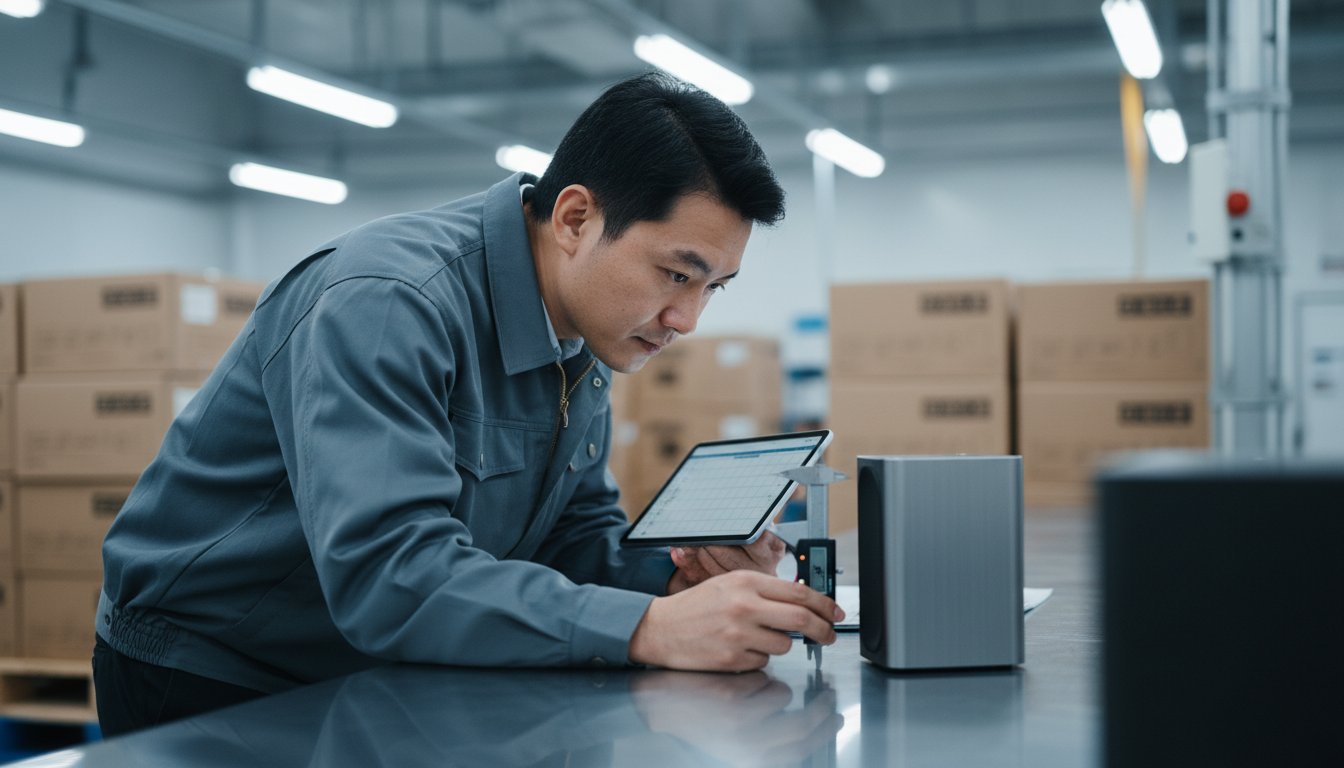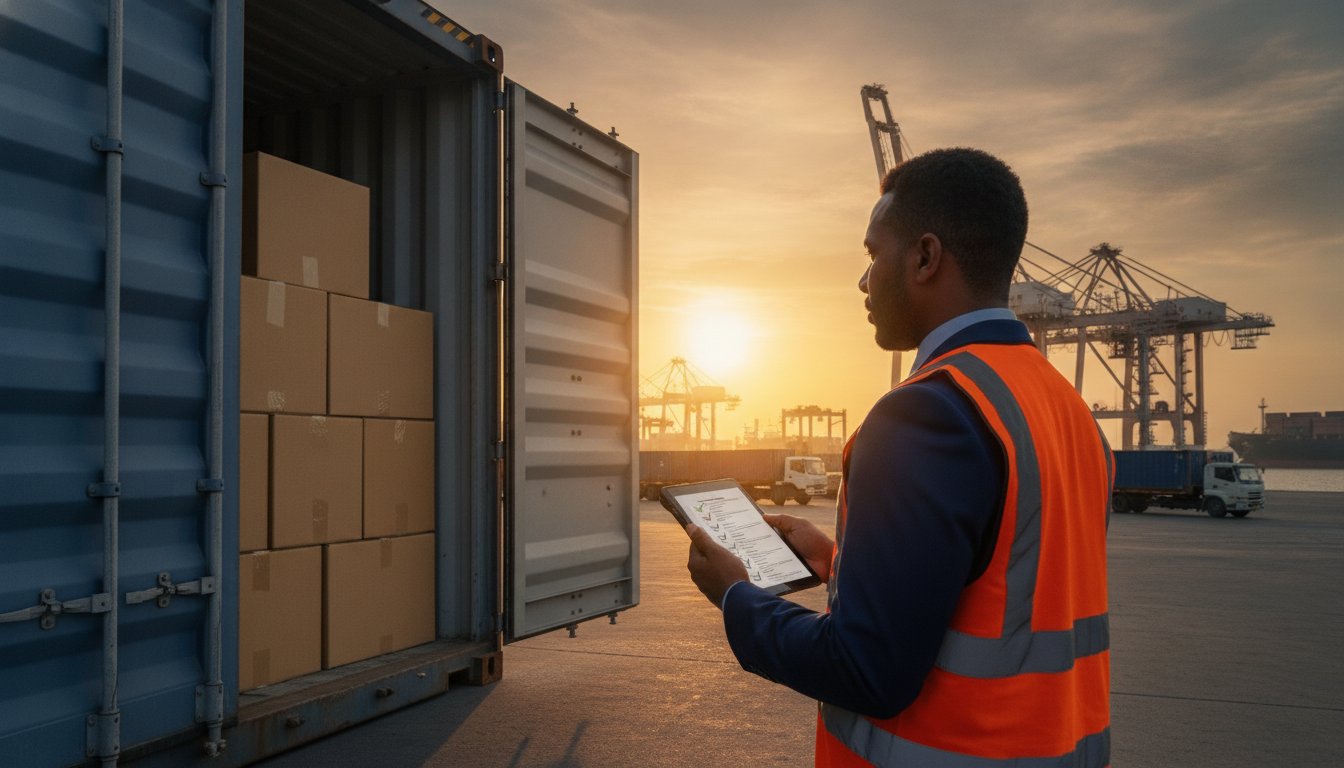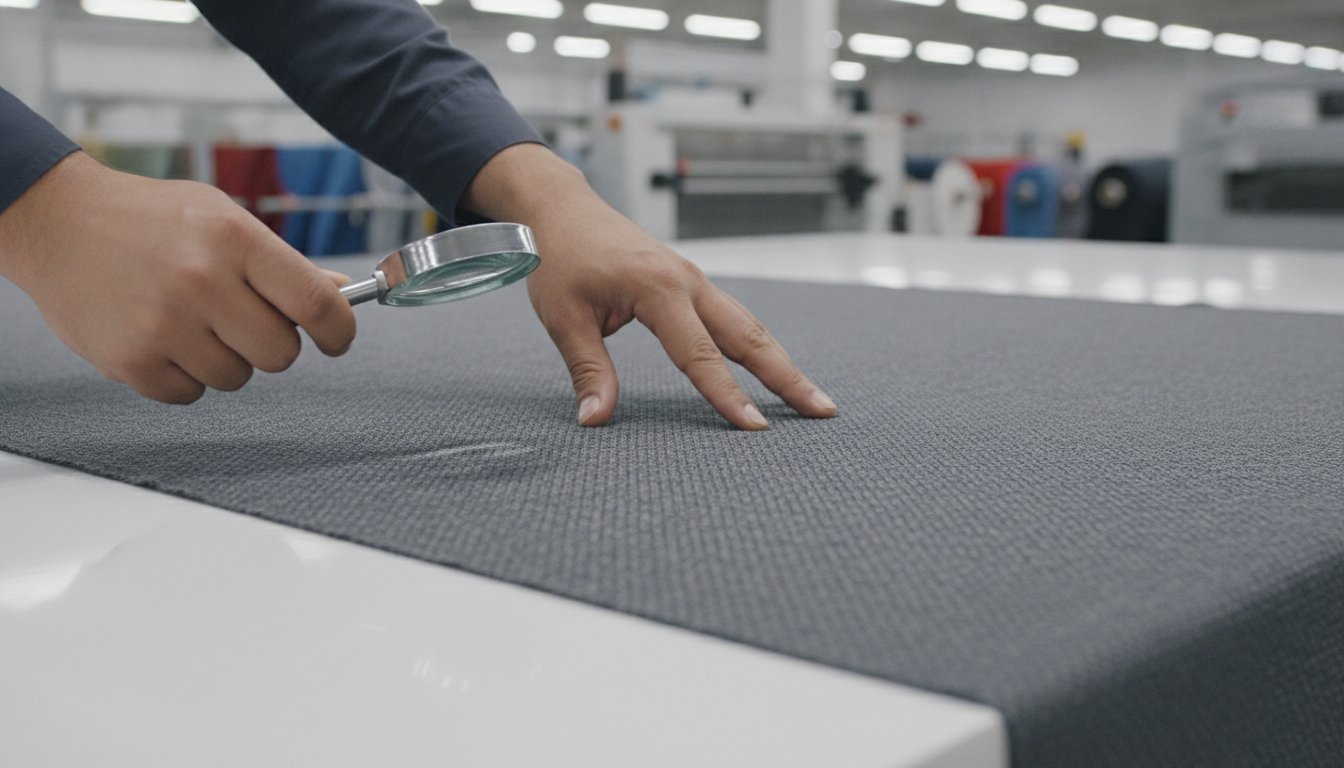

For every success story in global manufacturing, there's a cautionary tale: a disastrous shipment, a supplier who vanishes, or a simple miscommunication that costs thousands. This is the core challenge of sourcing from Asia-bridging the vast distance between your quality standards and the final product that arrives at your warehouse. The opportunities are immense, but navigating this landscape without a clear strategy is a financial risk most businesses cannot afford to take.
This guide is your blueprint for eliminating that uncertainty. We will provide you with a comprehensive framework to manage quality and mitigate risk at every stage of the import process. You will learn expert-driven strategies to find and vet reliable suppliers, establish clear product specifications, and implement a robust inspection plan that stops problems before your shipment sails. By the end, you will have the confidence and the tools to protect your investment, receive consistently high-quality products, and build a secure, scalable supply chain for long-term success.
Key Takeaways
- Learn the critical vetting steps to perform before paying a deposit to avoid common supplier scams and quality issues.
- Discover how to implement in-production quality controls, ensuring your product specifications are met from day one.
- Understand the role of a Pre-Shipment Inspection (PSI) as your final line of defense to verify quality and quantity before goods are shipped.
- Mitigate the top financial and logistical risks associated with sourcing from Asia, whether you are working with factories in China, Vietnam, or India.
The Top 4 Risks of Sourcing from Asia (And How to Avoid Them)
The strategy of global sourcing, particularly sourcing from Asia, offers enormous cost benefits that can transform a business. However, these opportunities come with significant risks that can lead to costly delays, defective products, and financial loss. Understanding these common pitfalls is the first step toward protecting your investment and ensuring a stable supply chain. Proactive quality control is not an expense; it is the key to successful, long-term sourcing.
Here, we break down the most critical risks importers face and provide actionable, proven mitigation strategies for each.
Risk 1: Supplier Scams & Fraud
A price that seems too good to be true usually is. Unrealistic quotes, poor communication, and an unwillingness to provide documentation are major red flags. Many importers fall victim to dealing with trading companies that pose as factories, adding a layer of cost and miscommunication. You must verify a supplier's legitimacy before sending any payment. One day of due diligence can save you from a total loss.
- Solution: Conduct a comprehensive factory audit to verify licenses, capabilities, and operational legitimacy on-site.
Risk 2: Quality Fade and Inconsistency
‘Quality fade’ is a common and costly problem where a supplier gradually reduces product quality over time to increase their profit margin. The first production run may be perfect, but by the third, they may be using cheaper materials or cutting corners on processes. This leads to customer complaints and damaged brand reputation. Setting clear standards is not enough; you must verify they are being met.
- Solution: Implement independent during-production and pre-shipment inspections to ensure every batch meets your exact specifications.
Risk 3: Communication Barriers & Cultural Differences
Misinterpreting ‘yes’ can lead to major production errors. In many Asian business cultures, a ‘yes’ may simply mean “I hear you,” not “I agree and will execute this perfectly.” Vague instructions or assumptions about quality and deadlines can result in a final product that doesn't match your vision. Clear, documented communication is non-negotiable when sourcing from Asia.
- Solution: Use a detailed, bilingual specification sheet and employ a local, third-party team to act as your eyes and ears, ensuring nothing is lost in translation.
Risk 4: Intellectual Property (IP) Theft
The risk of your unique product design being copied and sold to competitors is very real. A US or EU patent offers little to no protection in China, and legal recourse is often slow and expensive. Protecting your IP requires a proactive, multi-layered approach that begins long before production starts. Choosing the right partner is your first line of defense.
- Solution: Work only with thoroughly vetted suppliers and implement a China-specific NNN (non-disclosure, non-use, non-circumvention) agreement.
Step 1: Vetting Your Supplier Before You Pay a Deposit
In the complex world of international trade, proper supplier vetting is the single most critical step to mitigate risk when sourcing from asia. A professional website or a high rating on a B2B platform is merely an advertisement, not a guarantee of quality or legitimacy. An upfront investment in due diligence is not an expense; it is insurance against costly scams, production delays, and quality failures that can jeopardize your business. This process builds the essential foundation for a reliable and successful long-term partnership.
Initial Screening and Communication
Your initial contact sets the tone for the entire relationship. Go beyond price inquiries and ask targeted questions to gauge their capabilities and professionalism. A supplier's response time and clarity are early indicators of their operational efficiency. Always request and verify essential documents:
- Business License: Confirms they are a legally registered entity.
- Certifications: Documents like ISO 9001 indicate a formal Quality Management System.
- Product Samples: Never commit to a large order without first evaluating a physical sample. This is a non-negotiable step to verify their ability to meet your quality standards.
The Role of a Factory Audit
A factory audit is your eyes on the ground, providing an independent verification of a potential supplier’s claims. It is an on-site evaluation conducted by a professional inspector to assess a factory's real-world capabilities. An audit confirms that you are dealing with a legitimate manufacturer, not a trading company misrepresenting itself. The process verifies production capacity, the condition of machinery, and the robustness of their quality control systems. It also ensures the facility meets social and ethical compliance standards, verifying that the factory can meet your quality requirements and adhere to international product safety standards.
Interpreting an Audit Report
A professional audit report provides the objective data you need to make an informed decision. Key sections will detail the factory profile, quality management systems, and a list of non-conformities. Pay close attention to any major non-conformities-these are critical issues, such as a lack of incoming quality control or falsified records, that should be considered deal-breakers. However, the report is not just a pass/fail document; it is a tool you can use to discuss necessary improvements with a promising supplier, turning potential risks into managed expectations. See a sample factory audit report here.
Step 2: Managing Quality During Production
A common mistake in sourcing from Asia is treating quality control as a final hurdle. True risk management involves embedding quality checks throughout the entire production cycle. Waiting until an order is 100% complete to inspect it is a recipe for costly delays and disputes. Catching a deviation early prevents an entire batch from being compromised, saving you time, money, and your brand's reputation. One day of proactive inspection can save you months of trouble.
Creating a Watertight Product Specification Sheet
Your Product Specification Sheet is the single most important document for ensuring quality. It is your contract with the factory, defining exactly what you expect. A comprehensive sheet leaves no room for ambiguity and should include:
- Technical Details: Precise materials, dimensions, weight, and tolerances.
- Visual Standards: Color references (e.g., Pantone codes), finish, and texture.
- Packaging Requirements: Carton specifications, labeling, and protective materials.
- Documentation: Clear diagrams, technical drawings, and high-resolution photos.
Crucially, ensure key technical terms are translated to avoid misunderstandings.
The 'Golden Sample' and First Article Inspection (FAI)
Before mass production begins, you must approve a pre-production sample. This "golden sample" becomes the physical benchmark against which all subsequent units are measured. A First Article Inspection (FAI) takes this a step further by having an inspector on-site to verify the very first units off the assembly line. This critical check confirms the factory has correctly interpreted your specifications and is the final opportunity to correct tooling or processes before thousands of units are made.
During Production Inspection (DPI/DUPRO)
A During Production Inspection (DPI or DUPRO) is an on-site evaluation conducted when 20-50% of your order is complete. This is your early warning system. An inspector can identify systematic issues-such as an incorrect machine setting or a misunderstanding by line workers-that could affect the entire production run. A DPI verifies that quality is consistent with the golden sample and ensures your supplier is on track to meet your deadline, minimizing the risk of last-minute surprises.
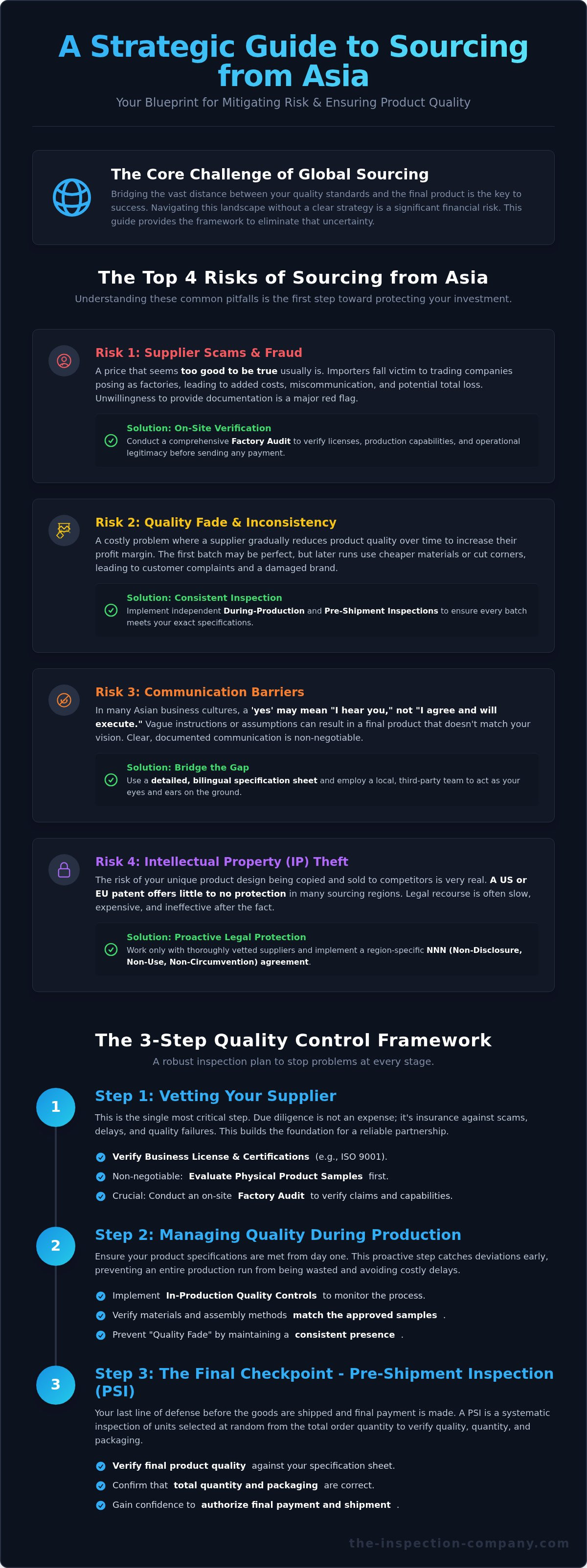
Step 3: The Final Checkpoint - Pre-Shipment Inspection (PSI)
After weeks or months of development and production, your goods are finally ready. This is the most critical moment in the process of sourcing from Asia. A Pre-Shipment Inspection (PSI) is your last line of defense-an independent, on-site verification that happens once production is 100% complete and at least 80% of the goods are packed. This isn't just a formality; it's the essential step that gives you the power to approve or reject the shipment before it leaves the factory and your final payment is released. Shipping without a PSI means shipping blind, exposing your business to significant financial risk.
What Does a Pre-Shipment Inspection Cover?
A comprehensive PSI provides a clear, objective snapshot of your entire order. Our inspectors follow a detailed checklist tailored to your product, but the core verification points always include:
- Quantity Verification: We count the shipping cartons and inner contents to ensure you receive the exact number of units you paid for.
- Workmanship & Defect Classification: We identify and categorize any defects as minor, major, or critical, giving you a clear understanding of the overall product quality.
- On-Site Product Testing: We perform functional, safety, and basic durability tests to ensure the product works as intended and meets your specifications.
- Packaging & Labeling: We verify that all packaging, barcodes, and shipping marks are correct-a crucial step for avoiding issues with customs or Amazon FBA receiving.
Understanding AQL (Acceptable Quality Limit)
The Acceptable Quality Limit (AQL) is the international industry standard for determining the sample size for an inspection and the number of defects that will trigger a "fail" result. Instead of inspecting every single unit, AQL uses statistical sampling to provide a highly accurate assessment of the entire production batch. This allows you to make data-driven decisions efficiently. By defining AQL levels for minor, major, and critical defects with your supplier upfront, you establish clear, measurable pass/fail criteria that removes ambiguity from your quality standards.
Making the Final Decision: Approve or Reject?
The detailed PSI report, complete with high-resolution photos and objective data, is your negotiation tool. If the inspection fails, you have several options. You can use the photographic evidence to require your supplier to rework the defective items, sort the entire batch to remove faulty units, or, in severe cases, reject the entire shipment. This report ensures you don't pay for substandard goods. One day of inspection can save you from months of trouble and costly returns. Don't ship blind. Get an instant quote for your inspection.
Beyond China: Sourcing Considerations for Vietnam, India, and More
As global supply chains evolve, experienced importers are diversifying their manufacturing bases to mitigate risk. While China remains a powerhouse, countries like Vietnam, India, and Thailand are rapidly emerging as viable alternatives. This shift makes a robust risk management strategy for sourcing from Asia more critical than ever. Each country presents a unique landscape of opportunities and challenges that demand careful consideration.
Sourcing from Vietnam
Vietnam has become a popular choice for its competitive labor costs and favorable trade agreements, such as the EVFTA with Europe. However, businesses must be prepared for logistical hurdles, including less developed infrastructure and a reliance on imported raw materials which can affect lead times.
- Key Industries: Furniture, textiles, footwear, and electronics assembly.
- Primary Risk: Factories are scaling at an unprecedented rate. Quality control can falter under pressure, making independent pre-shipment inspections essential to verify standards before your goods leave the port.
Sourcing from India
India offers a vast and diverse manufacturing sector, renowned for its skilled workforce and deep expertise in certain product categories. The primary challenges often involve navigating complex bureaucracy and regional logistical inconsistencies, which can lead to unexpected delays.
- Key Industries: Apparel and textiles, home goods, handicrafts, and engineered products.
- Primary Risk: The market is highly fragmented. Rigorous supplier vetting and factory audits are crucial to ensure you partner with a reliable and compliant manufacturer capable of meeting your quality and ethical standards.
Why Your QC Process Must Remain Consistent
Moving production to a new country does not eliminate risk-it simply changes its nature. The fundamental principles of quality management are universal. Whether you are manufacturing in Shanghai or Ho Chi Minh City, the need to verify product specifications, quality, and compliance remains unchanged. Assuming a new supplier is less risky is a costly mistake.
Your quality standards should not be negotiable. The most effective way to manage this transition is to apply a consistent QC framework across all your suppliers. An independent quality control partner provides a uniform standard of inspection and auditing, giving you a reliable benchmark regardless of the factory's location. We help you adapt your approach to the local context while ensuring your core quality standards are always met. One day of inspection can save you months of trouble.
Your Partner for Secure and Successful Sourcing
Successfully navigating the complexities of sourcing from Asia hinges on a proactive, multi-stage approach to quality control. As we've explored, this begins with rigorous supplier vetting and continues with in-process checks to catch issues early. Ultimately, a comprehensive Pre-Shipment Inspection is your final, non-negotiable safeguard, ensuring the products you paid for are the products that leave the port. This diligence is the difference between a profitable partnership and a costly mistake.
You don’t have to manage these critical checkpoints alone. With over 25 years of European management experience and a network of more than 700 professional inspectors across Asia, we provide the independent verification you need. We stop problems before your shipment sails, delivering detailed reports with photos and videos within 24 hours so you can make informed decisions with absolute confidence.
Secure your supply chain. Get your free inspection quote today.
Take control of your quality and build a more resilient, profitable international business.
Frequently Asked Questions About Sourcing from Asia
How much does a product inspection in Asia typically cost?
A standard product inspection in Asia typically costs between $250 and $350 USD per inspector-day. This all-inclusive rate is a minor investment when sourcing from Asia, covering the inspector's time, travel, and the generation of a comprehensive report. The final price can vary based on factory location and product complexity. This single-day expense is critical to avoid the significant financial losses associated with defective goods, protecting your brand's reputation and bottom line.
What is the difference between a factory audit and a product inspection?
A factory audit evaluates the supplier, while a product inspection evaluates the product. An audit verifies the factory's legitimacy, capabilities, and ethical standards before you place an order, answering the question, "Is this a reliable partner?" In contrast, a product inspection occurs during or after production to check if your goods meet quality standards. It answers, "Is my product made correctly?" Both are vital tools for minimizing risk in your supply chain.
Can I trust the internal QC reports from my supplier's factory?
While a supplier's internal QC report can be a starting point, it should not be your sole source of quality assurance. The factory's QC team works for the supplier, creating an inherent conflict of interest. Their primary goal is to ship the product, not necessarily to enforce your strict quality standards. An independent, third-party inspection provides an unbiased assessment of your shipment's quality, ensuring your interests are protected before you make the final payment.
How do I create an effective inspection checklist for my product?
An effective inspection checklist is your blueprint for quality. It must be specific and unambiguous. Start with core product specifications, materials, and colors. Detail all packaging, labeling, and shipping mark requirements. Clearly define on-site tests to be performed, such as function tests or measurements. Finally, provide a defect classification list with photo examples to guide the inspector on what constitutes a minor, major, or critical defect. A detailed checklist leaves no room for interpretation.
What happens if a shipment fails a pre-shipment inspection?
A failed pre-shipment inspection gives you critical leverage before the goods leave the factory. Your first step is to use the detailed inspection report to discuss the findings with your supplier. You can demand they rework the defective items, sort the entire batch to remove faulty units, or even re-manufacture the order if defects are widespread. This process ensures problems are fixed at the source, saving you from receiving a shipment of unsellable products and costly return logistics.
Is it safe to pay 100% upfront when sourcing from Asia?
Paying 100% upfront is extremely risky and not a standard business practice. It removes all your leverage if quality issues arise. The industry standard payment structure is typically 30% to 50% upfront to begin production, with the final balance due after the goods have passed a pre-shipment inspection and you have received proof of shipment (like a Bill of Lading copy). Tying your final payment to a successful inspection is your most powerful quality control tool.
How can I ensure my products meet Amazon FBA requirements?
To ensure your products meet Amazon's strict FBA requirements, your inspection checklist must include FBA-specific checkpoints. The inspector should verify correct FNSKU labeling, proper poly-bagging with suffocation warnings, and adherence to carton weight and dimension limits. A pre-shipment inspection is the only way to confirm these critical details are correct before your inventory is shipped, preventing costly re-labeling fees or outright rejection of your shipment by Amazon's fulfillment centers.