
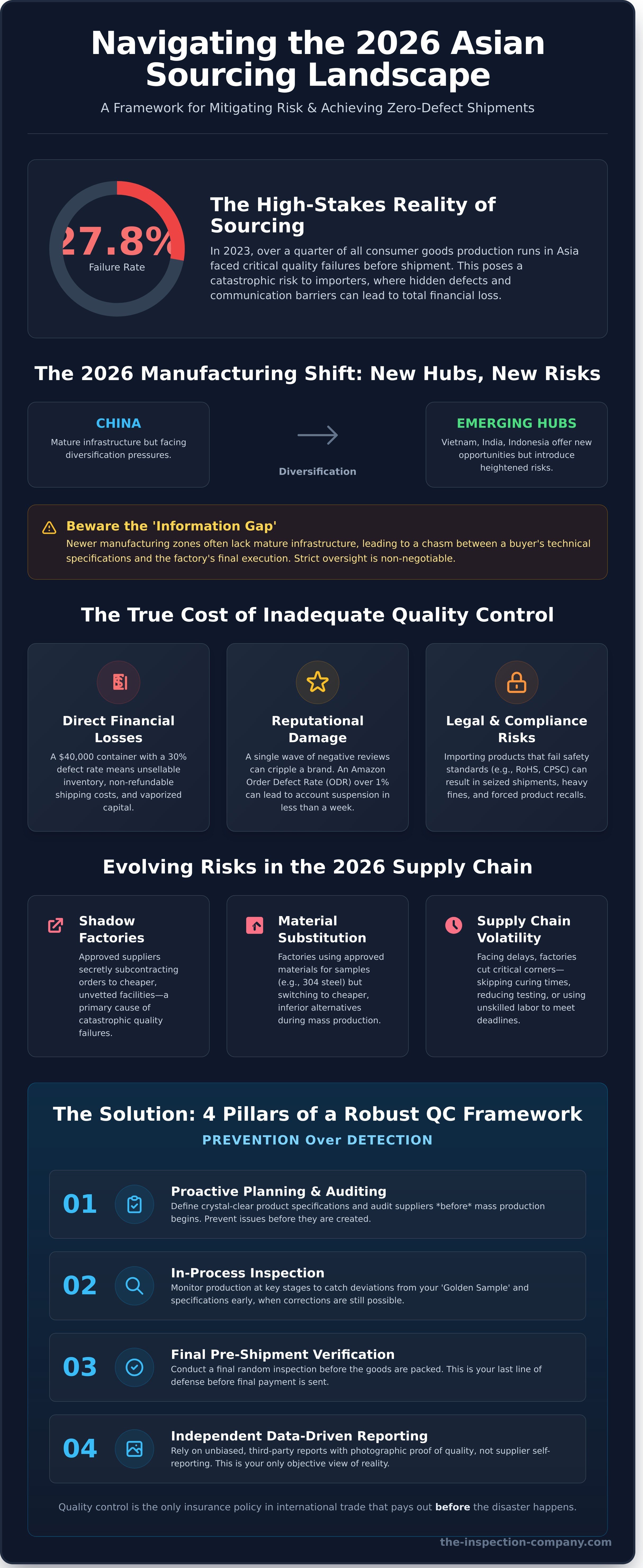
Industry reports from 2023 indicate that product inspection failure rates in Asia reached a staggering 27.8% in the consumer goods sector. This means over a quarter of production runs face critical quality issues before they even leave the factory. It’s a risk that keeps importers awake at night; you've likely worried about communication barriers, hidden defects, and the catastrophic cost of receiving a shipment that’s dead on arrival. The lack of transparency thousands of miles away can feel like a gamble you can’t afford to lose.
This guide is your solution. We've built a professional framework for effective sourcing from Asia quality control, designed to mitigate those risks and ensure the product you pay for is the product you receive. By the end of this article, you will have a clear, actionable plan to get photographic proof of quality, build a bulletproof QC checklist, and achieve zero-defect shipments before your final payment is ever sent.
Key Takeaways
- Learn why the 2026 manufacturing shift to emerging hubs like Vietnam and India demands a more rigorous quality control strategy.
- Discover the four essential inspection stages that form a professional QC framework, designed to prevent defects rather than just detect them.
- Understand the "Golden Sample" trap and why relying solely on supplier-sent photos is the single biggest risk to your product quality.
- Implement a proactive sourcing from asia quality control plan by defining clear product specifications and auditing suppliers before mass production begins.
Table of Contents
The Landscape of Sourcing from Asia in 2026: Why Quality Control is Non-Negotiable
Sourcing from Asia is no longer a simple transaction; it's a complex strategic operation. Effective sourcing from asia quality control isn't just about checking a few samples at the end of a production run. It is the systematic, independent verification of your product specifications, production processes, and factory standards from start to finish. This process involves a range of activities defined under the umbrella of Quality Control (QC), which serves as your on-the-ground defense against costly errors thousands of miles from your warehouse.
By 2026, the manufacturing map of Asia has fundamentally shifted. While China remains a powerhouse, a 2024 Gartner survey revealed that over 50% of supply chain leaders have already begun moving sourcing out of China to emerging hubs like Vietnam, India, and Indonesia. This diversification introduces new variables and heightened risks. These newer manufacturing zones often lack the mature, decades-old infrastructure of regions like Guangdong or Zhejiang. This means importers face a steeper learning curve and require even stricter oversight to bridge the critical 'Information Gap'-the chasm between a Western buyer's technical specifications and a factory's interpretation and execution.
Never underestimate this gap. It’s where precise engineering tolerances become loose approximations and specified materials get swapped for cheaper alternatives. In this high-stakes environment, hope is not a strategy. As we always say, quality control is the only insurance policy in international trade that pays out before the disaster happens.
The True Cost of Skipping Quality Control
Failing to invest in professional inspections isn't a cost-saving measure. It’s a gamble that rarely pays off. The fallout extends far beyond a few defective units and can inflict severe, long-term damage on your business. The risks are not theoretical; they are daily realities for unprepared importers.
-
Direct Financial Losses: Imagine a $40,000 container of electronics arriving with a 30% defect rate due to faulty soldering. The inventory is unsellable, the shipping costs are non-refundable, and your capital is gone.
-
Indirect Reputational Damage: One wave of negative reviews can cripple your brand. On platforms like Amazon, your Order Defect Rate (ODR) must remain below 1%. A batch of poor-quality goods can lead to account suspension in under a week, erasing years of hard work.
-
Legal and Compliance Risks: Customs authorities don't grant leniency for ignorance. Importing products that fail to meet mandatory safety standards, like RoHS for electronics in the EU or CPSC regulations in the US, can result in seized shipments, heavy fines, and forced recalls.
Evolving Risks in the 2026 Asian Market
The supply chain of 2026 is more dynamic and volatile than ever. This evolution creates new and subtle threats that can bypass even experienced importers who rely solely on their supplier's in-house QC reports. You must be aware of what’s happening behind the factory gates.
-
The Rise of 'Shadow Factories': Your approved, audited supplier may accept your order and then, without your knowledge, subcontract it to a cheaper, unvetted facility to protect their margins. This unauthorized outsourcing is a primary cause of catastrophic quality failures.
-
Material Substitution: To combat rising raw material costs, a factory might produce your approved pre-production samples with specified components (e.g., 304-grade stainless steel) but switch to a cheaper, inferior alternative (like rust-prone 201-grade steel) during mass production.
-
Supply Chain Volatility: Post-2020 global disruptions have created immense pressure on lead times. Factories facing delays may cut critical corners-skipping curing times, reducing testing protocols, or using inexperienced labor-to meet a shipping deadline, pushing the consequences onto you.
The 4 Pillars of a Robust Quality Control Framework
A reactive approach to quality control is a recipe for financial loss. Waiting until your products arrive at their destination to discover defects is far too late. The core philosophy of a successful quality strategy is prevention over detection. It’s about building a system that identifies and corrects issues at the source, not just catching them at the finish line. This proactive system is built on four essential stages of oversight, each acting as a critical checkpoint in your production timeline.
Effective sourcing from asia quality control relies on unbiased, expert evaluation. While a factory may provide its own internal QC reports, these documents can lack the objectivity required for a high-stakes business decision. An independent third-party inspector works exclusively for you, providing a transparent and data-driven assessment of your production. This impartial oversight is the only way to guarantee that the information you receive is accurate and protects your investment.
Factory Audits: Vetting the Source Before You Pay
Before you transfer a deposit, you must verify your supplier’s legitimacy and capability. A factory audit is a comprehensive on-site evaluation that reveals critical operational data. It confirms whether a potential partner has the necessary production capacity, robust quality management systems like ISO 9001, and a stable operational history. Audits can be tailored, from a technical audit assessing machinery and processes to a social compliance audit verifying ethical labor standards. Vetting your supplier is the non-negotiable first step in any professional supplier management process.
During Production (DuPro) and Pre-Shipment Inspection (PSI)
Once production begins, on-the-ground monitoring is essential. A During Production Inspection (DuPro) is conducted when 10-20% of your order is complete. This early intervention is designed to catch systemic errors, such as an incorrect color formulation or a malfunctioning mold, before they compromise the entire production run. Identifying a major defect at this stage can save you weeks of delays and prevent catastrophic financial losses.
The final gatekeeper is the Pre-Shipment Inspection (PSI). This is your last opportunity to identify and address issues before the final payment is made and the goods are shipped. A PSI is a detailed final review of your finished products, where an inspector uses a statistical sampling method based on international standards. This process is fundamental to a successful sourcing from asia quality control strategy, as it provides a clear snapshot of your order's overall quality. The results are measured against your pre-defined Acceptable Quality Level (AQL), a critical metric that dictates whether the batch passes or fails. Using a standardized AQL calculator removes guesswork and provides an objective, data-backed basis for your decision to accept or reject the shipment.
Together, these four pillars-Audit, PPI, DuPro, and PSI-create a comprehensive framework that protects your business from costly surprises. This methodical approach, which echoes principles found in total quality management systems like the Baldrige framework for quality, transforms quality control from a mere final check into an integrated, preventative process. Implementing these inspections doesn't have to be a logistical burden; you can book an independent inspection and receive a detailed report within 24 hours, giving you the confidence to manage your supply chain effectively.
Why Supplier 'Self-Reporting' is Your Biggest Sourcing Risk
The most common objection we hear from new importers is, "But my supplier sends me high-quality photos and videos." This is a dangerous and costly assumption. Relying on factory-provided updates is not a quality control strategy; it's a gamble with your capital. The images you receive are often of a meticulously prepared "golden sample," a perfect unit that rarely represents the quality of the full production run. What you don't see are the subtle deviations, the shortcuts on the production line, or the units with hidden flaws.
The core issue is a fundamental conflict of interest. A factory's internal Quality Control (QC) department is paid by the factory. Their primary incentive is to ensure the shipment goes out on time, not to find problems that cause delays and require expensive rework. They are not your advocate. True sourcing from asia quality control requires an independent party whose only objective is to protect your interests and verify your standards are being met, without bias.
Consider a case from Q4 2023 involving a US-based electronics importer. They chose to save money by forgoing a $300 pre-shipment inspection on a $50,000 order of Bluetooth speakers, trusting the supplier's pristine photos. The shipment arrived with a 35% defect rate due to faulty battery connectors, an internal issue impossible to see from the outside. The cost of returns, freight, and lost sales eclipsed $18,000, turning a profitable product into a significant loss.
The Psychology of the Factory-Buyer Relationship
In many Asian business cultures, the concept of 'Face' is paramount. Admitting a major production problem can be seen as a loss of face for the factory manager. This can lead to a tendency to hide or downplay issues rather than report them transparently. A third-party inspector acts as a neutral bridge, removing emotion and cultural pressures. They provide objective, fact-based reports, allowing you to address problems directly without damaging your long-term supplier relationship. Their presence also provides critical 'boots on the ground' verification that the factory is a legitimate, operational facility and not just a trading office.
Detecting the 'Hidden' Defects
An inspector's value goes far beyond what a camera can capture. Self-reporting completely fails to identify critical issues that can ruin a shipment, such as:
-
Functional Failures: A product might look perfect but fail under real-world use. Independent inspectors conduct on-site functional tests, like checking electronic components or testing the load-bearing capacity of a chair, to ensure products work as intended.
-
Packaging and Labeling Errors: Incorrect barcodes, insufficient protective packaging, or non-compliant labeling can lead to entire shipments being rejected by fulfillment centers like Amazon FBA, resulting in costly re-labeling fees and delays.
-
Material and Safety Non-Compliance: A supplier might substitute a specified material for a cheaper, weaker alternative to save costs. This can lead to product failure and, more seriously, non-compliance with mandatory product safety standards in your target market.
-
Defect Misclassification: Your supplier's idea of a minor flaw might be a deal-breaker for your customers. An independent inspection service works from your pre-defined checklist to classify all major vs minor defects, ensuring your quality standard is the one that matters.
Ultimately, trusting a supplier to inspect their own work is like asking a student to grade their own exam. An independent inspection is the only reliable method to ensure the products you paid for are the products that get shipped.
Implementing a 2026 QC Strategy: A Step-by-Step Guide
A reactive approach to quality control is a recipe for financial loss. By 2026, supply chains will face even greater demands for transparency and compliance, making a proactive strategy essential. Simply hoping your supplier gets it right isn't a business plan; it's a gamble. A structured, five-step implementation process transforms your sourcing from asia quality control from a point of anxiety into a competitive advantage, protecting your investment and brand reputation.
Step 1: Define Everything Before Production
Ambiguity is the enemy of quality. Before a single unit is produced, you must provide your factory with a detailed product specification sheet and a Defect Classification List. This document categorizes potential flaws into three tiers: Critical (e.g., safety hazards, rendering the product unusable), Major (e.g., functional failures, significantly impacting marketability), and Minor (e.g., small cosmetic blemishes). This removes subjectivity and gives your supplier a clear, non-negotiable standard to meet.
Step 2: Conduct a Pre-Production Factory Audit
Don't take a sales brochure at face value. A professional factory audit is a non-negotiable step to verify a potential supplier's claims. An audit assesses everything from their internal quality management systems (like ISO 9001 certification) to their production capacity and social compliance. Verifying these capabilities upfront prevents catastrophic failures down the line. Over 60% of production delays and quality failures can be traced back to issues that a pre-production audit would have identified.
Step 3: Link Payments to Quality Milestones
Integrate your QC process directly into your purchase order (PO) and payment schedule. This gives you critical leverage. A typical structure is a 30% initial deposit, 40% paid only after the goods pass a pre-shipment inspection, and the final 30% paid upon successful delivery. This financially incentivizes your supplier to meet your standards, as their payment is directly tied to a successful inspection report.
Step 4: Engage an Independent Inspection Partner
Using the factory's in-house QC team is a clear conflict of interest. You need an unbiased third party on the ground. Hiring an independent inspection company with proven local expertise in your specific product category is the only way to get a truly objective assessment. Their job isn't to make friends with the factory; it's to protect your interests by rigorously testing your products against your pre-defined checklist.
Step 5: Act on the Inspection Report Within 24 Hours
A professional inspection service will deliver a detailed report, complete with photos and data, within 24 hours of the inspection. Review it immediately. This report is your critical 'Go/No-Go' decision point. If it passes, you can authorize shipment with confidence. If it fails, you can demand rework or reject the batch before it ever leaves the factory, saving you months of trouble and thousands in shipping costs for defective goods.
The Importance of the Inspection Checklist
A generic checklist yields generic results. Your inspection checklist is the tactical instruction manual for your inspector. It must be customized to your product, covering aesthetics, functionality, safety tests, and packaging. Building your checklist based on established international product inspection companies' standards provides a strong foundation. Vague points like "check quality" are useless. Instead, include specific, measurable actions like "Verify product weight is 250g +/- 2g" or "Conduct a full-function test on 100% of the AQL sample size."
Navigating 2026 Compliance Standards
The future of effective sourcing from asia quality control is tied to compliance. As of 2024, there's a growing regulatory focus on Environmental, Social, and Governance (ESG) criteria. You must ensure your suppliers meet ethical labor standards and environmental regulations. This includes verifying material certifications and understanding the RoHS compliant meaning for electronics, or securing CE, CPC, and UKCA marks for market access. Finally, always secure the shipment with a supervised container loading inspection. This final check verifies carton counts and ensures the approved batch is what actually gets loaded, preventing a last-minute 'bait and switch' with inferior goods.
Don't leave your investment to chance. Book a comprehensive factory audit today and verify your supplier's capabilities before production begins.
Secure Your Asian Supply Chain with The Inspection Company
Navigating the complexities of Asian manufacturing requires more than a good supplier relationship; it demands independent, on-the-ground verification. For over 25 years, The Inspection Company (TIC) has been the trusted partner for global businesses, turning uncertainty into control. We bridge the gap between your expectations and your factory's output with a unique operational model: meticulous European management combined with a network of over 700 local inspectors across 14 Asian countries.
This structure ensures that your quality standards are not lost in translation. While our management guarantees a deep understanding of Western market demands and compliance, our local teams execute inspections with unparalleled regional expertise. Effective sourcing from asia quality control isn't just about checklists; it's about having a trusted team on the factory floor who can identify risks before they become liabilities.
We operate on a simple, powerful principle: speed and accuracy. With our 24-Hour Promise, you receive a detailed inspection report, complete with high-resolution photos and actionable data, on the very same day the inspection is completed. This allows you to make critical go/no-go decisions about your shipment before it leaves the port, saving you from catastrophic financial losses and brand damage. Stop guessing about your product quality and start verifying it with professional oversight.
European Standards, Asian Presence
Our hybrid model provides the best of both worlds. You get the strict, uncompromising quality benchmarks and communication protocols you'd expect from a European partner, implemented by professionals who understand the local culture and business landscape. Every TIC inspector operates under a strict zero-tolerance anti-bribery policy, ensuring their only loyalty is to you, our client. We offer fully customizable inspection packages designed for startups, SMEs, and enterprise-level retailers, ensuring your specific QC needs are met precisely.
Ready to Avoid Costly Surprises?
Implementing professional quality control is a straightforward, three-step process with us: you request the inspection, our team coordinates all logistics with your supplier, and you receive the definitive report. It's that simple. For e-commerce sellers, our specialized Amazon FBA service ensures your products meet all of Amazon’s rigorous prep requirements, from FNSKU labeling to packaging standards, preventing costly rejections at the fulfillment center. Don't let your investment travel 5,000 miles on a hopeful guess. Take control of your supply chain today.
Get your free instant inspection quote and secure your production standards now.
Secure Your 2026 Supply Chain: The Final Step in Quality Control
Navigating the Asian sourcing market in 2026 requires more than a good supplier relationship. The single biggest risk to your business remains unverified supplier self-reporting, a direct path to costly defects and shipment delays. Your success now depends entirely on implementing a robust, independent framework for your sourcing from asia quality control.
Don't leave your investment to chance. The Inspection Company provides that critical, on-the-ground verification. With a network of 700+ inspectors across Asia, all operating under strict European Management and to ISO 9001 certified standards, we are your eyes on the factory floor. We stop problems before they become your problems.
One day of inspection can prevent months of financial loss. Take the decisive step to protect your investment. Secure Your Shipment: Get a Free Inspection Quote Today and build a resilient supply chain for 2026 and beyond.
Frequently Asked Questions
Is quality control really necessary if I've worked with the same supplier for years?
Yes, ongoing quality control is essential, even with a trusted supplier. Over 60% of quality issues we identify occur with suppliers clients have used for more than three years. This is often due to "quality fade," where standards slip over time, or changes in the factory's staff or raw material sourcing. Consistent checks are a cornerstone of successful sourcing from asia quality control; they protect your investment and brand reputation against unforeseen changes.
How much does a typical quality control inspection in Asia cost in 2026?
A typical quality control inspection in Asia is projected to cost between $299 and $349 USD per inspector-day in 2026. This all-inclusive rate covers the inspector's time, travel, and the generation of a comprehensive report. The final price depends on the factory's location and the complexity of the inspection requirements. This single-day investment can save you thousands in costs associated with defective products, making it a critical part of your budget.
Can an inspection company help me if I've already paid the factory in full?
Yes, an inspection company can still provide critical value after you've paid in full. A Pre-Shipment Inspection will give you a detailed, objective report on your product's quality before it leaves the factory. While your negotiation leverage for a refund is reduced, this report allows you to stop a shipment of defective goods. This prevents you from incurring shipping costs and receiving a batch of unsellable products, which is a far more costly problem.
What happens if the inspection report shows a 'Fail' result?
A 'Fail' result on an inspection report gives you the power to act before shipment. You receive a detailed report with photographic evidence, which you use as leverage with your supplier. The standard procedure is to demand the factory sort and rework the defective units. Based on your contract terms, you can require a re-inspection, often at the factory's expense, to verify the corrections have been made. This process stops problems before they leave Asia.
How do I choose between a Pre-Shipment Inspection and a During Production Inspection?
Choose a During Production Inspection (DuPro) to identify systemic issues early, which is ideal for new suppliers or complex production runs where catching problems mid-process is critical. A Pre-Shipment Inspection (PSI) is the final check when at least 80% of the order is complete and packed. The PSI is the most common choice, as it's your last chance to verify the quality and quantity of the entire batch before authorizing final payment and shipment.
Do you perform quality control in countries other than China, such as Vietnam or India?
Yes, we provide comprehensive quality control services across Asia, not just in China. Our network of professional inspectors operates in major manufacturing hubs including Vietnam, India, Thailand, Bangladesh, and Malaysia. Our European management ensures that the same high standards for inspection and reporting are applied consistently, regardless of the country. This provides a reliable standard for your entire Asian supply chain and protects your brand.
What is the difference between a factory audit and a product inspection?
A factory audit evaluates the supplier, while a product inspection evaluates the goods. An audit is a proactive assessment of a factory's systems, capacity, and compliance (like ISO 9001 or social standards) before you place an order. An inspection is a reactive check of your products against your specifications during or after production. An audit tells you if they can make your product correctly; an inspection tells you if they did.
How long does it take to receive the final inspection report?
You will receive the final, detailed inspection report within 24 hours of the inspection's completion. Our process is designed for speed and efficiency to help you make timely decisions about your shipment. The report includes a clear Pass/Fail result, a summary of findings, and extensive photographic evidence documenting any defects or issues found. This rapid turnaround is critical for maintaining your production and shipping schedule without costly delays.