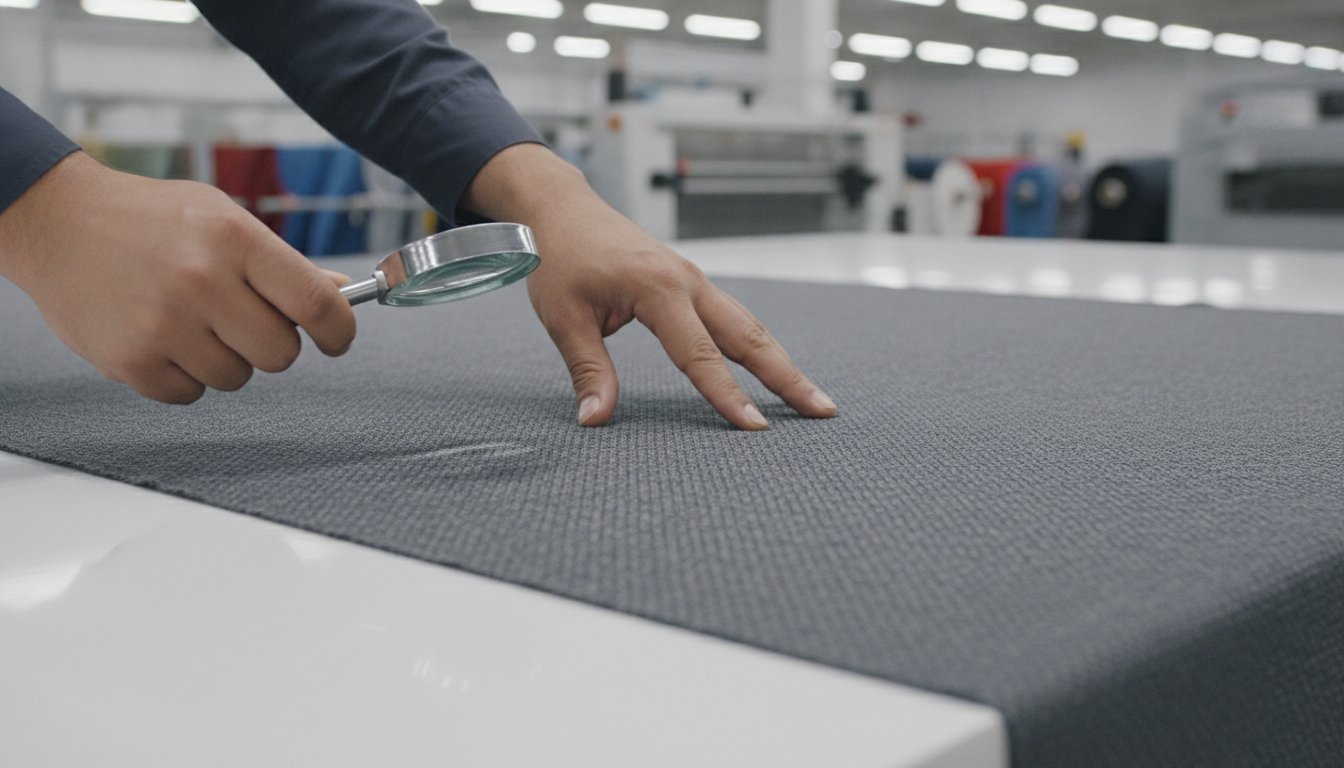

A 2023 report from Cone Communications revealed that 86% of consumers expect companies to act on social and environmental issues, and they will hold brands accountable for their supply chains. A single negative headline about forced labor or unsafe conditions can erase years of brand-building and trigger a costly public relations crisis. It's a risk you can't afford to take.
You already know that your brand’s reputation is one of your most valuable assets. The challenge is ensuring your partners in Asia uphold the same ethical standards you do. That’s why a professional social compliance audit factory check is no longer optional; it's an essential part of modern importing. This guide provides the clear, actionable framework you need to verify ethical practices, protect your business, and confidently manage your supply chain.
We will break down the key differences between standards like SMETA, BSCI, and SA8000, detail the on-site audit process, and give you a reliable plan for handling a failed audit to avoid trouble before your shipment sails.
Key Takeaways
- Understand what a social compliance audit is and how it directly protects your brand's reputation by identifying critical ethical risks in your supply chain.
- Discover the step-by-step process of a social compliance audit factory, from the initial meeting to the physical inspection, to ensure no critical details are missed.
- Learn how to interpret audit reports, distinguishing between minor issues and "Zero Tolerance" findings that require immediate action with a supplier.
- Recognize the significant risks of relying on supplier "self-audits" and why an independent, third-party verification is your only guarantee of true compliance.
What is a Social Compliance Audit for Factories?
A social compliance audit for a factory is a formal, on-site evaluation of a supplier's adherence to local labor laws and international ethical standards. It is not a suggestion; it's a verification process. The core objective is to identify and mitigate critical supply chain risks before they become costly liabilities. These risks include forced labor, child labor, unsafe working conditions, excessive overtime, and illegal wage practices. A professional Social audit provides the objective data needed to protect your brand, your investment, and your market access.
For decades, these audits were optional. That is no longer the case. With new global due diligence laws taking full effect, 2026 represents a turning point where social audits become mandatory for thousands of importers. Failing to comply doesn't just risk your reputation; it risks legal penalties and the seizure of your goods.
It's also vital to understand the difference between social and technical audits. They are not interchangeable. A social compliance audit focuses on people and ethics. Auditors are trained to interview workers, analyze payroll records, and assess health and safety protocols against standards like SA8000 or Sedex (SMETA). A technical audit, in contrast, focuses on production capabilities and quality management systems, like ISO 9001. Using the wrong type of auditor for the job provides a false sense of security and leaves your business exposed.
The Evolution of Ethical Sourcing Standards
The landscape has shifted dramatically from voluntary Corporate Social Responsibility (CSR) initiatives to legally binding requirements. Laws like Germany's Supply Chain Act (LkSG) and the EU's Corporate Sustainability Due Diligence Directive (CSDDD) now hold companies accountable for human rights violations in their supply chains. By 2026, consumer pressure on major platforms like Amazon will demand unprecedented transparency, making ethical sourcing a key brand differentiator. This also changes the audit's purpose from a one-time "snapshot" to a tool for continuous improvement and building stronger, more resilient supplier partnerships.
Who Needs a Social Audit?
A social compliance audit factory assessment is essential for any business seeking to secure its supply chain. You absolutely need one if you are:
- Importing from high-risk regions. Any sourcing from manufacturing hubs like China, Vietnam, Bangladesh, India, or Cambodia carries inherent risks that must be professionally managed.
- Selling to major retailers. Companies like Walmart, Target, and Costco have strict supplier codes of conduct. A failed audit can get your company delisted, costing you a critical sales channel.
- Protecting your ESG rating. A company's supply chain practices can impact its Environmental, Social, and Governance (ESG) score by as much as 30%. A poor rating deters investors and damages public perception.
The 9 Critical Pillars of a Factory Social Audit
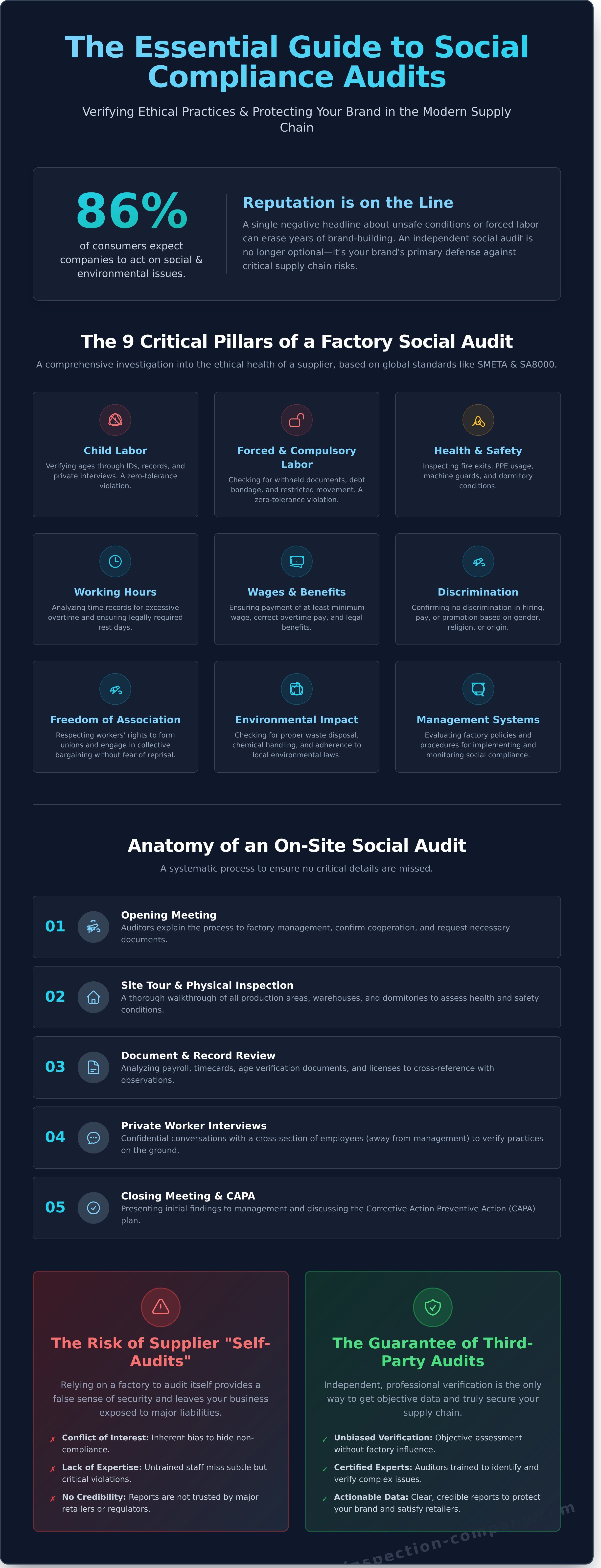
A social compliance audit is not a simple checklist. It's a comprehensive investigation into the operational and ethical health of a supplier. To protect your brand from reputational damage and supply chain disruptions, auditors focus on nine interconnected pillars that reveal a factory's true commitment to safe and fair labor practices. These areas form the foundation of globally recognized standards like SMETA (Sedex Members Ethical Trade Audit) and SA8000.
The most severe violations involve fundamental human rights. Auditors are trained to detect and verify these critical risks:
- Child Labor: This goes far beyond asking for age records. Inspectors cross-reference government-issued IDs, school records, and production rosters. Private, off-site interviews with young-looking workers are essential to confirm ages and uncover any coaching by management.
- Forced Labor: Auditors look for the subtle indicators of modern slavery. Are passports or identity documents withheld? Are workers charged recruitment fees that create debt bondage? Is overtime truly voluntary? A comprehensive audit, as defined by sources like the US Department of Labor on Social Auditing, treats any restriction on a worker's freedom of movement as a zero-tolerance violation.
- Health and Safety (H&S): A safe workplace is a non-negotiable right. Inspectors conduct a thorough physical assessment, checking for clear and unlocked fire exits, functional fire extinguishers, and proper machine guarding. They verify that workers handling chemicals have and use the correct Personal Protective Equipment (PPE). In factories with dormitories, conditions are checked for sanitation, overcrowding, and structural safety, preventing tragedies like the 2013 Rana Plaza collapse.
- Freedom of Association: Workers must have a voice. An audit verifies their right to form or join trade unions and bargain collectively without fear of reprisal. This is often assessed through confidential interviews, where workers can speak freely about their ability to raise grievances.
- Discrimination: A factory's hiring, promotion, and compensation practices must be equitable. Auditors review HR records to ensure there is no evidence of discrimination based on gender, race, religion, age, or disability.
Wages, Hours, and Disciplinary Practices
This pillar exposes the day-to-day reality for employees. A rigorous social compliance audit factory inspection involves a deep dive into payroll records, cross-referencing them with timecards to ensure legal minimum wages and overtime rates are correctly paid. Auditors hunt for "double bookkeeping" systems used to hide illegally long workweeks, which can exceed 70 hours. They also investigate disciplinary policies to ensure they don't include illegal fines, corporal punishment, or verbal abuse.
Environmental and Management Systems
Ethical sourcing extends to environmental responsibility and management integrity. Audits assess the factory’s procedures for handling hazardous waste and controlling emissions, verifying they hold the required local permits. Just as important is an evaluation of the management's commitment to transparency. A management team that is uncooperative or attempts to hide records is a major red flag. This also includes ensuring the audited factory isn't using unapproved subcontractors to hide non-compliant production stages.
Each of these pillars represents a significant risk to your business if left unverified. An on-site audit provides the objective data needed to make informed sourcing decisions and protect your supply chain. You can see our detailed social audit checklist to understand how our experts mitigate these specific risks for global brands.
Step-by-Step: The Anatomy of an On-Site Social Audit
A professional social audit is far more than a simple factory visit. It’s a systematic investigation designed to uncover the reality of a supplier's operations, protecting your brand from the significant risks of non-compliance. Each phase is critical for building a complete and accurate picture. This methodical process, which aligns with principles outlined in the US Department of Labor's guide to social compliance, ensures that findings are verifiable and actionable. The on-site audit unfolds across five distinct stages.
- Opening Meeting: The audit begins with a formal meeting with factory management. The auditor sets a professional tone, confirms the audit scope, outlines the day’s schedule, and requests access to all necessary facilities and documents. This isn't a negotiation; it's a clear statement of purpose to ensure full cooperation.
- Factory Walk-through: This is the "eyes-on" phase. Auditors meticulously inspect all areas, from production lines and chemical storage to canteens and worker dormitories. They are trained to spot immediate risks, such as blocked fire exits (a violation found in over 15% of initial audits in 2023), improper use of personal protective equipment (PPE), or unsanitary living conditions.
- Document Review: Here, auditors scrutinize the paper trail. This includes payroll records, time cards, employee contracts, and safety certifications. The goal is to find inconsistencies that point to deeper problems, a critical step in any social compliance audit factory assessment.
- Worker Interviews: Confidential interviews are conducted with a representative sample of workers, away from the presence of management. This is often where the most critical non-compliance issues, like verbal abuse or forced overtime, are uncovered.
- Closing Meeting: The audit concludes with a summary meeting where the auditor presents initial findings to management. They will outline any non-conformities and introduce the Corrective Action Plan (CAP), which details the required steps and deadlines for remediation.
Document Verification: Spotting Fake Records
A common risk, particularly in Asian factories, is the practice of "double bookkeeping." Management may present a falsified set of records showing legal working hours and pay, while the real records are hidden. Our auditors cross-reference payroll data with production logs, machine operating hours, and even utility bills. A factory claiming an 8-hour workday that shows a 14-hour spike in electricity consumption presents a major red flag for unpaid overtime.
The Importance of Confidential Worker Interviews
Workers often fear losing their jobs if they speak truthfully in front of supervisors. Independent auditors create a secure environment for them to share their real experiences. Experienced inspectors use techniques like asking open-ended questions and observing non-verbal cues to identify "coached" answers. If five different workers give the exact same rehearsed answer about overtime, it’s a clear sign of management interference, and a deeper investigation is required.
Interpreting the Report: Dealing with Critical Findings
Receiving your audit report is the moment of truth. An "all clear" is the goal, but findings of non-compliance are common and require a strategic response, not panic. The results of your social compliance audit factory report are not just a grade; they are a roadmap. How you navigate this map determines the security of your supply chain and the integrity of your brand. Understanding the severity of each finding is the critical first step.
Audit findings are typically categorized into three levels of severity. Each level carries different implications for your production timeline and your relationship with the supplier.
- Minor Non-Compliance: These are typically isolated administrative lapses with low risk. Examples include an incorrectly filed training record from six months ago or a missing signature on a single timesheet. These issues rarely impact shipment and can usually be corrected within 30 days.
- Major Non-Compliance: This indicates a systemic problem that, if left unaddressed, could become a critical risk. Examples include overtime hours consistently exceeding legal limits by 10-15% or inadequate record-keeping for chemical handling. Shipments may be put on hold until a credible Corrective Action Plan (CAP) is in place.
- Critical Non-Compliance: These are "Zero Tolerance" issues that represent a severe breach of ethical standards or an immediate danger to workers. Any finding at this level requires an immediate halt to production and shipment until resolved.
The "Zero Tolerance" List
Certain violations are so severe that they demand an immediate and decisive response. Our auditors classify findings like child labor, any form of forced or bonded labor, and immediate life-threatening safety hazards (such as locked fire exits or exposed high-voltage wiring) as "Zero Tolerance." While this sounds final, it doesn't always mean terminating the contract on the spot. Your legal and ethical obligation is to ensure the issue is remediated, which may involve collaborating with the factory and third-party organizations to protect vulnerable workers.
Managing the Corrective Action Plan (CAP)
A failed audit is an opportunity for improvement. The Corrective Action Plan is the formal tool for this process. It's a document outlining how the factory will fix each non-compliance finding. To be effective, every action item must be SMART: Specific, Measurable, Achievable, Relevant, and Time-bound. For example, instead of "Improve worker safety," a SMART goal would be: "Install machine guards on all 12 stamping presses and conduct mandatory operator safety training by October 31st." Verifying these changes requires a follow-up audit, typically within 60-90 days, to ensure the CAP was implemented correctly and is sustainable.
Navigating a complex CAP can be challenging, especially when dealing with systemic issues. One day of expert guidance can prevent months of costly delays and reputational damage. If your audit reveals major or critical findings, don't leave the solution to chance. Get professional support to manage your factory's Corrective Action Plan and verify true compliance.
Securing Your Supply Chain: Why Professional Third-Party Audits Matter
After understanding the standards and processes, the final and most critical step is implementation. Relying on a factory’s internal reports is a significant business risk. A self-audit is like allowing a student to grade their own exam; the results are predictably skewed and unreliable. True oversight requires an independent, professional partner with an unbiased perspective. This is where a third-party audit becomes an investment in your brand's integrity, not just an expense.
The challenge for Western businesses is often a disconnect between their ethical standards and the operational realities in Asian manufacturing hubs. Our European management team, based directly in Asia, bridges this critical gap. We don't just translate a checklist; we interpret and enforce the spirit of global compliance standards within the local cultural and industrial context. This ensures that your requirements are met with precision, not just acknowledged on paper.
Speed and reliability are paramount in modern supply chains. Delays in information lead to delays in decisions, which can halt production or shipment. We deliver a comprehensive audit report within 24 hours of the site visit. With a network of over 700 trained inspectors across Asia, we guarantee 100% transparency and on-the-ground verification, providing you with the actionable intelligence you need to move forward with confidence.
Risk Mitigation: One Day of Inspection Saves Months of Trouble
A single day on-site for a social compliance audit factory can prevent catastrophic financial and reputational damage. The return on investment is immediate and substantial when measured against the potential costs of non-compliance. Consider these critical points:
- Cost-Benefit Analysis: The average cost of a third-party audit is a fraction of the fallout from a supply chain scandal. A 2018 report found the average product recall costs a company $10 million in direct costs alone, excluding the immense brand damage.
- Protect Your Marketplace Access: Platforms like Amazon have strict Supply Chain Standards. A suspension for "unethical sourcing" can instantly freeze your listings, inventory, and revenue streams, taking months to resolve.
- Future-Proof Your Business: Upcoming regulations like the EU's Corporate Sustainability Due Diligence Directive (CSDDD), set to take effect for some companies as early as 2027, will legally mandate supply chain scrutiny. Proactive audits build the resilient framework you'll need to compete.
How to Book Your First Social Compliance Audit
Initiating an audit is a straightforward process designed to get you answers quickly. You don't need to be a compliance expert; that's our job. Our simple 3-step process ensures a smooth and efficient experience from start to finish.
To begin, you only need to provide your inspection partner with a few key details: the factory's full name and address, a primary contact person, the total number of workers, and your preferred audit date. From there, we handle the rest.
The process is simple:
- Request: Submit your audit request with basic factory information.
- Coordination: Our team contacts the factory to schedule the on-site visit, handling all logistics.
- Reporting: You receive a detailed, actionable report in your inbox within 24 hours of the audit's completion.
Don't leave your brand's reputation to chance. A professional social compliance audit factory is the ultimate safeguard for your supply chain and your bottom line. Protect your brand today-get an instant audit quote from The Inspection Company.
Fortify Your Supply Chain for 2026 and Beyond
Navigating the complexities of global sourcing requires more than a handshake agreement. A thorough understanding of the nine critical compliance pillars is essential for protecting your brand from reputational damage and operational risks. A professional social compliance audit factory report provides the transparent, actionable data you need to make informed decisions and enforce corrective action plans effectively. Don't leave your supply chain vulnerable to critical failures.
The Inspection Company brings over 25 years of specialized experience in Asian quality management directly to your partners. Our European management guarantees that Western quality standards are upheld on the ground, delivering detailed audit reports within 24 hours of inspection. It’s the clarity you need to prevent problems before they impact your business and your customers.
Avoid costly surprises-book your factory social compliance audit now
Take control of your supply chain's integrity and build a more resilient, ethical business.
Frequently Asked Questions
What is the difference between a social audit and a quality audit?
A social audit assesses a factory's adherence to ethical labor practices, health, and safety standards. It focuses on people, examining worker interviews, payroll records, and facility safety. In contrast, a quality audit evaluates a factory's manufacturing processes and systems to ensure product quality and consistency. It focuses on the product and the systems that create it, such as ISO 9001 compliance. One protects your brand's reputation, the other protects your product's integrity.
How much does a social compliance audit cost in China or Vietnam?
A social compliance audit typically costs between $600 and $1,200 USD per auditor-day. The final price depends on the specific audit standard, such as SMETA or BSCI, and the factory's size, which determines the number of auditor-days required. A small facility with 150 workers might require one day, while a larger one with over 750 workers could need two or more auditors for a comprehensive assessment. It's a small investment to prevent significant supply chain risks.
Can a factory "fake" a social compliance audit?
Yes, factories can attempt to deceive auditors. This is a significant risk. Deception can include coaching workers on what to say, presenting falsified payroll and timecard records, or hiding underage workers. Some factories even maintain two sets of books. Using an experienced, independent third-party auditing firm is the most effective way to mitigate this risk. Our auditors are trained to identify inconsistencies between documents, interviews, and visual observations to uncover the truth.
Which social audit standard is best: SMETA, BSCI, or SA8000?
The best standard depends on your specific market and supply chain requirements. SMETA is one of the most widely recognized standards globally, accepted by many retailers in the UK and US. BSCI (amfori) is prevalent among European companies and focuses on a developmental approach to improving supplier conditions. SA8000 is a more rigorous certification standard, ideal for brands wanting to demonstrate the highest level of social accountability. We can help you determine the right fit for your business.
What happens if my factory fails the social compliance audit?
A failed audit initiates a formal corrective action process. The factory receives a Corrective Action Plan (CAP) detailing all non-conformities and is typically given 30 to 90 days to resolve them. A follow-up audit is then scheduled to verify the fixes have been implemented effectively. While critical violations like forced labor can lead to immediate disqualification, most failures are an opportunity for the supplier to improve their operations with your guidance.
How often should I conduct social audits on my suppliers?
You should conduct a social compliance audit on your factory partners annually. This is the industry standard for maintaining visibility and ensuring ongoing adherence to ethical practices. For suppliers deemed high-risk or those who have previously failed an audit with major non-conformities, we recommend a more frequent schedule of every six months. Regular audits demonstrate due diligence and protect your brand from the reputational damage of an unethical supply chain.
Do Amazon sellers need social compliance audits for their factories?
Yes, Amazon sellers, particularly those with private-label brands, increasingly need these audits. Amazon's Supply Chain Standards explicitly require suppliers to uphold ethical labor practices. While not yet enforced on every seller, Amazon can request a valid social compliance audit factory report at any time. Failure to produce one can risk product delisting or account suspension. Proactive audits are a critical step to secure your Amazon business for the long term and meet rising consumer expectations.
How long does it take to get the final audit report?
You will receive your comprehensive, official audit report within 3 to 5 business days after the on-site visit is complete. Immediately after the audit, our inspector conducts a closing meeting with factory management to discuss the initial findings and critical issues. This gives you immediate insight, but the detailed report provides the complete analysis, photographic evidence, and a formal Corrective Action Plan to drive necessary improvements without delay.