
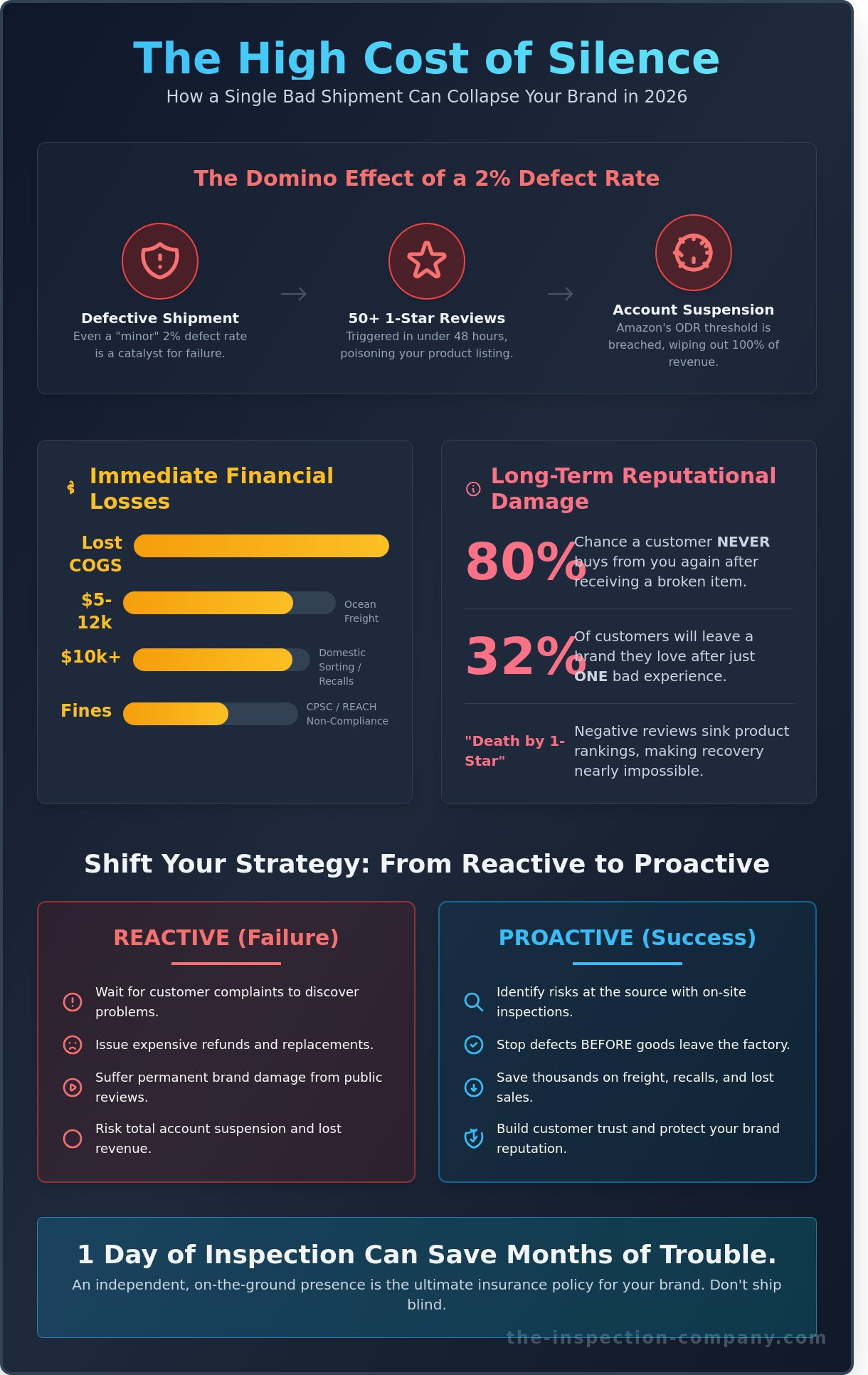
What if a single shipment of defective goods could trigger 50 one star Amazon reviews in 48 hours and lead to a permanent account suspension? You likely already realize that sourcing from global manufacturing hubs offers essential scale, but the persistent lack of control over overseas factory floors remains a constant source of anxiety. It's a justified concern. Even a 2% defect rate can be the catalyst for a total brand collapse. Protecting brand reputation with quality control is no longer a secondary task; it's the most critical insurance policy for your business in 2026.
Our goal is to help you avoid costly surprises before shipment. One day of inspection can save months of trouble. In this guide, you'll discover how a robust quality control strategy acts as the ultimate shield for your brand reputation when sourcing from international partners. We will provide the practical steps to implement an inspection plan that secures your supply chain integrity and protects your bottom line from the high costs of product recalls. By the end, you'll have the confidence to manage your manufacturing with European management standards and precision.
Key Takeaways
- Understand why quality control serves as the physical manifestation of your brand promise and the foundation of long-term customer trust.
- Identify the hidden financial and reputational risks of manufacturing failures, from immediate refund costs to the erosion of customer lifetime value.
- Master a three-step strategy for protecting brand reputation with quality control by implementing non-negotiable standards and multi-stage inspection schedules.
- Discover why the "Independent Eye" principle is essential for moving beyond basic checklists to secure comprehensive brand insurance.
- Learn how an on-the-ground local presence overcomes geographical and cultural challenges to stop costly surprises before your shipment sails.
The Invisible Link: How Quality Control Defines Your Brand Reputation
Brand reputation isn't just a marketing concept; it's the cumulative trust built through consistent product performance over time. When you source goods internationally, your brand promise is only as strong as the physical items that land on your customer's doorstep. Quality control serves as the tangible manifestation of that promise. It's the difference between a loyal advocate and a public refund request.
Importers often face a dangerous "Expectation vs. Reality" gap. A sample might look perfect in January, but the mass production batch in June could arrive with 15% more defects than agreed upon. This discrepancy happens because of material substitutions, factory staff turnover, or rushed production schedules. Protecting brand reputation with quality control requires closing this gap before goods leave the factory floor. If the reality of the product fails to meet the expectation set by your marketing, the brand suffers immediate, often irreversible damage.
Independent inspection services act as your eyes and ears on-site. They provide the objective data needed to make informed shipping decisions. By utilizing a third-party partner, you ensure that your brand remains synonymous with reliability and professional standards.
Why Quality is the Bedrock of Customer Trust
Trust is fragile. A study by PwC found that 32% of customers will stop doing business with a brand they love after just one bad experience. In the age of digital transparency, a single defective batch can trigger a cascade of 1-star Amazon reviews that permanently lower your conversion rate. These negative reviews act as a multiplier, reaching thousands of potential buyers before you even realize a problem exists.
Consumers also use sensory cues to judge value. A product that feels lightweight or has a rough finish signals "cheap" to the brain, regardless of the price. Consistent QC ensures these premium markers remain intact across every unit. When a customer feels the weight and finish of a high-quality product, they're subconsciously validating their decision to trust your brand.
The Shift from Reactive to Proactive Brand Protection
Traditional sourcing often relies on reactive measures, like issuing refunds after a customer complains. This is an expensive way to fail. Proactive brand protection means identifying risks at the source. It’s a strategic investment that pays for itself by avoiding the $10,000+ costs often associated with sorting defective stock at a domestic warehouse or managing a product recall.
Protecting brand reputation with quality control is most effective at two critical stages. Pre-production inspections verify raw materials before assembly starts, while Pre-shipment inspections (PSI) offer the final chance to stop errors before they sail. Moving from "fixing" to "preventing" secures your bottom line and your name. One day of inspection can save months of trouble and thousands of dollars in lost customer lifetime value.
The High Cost of Silence: Financial and Reputational Risks of QC Failures
Protecting brand reputation with quality control isn't just a marketing slogan; it's a financial survival strategy for 2026. When a shipment arrives with a 15% defect rate, the immediate costs are staggering. You're looking at the total loss of COGS (Cost of Goods Sold), the $5,000 to $12,000 spent on ocean freight, and the administrative burden of processing thousands of refunds. These direct hits to your balance sheet are only the beginning of the damage.
The indirect costs often outweigh the initial loss. A high return rate destroys your Customer Lifetime Value (CLV). If a customer receives a broken item, there's an 80% chance they'll never buy from your brand again. For Amazon sellers, the stakes are even higher. Amazon’s ODR (Order Defect Rate) must stay under 1% to keep an account in good standing. Crossing this threshold triggers immediate account suspension, which can wipe out 100% of your revenue in a single afternoon. A single batch of faulty electronics leads to a "Death by 1-Star" scenario where your product ranking drops from page 1 to page 20, making recovery nearly impossible without massive PPC spending.
- Legal Risks: Shipping non-compliant goods can lead to fines from agencies like the CPSC or REACH.
- Lost Sales: Stockouts caused by rejected shipments mean your competitors capture your market share.
- Storage Fees: Defective inventory sits in 3PL warehouses, accruing daily storage costs while you decide how to dispose of it.
Product Recalls: The Brand Killer
Cross-border recalls are a logistical nightmare. If a consumer product fails safety standards, you're responsible for the reverse logistics from thousands of individual homes. Major retailers like Walmart or Target charge significant "chargebacks" for non-compliance and won't hesitate to pull your entire line if a single SKU shows a 3% failure rate. Imagine a small kitchen appliance brand that skips a final check. A small wiring defect leads to a mandatory safety recall. The $150,000 in recall logistics and legal fees often exceeds the company's annual profit, leading to total brand collapse.
Hidden Costs of 'Supplier-Only' Quality Reports
Relying on a factory to grade its own work is a fundamental conflict of interest. Suppliers often present a "Golden Sample" during the prototype phase that uses premium materials. During mass production, they might swap components to save 8% on material costs. Without quality inspection services that are independent, you won't know about these changes until the goods reach your warehouse. Professional inspectors remove bias by following strict AQL (Acceptable Quality Limit) standards, ensuring the production matches the approved sample. It's much cheaper to catch an error in the factory than at your customer's doorstep. One day of inspection can save months of trouble.
Strategic Quality Control: Moving Beyond Checklists to Brand Insurance
Quality control isn't just a logistical hurdle. It's your most effective form of brand insurance. In 2026, the cost of a single product recall can exceed $10 million for mid-sized importers. Protecting brand reputation with quality control means moving away from simple "pass/fail" mindsets toward a comprehensive risk management strategy. One day of inspection can save months of trouble, especially when operating in complex Asian manufacturing hubs.
QA vs. QC: Which Protects Your Reputation More?
Many importers confuse Quality Assurance (QA) with Quality Control (QC). They aren't the same. QA focuses on the process. It's about preventing defects before they occur. QC focuses on the product. It's about identifying defects before they reach your customers. To survive a competitive market, you need both. A factory audit verifies the "process" by checking if the supplier's systems are robust. A Pre-Shipment Inspection (PSI) verifies the "result" by examining the actual goods. Without QA, your QC will constantly find errors. Without QC, your QA remains unproven.
The "Independent Eye" principle is essential here. Factory-owned QC teams often face internal pressure to hit shipping quotas. They might overlook a 5% defect rate to keep the assembly line moving. A third-party inspector has no such conflict. They provide a transparent, unbiased report that reflects the true state of your shipment. This objectivity is bolstered by European management standards. These standards align Western quality expectations with Asian production capabilities to ensure nothing is lost in translation.
The Role of Factory Audits in Supplier Vetting
Successful importing begins long before the first unit is produced. A supplier's social compliance and ethical standing are now as critical as their technical capacity. If a factory fails an audit for poor working conditions, your brand's reputation is at risk. There's also a direct link between factory organization and product consistency. A cluttered, poorly managed shop floor leads to a 25% higher chance of "critical" defects during final production. At The Inspection Company, we've spent over 25 years vetting suppliers to ensure they meet the rigorous standards our clients demand.
Defining your Acceptable Quality Level (AQL) is the final step. This is your reputation threshold. It's a statistical tool that determines how many defects are "acceptable" before a batch is rejected. For high-precision goods, an AQL of 1.0 for major defects is often the limit. If you accept a higher AQL just to save on costs, you're essentially gambling with your brand's future. Protecting brand reputation with quality control requires setting these limits early and refusing to compromise on them.
Building a Reputation-First Quality Control Strategy in 3 Steps
Protecting brand reputation with quality control starts with a shift from reactive damage control to proactive prevention. One day of inspection can save months of trouble; it's the difference between a successful product launch and a logistical nightmare. To secure your supply chain for 2026, you must move beyond occasional spot checks and implement a systematic approach that eliminates ambiguity.
Defining Your Quality Standard
You can't expect a factory to meet standards you haven't clearly defined. A robust inspection checklist is your first line of defense, covering aesthetics, mechanical function, and specialized safety requirements. Your checklist should categorize defects into three specific tiers: critical, major, and minor. A Critical Defect is any issue that poses a safety risk to the user. Major defects usually render the product unsaleable, while minor defects are slight deviations from the "golden sample" that don't affect function.
Most professional importers utilize the ISO 2859-1 standard (AQL) to set non-negotiable limits. For example, setting a 0% limit for critical defects and a 2.5% limit for major defects creates a clear "Pass/Fail" framework. This objective data prevents suppliers from negotiating their way out of poor craftsmanship.
The Power of Data and Transparency
Managing production across oceans requires more than just trust. You need centralized oversight. Using a digital Quality Platform allows for global oversight from your desk, giving you a bird's-eye view of every factory's performance. When data is centralized, you can identify if a specific supplier's defect rate has increased by 12% over the last two quarters, allowing you to intervene before a crisis occurs.
High-resolution photo and video evidence are mandatory for brand protection. You shouldn't rely on a written "OK" from a factory manager. Detailed visual documentation provides the proof needed to hold manufacturers accountable and ensures that what you see in the report is exactly what's loaded into the container.
To stay ahead of the curve, implement a multi-stage inspection schedule:
- Pre-Production Inspection (PPI): Verify raw materials and components before assembly begins to avoid using sub-standard inputs.
- During Production Inspection (DuPro): Conduct this when 20% to 50% of the order is finished to catch systemic errors early.
- Pre-Shipment Inspection (PSI): This is your final gatekeeper, performed when 100% of the goods are produced and at least 80% are packed.
Speed is just as vital as accuracy. We prioritize 24-hour reporting because a delay in information is a delay in decision-making. If a shipment fails PSI, you need that data immediately to stop the balance payment and order repairs. By following these three steps, you create a shield for your business, effectively protecting brand reputation with quality control measures that leave nothing to chance.
Independent Verification: Why On-the-Ground Presence is Your Ultimate Shield
Importers face a physical impossibility: you can't be in 10 factories across different provinces at the same time. Relying on factory-sent photos is a gamble that often results in a 15% to 20% defect rate in unmonitored shipments. On-the-ground presence is the only way to verify reality. Local inspectors bring a critical advantage because they understand the local dialect and cultural nuances that Western buyers often miss. They spot the "red flags" in a factory's behavior before a single product is even packed. This local insight is your primary defense against hidden shortcuts.
Our European management model provides a unique bridge. It combines Western quality standards and rigorous reporting with local execution. This ensures your technical specifications are followed to the letter, removing the risk of requirements being lost in translation. It's about having a seasoned expert who represents your interests exclusively. This level of oversight is essential for protecting brand reputation with quality control. As we always say: one day of inspection saves months of trouble.
Stopping Problems Before They Sail
The Pre-Shipment Inspection (PSI) represents your last window of leverage. Once the goods are on the water and the final balance is paid, your bargaining power vanishes. When a factory knows an independent inspector will arrive, the psychological impact is immediate; they often self-correct up to 30% more defects during the production phase. If an inspection fails, it's a professional crossroad, not a relationship-ender. You use the data-backed report to demand re-work or replacements. This systematic approach is the only reliable way of protecting brand reputation with quality control before products reach your warehouse.
Scaling Your Business Securely
Scaling requires constant experimentation with new suppliers and product lines. In 2024, industry data indicated that 40% of new supplier partnerships fail within 12 months due to quality drift. Using independent QC allows you to vet these new partners without endangering your established brand equity. A Container Loading Inspection (CLI) is the final piece of the puzzle. It verifies that the exact quantity of goods is loaded and that the carton handling prevents transit damage. You don't have to guess if your shipment is correct; you have the proof. Secure your brand reputation with professional inspection services and stop problems before they reach your customers.
Secure Your Market Position for 2026
Importers face higher stakes than ever as we move toward 2026. A single shipment of defective goods doesn't just waste capital; it erodes the trust you've built with your customers over years. Transitioning from basic checklists to a reputation-first strategy ensures that quality control acts as your ultimate brand insurance. By prioritizing independent verification on the factory floor, you eliminate the risks of silence and hidden defects before they reach your warehouse. Protecting brand reputation with quality control requires a partner who understands the ground reality in Asia. The Inspection Company brings over 25 years of experience to your supply chain. Our European management team leads a network of 700+ local inspectors to ensure every detail meets your specifications. We deliver detailed reports within 24 hours of the site visit, so you never have to wait to make critical shipping decisions. One day of professional inspection saves months of logistical trouble. Avoid costly surprises; book your professional inspection today. It's time to take full control of your quality standards and build a brand that customers can rely on for years to come.
Frequently Asked Questions
How does quality control directly impact my brand's bottom line?
Quality control prevents massive financial losses by stopping defective goods before they leave the factory. Protecting brand reputation with quality control ensures you don't face return rates that often exceed 20% in the consumer electronics sector. One day of inspection saves months of legal trouble and thousands in shipping costs for unsellable inventory. You maintain your margins by avoiding the 3x cost multiplier associated with replacing a faulty product after it reaches a customer's hands.
Can I rely on my factory's internal quality control reports?
You shouldn't rely solely on internal reports because factories have a natural conflict of interest. Independent audits regularly find 35% more critical defects than a factory's own team reports. An independent report provides a transparent, unbiased view of the production line. It's the only way to verify that your specific requirements are met without the supplier hiding errors to meet their internal shipping deadlines.
What is the difference between Pre-Shipment Inspection and a Factory Audit?
A Pre-Shipment Inspection (PSI) focuses on the physical goods, while a Factory Audit evaluates the supplier's reliability and capacity. During a PSI, we check the order's packaging and a sample of the products for functional defects. A Factory Audit, usually based on ISO 9001 standards, examines business licenses, machinery maintenance, and quality management systems. Use an audit to vet a new partner and a PSI to verify a specific shipment's quality.
How much should I expect to pay for third-party quality control?
Most professional firms charge a flat rate starting at $300 per man-day for inspections in major Asian manufacturing hubs. This investment is minimal compared to the $15,000 cost of a rejected sea freight container. The price typically includes the inspector's travel, the full day of onsite testing, and a detailed PDF report delivered within 24 hours. For a standard order of 5,000 units, one or two man-days are usually sufficient to ensure compliance.
What happens if a product inspection fails just before shipping?
If an inspection fails, the factory is required to sort and rework the defective units at their own expense. You shouldn't authorize shipment or release final payment until a re-inspection confirms the issues are resolved. We've seen cases where failing to re-inspect led to a 100% loss of the shipment's value. Using a professional report as leverage allows you to demand corrective actions before the goods leave the country.
How do I know which quality standards (AQL) are right for my brand?
Most importers use the ISO 2859-1 standard, specifically a Level II inspection with a 2.5 limit for major defects. This means if a sample of 200 units has more than 10 major defects, the lot fails. Protecting brand reputation with quality control requires tighter limits, such as a 1.0 AQL for high-end luxury goods or medical devices. We help you select these limits based on your specific risk tolerance and product category requirements for 2026.
Why is an on-the-ground presence in Asia better than remote management?
Remote management relies on photos that the factory selects, which often hide systemic issues. An on-the-ground presence allows for random sampling and immediate verification of the production status. With over 25 years of experience in Asia, we know that physical presence stops factories from cutting corners to save costs. You get a transparent view of the factory floor that a video call or email chain simply cannot provide.
Can quality control help me with Amazon FBA compliance?
Quality control is essential for Amazon FBA because it verifies that every carton meets specific labeling and weight requirements. We check FNSKU barcodes, Suffocation Warnings, and "Sold as Set" stickers to prevent Amazon from rejecting your inventory. Amazon rejects roughly 15% of shipments that don't meet their strict labeling rules. Our inspectors follow a 10-point checklist specifically designed to meet Amazon's updated 2026 fulfillment standards.