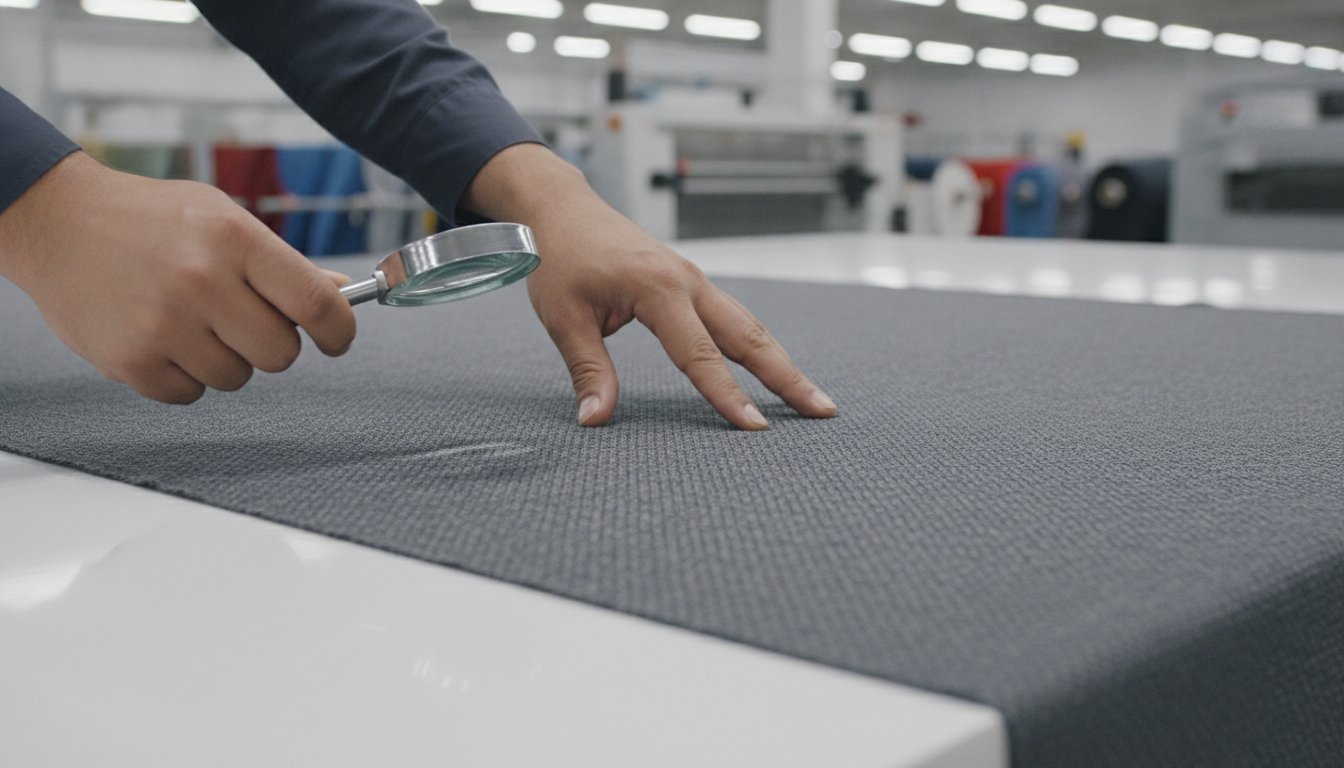

You’re staring at an inspection report, and a wave of uncertainty hits. Is a loose thread a deal-breaker? Is that small scratch acceptable, or a sign of bigger problems? Making the final pass/fail decision on a shipment worth thousands of dollars can feel like a gamble without objective standards. This is where a robust system for product defect classification becomes your most valuable asset in international sourcing, transforming ambiguity into clear, actionable data.
Without a defined framework, you risk a costly communication gap with your supplier, where your definition of 'good enough' may not align with theirs. This ambiguity leaves your business exposed to defective goods, customer returns, and damage to your hard-earned brand reputation. The key to avoiding these costly surprises is establishing a shared language for quality before your shipment is packed and ready to sail.
This guide will demystify the process. We will walk you through the industry-standard AQL framework, teaching you how to categorize defects as Minor, Major, or Critical. You will gain the tools to set unambiguous quality standards, effectively communicate them to your factory, and make confident, data-driven decisions that protect your investment and your brand.
Key Takeaways
- Move beyond subjective quality checks by establishing a clear standard that your supplier and inspector both understand.
- Master the AQL framework to classify defects as Minor, Major, or Critical based on their impact on product safety and usability.
- Effective product defect classification is the foundation for making objective, data-driven pass/fail decisions on your shipments.
- Translate your quality standards into a detailed defect checklist to provide your inspector with clear, actionable instructions.
Why Product Defect Classification is Your First Line of Defense
In international trade, subjective assessments of quality like "good" or "bad" are unreliable and lead to costly disputes. To protect your investment and your brand, you must move beyond ambiguity. A systematic product defect classification process is your first and most critical line of defense, establishing a universal language for quality that is understood by your team, your supplier, and your third-party inspectors.
By defining and categorizing potential defects before production begins, you create clear, non-negotiable standards. This proactive approach transforms quality control from a reactive problem into a managed process. It allows you to catch issues at the source, mitigate financial risk before final payment, and ultimately safeguard your brand’s reputation from the damage of negative reviews and product returns.
The Cost of Unclassified Defects
Failing to define quality standards opens your business to significant and avoidable risks. Ambiguity in your supply chain almost always translates into tangible losses. These consequences include:
-
Financial Loss: Unexpected costs from product rework, customer returns, shipping fees for defective goods, and completely unsellable inventory can destroy your profit margins.
-
Supply Chain Delays: A rejected shipment due to quality failures means missed deadlines, stock-outs, and lost sales opportunities while you wait for replacements.
-
Brand Damage: When poor-quality products reach your customers, the resulting dissatisfaction leads to negative reviews, loss of trust, and long-term harm to your brand's reputation.
-
Supplier Disputes: Without clear, pre-agreed standards, arguments over who is at fault for defects are inevitable, straining relationships and leading to costly resolutions.
Setting Expectations with Your Supplier
A comprehensive defect list is more than an internal tool; it is a cornerstone of a healthy supplier relationship. It removes ambiguity from your manufacturing agreement and empowers your supplier to conduct more effective internal quality control, as they know exactly what you will be looking for. This clarity provides an objective basis for accepting or rejecting a shipment, often guided by statistical sampling methods outlined in The AQL Standard. This formal product defect classification ensures both parties are aligned, minimizing friction and protecting your final product quality.
The AQL Standard: Understanding Minor, Major, and Critical Defects
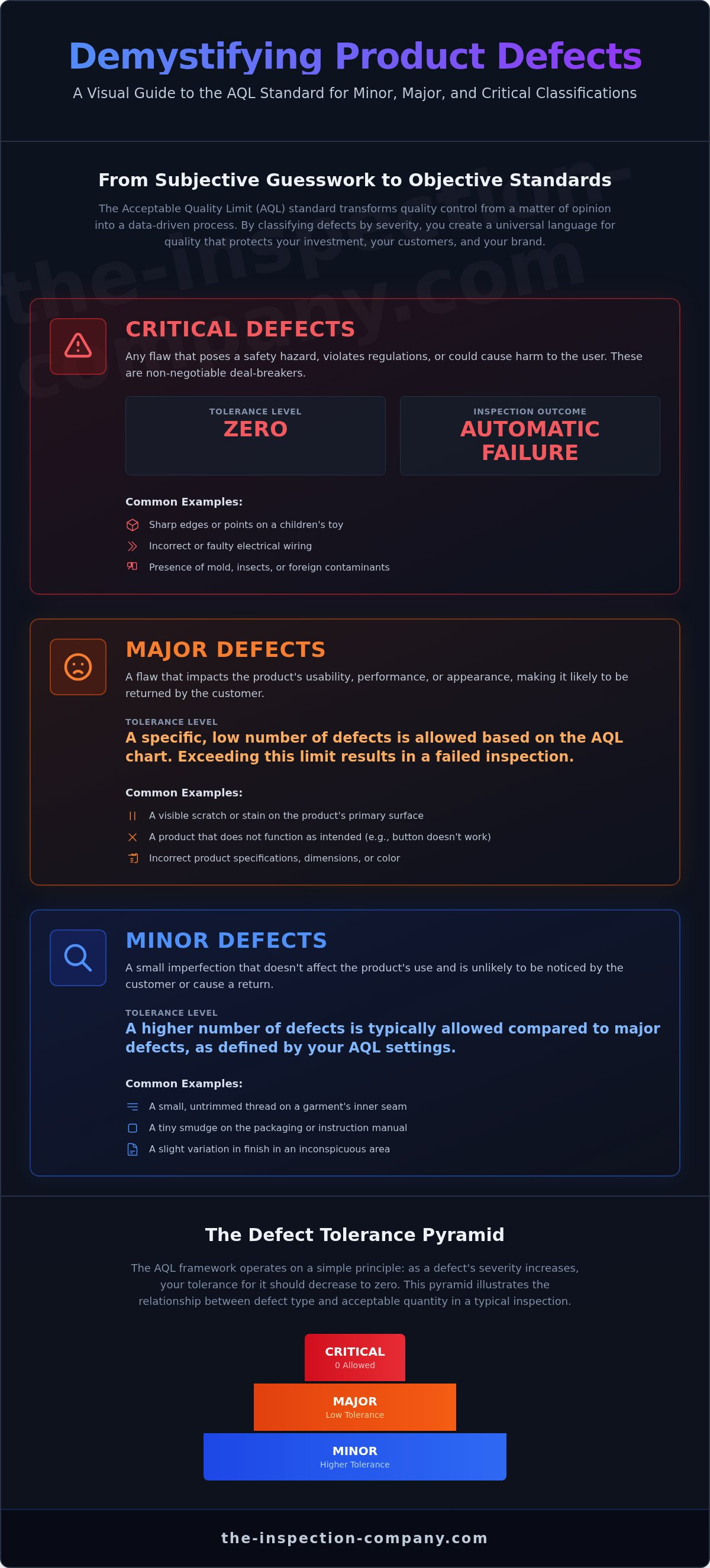
To move from subjective opinion to objective data, the global quality control industry relies on the Acceptable Quality Limit (AQL) standard. This is the essential framework for product inspection, providing a statistically valid method for sampling a shipment and classifying defects based on their severity. This systematic approach to product defect classification ensures that inspection results are consistent, repeatable, and based on international standards, not a factory manager's opinion. The AQL system serves as a business's first line of defense against substandard goods.
Defects are not created equal. Their potential impact on your customer and your brand determines how they are categorized. The number and severity of defects found during an inspection directly determine whether a shipment passes or fails, protecting you from costly returns, reputational damage, and potential liability.
Critical Defects: The Deal-Breakers
A critical defect is the most severe type of issue, defined as any flaw that could pose a safety hazard to the user or violates mandatory regulations. These are non-negotiable failures that can lead to product recalls, legal action, and irreparable harm to your brand. The tolerance for critical defects is always zero. Discovering even one is enough to trigger an automatic failure for the entire inspection.
-
Examples: Sharp edges on a children's toy, incorrect or faulty electrical wiring, the presence of mold or insects in packaging, or using a banned chemical.
-
Action: Immediate rejection of the entire production lot is the standard and recommended practice.
Major Defects: The Functionality Failures
A major defect is a flaw that is likely to be noticed by the customer and could result in the product being returned. These defects typically impact the product's usability, performance, appearance, or salability. While not inherently dangerous, they represent a failure to meet the customer's basic expectations and can significantly damage your market reputation. Your AQL standard will define the maximum acceptable number of major defects.
- Examples: A non-functioning button on an electronic device, visible scratches or cracks on a product's surface, or incorrect stitching that compromises a garment's durability.
Minor Defects: The Small Imperfections
A minor defect is a small discrepancy that does not affect the product's function or form and is unlikely to be noticed by most customers. These are typically slight aesthetic issues that fall short of your brand's quality standards but won't lead to a product return. While a single minor defect is rarely a concern, a high quantity can indicate a lack of attention to detail in the production process. A higher number of minor defects is generally acceptable within AQL limits compared to major defects.
- Examples: A tiny, untrimmed thread on an inside seam, a minuscule paint bubble in an inconspicuous area, or a small smudge that can be easily wiped off.
Real-World Examples: Classifying Defects Across Product Categories
Effective product defect classification is never one-size-fits-all; it is highly specific to the product in question. A flaw considered minor for a low-cost promotional item could be a major defect for a premium luxury good, leading to costly returns and significant brand damage. Your classification system must account for the product's intended function, price point, and the expectations of your target market.
To minimize subjectivity and ensure your quality control team and supplier are aligned, it is essential to develop a detailed and objective defect classification checklist for each product. Use the following industry examples as a reliable framework to build your own list and avoid costly surprises before your shipment sails.
Garments & Textiles
In the apparel industry, defects can range from minor aesthetic issues to critical safety hazards that can halt a shipment. A clear definition protects both the end-user and your company's reputation.
-
Critical: A broken needle, pin, or other sharp object left in a garment, posing a direct injury risk to the consumer.
-
Major: Incorrect sizing beyond tolerance, open seams, holes in the fabric, or a significant color mismatch from the approved sample.
-
Minor: A few untrimmed threads, a slightly crooked interior label, or a small crease from packaging.
Consumer Electronics
For electronics, defects often relate directly to functionality, performance, and safety, where failures can have severe consequences. The margin for error is extremely low.
-
Critical: Faulty wiring, improper insulation, or battery defects that present a fire or electric shock hazard.
-
Major: The device fails to power on, a cracked screen, non-functional buttons or ports, or failure to connect to Wi-Fi/Bluetooth.
-
Minor: Small cosmetic scratches on the casing, a slight deviation in the housing color, or minor smudges that can be cleaned.
Hard Goods (e.g., Furniture, Kitchenware)
This broad category, including items like furniture, kitchen tools, and home decor, prioritizes structural integrity, durability, and final finish. Defects here can render a product unsafe or unusable.
-
Critical: Structural instability in a chair or table that could lead to collapse and injury; presence of lead paint.
-
Major: Deep scratches on primary surfaces, incorrect assembly dimensions preventing proper use, or missing essential hardware.
-
Minor: A small paint chip or blemish on an unexposed or hidden surface, such as the underside of a shelf.
How to Create an Objective Defect Classification Checklist
Your quality inspection checklist is the single most important document you will provide to your inspector. It is more than a simple list; it is the tool that translates your quality standards into clear, actionable instructions. A vague or incomplete checklist leads to inconsistent results and disputes with your supplier. A detailed one ensures every inspection is performed to the same objective standard, every time.
This document is essential for minimizing risk and holding your factory accountable. By clearly defining what constitutes a defect and its severity, you create a powerful system for managing quality. An effective checklist is the foundation of any successful product defect classification strategy.
Step 1: Brainstorm and List Potential Defects
Begin by compiling a comprehensive list of every potential issue that could arise with your product. This requires a thorough analysis from multiple angles. To create a robust list, you should:
-
Review past data: Analyze customer complaints, return reasons, and previous inspection reports to identify recurring problems.
-
Examine competitor products: Look at reviews and common failure points for similar items on the market.
-
Think holistically: Consider every aspect of your product, including raw materials, individual components, assembly, functionality, aesthetics, and even shipping packaging.
Step 2: Classify Each Defect as Minor, Major, or Critical
With your list of potential issues, the next step is to classify them. This process removes subjectivity from the inspection. For each item, ask the critical question: "Would a customer in my target market be likely to return the product for this?" This framework helps you assign a severity level based on impact-from safety and functionality to simple aesthetics. Be specific. "Bad stitching" is subjective; "Open seam longer than 1cm on a primary seam" is a clear, measurable standard.
Step 3: Define Your AQL Tolerances
A perfect production run is rare. You must decide your tolerance for error by setting your Acceptable Quality Limits (AQL). This involves determining the maximum number of minor and major defects you will accept in a given shipment. Your AQL is based on your risk tolerance and market positioning-a luxury good will have a much stricter AQL than a disposable one. Using a standard AQL table allows you to systematically set your inspection level and limits, providing a clear pass/fail result.
Building a truly effective product defect classification checklist takes experience. If you need help translating your quality standards into a document that protects your investment, our experts can guide you.
Making the Call: How Classification Informs Pass/Fail Decisions
The inspection is complete, and the data is in. This is the critical moment where a well-defined product defect classification system proves its value. Instead of relying on guesswork or emotional reactions, you can now make a clear, data-driven decision. This objective approach removes ambiguity, providing you with a solid foundation to either accept or reject a shipment and protecting your business from the high costs of poor quality.
Reading Your Inspection Report
Your professional inspection report is the official record of your product's quality status. It provides a concise summary of all findings, detailing the exact number of critical, major, and minor defects found within the sample size. More importantly, the report compares these defect counts directly against your pre-defined AQL (Acceptable Quality Limit) tolerances, generating a clear "Pass," "Fail," or "Pending" result. High-resolution photos and detailed descriptions of each defect provide indisputable evidence to support the findings.
Communicating with Your Supplier After a Failed Inspection
A failed inspection does not have to result in a contentious dispute. When you share a detailed, third-party report with your supplier, the conversation shifts from opinion to fact. The objective data makes your position clear and defensible, paving the way for a productive discussion about corrective actions. Common solutions include:
-
Sorting: The factory inspects 100% of the production lot to find and remove all defective units.
-
Reworking: The supplier fixes the identified defects on the faulty products to bring them up to standard.
-
Remaking: In cases of widespread or critical issues, the supplier agrees to re-manufacture all or part of the order.
The Role of a Third-Party Inspector
An independent inspector is your most valuable asset in enforcing your quality standards. They act as your unbiased representative on the factory floor, ensuring your requirements are met without compromise. Their expertise guarantees that your product defect classification system is applied correctly and consistently, which is essential for reliable data. An inspector's detailed report provides the actionable evidence you need to hold your supplier accountable and stop problems before your shipment sails. Get an instant quote for your next shipment inspection.
Secure Your Shipments with Objective Classification
Mastering quality control begins with a clear, systematic approach. As we've covered, understanding the AQL standard and creating an objective checklist are your primary defenses against costly returns and brand damage. Effective product defect classification transforms subjective quality concerns into actionable data, allowing you to make informed pass/fail decisions with confidence and protect your investment before it ever leaves the factory.
You don't have to manage this critical process alone. The Inspection Company provides the independent, on-the-ground expertise you need to enforce your standards. With European management and over 700 inspectors across Asia, we act as your eyes and ears on the factory floor. You receive detailed inspection reports with high-resolution photos within 24 hours, giving you the clarity to approve or reject shipments decisively.
Don't leave your quality to chance. Stop problems before they ship. Book your independent inspection today. Take control of your supply chain and ship every order with complete peace of mind.
Frequently Asked Questions About Product Defect Classification
What is the difference between defect classification and AQL?
Defect classification defines what constitutes a minor, major, or critical defect for your product. In contrast, the Acceptable Quality Limit (AQL) defines how many of those defects are permissible in a shipment before it fails inspection. A comprehensive product defect classification list is the essential foundation upon which your AQL standards are applied, ensuring your quality expectations are objectively measured and enforced by an independent inspector during a pre-shipment inspection.
Can a defect be 'minor' for one brand but 'major' for another?
Absolutely. The severity of a defect is directly tied to your brand's quality standards and the product's intended use and price point. For example, a small scratch on an industrial-grade tool might be a minor issue. However, the exact same scratch on a premium leather handbag would likely be classified as a major defect, as it severely impacts the product's aesthetic value and marketability. This is why a customized checklist is essential to protect your brand.
How many defects are typically acceptable in a shipment?
The number of acceptable defects is not a fixed figure; it is determined by the AQL standards you set for your inspection. A common industry standard is AQL 2.5 for major defects and 4.0 for minor defects, with a zero-tolerance policy for critical defects. For a given sample size, this means the number of defects found must not exceed the limits set by these percentages for the shipment to pass inspection and be approved for payment.
What happens if an inspector finds just one critical defect?
Standard inspection protocol dictates that if an inspector finds even a single critical defect, the entire shipment fails inspection immediately. This strict zero-tolerance policy exists because critical defects pose a significant risk of harm to the end-user, can cause product failure, or violate mandatory safety regulations. This approach is a crucial risk mitigation step to avoid product recalls, legal liability, and severe damage to your brand's reputation and finances.
How should I include my defect classification list in my purchase order?
To ensure your quality standards are legally binding, you should formally attach your detailed defect classification list as an annex or addendum to your purchase order (PO). Reference this document clearly within the main body of the PO, stating that adherence is a condition of acceptance. This transforms your quality checklist from a simple guideline into a contractual requirement for your supplier, providing a clear basis for rejecting a shipment if standards are not met.
Who is responsible for creating the defect classification checklist?
As the importer, you are ultimately responsible for creating the defect classification checklist because it must reflect your brand's unique quality standards. However, this should not be done in isolation. We strongly advise collaborating with your supplier, who has manufacturing expertise, and your third-party inspection partner. This collaboration ensures your checklist is comprehensive, practical for the factory to follow, and effective for verifying quality before your shipment sails.