
One small oversight in product safety can lead to catastrophic consequences: seized shipments, hefty fines, or even a permanent ban from marketplaces like Amazon. This high-stakes reality is why a thorough understanding of product compliance is no longer optional for importers-it's essential for market access and business survival. It is the critical process of ensuring your goods meet the legal, safety, and quality standards required in your target market, protecting both your brand and your customers from significant risk.
But navigating the complex web of regulations, certifications, and testing requirements can feel overwhelming. Who is ultimately responsible for meeting these standards-you or your supplier? How can you be certain that your products won't be flagged and rejected at the border, turning your investment into a total loss? The lack of clear answers can be a major source of anxiety for any business sourcing products from overseas.
This guide is designed to cut through that confusion. Here, you will gain a clear, high-level understanding of what compliance entails for your business. We will help you navigate key regulations and provide a practical framework to verify your products meet all necessary standards *before* they ship. Arm yourself with the knowledge to avoid costly surprises and import with confidence.
Key Takeaways
- Understand compliance not as a complex burden, but as the essential "passport" that grants your products market access.
- Identify the significant financial risks of non-compliance, including costly recalls, customs seizures, and potential legal action.
- Follow a clear, 4-step framework to build a basic product compliance strategy and demystify the process for any imported item.
- Discover how independent inspections serve as a critical verification step, ensuring your supplier has met key safety and regulatory standards before shipment.
What is Product Compliance? (And Why It's Non-Negotiable for Importers)
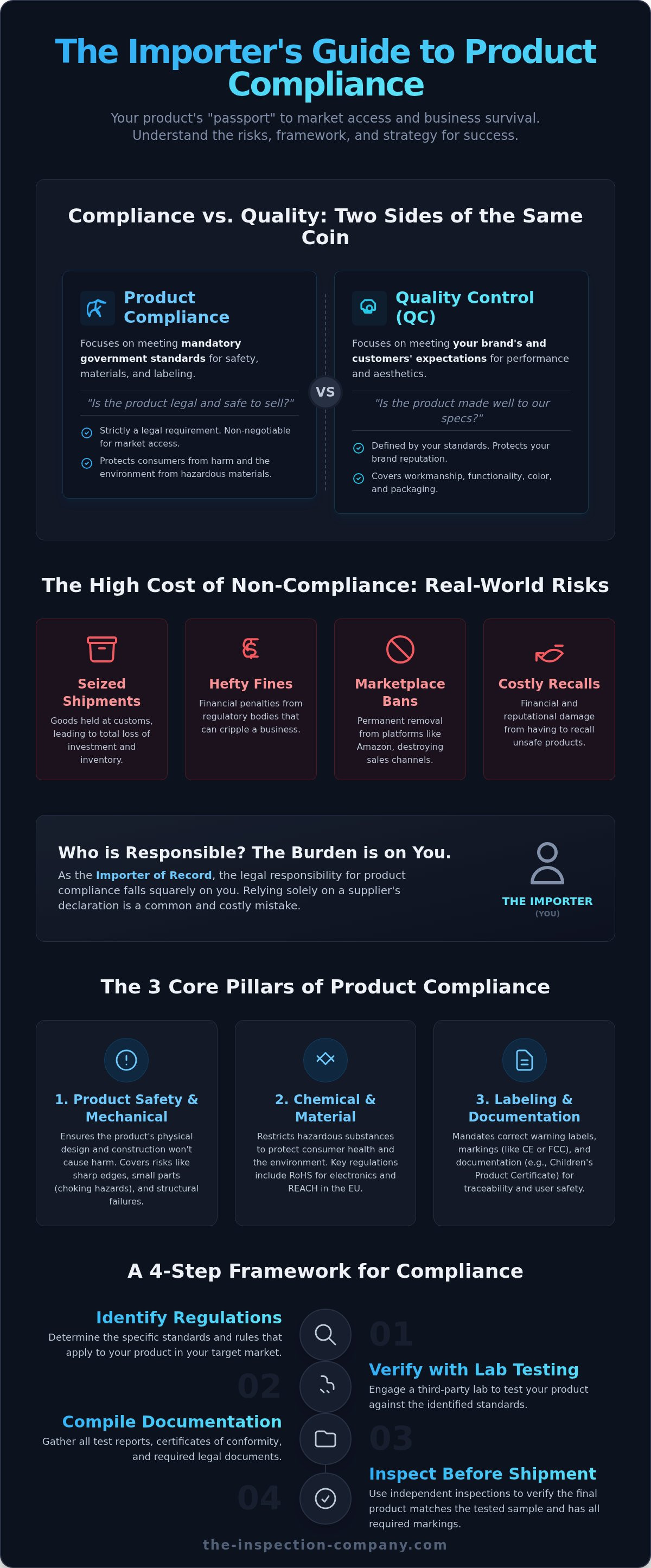
In simple terms, product compliance means ensuring your product meets all the mandatory legal standards, regulations, and specifications of the market where you intend to sell it. Think of it as your product's passport; without it, your goods will be denied entry, held at customs, or worse, forcibly removed from the market. This process is a specific application of broader regulatory compliance, which governs how organizations adhere to laws and regulations. It is not an optional extra-it is a strict legal requirement.
Failure to comply carries severe consequences. For example, the widespread recall of hoverboards in the mid-2010s was due to non-compliant lithium-ion batteries that posed a significant fire risk. Brands that failed to verify compliance faced millions in losses, damaged reputations, and legal action. This is a powerful reminder that overlooking product compliance can dismantle a business.
Product Compliance vs. Quality Control: What's the Difference?
While related, these two concepts are distinct. Understanding the difference is critical for effective risk management.
- Quality Control (QC): Focuses on meeting your brand's or your customer's expectations for performance, workmanship, and aesthetics. A QC inspection asks, "Is the product made well and to our specifications?"
- Product Compliance: Focuses on meeting mandatory government standards for safety, materials, and labeling. It asks, "Is the product legal and safe to sell?"
A product can pass a QC check but still fail compliance-for instance, if it functions perfectly but contains a banned chemical. However, a thorough quality inspection can and should verify physical compliance attributes, such as correct warning labels or required markings.
Who is Responsible? The Importer's Critical Role
As the 'Importer of Record'-the entity responsible for ensuring imported goods comply with local laws-the legal burden falls squarely on you, the importer. A common and costly mistake is relying solely on a supplier's declaration of conformity or test reports. These documents can be outdated, invalid, or belong to a different product entirely. The responsibility to sell a safe and legal product ultimately rests with the brand on the box. Therefore, independent verification through third-party lab testing and inspections is the only reliable way to mitigate your risk and ensure your shipment is fully compliant.
The Core Pillars of Product Compliance: A Framework for Importers
Navigating the landscape of product compliance can feel overwhelming. Regulations are complex, dense, and vary significantly by product type and target market-the rules for selling electronics in the European Union are entirely different from those for children's toys in the United States. To simplify this, we can categorize the vast world of regulations into three core pillars. This framework provides a high-level overview to help you identify and manage the key risks associated with your specific product.
Consider this your starting point. Each of these pillars represents a deep and technical field, but understanding them is the first step toward building a robust compliance strategy and avoiding costly delays, fines, or product recalls.
1. Product Safety & Mechanical Standards
This pillar covers any risk of physical harm to the end-user. It focuses on your product's design, construction, and physical properties. Key concerns include sharp edges, small parts that pose a choking hazard, and overall structural integrity under normal use. For importers targeting the US, understanding the requirements for a Children's Product Certificate (CPC) is non-negotiable for toys and other kids' items. Resources like the official CPSC business education portal are essential for navigating these rules. Other examples include flammability testing for textiles and furniture. On-site inspections are critical to verify that a product’s final assembly and construction meet these crucial safety standards.
2. Chemical & Material Restrictions
What your product is made of is just as important as how it is built. This area of compliance focuses on restricting hazardous substances to protect consumer health and the environment. Major regulations include RoHS (Restriction of Hazardous Substances) for electronics, REACH (Registration, Evaluation, Authorisation and Restriction of Chemicals) in the EU, and California’s Proposition 65. These standards limit the presence of heavy metals like lead and cadmium, as well as phthalates and other harmful chemicals. Verifying compliance typically requires accredited lab testing, an essential component of any comprehensive risk management plan.
3. Labeling, Marking, and Documentation
Your product and its packaging must communicate specific information to consumers and regulators. This pillar covers all mandatory marks, labels, and accompanying documents. Depending on your market, you may be required to display marks like the CE logo in the EU, the FCC mark for electronics in the US, or the UKCA mark for Great Britain. Other common requirements include:
- Country of origin labeling ("Made in China")
- Age grading and warning labels (e.g., choking hazards)
- Tracking information for traceability
This is a critical checkpoint during a pre-shipment inspection, as incorrect labeling can lead to entire shipments being rejected at customs.
The High Cost of Non-Compliance: Real-World Risks to Your Business
Viewing product compliance as a business expense is a critical mistake; it is an investment in your company's survival. Failing to meet regulatory standards moves beyond abstract legal theory and creates tangible, severe risks that can cripple your operations. A single non-compliant shipment that is rejected, recalled, or results in a lawsuit has the potential to wipe out an entire year's profit. The consequences are not just possible-they are predictable.
Understanding these real-world risks is the first step toward protecting your business.
Financial Penalties and Forced Recalls
Regulatory bodies like the U.S. Consumer Product Safety Commission (CPSC) can levy civil penalties reaching into the millions of dollars for violations. Beyond fines, a forced product recall is a logistical and financial catastrophe. The direct costs compound quickly and include:
- Notifying every customer and managing returns.
- Shipping and processing the returned goods.
- Disposing of or attempting to remanufacture unsellable inventory.
- Issuing full refunds or sending replacement products.
Shipment Seizures and Customs Delays
Your goods must clear customs before they can be sold. If authorities suspect a violation, they can seize your entire shipment for inspection, leading to costly delays that disrupt your supply chain and halt sales. If products are confirmed to be non-compliant, they can be refused entry or even destroyed at the port. This leaves you with frozen cash flow for inventory you can never sell, plus additional fees for storage, testing, or re-exporting the rejected goods.
Marketplace Suspensions and Brand Damage
For e-commerce sellers, the risks are immediate. Marketplaces like Amazon have strict product compliance policies and will suspend or permanently remove listings-or even your entire account-over safety concerns. The long-term damage is even more severe. A product associated with a safety issue earns negative reviews and shatters customer trust. Rebuilding a tarnished brand reputation is a slow, expensive, and often impossible task in a competitive market.
How to Build a Basic Product Compliance Strategy in 4 Steps
Navigating regulations can seem daunting, but a proactive strategy transforms product compliance from a liability into a manageable process. By following a structured approach, you can minimize risks, avoid costly delays, and ensure your goods meet the legal standards of your target market. This four-step framework is designed to demystify the process and give you control over your supply chain.
Step 1: Identify Your Product's Requirements
Compliance begins long before production. First, define your target market (e.g., USA, EU, Canada), as regulations differ significantly. Research the mandatory standards, certifications, and chemical restrictions for your specific product category. For complex products, consulting a compliance expert or testing lab is a critical investment. The goal is to create a definitive compliance checklist detailing every standard and marking your product must have.
Step 2: Communicate Clearly with Your Supplier
Never assume your supplier understands the regulations of your end market. Your compliance checklist must be a non-negotiable part of your manufacturing agreement. Provide unambiguous specifications for all materials, components, and required labeling (like FCC or CE marks). Always request supporting documentation, such as material declarations or component certificates, but remember that ultimate responsibility lies with you, the importer.
Step 3: Verify with Testing and Inspection
Trust but verify. Do not rely solely on test reports provided by your supplier, as they may be outdated, irrelevant, or falsified. Always arrange for an independent, third-party lab to test a sample from your actual production run. Furthermore, a pre-shipment inspection is essential to confirm that the final goods match your checklist. An inspector will verify:
- Correct physical markings and logos
- Proper warning labels and user manuals
- Packaging compliance
- Overall product specifications
Step 4: Compile and Maintain Your Documentation
Your final step is to create a comprehensive technical file for each product. This file is your proof of due diligence and should contain all test reports, certificates of conformity, supplier declarations, and inspection reports. Keep this file organized and accessible, as you will need it if questioned by customs authorities, government regulators, or major retailers. Having this documentation ready demonstrates professional oversight of your product compliance program. Need to verify your product on-site? See how our inspections work.
How Independent Inspections Secure Your Compliance Efforts
Understanding regulations is the first step; verifying they are met is the critical second. While we are not a law firm and do not provide legal advice, we act as your essential verification partner on the ground. Our role is to provide objective, detailed data from the factory floor, allowing you to confirm that your product compliance requirements are being followed before the goods are shipped. This proactive approach is the most effective way to avoid costly delays, rejections, and legal complications at customs.
Verifying Physical and Labeling Requirements
An on-site inspection is the only reliable way to confirm your product’s physical attributes and packaging meet market standards. A professional inspector uses your specifications as a checklist to systematically verify every critical detail. This is a non-negotiable step for ensuring your products are safe, correctly represented, and ready for your target market.
- Labels and Markings: We confirm that all required labels-such as country of origin, CE, UKCA, or FCC marks-are present, legible, and correctly placed.
- Packaging and Warnings: Inspectors check for required suffocation warnings on polybags, accurate product descriptions, and compliant barcode information.
- Material Integrity: We help spot unauthorized substitutions of cheaper, non-compliant materials that could compromise your product's safety and quality.
- Product Construction: We perform on-site checks to verify construction against safety standards, such as ensuring there are no sharp edges on a children's toy or that electronic enclosures are properly sealed.
The Role of Factory Audits in Compliance
Consistent product compliance depends on a supplier with robust internal processes. A one-time successful production run means little if the next one fails. A factory audit is a deep assessment of your supplier's Quality Management System (QMS), revealing their capability to manufacture products to your standard consistently. An audit verifies if the factory has the certifications (like ISO 9001) and the internal controls needed to be a reliable long-term partner, minimizing your risk with every future order.
Ultimately, one day of inspection can save you months of trouble and significant financial loss. Protecting your investment and brand reputation starts with independent verification. Contact us to see how our global network of inspectors can provide the assurance you need.
Secure Your Market Access with Proactive Compliance
As we've explored, navigating the complexities of international trade requires more than just a good product; it demands a robust strategy for product compliance. This isn't merely about ticking boxes-it's about safeguarding your brand, your finances, and your reputation. The cost of non-compliance, from seized shipments to damaging recalls, is a risk no importer can afford. A proactive approach, anchored by independent verification, is the only way to ensure your goods meet the required standards before they ever leave the factory.
Don't leave your success to chance. With a network of over 700 inspectors across Asia, our European-managed teams provide the independent oversight you need to mitigate risk. You'll receive a detailed, actionable inspection report within 24 hours, giving you the clarity and confidence to approve your shipment. Take the final, decisive step toward secure, compliant importing.
Don't risk your shipment. Get a free, instant inspection quote today.
Frequently Asked Questions About Product Compliance
What is the difference between product compliance and product certification?
Product compliance is the broad requirement for a product to meet all applicable laws, standards, and regulations in its target market. It covers everything from materials to labeling. Product certification, however, is a formal process conducted by an accredited body to verify that a product meets specific standards. A certificate is issued as proof, but it is just one component of achieving total compliance. You are responsible for the overall compliance of your product.
How much does product compliance testing cost?
The cost of compliance testing varies significantly based on your product's complexity, materials, and destination market. A simple textile product may cost a few hundred dollars to test, whereas complex electronics requiring FCC or EMC testing can cost several thousand. While it is an upfront expense, this investment is critical. It protects you from the far greater costs of a product recall, customs rejection, or potential legal action, which can jeopardize your entire business.
Is a CE mark valid for selling products in the USA?
No, a CE mark is not valid for selling products in the USA. The CE marking indicates conformity with health, safety, and environmental protection standards for products sold within the European Economic Area (EEA). The United States has its own distinct regulatory requirements. For example, electronics often require FCC certification for electromagnetic interference, and children's products must meet CPSC (Consumer Product Safety Commission) standards. Always verify the specific requirements for your US market.
My supplier gave me a test report. Is that enough to prove compliance?
A supplier's test report is a useful starting point, but it is not sufficient proof of compliance on its own. You must verify its authenticity and relevance. Is the report from an accredited, independent lab? Does it apply to your specific production batch, not an earlier sample? Relying solely on a provided document without due diligence introduces significant risk. We strongly recommend independent verification to ensure your shipment meets all required standards before it leaves the factory.
Can a pre-shipment inspection guarantee 100% product compliance?
A pre-shipment inspection (PSI) is a critical quality control step, but it cannot guarantee 100% product compliance alone. A PSI primarily verifies workmanship, functionality, and specifications against your requirements. While inspectors can check for visible compliance issues like correct labeling, they cannot perform the complex lab tests needed to confirm material safety or regulatory adherence. A comprehensive product compliance strategy integrates both on-site inspections and accredited laboratory testing to minimize your risks effectively.
What happens if regulations change after my product is manufactured?
As the importer, you are responsible for ensuring your product meets all regulations in effect when it is placed on the market. If rules change after manufacturing but before your goods clear customs, your product must comply with the new standards. This could force you to conduct additional testing, update labeling, or even halt the shipment entirely. Staying informed about regulatory updates in your target market is a non-negotiable part of the import process.