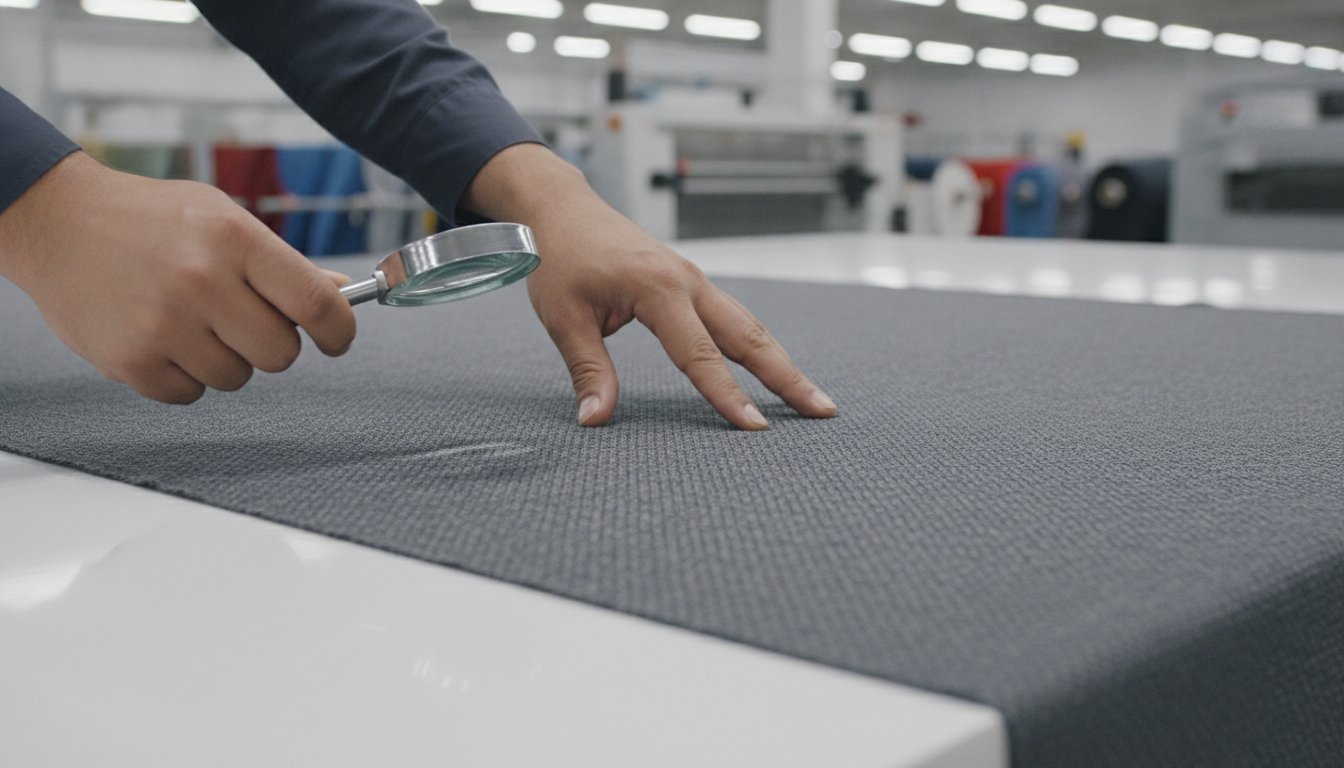

The final payment to your supplier is due, but a critical question remains: are the goods you're paying for correct and free of defects? For many importers, this uncertainty is the most stressful part of sourcing. This is precisely why a pre-shipment inspection (PSI) is not a luxury-it's an essential safeguard for your investment. This final, vital check happens at the factory before your goods are loaded, acting as your eyes on the ground to prevent costly surprises, customer complaints, and the high cost of international returns.
In this comprehensive guide, we will demystify the entire process. You will learn exactly what a PSI covers, why it's a non-negotiable tool for managing supply chain risk, and how to use the findings in your report to confidently approve payment and shipment. Get ready to transform uncertainty into control and stop problems before they ever leave the factory.
What is a Pre-Shipment Inspection (PSI) and Why Is It Non-Negotiable?
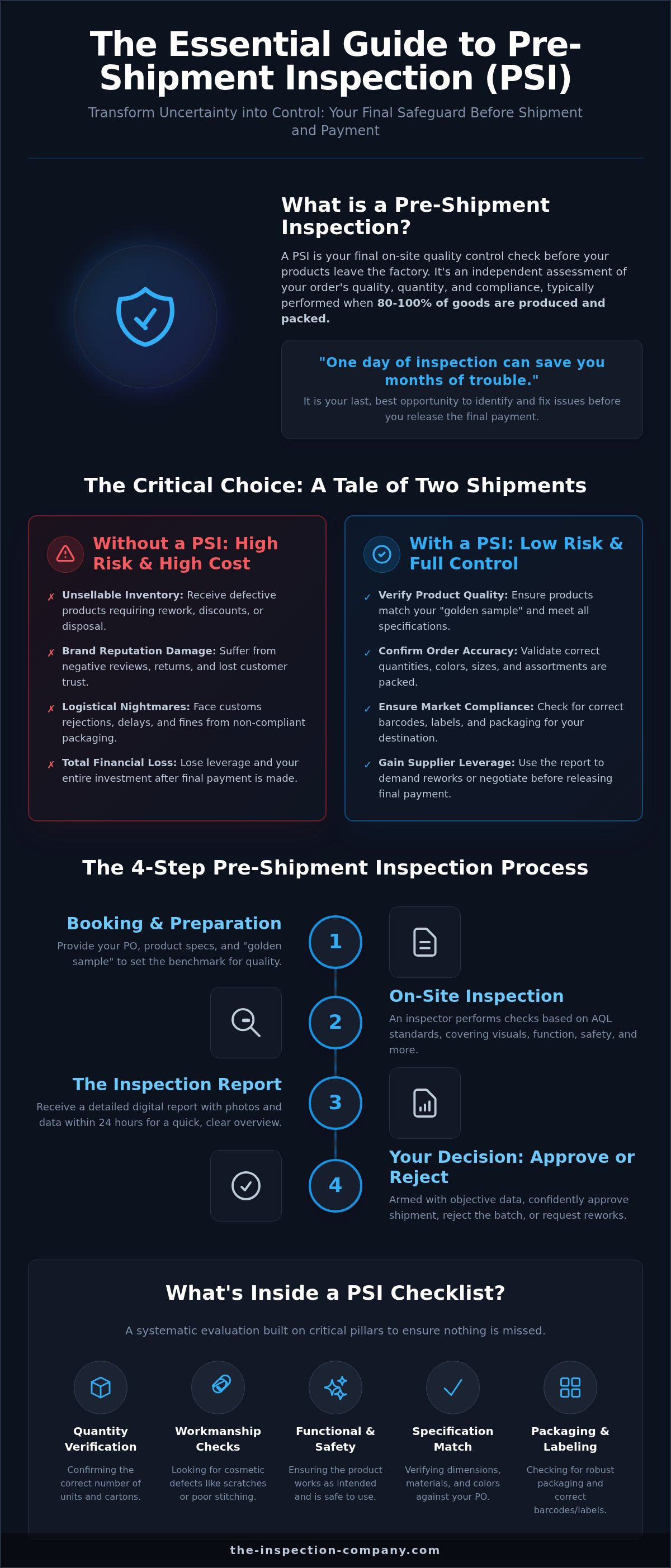
A Pre-Shipment Inspection (PSI) is your final line of defense in the manufacturing process. It is a systematic, on-site quality control check performed on your goods before they leave the factory and, crucially, before you release the final payment to your supplier. Typically conducted when 80-100% of your order is produced and packed, the core purpose of Pre-Shipment Inspection (PSI) is to provide an independent assessment of your order's quality and compliance against your established criteria.
The primary goal is simple but powerful: to identify quality defects, quantity discrepancies, and packing issues at the source-not when a container of faulty products arrives at your warehouse. Failing to conduct this final check exposes your business to significant financial and reputational risk. As we often say, one day of inspection can save you months of trouble. It is your last, best opportunity to hold your supplier accountable and demand corrections before your leverage is gone.
The Core Benefits for Importers and Amazon Sellers
A professional PSI empowers you with the objective data needed to make an informed ship/no-ship decision. Key benefits include:
-
Verify Product Quality: Ensure your products meet your specifications, quality standards, and match the approved "golden sample."
-
Confirm Order Accuracy: Confirm that the correct quantity, assortment, colors, and sizes are packed and ready for shipment.
-
Ensure Market Compliance: Check for correct labeling, barcodes, and packaging to avoid costly customs rejections or delays in your destination market.
-
Gain Supplier Leverage: Use the detailed inspection report to negotiate with your supplier to rework defects or fix issues before you transfer the final payment.
The High Cost of Skipping a Final Inspection
The small investment in a pre-shipment inspection pales in comparison to the potential costs of receiving a problematic shipment. Skipping this essential step can lead directly to:
-
Unsellable Inventory: Receiving defective products that require expensive rework, must be sold at a deep discount, or discarded entirely.
-
Brand Reputation Damage: Dealing with a surge of negative customer reviews, product returns, and long-term harm to your brand's credibility.
-
Logistical Nightmares: Facing customs holds, rejections, or fines due to non-compliant labeling or incorrect packaging information.
-
Total Financial Loss: Losing your entire investment if a supplier ships a substandard order and refuses to cooperate after receiving full payment.
The Pre-Shipment Inspection Process: A 4-Step Breakdown
A professional pre-shipment inspection is designed to be a fast, transparent, and straightforward process that empowers you with critical data before you authorize final payment and shipping. The entire journey, from booking to receiving your final report, is structured to minimize your effort and maximize your control over product quality. This standardized approach aligns with international best practices, including the World Trade Organization guidelines, ensuring a reliable and verifiable outcome every time.
Here’s how our efficient 4-step process works from your point of view:
Step 1: Booking and Preparation
Initiating an inspection is simple. You book online, providing key information like the factory’s address and contact details. To ensure our inspector has everything needed for a thorough check, you will also provide essential documents, including:
-
Your Purchase Order (PO) to verify order details.
-
Detailed product specifications and quality requirements.
-
An approved "golden sample" for the inspector to use as a benchmark for quality and function.
Step 2: The On-Site Inspection
Once booked, our independent inspector travels to the factory location. They do not inspect every single unit; instead, they use a statistically significant random sampling method based on international AQL (Acceptable Quality Limit) standards. This ensures an accurate snapshot of the entire production batch. The physical check is comprehensive, covering:
-
Visual and Workmanship Checks: Looking for cosmetic defects like scratches or poor stitching.
-
Functional and Safety Testing: Ensuring the product works as intended and is safe to use.
-
Measurements and Specifications: Verifying dimensions, materials, and colors against your requirements.
-
Packaging and Labeling: Confirming that packaging is robust and all labels are correct.
Step 3: The Inspection Report
Immediately following the inspection, the inspector compiles a detailed report. This is not just a pass/fail summary; it is a comprehensive document filled with high-resolution photos, clear descriptions of any defects found, and all measurement data. We deliver this digital report to your inbox within 24 hours, giving you the objective evidence you need to act quickly and decisively.
Step 4: Your Decision: Approve or Reject
Armed with the detailed report, you can make a fully informed decision. You have clear options: approve the shipment if the quality meets your standards, reject the batch if defects are too severe, or instruct your supplier to rework the specific issues identified in the report. This final step puts you in complete control, preventing costly problems before your shipment sails. See what a final report looks like. Request a Sample Report .
What's Inside a Pre-Shipment Inspection Checklist?
A professional pre-shipment inspection is not a random spot-check; it is a systematic and meticulous process guided by a comprehensive checklist. This document acts as the blueprint for the inspection, ensuring that every aspect of your production order is verified against your exact requirements before it leaves the factory. While every checklist is customized to the specific product, it is built upon four critical pillars that guarantee a thorough evaluation.
Quantity and Shipment Verification
The first step is to confirm that what you ordered is what has been produced and packed. This avoids costly surprises upon arrival. An inspector will physically verify:
-
Total Quantity: The number of units and shipping cartons precisely matches the quantity specified in your purchase order.
-
Correct Assortment: The breakdown of sizes, colors, and styles is accurate across the entire shipment.
-
Shipping Marks: All labels and markings on the export cartons are correct to ensure smooth transit and receipt by your logistics partner.
Quality and Workmanship (AQL)
This is the core of the quality control process. Using the internationally recognized AQL (Acceptable Quality Limit) standard, inspectors perform a statistical sampling of the goods to identify defects. These are classified by severity:
-
Critical Defects: Issues that render a product unsafe or non-functional.
-
Major Defects: Flaws that are likely to be noticed by the end-user and could result in a return.
-
Minor Defects: Small imperfections that do not affect the product's use or saleability.
Product Specifications and Functionality
Here, the inspector confirms that the products conform to every technical and functional requirement you set. Comprehensive pre-shipment inspection services include a series of on-site tests and measurements to validate that the final product is a perfect match for your "golden sample." Checks include measuring dimensions and weight, performing functional tests (e.g., turning on electronics, testing a zipper’s strength), and verifying correct materials, logos, and Pantone color codes.
Packaging and Labeling
Your product's journey is far from over when it leaves the production line. The inspection must also verify that the packaging can withstand the rigors of international shipping and meets market requirements. This includes checking the durability of export cartons, the presence of correct inner packaging and protective materials, and ensuring all barcodes, warning labels, and country of origin markings are present, legible, and accurately placed.
How to Prepare for a Successful First Inspection
A pre-shipment inspection is a powerful tool, but its effectiveness depends directly on the quality of information you provide. Investing a small amount of time in preparation ensures our inspectors can precisely evaluate your products against your standards. Clear, detailed instructions are the foundation of a successful inspection, eliminating ambiguity and focusing the process on what matters most to your business and your customers.
Follow this simple checklist to maximize the value of your next quality control check and avoid costly surprises down the line.
Provide a Detailed Product Specification Sheet
The specification sheet is the inspector's primary blueprint. The more detail you provide, the more accurately we can verify your production. Ambiguity is the enemy of quality control. Ensure your document includes:
-
All critical dimensions, weights, and tolerances.
-
Specific material types, finishes, and Pantone color codes.
-
A complete list of all components and accessories.
-
High-resolution product photos, technical drawings, or CAD files.
Define Your Quality Expectations and Defect List
Clearly communicate what constitutes an unacceptable product. Create a defect list that classifies potential issues as Minor, Major, or Critical. If you have experienced common problems in past production runs, provide photos as examples. This allows the inspector to apply your unique quality standards and focus on the issues that could lead to customer returns or product failure.
Send an Approved 'Golden Sample' to the Factory
A physical, pre-approved sample is the ultimate reference point. It allows the inspector to verify aspects that technical documents cannot, such as texture, feel, weight, and precise color matching under different lighting conditions. Instruct your supplier to have this "golden sample" available on the day of the pre-shipment inspection to serve as the benchmark for the entire batch.
Communicate with Your Supplier
Proactive communication with your factory is essential. Inform them of the scheduled inspection date well in advance and provide them with a copy of your quality requirements. Crucially, ensure your payment terms specify that passing the final inspection is a condition for releasing the final payment. This incentivizes your supplier to conduct their own internal quality checks and present a compliant batch for inspection.
By taking these preparatory steps, you empower your inspection partner to act as a true extension of your team. For more expert guidance on safeguarding your supply chain, contact our quality control specialists today .
Your Final Step to a Flawless Shipment
As this guide has shown, mastering the pre-shipment inspection is not just about ticking a box; it's a non-negotiable strategy for risk mitigation. By understanding the core process, defining a comprehensive checklist, and preparing your supplier, you transform a simple check into a powerful tool. This final verification is your last opportunity to identify defects, confirm specifications, and ensure your products meet the exact standards your customers expect-before they are loaded for transit.
Don't let distance create uncertainty. Take decisive action to protect your investment and your brand's reputation. As your ISO 9001 certified partner, we provide the on-the-ground expertise you need. Our network of over 700 professional inspectors across Asia's key manufacturing hubs acts as your eyes and ears, delivering detailed reports with high-resolution photos and videos within just 24 hours. We stop problems before your shipment sails, saving you from costly surprises.
Secure your next shipment. Get an instant inspection quote today.
Frequently Asked Questions About Pre-Shipment Inspections
When is the best time to schedule a pre-shipment inspection?
The ideal time is when 100% of your production is complete and at least 80% of the goods are fully packed for shipping. This timing is critical because it allows the inspector to verify the total quantity and pull a random sample from the final packaged units. Scheduling too early means the full order isn't ready for a valid assessment, while scheduling too late can cause costly shipping delays if quality issues are discovered and require correction.
How much does a pre-shipment inspection cost?
A professional pre-shipment inspection is a strategic investment to prevent significant financial loss. Typically, the cost for a standard inspection is a flat, all-inclusive fee ranging from $250 to $350 USD per inspector-day. This transparent price covers the inspector's on-site work, travel, and the generation of your detailed report. The final cost depends on the factory's location, but it remains a minor expense compared to the risk of receiving a shipment of defective goods.
What happens if my shipment fails the inspection?
A "Fail" result provides you with the crucial evidence and leverage needed to address quality issues with your supplier before final payment is released. Using the detailed inspection report, you can demand specific corrective actions, such as having the factory sort and rework the defective products. Alternatively, you can negotiate a discount to compensate for the quality issues. This process ensures problems are fixed at the source, saving you from the high costs of returns, repairs, or brand damage.
Can I perform the inspection myself instead of hiring a company?
While you can perform an inspection yourself, it is often far more expensive and less effective. The costs of international flights, accommodation, and time away from your core business activities can easily exceed the fee for a professional service. A third-party inspection company provides an unbiased, independent assessment based on established AQL standards. Our local, trained inspectors have the expertise and equipment to conduct a thorough evaluation efficiently and without bias.
What is the difference between a pre-shipment inspection and a factory audit?
A pre-shipment inspection (PSI) is product-focused. Its sole purpose is to verify the quality, specifications, and quantity of your completed goods for a specific order before it ships. In contrast, a factory audit is supplier-focused. It is a comprehensive evaluation of the factory's systems, capabilities, and compliance with social and quality standards. An audit helps you vet a potential new partner, while a PSI ensures the quality of an individual production run.
How many units does the inspector check during a PSI?
The number of units checked is not arbitrary; it is determined by the internationally recognized AQL (Acceptable Quality Limit) statistical sampling standard. Based on your total order quantity and your chosen inspection level, the AQL chart specifies the exact sample size to be inspected. This method provides a statistically significant snapshot of your entire order's quality, allowing for a reliable assessment without the time and expense of checking every single item.
Do I need an inspection for every single order?
We strongly recommend an inspection for every order to ensure consistent quality and mitigate risk. Even with a trusted supplier, quality can vary between production batches due to changes in raw materials, staff, or internal processes-a risk known as "quality fade." A consistent inspection program protects your brand's reputation, prevents costly surprises, and ensures every shipment meets your standards. One day of inspection can save you from months of trouble caused by a single bad shipment.