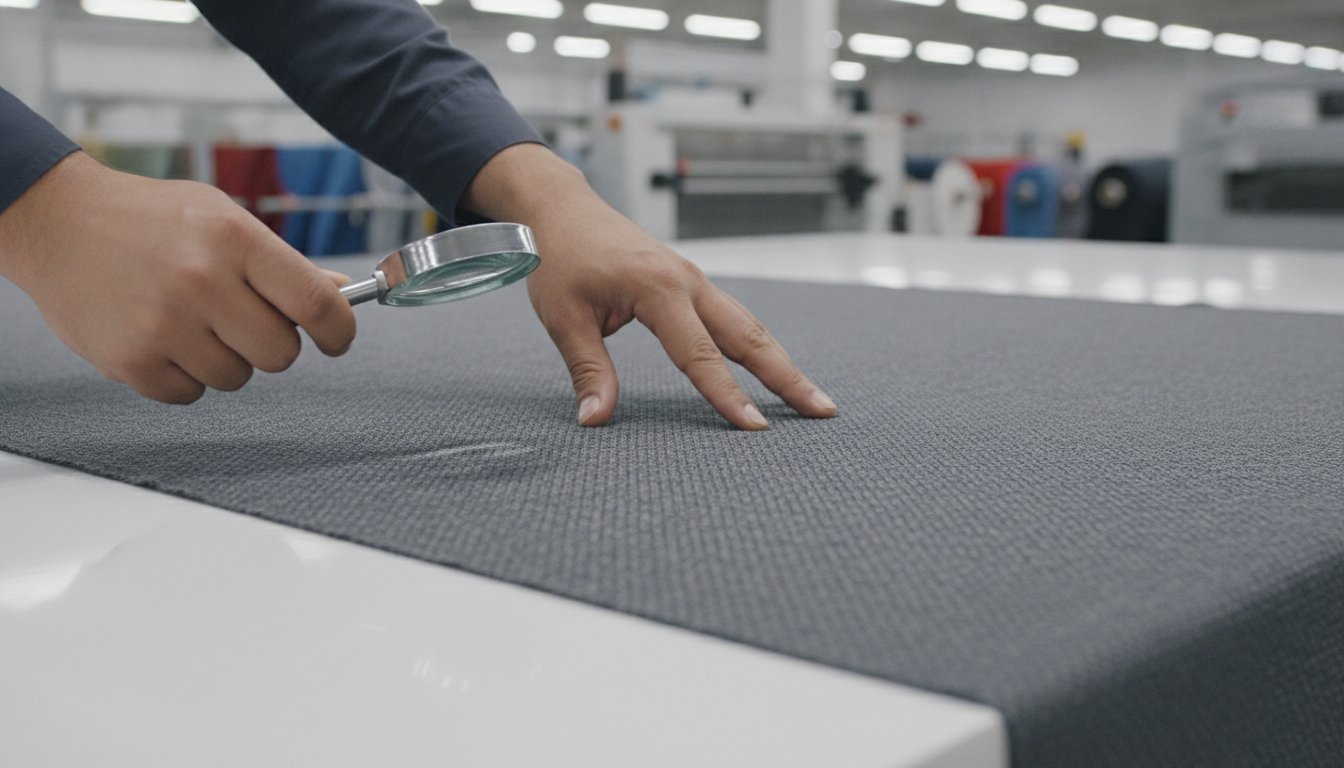

What is the biggest risk when sourcing products? For many businesses, it’s opening a long-awaited shipment only to discover the goods are fragile, faulty, or unsafe for customers. This isn't just a hypothetical nightmare; it's a costly reality that can lead to damaging recalls, negative reviews, and a ruined brand reputation. The most effective way to avoid this is to verify quality before your shipment ever sails, and that requires a specific, data-driven approach: rigorous mechanical testing.
This guide provides the essential information you need to protect your investment and your brand. We will walk you through the key mechanical tests that verify a product's strength, durability, and safety against real-world use. You will learn how these procedures prevent costly failures, ensure you meet critical compliance standards for your target market, and give you the confidence that the final shipment matches the quality of the approved sample. It’s time to ship a product you can stand behind.
Key Takeaways
- Understand how physical stress tests predict real-world performance, helping you avoid costly product failures and safety recalls.
- Discover the critical types of mechanical testing-from tension and impact to fatigue-that verify your product's structural integrity.
- Learn to integrate testing into your quality control process at key production stages to identify weaknesses before they become expensive problems.
- Find out how to create clear, enforceable testing requirements for your supplier to ensure your product is built to last.
What is Mechanical Testing and Why It's Critical for Importers
In simple terms, mechanical testing involves subjecting a product, component, or material to physical forces to understand its limits. Technicians apply controlled tension, compression, impact, or torsion to measure how an item responds to real-world stress. This process goes far beyond a simple visual check; it's a predictive science designed to answer one crucial question: will this product fail when a customer uses it? For a deeper technical overview of the various procedures involved, Wikipedia offers a comprehensive guide on What is Mechanical Testing.
For importers, this isn't just an engineering exercise-it's an essential risk management tool. A single failed test during a pre-shipment inspection can identify a systemic manufacturing defect, such as a weak weld or brittle plastic. Discovering this weakness in the factory saves you from receiving an entire shipment of faulty goods. It transforms a potential financial disaster into a manageable production issue, protecting your investment before it ever leaves the port.
The Business Case: Beyond the Science
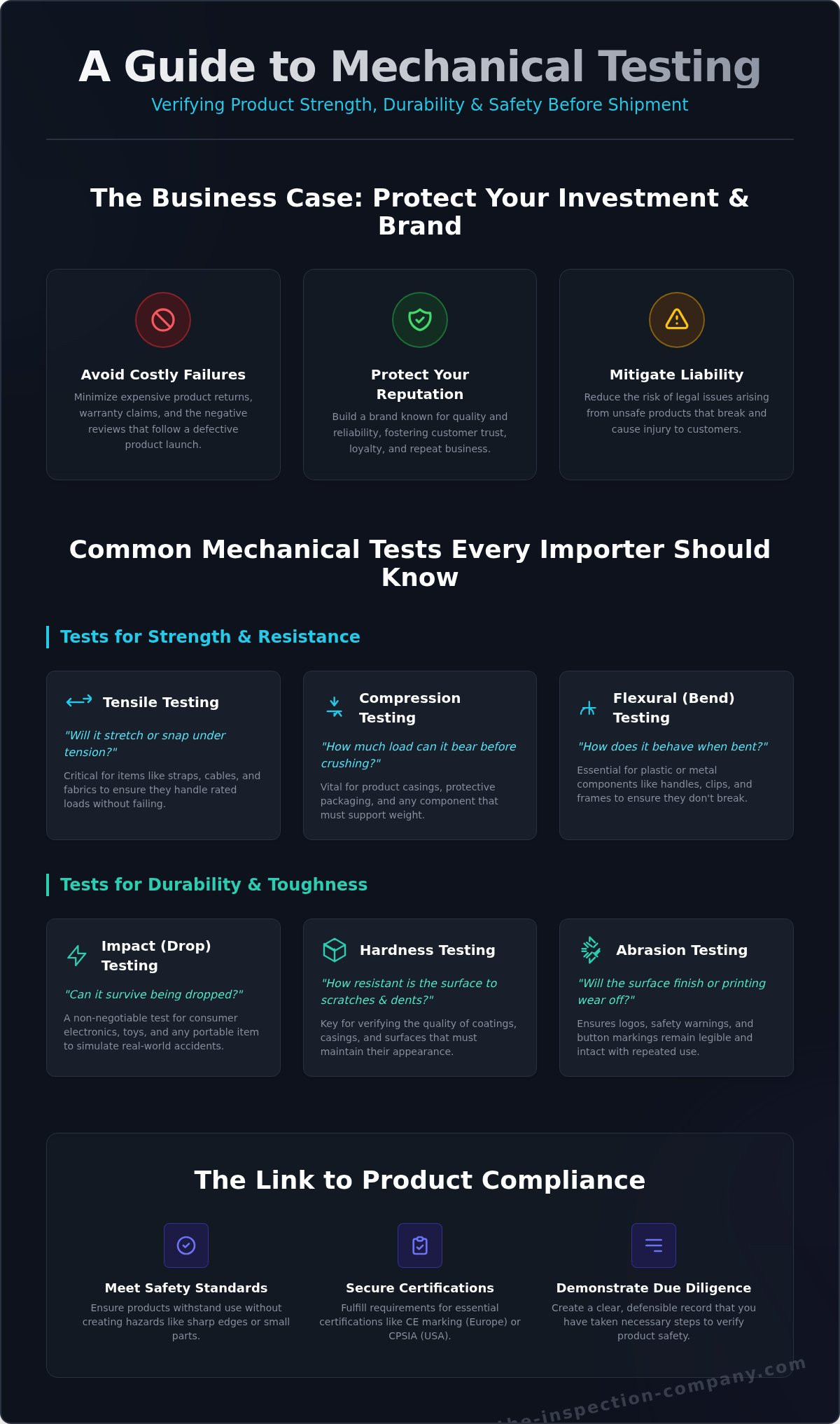
Effective mechanical testing directly protects your bottom line and brand integrity. By verifying product durability before shipment, you can proactively:
-
Avoid costly failures: Minimize expensive product returns, warranty claims, and the flood of negative online reviews that follows a defective product launch.
-
Protect your reputation: Build a brand known for quality and reliability, fostering customer trust and repeat business.
-
Mitigate liability: Reduce the risk of legal issues arising from unsafe products that break and cause injury.
The Link to Product Compliance
In many markets, mechanical tests are not optional; they are a mandatory part of achieving product compliance. This is especially true for regulated categories like children's toys, electronics, and furniture. These tests provide the verifiable data needed to:
-
Meet safety standards: Ensure products can withstand foreseeable use and abuse without creating hazards like sharp edges or small parts.
-
Secure certifications: Fulfill testing requirements for essential certifications, such as CE marking in Europe or CPSIA in the United States.
-
Demonstrate due diligence: Create a clear, defensible record that you have taken the necessary steps to verify your product's safety and quality.
Common Mechanical Tests Every Product Developer Should Know
Effective mechanical testing is not a single action but a suite of targeted procedures designed to simulate real-world stress. Each test answers a specific, critical question about your product's performance, helping you avoid costly defects and customer complaints. To ensure these tests are reliable and repeatable across different facilities, it is crucial to Specify Mechanical Testing Requirements using internationally recognized standards. This step removes ambiguity and holds your supplier accountable for delivering a durable product.
Below are the essential tests grouped by the type of stress they apply, helping you verify product integrity before your shipment sails.
Tests for Strength and Resistance
These fundamental tests measure a material's ability to withstand static forces like pulling, pushing, and bending. They answer the most basic questions about a product's structural integrity.
-
Tensile Testing: Answers the question, "Will it stretch or snap under tension?" This is critical for items like straps, cables, and fabrics, ensuring they can handle their rated loads without failing.
-
Compression Testing: Asks, "How much load can it bear before crushing or deforming?" This is vital for product casings, protective packaging, and any component that must support weight.
-
Flexural (Bend) Testing: Determines, "How does it behave when bent?" Essential for plastic or metal components like handles, clips, and frames to ensure they don't break or permanently deform under normal use.
Tests for Durability and Toughness
Durability goes beyond simple strength. These tests simulate sudden impacts and the wear-and-tear of daily use, which are common causes of product returns.
-
Impact Testing (Drop Test): The ultimate real-world test, it answers, "Can it survive being dropped?" This is a non-negotiable test for consumer electronics, toys, and any portable item.
-
Hardness Testing: Asks, "How resistant is the surface to scratches, dents, and punctures?" This test is key for verifying the quality of coatings, casings, and surfaces that must maintain their appearance.
-
Abrasion Testing: Determines, "Will the surface finish, paint, or printing wear off with use?" It ensures logos, safety warnings, and button labels remain legible throughout the product's lifespan.
Tests for Longevity
These tests assess a product's ability to function reliably over time and through challenging conditions, from repeated use to cross-continental shipping.
-
Fatigue Testing: Answers, "Can it withstand repeated cycles of stress without failing?" This is essential for moving parts like hinges, springs, buttons, and switches, simulating months or years of use in just a few hours.
-
Vibration Testing: Asks, "How will it hold up during shipping and transport?" By simulating the vibrations of a truck or cargo ship, this test helps prevent products from arriving with loose screws, broken solder joints, or other damage.
Integrating Mechanical Testing into Your Quality Control Strategy
Effective product development relies on more than a single, final test. Instead, mechanical testing should be viewed as an integral, ongoing process woven throughout your production timeline. It is a critical component of a robust quality control strategy, designed to identify potential failures before they become costly liabilities.
Understanding the distinct roles within this process is essential for success:
-
The Importer: You define the quality standards, specify which tests are required, and set the pass/fail criteria based on your product's intended use and market.
-
The Factory: Your supplier is responsible for manufacturing the product according to your specifications, using the correct materials and processes.
-
The Testing Laboratory: An accredited lab performs the specialized tests, providing objective, data-driven reports on the product's performance against your standards.
A third-party inspection service acts as your independent verifier, ensuring this entire process is followed correctly on the ground.
During Product Development and Pre-Production
The earliest stages of development offer the greatest opportunity to prevent durability issues. By subjecting initial designs and material options to a range of Common Mechanical Tests like tensile and impact tests, you can make informed decisions that build quality in from the start. This data is crucial for validating the "golden sample" during a First Article Inspection (FAI), confirming it meets all performance requirements before you authorize mass production.
During and After Mass Production
Once production begins, the challenge is to maintain consistency. How do you ensure the 10,000th unit is as durable as the first? This is where on-site verification becomes indispensable. An inspector can perform basic function tests and visually check that the specified materials are being used. During a Pre-Shipment Inspection (PSI), our team can also review the factory's lab test reports, verifying that the required mechanical testing was completed and passed for the production batch. This final check stops problems before your shipment sails.
Ensure your factory's quality is consistent. Book an inspection.
How to Specify Mechanical Testing Requirements with Your Supplier
Conducting effective tests is impossible without clear communication. Ultimately, defining and specifying product durability requirements is the importer's responsibility. Vague instructions like "must be durable" are subjective and leave you exposed to risk. To avoid costly defects and ensure your product meets customer expectations, your requirements must be documented in the official purchase order.
Leaving these critical details undocumented can lead to disputes, failed inspections, and products that cannot be sold. One day of careful specification can save you months of trouble.
Understanding International Standards (ISO, ASTM)
You don't have to start from scratch. International standards provide a globally recognized framework for quality and safety. The most common are:
-
ISO (International Organization for Standardization): Develops standards across a vast range of industries.
-
ASTM International (American Society for Testing and Materials): Publishes technical standards for materials, products, and services.
For instance, ASTM F963 is a consumer safety specification that outlines mandatory mechanical testing for toys to prevent injuries from sharp points or small parts. Work with your supplier to identify relevant standards for your product category, but always verify they meet your market's compliance and performance needs.
Creating Your Product's Test Plan
A robust test plan translates general standards into specific, measurable actions for your product. This plan should be a core component of your quality control checklist, giving your inspector a clear mandate. When building your plan, be sure to:
-
Consider user scenarios: Think about both the intended use and potential misuse of your product. How much weight will a user put in that backpack? Will a child try to stand on that storage box?
-
Define exact test parameters: Be precise. Instead of "test the handle," specify "perform a pull test on the handle with 25 kg of force for 60 seconds."
-
Establish clear pass/fail criteria: Ambiguity is your enemy. A clear criterion is: "The handle must show no signs of tearing, seam slippage, or deformation after the test is complete."
Integrating these details into your quality control documents is non-negotiable. It provides your inspector and supplier with an objective benchmark for performance, stopping problems before your shipment ever sails. Download a sample inspection checklist to see how to include testing criteria.
Secure Your Product's Integrity with Expert Testing
In the complex world of international manufacturing, overlooking product durability is a risk no importer can afford. As we've explored, understanding common tests and integrating them into your quality control strategy are critical first steps. Ultimately, a proactive approach to mechanical testing is not just a technical step; it is a fundamental business strategy that protects your investment, ensures consumer safety, and safeguards your brand's reputation against costly defects and returns.
Partnering with an experienced third-party inspection service removes the guesswork. With European management and over 25 years of experience in Asia, we provide the on-the-ground expertise you need. Our network of over 700 inspectors across 20+ countries ensures your specifications are met, delivering detailed inspection reports with photo and test verifications within 24 hours.
Don't leave quality to chance. Get a free quote to verify your product's durability. Take control of your supply chain today and build a brand that customers trust.
Frequently Asked Questions About Mechanical Testing
What is the difference between mechanical testing and chemical testing?
Mechanical testing evaluates a product's physical properties-like strength, hardness, or fatigue resistance-by applying physical force. It answers how a product performs under stress. In contrast, chemical testing analyzes a material's composition to verify its elemental makeup, purity, or compliance with safety regulations like RoHS or REACH. One assesses physical durability and performance, while the other confirms material integrity and safety.
Does The Inspection Company perform these mechanical tests in a lab?
We manage the entire testing process, but to ensure complete impartiality and access to specialized equipment, we use a network of fully-accredited, independent partner laboratories. Our inspectors collect samples directly from the factory during an inspection, and we coordinate with the appropriate lab to perform the test. This guarantees that the results are objective, reliable, and based on a truly representative sample from your production run.
How much does mechanical testing typically cost?
The cost of mechanical testing depends on the test's complexity, the required international standard (e.g., ASTM, ISO), and the number of samples. A simple hardness test will cost less than a complex fatigue or vibration analysis. While there is an upfront investment, it is minimal compared to the significant financial damage caused by product failures, costly returns, and harm to your brand's reputation. We provide a transparent quote based on your specific needs.
Do I need to test every single unit from my production run?
No, testing every unit is neither practical nor cost-effective. We use internationally recognized statistical sampling plans, such as AQL (Acceptable Quality Limit), to select a representative number of units from your production batch. Testing this sample provides a high degree of confidence in the overall quality and durability of the entire shipment, allowing you to make an informed decision without incurring unnecessary costs or production delays.
How do I find a reliable third-party laboratory in Asia?
Finding a trustworthy laboratory independently can be a significant risk. The Inspection Company eliminates this uncertainty by leveraging our rigorously vetted network of ISO 17025 accredited labs across Asia. Our local expertise and European management ensure we select the right facility for your specific product and compliance requirements. We manage the entire process, providing you with the assurance of accurate, impartial, and reliable test results.
What happens if my product fails a mechanical test during inspection?
If a product fails a test, we notify you immediately. You will receive a detailed report outlining the specific failure, supported by data and photographic evidence. This empowers you to take decisive action with your supplier before the shipment is finalized. Common next steps include demanding a rework of the defective goods or negotiating new terms to mitigate your financial risk. Our report provides the objective evidence you need to protect your investment.