

Is your profit margin disappearing somewhere between your supplier's factory and your warehouse? You negotiate a great price per unit, only to see it eroded by unexpected customs fees, port charges, and other costly surprises. Relying on the factory price alone is a critical mistake in international trade, as it fails to account for the complex web of expenses that determine your true profitability. This is where a comprehensive landed cost calculator becomes an essential tool, not just for accounting, but for strategic risk management and accurate pricing.
In this complete guide, we move beyond basic shipping and duties. We will provide a clear framework to help you calculate the final, all-inclusive cost for every unit you import. You will learn to accurately factor in freight, insurance, and taxes, and more importantly, how to quantify the hidden expenses of quality control inspections, payment processing fees, and supplier-related risks. Arm yourself with the knowledge to price your products with confidence and ensure no hidden cost ever jeopardizes your bottom line again.
Key Takeaways
- Your true product cost goes far beyond shipping and duties; learn to identify the hidden expenses that erode your profit margins.
- Follow our step-by-step worksheet, which acts as a manual landed cost calculator, to determine your precise cost based on sellable units.
- Transform your landed cost data from a simple expense line into a strategic tool for optimizing suppliers and pricing strategies.
- Discover how a Pre-Shipment Inspection is the most effective way to control unpredictable costs like defects and rework, protecting your investment before it ships.
What is Landed Cost? (And Why Most Calculations Are Incomplete)
In international trade, the landed cost is the total price of a product once it has arrived at the buyer's door. A comprehensive Landed cost definition includes not just the price of the goods but every single expense incurred to get them into your warehouse. Understanding this figure is the bedrock of your profitability. It dictates your pricing strategy, clarifies your true profit margins, and allows for accurate financial budgeting. Without a precise calculation, you are operating on assumptions that can quickly erode your bottom line.
While many businesses use a standard formula, it often conceals a significant risk. A reliable landed cost calculator must account for more than just the obvious expenses, or it will inevitably lead to costly surprises.
The Standard Landed Cost Formula Components
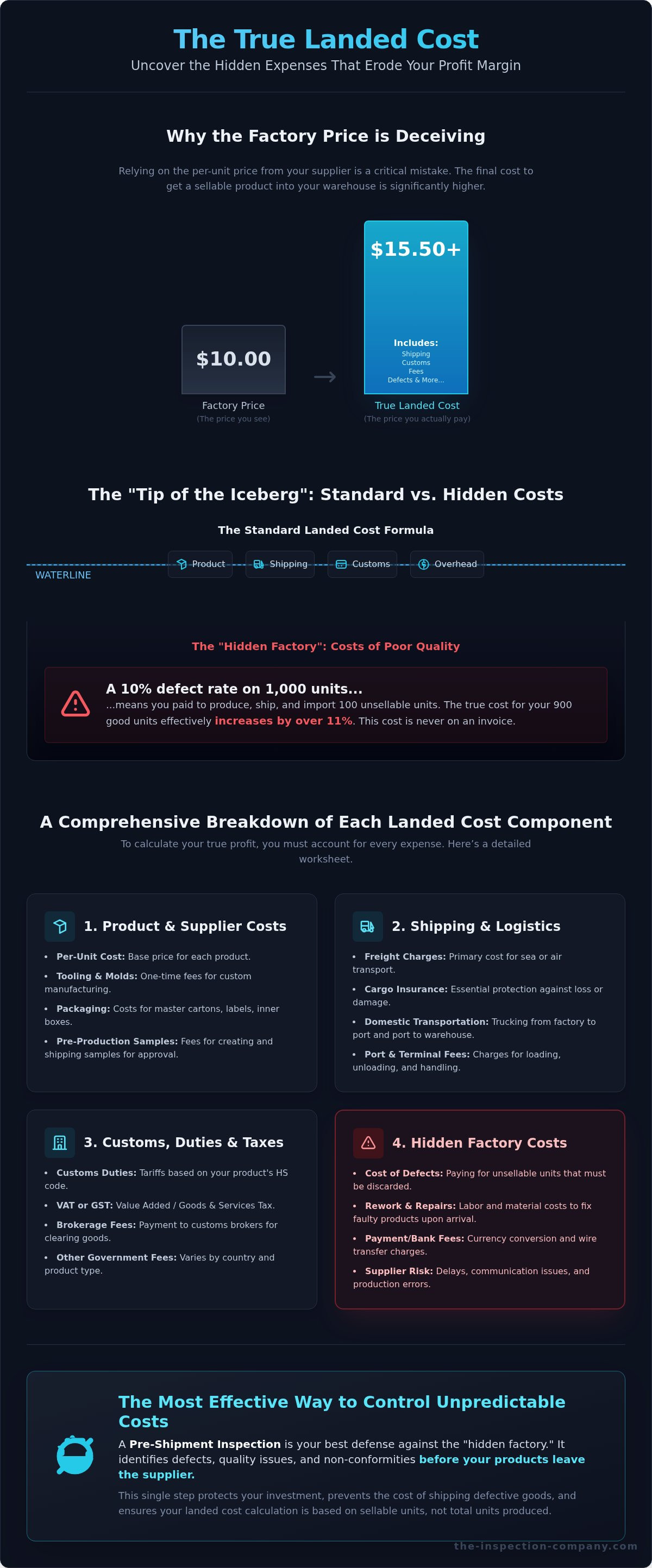
The conventional formula for landed cost is a sum of four key pillars. Think of it like building a house: the raw materials are just one part of the total project budget. This formula is the essential starting point, but as we'll see, it's not the final answer for a diligent importer.
- Product: The ex-factory price you pay your supplier for the goods.
- Shipping: All logistics costs, including freight, insurance, and handling fees.
- Customs: Government-levied charges like duties, tariffs, taxes, and customs brokerage fees.
- Overhead: Ancillary costs such as banking fees, currency conversion, and agent commissions.
The Hidden Factory: How Poor Quality Inflates Your True Cost
The critical variable missing from the standard calculation is the cost of poor quality-the expenses generated by what quality experts call the "hidden factory." These are the unplanned costs of rework, defects, and production delays that occur at the factory but are only discovered upon arrival. Imagine you order 1,000 units, but 10% arrive defective and unsellable. You still paid to produce, ship, and clear customs for all 1,000 units. This means the true landed cost for your 900 good units has effectively increased by over 11%, a cost that was never on an invoice but directly impacts your profit.
A Comprehensive Breakdown of Each True Landed Cost Component
The price on your supplier's invoice is only the starting point. To accurately determine your profit margin and avoid financial surprises, you must identify every expense incurred until the goods are in your warehouse. A reliable landed cost calculator requires a detailed breakdown of these variables, which often hide in plain sight across four key categories.
Component 1: Product & Supplier Costs
This is the foundation of your calculation-the direct costs paid to your manufacturer. While the per-unit price is the most obvious, other essential supplier-side fees can impact your initial outlay.
- Per-Unit Cost: The base price agreed upon for each individual product.
- Tooling & Molds: One-time charges for creating custom molds or production line tooling required for your specific product.
- Packaging: The cost of all packaging materials, including inner boxes, master cartons, labels, and protective wrapping.
- Pre-Production Samples: Fees for creating and shipping initial samples for your review and approval before mass production begins.
Component 2: Shipping & Logistics Costs
This category covers the complex physical journey from the factory floor to your final destination. Overlooking any of these steps can lead to unexpected and significant charges.
- Freight Charges: The primary cost of moving goods via sea or air from the port of origin to the port of destination.
- Cargo Insurance: A critical investment to protect your business from financial loss if goods are damaged or lost in transit.
- Domestic Transportation: Trucking and handling fees at both ends-from the factory to the origin port and from the destination port to your warehouse.
- Port & Terminal Fees: Various charges for loading, unloading, and handling your container at ports and terminals.
Component 3: Customs, Duties & Taxes
These government-levied fees are non-negotiable and can dramatically alter your final cost per unit. These are a core part of understanding landed cost, as they vary widely by product and country of import.
- Customs Duties: Tariffs calculated based on your product's official Harmonized System (HS) code.
- VAT or GST: Value Added Tax or Goods and Services Tax applied by the destination country's government upon import.
- Customs Brokerage Fees: Payment to the licensed agent who facilitates the customs clearance process on your behalf.
- Other Duties: Be aware of potential anti-dumping or countervailing duties that can be placed on specific goods from certain countries.
Component 4: Risk, Compliance & Quality Control Costs
Smart importers view these not as expenses, but as strategic investments in their brand's reputation and financial health. Factoring them into your landed cost calculator ensures you avoid the catastrophic costs of a product recall, customs rejection, or unsellable inventory.
- Pre-Shipment Inspection (PSI): The cost to verify product quality and specifications before you release final payment and the goods are shipped.
- Factory Audits: Fees for vetting a new supplier's capabilities, ethical standards, and quality management systems.
- Lab Testing Fees: Essential for ensuring your product meets mandatory safety and compliance standards (e.g., CPC for children's products, RoHS for electronics).
- Bank Fees: The transaction costs associated with making international wire transfers to your supplier.
How to Calculate Your True Landed Cost: A Step-by-Step Worksheet
While an automated landed cost calculator provides a quick estimate, a manual calculation ensures you understand every variable impacting your bottom line. This worksheet empowers you to verify your costs with precision, minimizing the risk of unexpected expenses. The true formula accounts not just for total expenses, but for product quality:
True Landed Cost Per Unit = (Total Costs) / (Number of Good, Sellable Units)
Step 1: Gather All Your Cost Documents
Accuracy is paramount. To calculate your landed cost, you must work with firm numbers, not estimates. Before you begin, collect all relevant documentation from your supply chain partners. This includes:
- Commercial Invoice from your supplier, detailing the product cost.
- Freight Forwarder Quote outlining shipping, customs, and insurance fees.
- Third-Party Inspection Report, which confirms the quantity of sellable goods.
- Quotes for any additional services like warehousing or local transportation.
Step 2: Calculate Total Costs by Component
Using your documents, list every expense associated with getting the goods from your supplier to your warehouse. The costs you are responsible for depend on the agreed-upon Incoterms. For example, with FOB (Free On Board), your supplier covers costs until the goods are on the vessel; with EXW (Ex Works), you are responsible for every cost from the factory door.
Step 3: A Practical Example (Importing 1000 Phone Cases)
Let's walk through a scenario importing 1,000 phone cases from China to the US under FOB terms.
| Cost Component | Amount (USD) | Notes |
|---|---|---|
| Product Cost (1,000 units @ $3.00/unit) | $3,000.00 | From Commercial Invoice |
| Ocean Freight | $450.00 | From Freight Forwarder |
| Insurance (0.5% of product value) | $15.00 | Calculated from Invoice |
| Customs Duties (4% of product value) | $120.00 | Calculated from Invoice |
| Customs Brokerage Fee | $250.00 | From Freight Forwarder |
| Pre-Shipment Inspection Fee | $300.00 | Verifies quality before shipment |
| Total Landed Cost | $4,135.00 | Sum of all costs |
Initially, the calculation seems simple: $4,135 / 1,000 units = $4.14 per unit.
However, your pre-shipment inspection report reveals that 5% of the units (50 cases) have defects and are unsellable. This is where the true calculation becomes critical. You only have 950 sellable units. This changes the math and protects your profit margin.
True Landed Cost Calculation: $4,135 / 950 Good Units = $4.35 per unit.
This $0.21 difference is your real cost per sellable item. Knowing this figure before the shipment sails is essential for accurate pricing and inventory management, preventing costly surprises down the line.
Using Landed Cost Data to Make Smarter Business Decisions
Calculating your total landed cost is only the first step. The real value lies in using this data to drive strategic decisions that protect your capital and increase profitability. Proactive importers understand that this single metric is a powerful tool for financial stability and a significant competitive advantage. It moves your business from reactive problem-solving to proactive optimization.
Setting Profitable Pricing and Protecting Margins
Your landed cost per unit is your true Cost of Goods Sold (COGS). Pricing your products based on factory cost alone is a direct path to eroding margins. For example, if your factory cost is $10 but your landed cost is $17, setting a retail price based on the $10 figure guarantees a loss. By knowing the true COGS, you can accurately set prices to achieve your target profit margin and ensure every sale is profitable.
Improving Supplier Selection and Negotiation
A supplier with the lowest unit price is not always the most cost-effective partner. A comprehensive landed cost analysis allows you to compare suppliers holistically. One supplier might offer a 5% lower unit price but use substandard packaging, leading to higher damage rates and replacement costs. Use your data to negotiate from a position of strength, focusing on the total value and long-term cost, not just the initial invoice.
Identifying Opportunities for Cost Reduction
Your landed cost worksheet is a roadmap to savings. By analyzing the breakdown, you can pinpoint your largest and most variable expenses. This data, often organized using a landed cost calculator, empowers you to take specific actions:
- High Freight Costs: Explore consolidating shipments, negotiating with freight forwarders, or changing shipping methods.
- High Duties & Taxes: Verify that you are using the correct HS codes for your products to avoid overpayment.
- High Quality Control Costs: Unexpected expenses from defects, returns, and rework can inflate your final costs. Investing in a professional pre-shipment inspection minimizes these risks, preventing costly problems before your shipment ever leaves the factory.
By treating your landed cost not as a final number but as a dynamic diagnostic tool, you can continuously refine your supply chain for maximum efficiency and profitability.
How a Pre-Shipment Inspection De-Risks Your Landed Cost
Using a landed cost calculator is essential for forecasting your expenses, but it cannot predict the catastrophic financial impact of a quality control failure. Unexpected defects, incorrect quantities, or improper packaging can introduce massive, unbudgeted costs that derail your profitability. The most effective strategy to control these variables is not reactive, but proactive: a Pre-Shipment Inspection (PSI).
A PSI is the final, critical checkpoint that verifies your products meet your standards before they leave the factory. It is the single most important tool for protecting your investment and ensuring your calculated landed cost becomes a reality.
Stop Problems and Unexpected Costs Before Shipment
An independent inspection verifies product quality before you transfer the final payment and authorize shipment. This simple step prevents you from paying freight and duties on defective goods that you cannot sell. More importantly, it provides non-negotiable leverage. When issues are identified at the factory, the supplier is responsible for correcting them on their own time and dime, not yours.
The ROI of Quality Control: A Clear Comparison
Consider the financial logic. A professional inspection is a small, fixed fee-typically around $300. Compare that to the monumental and variable costs of receiving a defective shipment. Without an inspection, you risk facing:
- Return Shipping: The exorbitant cost of shipping a faulty order back to the manufacturer.
- Rework or Disposal: Paying for local repairs or absorbing the total loss of unsalvageable goods.
- Lost Sales: Stockouts and an inability to fulfill customer orders while you resolve the issue.
- Reputational Damage: The long-term harm to your brand from selling substandard products.
Framed this way, an inspection fee is not a cost; it is insurance against a significant financial loss.
Ensure You Get What You Paid For
A comprehensive PSI goes beyond just checking for defects. Inspectors verify that your order is 100% correct, including product specifications, quantity, colors, packaging, and labeling. This meticulous verification prevents costly surprises when your goods arrive at customs or your warehouse, ensuring the data you put into your landed cost calculator holds true. One day of inspection can save you thousands.
Protect your investment with a PSI quote.
Secure Your Margins: The Final Step in Landed Cost Calculation
Mastering your true landed cost goes beyond simple formulas; it requires a comprehensive view of every expense from factory to warehouse. By meticulously accounting for shipping, duties, insurance, and other fees, you transform a basic estimate into a powerful tool for strategic decision-making. However, even the most accurate landed cost calculator can be derailed by one critical, often overlooked variable: product quality.
A shipment of defective goods can instantly negate your carefully calculated profit margins, leading to costly returns and reputational damage. With over 700 inspectors across Asia and European management ensuring international quality standards, we provide the verification you need. You receive detailed reports with photos within 24 hours, stopping problems before they sail. Don't let hidden defects destroy your profits. Get a free Pre-Shipment Inspection quote today.
Take control of your supply chain and protect your bottom line with confidence.
Frequently Asked Questions
What is the difference between FOB and EXW price in landed cost calculations?
The primary difference is the point where financial responsibility transfers from seller to buyer. With an EXW (Ex Works) price, the buyer assumes all risks and costs from the factory door. With FOB (Free On Board), the seller is responsible for local transport and port handling until the goods are loaded onto the vessel. Understanding this distinction is critical for entering correct figures into a landed cost calculator, as it determines who pays for crucial origin charges.
How can I find the correct HS/HTS code to estimate customs duties for my product?
To find the correct Harmonized System (HS) or Harmonized Tariff Schedule (HTS) code, consult your destination country's official customs or trade commission website. For U.S. imports, the official HTS search tool is an essential resource. However, code classification can be complex. To avoid costly errors and shipment delays, we strongly recommend verifying the code with your customs broker, who can provide authoritative guidance based on your specific product details.
Why can't my freight forwarder just tell me the total landed cost?
Your freight forwarder can provide precise quotes for transportation and related logistics, but they do not control all cost variables. Customs duties, taxes, and potential government inspection fees are determined by customs authorities upon arrival and can fluctuate. A forwarder provides a reliable estimate for their services, but they cannot guarantee the final government-levied charges. This uncertainty is why a comprehensive landed cost calculator is a vital tool for importers to budget effectively.
Are customs duties calculated on the product cost alone or the total invoice value with shipping?
Customs duties are rarely calculated on the product cost alone. Most countries calculate duties based on the CIF value: Cost of Goods + Insurance + Freight. This means the dutiable value includes the total cost to get the products to the port of destination. Calculating duties on only the product's factory price is a common and costly mistake that leads to a significant underestimation of your total import expenses and negatively impacts your profit margins.
How does product packaging affect my landed cost?
Product packaging directly impacts your landed cost through freight charges. Inefficient or oversized packaging increases the shipment's dimensional weight, leading to higher shipping fees for both air and sea freight. Furthermore, inadequate packaging can result in product damage during transit. This not only causes a direct loss of inventory but also introduces the additional, unrecoverable costs of returns or replacements, all of which inflate your true landed cost per unit.
Should I include marketing and overhead costs in my landed cost calculation?
No, you should not include marketing and general overhead in your landed cost calculation. The landed cost is specifically the total expense to acquire a product and deliver it to your warehouse. It includes the product cost, shipping, insurance, customs, and duties. Marketing and overhead are separate business operating expenses that should be factored in later when you are determining your final sale price and overall product profitability, not the cost of goods.