
Your shipment from Asia is on its way, but suddenly you're hit with an unexpected bill for port handling fees and customs clearance. Your supplier insists it's your responsibility. Who's right? This costly confusion often comes down to three little letters on your purchase order: the Incoterm. Getting these international commercial terms wrong can erase your profit margins and create serious supplier disputes. Having the Incoterms explained clearly is not just an option-it’s a critical part of a successful import strategy that protects your bottom line.
This guide cuts through the complex jargon to give you complete control. We will break down each of the 11 Incoterms® 2020 rules, clarifying exactly where your responsibility begins and your supplier's ends. By the end, you will have the confidence to choose the most cost-effective term for your business, reduce your shipping risks, and negotiate from a position of strength. Prepare to make your next import from Asia your smoothest and most predictable one yet, free from costly surprises.
Key Takeaways
- Choosing the right Incoterm is your first line of defense against unexpected shipping costs and supplier disputes.
- This guide provides the essential incoterms explained, clarifying which of the 11 rules put you in control versus leaving liability with your supplier.
- Your choice of Incoterm directly dictates the timing and location for critical quality control inspections-a mistake here can mean accepting defective goods.
- Discover the four most common Incoterms for sourcing from Asia and learn which one offers the best balance of cost, control, and risk for your business.
What Are Incoterms and Why Do They Matter for Importers?
In international trade, ambiguity is your biggest enemy. A simple misunderstanding with a supplier can lead to costly delays, unexpected fees, and damaged business relationships. This is where Incoterms provide critical clarity. At their core, Incoterms are a set of globally recognized rules that define the responsibilities of sellers and buyers for the delivery of goods under a sales contract.
Published by the International Chamber of Commerce (ICC), these rules are periodically updated to reflect changes in global trade, with the latest version being Incoterms® 2020. For importers, a solid grasp of these terms is not optional-it's essential for risk management. Having incoterms explained clearly in your contract ensures that both you and your supplier know precisely who is responsible for every step of the shipping process. This prevents disputes over lost cargo, surprise invoices for freight, or delays at customs.
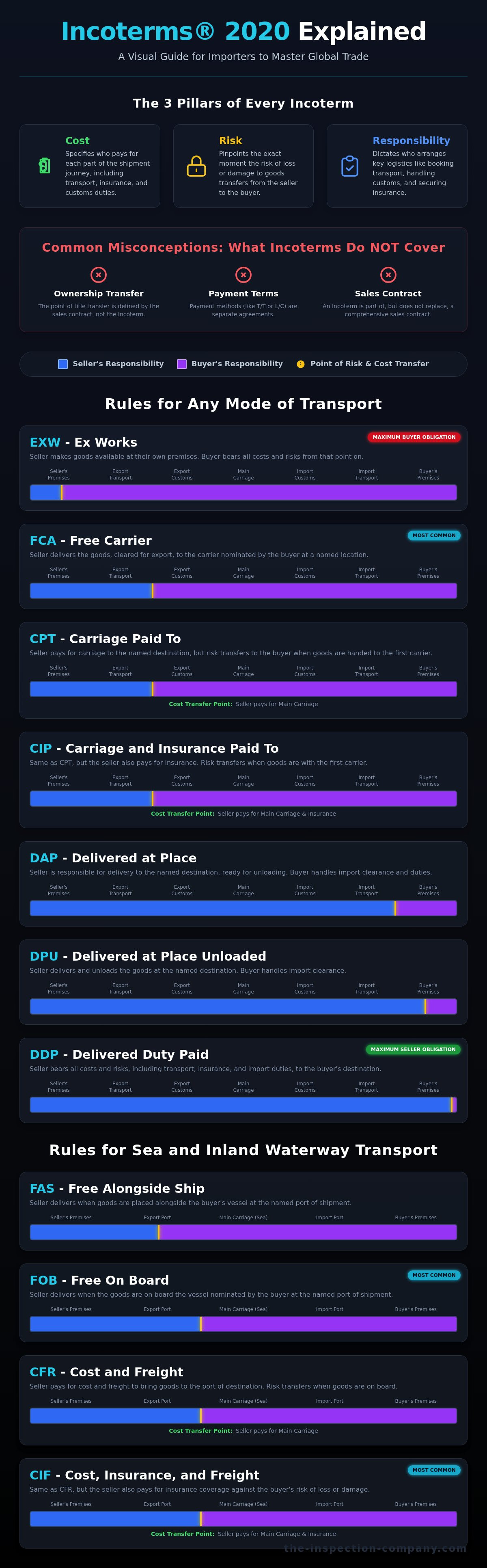
The 3 Pillars: Cost, Risk, and Responsibility
Every Incoterm rule precisely allocates three critical elements between the buyer and seller. Understanding this division is the key to choosing the right term for your shipment and protecting your business from financial loss.
- Cost: Specifies who pays for each part of the journey, including transport, insurance, and customs duties.
- Risk: Pinpoints the exact moment when the risk of loss or damage to the goods transfers from the seller to you, the buyer.
- Responsibility: Dictates who is in charge of arranging key logistics, such as booking transport, securing insurance, and handling customs clearance procedures.
What Incoterms Do NOT Cover (Common Misconceptions)
While powerful, Incoterms have a defined scope. Relying on them to cover aspects of your trade agreement they aren't designed for is a common and costly error. It's crucial to remember what they do not do:
- They do not transfer ownership. The point of title or ownership transfer is determined by the sales contract, not the Incoterm.
- They do not define payment terms. Incoterms are separate from your payment agreements with the supplier, such as a Telegraphic Transfer (T/T) or Letter of Credit (L/C).
- They do not replace a sales contract. An Incoterm is a vital component of your agreement, but it cannot replace a comprehensive sales contract that outlines product specifications, quality standards, and dispute resolution.
The 11 Incoterms® 2020 Rules at a Glance
To provide clear, actionable incoterms explained for global trade, the International Chamber of Commerce (ICC) organizes the 11 rules into two distinct categories based on the method of transport. Understanding which category applies to your shipment is the first critical step in mitigating risk and avoiding unexpected costs. As this detailed U.S. International Trade Administration guide highlights, selecting the correct term is essential for defining the precise point where responsibility for the goods transfers from the seller to you, the importer.
This section serves as a quick-reference guide to help you identify the right term for your specific shipping needs.
Category 1: Rules for Any Mode of Transport
These seven rules are the most flexible and can be used for any mode of transport, including air, road, rail, or multimodal (a combination of methods). They are often the most suitable choice for modern containerized shipments.
- EXW - Ex Works
- FCA - Free Carrier
- CPT - Carriage Paid To
- CIP - Carriage and Insurance Paid To
- DAP - Delivered at Place
- DPU - Delivered at Place Unloaded
- DDP - Delivered Duty Paid
Category 2: Rules for Sea and Inland Waterway Transport
These four rules are designed specifically for shipments where the point of origin and destination are both ports accessible by sea or inland waterways. They are typically used for bulk cargo or non-containerized goods.
- FAS - Free Alongside Ship
- FOB - Free On Board
- CFR - Cost and Freight
- CIF - Cost, Insurance, and Freight
Visual Chart: Buyer vs. Seller Responsibilities
Use this chart to quickly identify the exact moment when risk and cost transfer from your supplier to you for each of the 11 Incoterms. Understanding this transfer point is crucial for preventing costly disputes and ensuring your goods are properly insured.
| Incoterm | Seller's Core Responsibility | Point of Risk & Cost Transfer | Buyer's Core Responsibility |
|---|---|---|---|
| EXW | Makes goods available at their own premises. | Seller's premises (factory/warehouse). | Arranges and pays for all transport, customs, and assumes all risk from the seller's door. |
| FCA | Delivers goods, cleared for export, to the buyer's carrier at a named place. | When the buyer's carrier takes possession. | Arranges and pays for main carriage, import clearance, and assumes risk from that point. |
| CPT | Pays for carriage to the named destination. | Risk transfers when goods are handed to the first carrier. | Assumes risk during main transit; handles import clearance and duties. |
| CIP | Pays for carriage and insurance to the named destination. | Risk transfers when goods are handed to the first carrier. | Handles import clearance and duties. |
| DAP | Delivers goods to the named destination, ready for unloading. | When goods arrive at the destination, ready for unloading. | Responsible for unloading the goods and paying import duties. |
| DPU | Delivers and unloads the goods at the named destination. | Once goods are unloaded at the destination. | Responsible for import clearance and any further transport. |
| DDP | Delivers goods to destination, cleared for import, with duties paid. | When goods arrive at destination, cleared and ready for unloading. | Only responsible for unloading the goods. |
| FAS | Delivers goods alongside the buyer's vessel at the port of shipment. | When goods are alongside the vessel at the origin port. | Loads goods, arranges main carriage, and assumes all risk from that point. |
| FOB | Delivers goods on board the buyer's vessel at the port of shipment. | Once goods are loaded on board the vessel. | Arranges main carriage and assumes all risk from that point. |
| CFR | Pays for cost and freight to bring goods to the destination port. | Risk transfers once goods are on board the vessel. | Assumes risk during transit; responsible for insurance and import. |
| CIF | Pays for cost, insurance, and freight to the destination port. | Risk transfers once goods are on board the vessel. | Responsible for import clearance and duties. |
Deep Dive: The 4 Most Common Incoterms for Sourcing from Asia
Understanding which Incoterm to use is critical for managing costs, risk, and control over your supply chain. While the International Chamber of Commerce (ICC) publishes 11 official Incoterms® rules, importers sourcing from Asia will most frequently encounter these four. Having these specific incoterms explained will prevent costly surprises and give you control over your shipments.
EXW (Ex Works): Maximum Control, Maximum Responsibility
Under EXW, your only responsibility as the seller is to make the goods available at their own premises, such as a factory in Shenzhen. From that point on, you, the buyer, are responsible for everything-including loading the goods and, most critically, handling export customs clearance in China. This term offers the most control but also carries the highest risk.
- Pros: You have complete control over the entire logistics process and can potentially negotiate a lower product price. It's ideal if you are consolidating goods from multiple suppliers.
- Cons: Handling export documentation and procedures in a foreign country is a significant risk. Mistakes can lead to costly delays and legal trouble. We strongly advise against EXW for inexperienced importers.
FCA (Free Carrier): The Modern, Flexible Choice
FCA is often a more practical and secure alternative to EXW. The seller delivers the goods to a carrier or another person nominated by you, at a named place. Crucially, the seller is responsible for export clearance. For example, your Chinese supplier would deliver your electronics to your freight forwarder's warehouse at the Port of Yantian, with all export papers handled.
- Pros: You retain control over the main international shipping leg while avoiding the major risk of handling foreign export customs.
- Cons: You are still responsible for arranging and paying for the main freight, which requires coordination with a logistics partner.
FOB (Free On Board): The Classic Sea Freight Term
A long-standing and popular term, FOB is used exclusively for sea and inland waterway transport. Responsibility and risk transfer from the seller to you once the goods are loaded "on board" the vessel at the specified port of shipment. Defining the named port (e.g., "FOB Shanghai") is essential to avoid ambiguity and disputes. This is one of the most common terms when getting incoterms explained by suppliers.
- Pros: FOB is widely understood and creates a clear point of risk transfer. It balances responsibility well between buyer and seller.
- Cons: It is not suitable for containerized cargo that is handed over to the carrier at a terminal before being loaded, where FCA is the more appropriate term.
DDP (Delivered Duty Paid): The Hands-Off Approach
DDP represents the maximum obligation for the seller. They handle every step of the journey-shipping, insurance, import customs, duties, and taxes-delivering the goods to your final destination. Your electronics would simply arrive at your warehouse in Los Angeles with all costs covered.
- Pros: It offers ultimate simplicity and cost predictability for you, the buyer. There are no logistical headaches to manage.
- Cons: This is the most expensive option, as the seller bakes all logistics costs (plus a profit margin) into your price. You have zero control over the shipping carrier, transit times, or potential hidden fees passed on to you.
How Your Incoterm Choice Impacts Quality Control and Inspections
Understanding Incoterms goes beyond logistics and pricing; it is a fundamental part of your quality control and risk management strategy. The term you agree upon with your supplier dictates the point of risk transfer, which is your last chance to identify and rectify quality issues before the goods legally become your problem. A poor choice can make it difficult, or even impossible, to conduct a proper Pre-Shipment Inspection (PSI), exposing your business to significant financial risk.
By treating your Incoterm selection as a strategic decision, you can avoid costly surprises and ensure the products you pay for meet your standards before they leave the country of origin. This section of our guide on incoterms explained connects the rules of trade to the practical reality of quality assurance.
Aligning Your Pre-Shipment Inspection (PSI) with Your Incoterm
The timing of your inspection is critical, and it is directly linked to your chosen Incoterm. Once the goods pass the risk transfer point, they are your responsibility, defects and all. It's too late to reject the shipment or hold your supplier accountable without a costly dispute.
- EXW (Ex Works): You have the most control. Inspections should occur at the supplier's factory after production is complete but before your carrier picks up the goods. This provides maximum flexibility to address any issues on-site.
- FOB (Free On Board): You must conduct the inspection before the supplier delivers the goods to the port and they are loaded onto the vessel. Once loaded, the risk transfers to you. A PSI at the factory is essential to catch defects beforehand.
Using Incoterms to Strengthen Your Purchase Agreement
Your Purchase Order (PO) is more than just an order; it's a contract. Use it to protect your investment. Clearly specify the chosen Incoterm and link your final payment to a successful, passed Pre-Shipment Inspection report. This creates a powerful incentive for the supplier to meet your quality standards, as they know their payment depends on verification before the risk transfer takes place.
Case Study: How an FOB Term Saved an Importer $50,000
An importer ordered a $50,000 shipment of consumer electronics from a new supplier in China, agreeing to FOB Shenzhen terms. Before authorizing the shipment to the port, they scheduled a PSI at the factory. The inspection report revealed a critical defect in 30% of the units. Because the goods had not yet been loaded onto the vessel, the risk had not transferred. The importer was able to reject the entire shipment and withhold final payment, saving them from receiving a container of faulty products and avoiding a massive financial loss. Don't ship blind. Book a Pre-Shipment Inspection today.
Common Mistakes and Best Practices for Importers
Now that we have had the core incoterms explained, the final step is applying them correctly in your business operations. A simple misunderstanding in a purchase order can lead to costly disputes, unexpected fees, and significant shipment delays. To protect your investment and maintain control over your supply chain, it is critical to avoid common errors and adopt professional best practices.
Mistake 1: Using Sea-Only Terms (FOB, CIF) for Air Freight
One of the most frequent and high-risk errors importers make is applying sea-specific Incoterms to air freight. Rules like FOB, CFR, and CIF are designed exclusively for sea and inland waterway transport. Using them for air shipments creates a dangerous ambiguity about when risk officially transfers. If your goods are damaged in the airport terminal before being loaded onto the plane, your contract will be unclear, leaving you exposed to financial loss.
For any shipment that involves air, road, or rail, you should use the "multimodal" terms instead:
- FCA (Free Carrier)
- CPT (Carriage Paid To)
- CIP (Carriage and Insurance Paid To)
Mistake 2: Not Being Specific About the 'Named Place'
Simply writing 'FOB Shanghai' in your contract is not enough and invites trouble. A location like Shanghai is a massive logistical hub with multiple ports, terminals, and warehouses. This ambiguity can lead to disputes over who is responsible for paying local transport costs, such as moving the container from the factory to a specific quay. Always be precise. Instead of 'FOB Shanghai', your agreement should state the exact location, such as 'FOB Port of Shanghai, Yangshan Terminal, Pier 4'. This precision eliminates confusion and protects you from unexpected charges.
Best Practice: Always Reference 'Incoterms® 2020'
The Incoterms rules are updated periodically by the International Chamber of Commerce (ICC). Failing to specify which version you are using can cause serious legal and financial issues if a dispute arises, as you and your supplier may be referencing different sets of rules. Demonstrate professionalism and ensure absolute clarity by always citing the current version in your contracts and purchase orders. For example: FCA Shenzhen International Airport, Cargo Terminal 2, Incoterms® 2020.
With the rules of incoterms explained, you are now better equipped to negotiate with suppliers and manage your shipments effectively. Attention to detail is your greatest asset in international trade. Just as precise contract terms prevent financial risk, professional oversight of your production process prevents quality-related disasters. Securing your supply chain goes beyond paperwork; to avoid costly defects and ensure your products meet specifications before they ship, learn more about our independent quality control services.
Secure Your Shipments by Mastering Incoterms
Understanding the Incoterms® 2020 rules is fundamental to successful importing. As this guide has shown, your choice of term dictates far more than just shipping costs-it defines the critical point of risk transfer and directly impacts your ability to conduct essential quality control inspections. Now that you have had these key incoterms explained, you are better equipped to protect your investment and avoid common, costly errors.
The right Incoterm gives you the opportunity to inspect, but you still need a reliable partner on the ground to execute. Our team-led by European management in Asia with over 700 qualified inspectors-acts as your eyes and ears in the factory. We provide detailed, transparent inspection reports complete with photos within 24 hours, giving you the power to stop problems before they ship.
Don't leave your quality to chance. Avoid costly surprises and import with confidence. Get a free quote for your Pre-Shipment Inspection today.
Frequently Asked Questions About Incoterms
What is the main difference between Incoterms 2010 and 2020?
The most significant change in Incoterms 2020 is the replacement of Delivered at Terminal (DAT) with Delivered at Place Unloaded (DPU). This provides more flexibility, as DPU allows for delivery and unloading at any named place, not just a terminal. Another key update involves insurance: Carriage and Insurance Paid To (CIP) now requires a higher level of insurance (Clause A), while Cost, Insurance, and Freight (CIF) maintains the minimum required cover (Clause C).
Which Incoterm is best for a beginner or small business importing from China?
For new or small importers, Free on Board (FOB) is often the most strategic choice. Under FOB, your supplier handles getting the goods loaded onto the vessel at the origin port. This gives you, the buyer, full control over the main international freight leg, allowing you to choose your own forwarder and manage costs more effectively. This control is critical for avoiding hidden fees and securing reliable shipping, which is a common risk when sellers control the freight.
Do Incoterms determine who has ownership or title of the goods?
No, and this is a critical distinction that can lead to costly legal disputes. Incoterms exclusively define the transfer of risk, costs, and responsibilities between the seller and the buyer during shipment. They do not govern the transfer of legal title or ownership of the goods. The point at which ownership changes hands must be explicitly stated in your commercial sales agreement or purchase order to ensure your assets are protected throughout the transaction.
Can my business still use Incoterms 2010 in our contracts?
Yes, your business can use Incoterms 2010 or even older versions, provided you explicitly state the version in your contract. For example, the agreement must clearly read "FOB Shanghai, Incoterms 2010." However, to prevent misunderstandings and potential disputes with your supplier, using the most current version (Incoterms 2020) is the professional standard and highly recommended. Ambiguity in your contract creates unnecessary risk for your business.
How do Incoterms relate to payment terms like a 30/70 T/T split?
Incoterms and payment terms are separate but directly linked. Payment terms, such as a 30% deposit and 70% balance T/T (Telegraphic Transfer), define *when* you pay. The chosen Incoterm defines a specific physical event that can trigger that payment. For example, with FOB terms, the 70% balance payment is often contractually due upon the supplier providing a copy of the Bill of Lading, which proves the goods have passed the ship's rail and risk has transferred.
Who is responsible for product insurance under FOB vs. CIF?
The responsibility for insurance is a key difference between these terms. Under Free on Board (FOB), risk transfers to the buyer once goods are loaded onto the vessel, so the buyer is responsible for arranging and paying for marine insurance. In contrast, under Cost, Insurance, and Freight (CIF), the seller is obligated to purchase at least minimum insurance coverage for the goods up to the named destination port. A clear understanding of these roles, as this guide on incoterms explained shows, is vital for managing shipment risk.