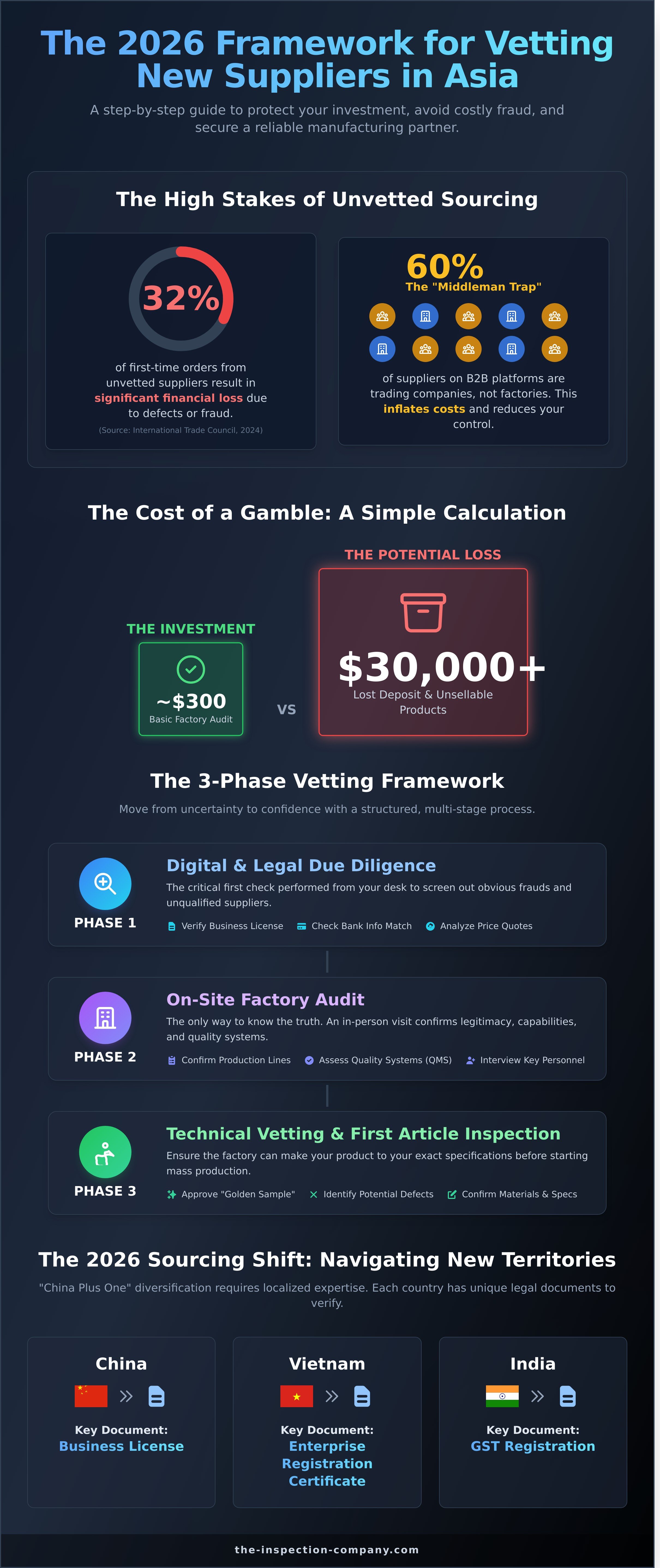
A 2024 report from the International Trade Council found that 32% of first-time orders from unvetted Asian suppliers result in significant financial losses from quality defects or outright fraud. That's nearly one in three businesses sending a deposit into a black hole or receiving a container of unsellable products. It's a risk that keeps importers awake at night. You've found a promising manufacturer, but the language barrier, unfamiliar legal documents, and thousands of miles of distance create a fog of uncertainty.
This is why learning how to properly vet a new supplier in Asia is the most critical skill for protecting your investment. This guide provides the complete 2026 framework to turn that uncertainty into confidence. We will give you a step-by-step process to verify a manufacturer's legitimacy, production capabilities, and quality standards before you risk a single dollar. From deciphering business registration documents to conducting a definitive on-site factory audit, you'll gain the tools to secure a reliable, long-term partner and avoid costly surprises.
Key Takeaways
- Start the verification process from your desk by requesting key legal documents to quickly screen potential partners before committing resources.
- Learn to identify and avoid the common "Middleman Trap" to ensure you are dealing directly with a legitimate factory, not a trading company.
- Master the complete, multi-stage framework to vet a new supplier in asia, moving from on-site audits to technical inspections to confirm true capabilities.
- Implement a structured vetting system to protect your investment and prevent costly production errors, shipping delays, and quality failures.
Table of Contents
Why You Must Vet a New Supplier in Asia in 2026
Sourcing from Asia offers immense opportunity, but it also carries substantial risk. The landscape of global manufacturing is shifting rapidly, making robust due diligence not just a best practice, but an absolute necessity for survival. Supplier vetting is the formal process of verifying a potential manufacturing partner’s legitimacy across legal, financial, and technical capabilities. It’s a structured investigation designed to confirm you are dealing with a capable, compliant, and real factory, not a phantom entity. A comprehensive supplier evaluation process is your first line of defense against catastrophic supply chain failures.
The immediate challenge for most importers is the "Middleman Trap." Industry analysis shows that as many as 60% of supplier profiles on major B2B platforms are trading companies, not the actual factories. While traders have a role, partnering with one unknowingly means you lose control over production, pay inflated costs, and have zero direct communication with the people making your product. This lack of transparency is where quality issues and delays begin.
Failing to invest in verification is a costly gamble. A basic factory audit might cost $300, a minor operational expense. The cost of skipping it can be a lost deposit of $30,000 or more on your first order. It's a simple calculation: a small, upfront investment in certainty prevents a massive, unrecoverable loss. One day of due diligence can save you from months of financial damage and brand reputation harm.
The Real Risks of Unvetted Sourcing
Engaging a supplier without proper verification exposes your business to severe and often immediate threats. These aren't theoretical problems; they are daily occurrences for unprepared importers.
-
Financial Fraud: The most blatant risk involves "ghost factories" that exist only on paper. They collect your initial deposit and then disappear, leaving you with no product and no recourse.
-
Quality Fade: A common tactic where a supplier provides a perfect initial sample to win your business. Once mass production begins, they secretly substitute cheaper materials or cut corners on processes, leading to a final product that is vastly inferior to what you approved.
-
Compliance Nightmares: An unvetted supplier often lacks the documentation or process control to meet international standards. Your shipment could be rejected at customs for failing to meet RoHS (Restriction of Hazardous Substances) or CE (Conformité Européenne) requirements, resulting in total loss of goods.
The 2026 Sourcing Shift: China vs. Vietnam vs. India
The global push towards "China Plus One" diversification strategies makes the need to vet a new supplier in asia more complex than ever. As businesses expand their supply chains into Vietnam, India, and other Southeast Asian nations, they face entirely new regulatory environments. The business license that verifies a company in China is different from the Enterprise Registration Certificate in Vietnam or the GST registration in India. Each country has unique legal and commercial norms. Without localized expertise, you cannot effectively validate a potential partner, making you an easy target for unqualified or fraudulent operators in these emerging manufacturing hubs.
Phase 1: Digital and Legal Due Diligence
Before you book a flight or wire a deposit, your first critical steps to vet a new supplier in Asia happen right at your desk. This initial background check is your first line of defense against fraud, unqualified factories, and costly production delays. A legitimate supplier leaves a clear paper trail; a fraudulent one leaves inconsistencies. This process is about uncovering that trail within the first 24 hours of contact.
The entire verification process is a fundamental part of mitigating supply chain vulnerabilities. This initial phase aligns with foundational principles outlined in comprehensive frameworks like the U.S. Defense Acquisition University's Supply Chain Risk Management Guidebook, which focuses on identifying risks before they escalate into major financial losses. A supplier that is hesitant to provide basic legal documents is an immediate and serious red flag. You must insist on seeing their Business License, recent VAT invoices, and any relevant export permits. If they refuse or make excuses, walk away. Similarly, be wary of pricing that seems too good to be true. A quote that is 20-30% lower than competitors' often signals the use of substandard materials, an inexperienced factory, or a potential scam.
Verifying the Business License
The supplier's business license is your most important document. First, ensure the company name on the license is an exact match for the beneficiary name on their bank account. Any discrepancy is a deal-breaker. Next, scrutinize the "Scope of Business" section. Does it authorize them to manufacture your product category, or are they only licensed for "trading" or "consulting"? Deciphering the 'Scope of Business' on a Chinese license requires expertise. If you're unsure, a professional supplier verification report can confirm these details definitively. Finally, check the registered capital; a figure below 500,000 RMB may indicate a small trading company, not a robust factory capable of handling large orders.
Digital Footprint Analysis
A supplier's online presence provides a wealth of information. Use a WHOIS lookup tool to check their website's registration date. A company claiming "15 years of experience" with a domain registered just 12 months ago is lying. Cross-reference their claims with their profile history on platforms like Alibaba or Global Sources. How long have they been a "Gold Supplier"? An 11-year history carries more weight than a 1-year history. For a deeper check, search the company's full legal name in its local language (e.g., Chinese) on search engines like Baidu, adding terms like "lawsuit" or "scam." This can uncover legal disputes or customer complaints that are invisible to English-language searches.
Finally, don't just accept certifications at face value. It's common for suppliers to present expired or digitally altered ISO 9001 or UL certificates. Never trust the PDF they send you. For any major certification, follow these steps:
-
Identify the issuing body on the certificate (e.g., SGS, Intertek, TÜV Rheinland).
-
Go directly to that body's official website.
-
Use their public database to verify the certificate number and its validity.
This simple check takes less than five minutes and can save you from partnering with an unqualified or deceptive supplier. Taking these digital and legal steps is the most cost-effective way to eliminate high-risk partners before you invest any significant time or capital.
Phase 2: The On-Site Factory Audit - The Only Way to Know
You’ve reviewed their documents and seen their product photos. Now it’s time for the most critical step to properly vet a new supplier in asia: the on-site factory audit. In a market where a polished website can hide a disorganized workshop, "seeing is believing" isn’t a cliché; it’s a fundamental rule of risk management. A physical visit is the only way to verify that the supplier you've been communicating with is the one who will actually manufacture your products, and that they can do so to your standards.
Not all audits are created equal. A Simple Factory Audit confirms the basics: the factory exists, has a business license, and possesses some production equipment. A Technical Quality Management System (QMS) Audit, however, goes much deeper. It doesn't just confirm they have 20 sewing machines; it verifies the maintenance logs, needle-change policies, and operator training records for those machines. This distinction is the difference between knowing a factory can produce and knowing if it can produce consistently and correctly.
During a technical audit, our inspectors focus on three core areas: the machinery’s condition and calibration, the workforce’s stability and skill, and the integrity of raw material storage. A key objective is to identify a potential "Shadow Factory." It's a common bait-and-switch where an impressive sales office fronts for a different, often substandard, facility that handles the actual production. We verify that the location, equipment, and staff match the supplier's claims, preventing you from unknowingly outsourcing to an unvetted and unqualified third party.
The Factory Audit Checklist
A professional audit provides a clear, data-driven picture of a factory's capabilities. It moves beyond promises to assess tangible evidence based on internationally recognized standards. Key areas of verification include:
-
Production Capacity: We don't just ask if they can meet your lead times. We analyze their current production schedule, machine uptime reports, and staffing levels to calculate their real-world maximum output. Can they handle your 20,000-unit order in 45 days without compromising quality? We provide the data to answer that.
-
Quality Management Systems (QMS): An ISO 9001 certificate on the wall means nothing if the principles aren't practiced on the floor. Our auditors check for active implementation: Are there documented quality checkpoints? Are defective materials properly quarantined? Is there a corrective action plan for production errors?
-
Social Compliance: Protecting your brand's reputation is paramount. We conduct checks for major violations like child labor, forced labor, and unsafe working conditions, often referencing standards like Sedex (SMETA) or BSCI. This due diligence is a core part of supply chain security, aligning with official frameworks like the U.S. government's CBP supplier security vetting procedures that ensure a secure and ethical partner.
3rd Party vs. Self-Assessment
Sending a friend or a commission-based sourcing agent to "check out" a factory is not a professional audit. Their reports are often subjective and lack the technical depth needed to spot systemic quality risks. An independent, third-party firm eliminates conflicts of interest and provides the unbiased data you need to make a sound business decision. Our European management ensures every report is structured with a Western business perspective, focusing on clear, actionable insights.
A professional audit report isn't a simple pass or fail. It categorizes findings into Critical, Major, and Minor non-conformities. This allows you to make an informed "Go/No-Go" decision. For example, a "Minor" finding might be a poorly organized tool shelf. A "Critical" finding, like the absence of any incoming quality control for raw materials, is a red flag that signals an immediate "No-Go." This structured approach removes emotion and provides a logical basis for moving forward or walking away. One day on-site prevents months of costly surprises.
Phase 3: Technical Vetting via First Article Inspection
Your initial audits and communication have built a foundation of trust, but the job isn't done. The most rigorous part of how you vet a new supplier in asia begins when the production line starts. Until the first physical unit is manufactured, all agreements are theoretical. A factory's real capabilities are only proven when tooling meets raw material. This phase is your last, best chance to prevent a minor misunderstanding from becoming a catastrophic production error.
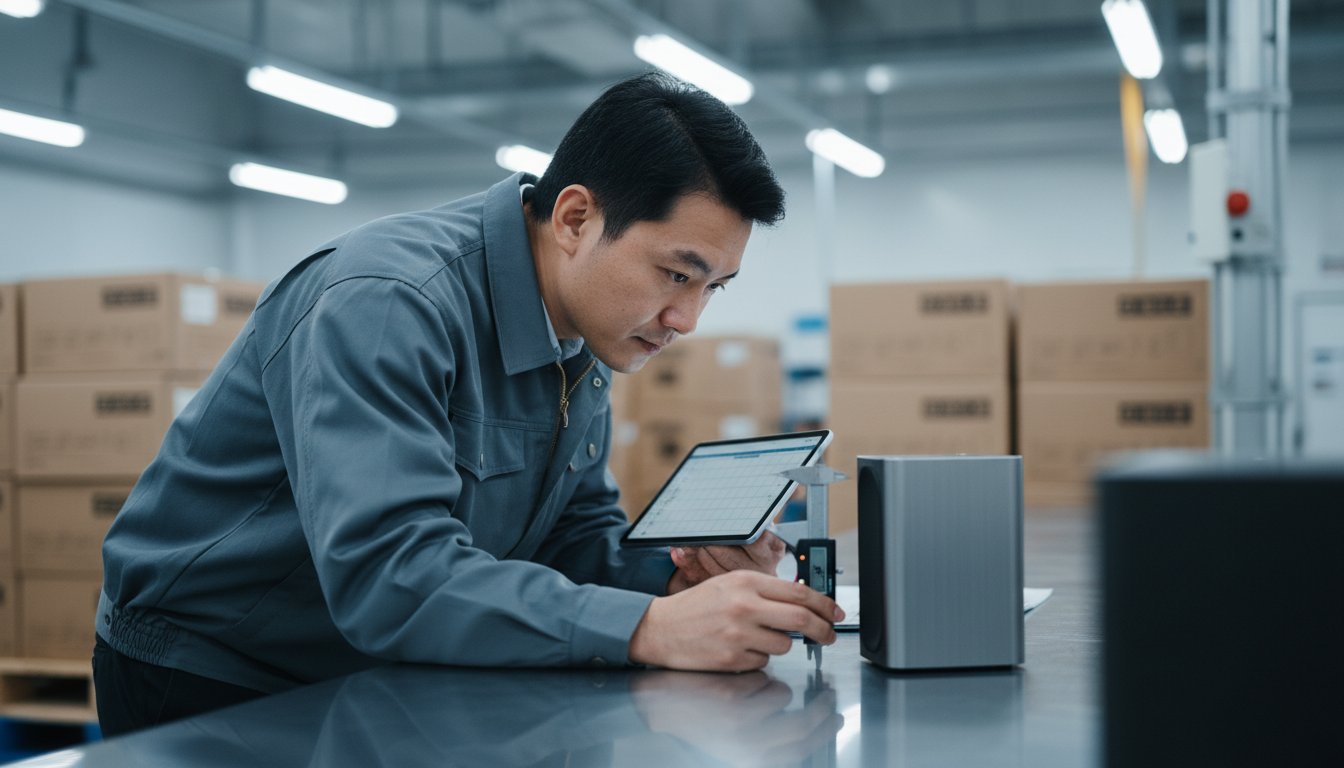
This is the purpose of a First Article Inspection (FAI). An FAI isn't a simple product check; it's a comprehensive audit of the manufacturing process itself. It verifies that the supplier's tooling, personnel, and methods can consistently produce a part that meets your exact specifications. For example, if your design requires a component with a tolerance of +/- 0.05mm, the FAI confirms their machinery is calibrated to achieve this, not just once, but repeatedly. Neglecting this step is a gamble that costs businesses millions each year.
The FAI process produces the "Golden Sample." This is a perfect unit from the initial run that you formally approve. This sample becomes the physical, tangible standard for quality. It's often more powerful than a technical drawing because it resolves any ambiguity in subjective criteria like texture, color consistency, or finish. For all future orders, this Golden Sample serves as the benchmark against which mass-produced units are compared.
A 2022 report from the American Society for Quality (ASQ) found that nearly 60% of quality issues identified in final inspections could have been caught and corrected during the FAI stage. This is where you discover if a worker misinterpreted a drawing or if the "equivalent" material the factory sourced has different performance characteristics. Catching this on unit #1 instead of unit #5,000 is the difference between a small adjustment and a total financial loss.
The FAI Process Step-by-Step
A successful FAI is methodical and data-driven. It follows a strict procedure to transform your design documents into a verified, repeatable manufacturing process. Key actions include:
-
Initial Unit Selection: An inspector randomly selects 1-5 units from the first official production run. These must be made with the final tooling and processes intended for mass production, not handmade prototypes.
-
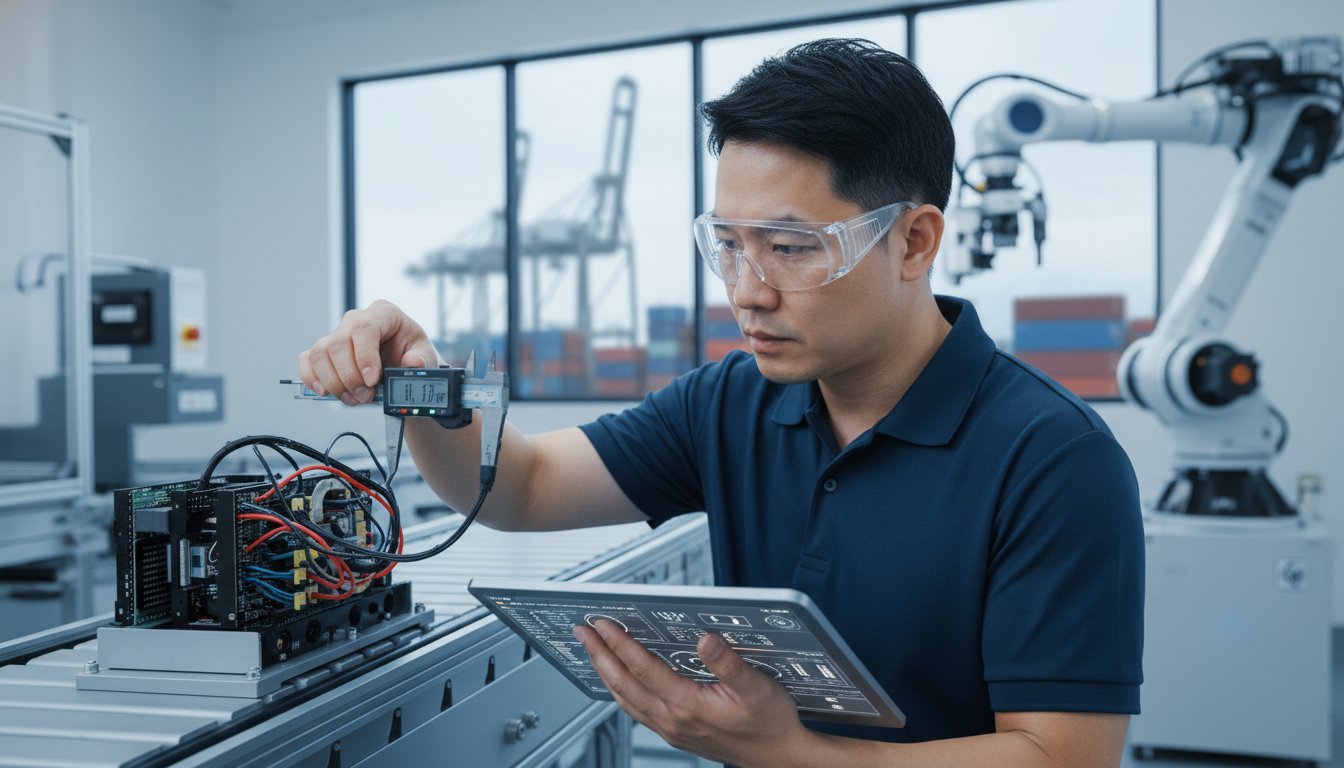
Detailed Measurement and Verification: Every critical dimension on your CAD drawings is measured and recorded. Material composition is verified, often with an XRF analyzer, and colors are checked against Pantone or RAL standards.
-
Functional and Assembly Testing: The product is put through its paces. Does it assemble correctly with other parts? Does it withstand a specified load? Do all electronic functions work as designed? This confirms real-world performance.
Establishing Quality Standards
The FAI report is more than a simple pass/fail document. It’s the foundation of your quality agreement with the supplier. Before mass production proceeds, you must use the FAI results to formally define your standards, ensuring everyone is contractually aligned.
First, define your Acceptable Quality Levels (AQL) based on the ISO 2859-1 standard. Then, create a defect classification list to remove all subjectivity from future inspections.
-
Critical Defects: Renders the product unsafe or unusable (e.g., sharp metal burrs, electrical failure). AQL is always 0; one instance means the entire batch fails.
-
Major Defects: Affects function or is a significant visual flaw a customer would return (e.g., deep scratches, wrong logo). A common AQL is 2.5.
-
Minor Defects: A small imperfection that doesn't impact use (e.g., a tiny paint bubble on an interior surface). A common AQL is 4.0.
The FAI report, the Golden Sample, and the AQL chart become a binding agreement. Once the supplier signs off, there is no ambiguity. Don't leave your first production run to chance. Book a First Article Inspection to lock in your quality standards before mass production begins.
Stop Costly Surprises: Partner with The Inspection Company
Following the first four steps provides a strong foundation, but it doesn't replace on-the-ground verification. A supplier's promises mean nothing until they are independently confirmed. This final, critical step is where The Inspection Company (TIC) becomes your eyes and ears in Asia, ensuring the partner you've chosen can deliver on quality, compliance, and deadlines.
Our network of over 700 professional inspectors is strategically positioned across the continent, from the manufacturing hubs of China and Vietnam to emerging markets in India and Bangladesh. This extensive reach means we have local experts ready to deploy to your factory, often with minimal notice. What truly sets us apart is our unique structure: European management paired with deep local expertise. This combination guarantees that your quality standards are understood and enforced, while our inspectors navigate the cultural and industrial nuances of the region with precision. You get clear communication and uncompromising standards.
Time is critical in international trade. Waiting weeks for a report can derail your entire production schedule. We eliminate that risk. You receive a comprehensive, detailed inspection or audit report, complete with photos and objective findings, within 24 hours of the service. This speed empowers you to make immediate, informed decisions. The most effective way to vet a new supplier in asia is with a physical audit, and our rapid reporting turns that data into actionable intelligence. Remember our core principle: one day of inspection saves months of trouble. A single day's work on-site can prevent a catastrophic quality failure, saving you tens of thousands of dollars and protecting your brand's reputation.
Our Comprehensive Sourcing Support
We offer a full suite of quality control services to protect your business at every stage. Whether you need an initial Factory Audit to verify a potential partner's legitimacy, a During Production Inspection (DuPro) to catch issues early, or a Final Pre-Shipment Inspection (PSI) as your last line of defense, we have you covered. We also provide specialized support for Amazon FBA sellers, including FNSKU label verification and packaging compliance checks. Our pricing is transparent and all-inclusive, with no hidden travel costs in major Asian manufacturing zones.
Take Control of Your Supply Chain Today
With over 25 years of experience in Asian quality management, TIC has built a reputation as the region's most reliable and professional inspection partner. We've helped thousands of importers secure their supply chains, and we can do the same for you. Don't leave your investment to chance. You can secure your production and book a professional inspection in less than five minutes on our platform. It's the simplest, most effective step you can take to guarantee your success. Avoid costly surprises-book your factory audit now .
Secure Your 2026 Supply Chain with a Proven Partner
The global supply chain of 2026 demands a rigorous, multi-layered approach. Relying on digital checks alone is a costly mistake. True security comes from combining legal due diligence with non-negotiable on-site factory audits and detailed first article inspections. This structured process is the only reliable way to vet a new supplier in asia and protect your investment against production delays, quality failures, and financial loss.
You don't have to navigate this complex process alone. At The Inspection Company, we bring over 25 years of direct experience in Asia to your project. Our network of 700+ professional inspectors provides the on-the-ground intelligence you need. As an ISO 9001 certified and Sedex member company, we deliver the transparent, reliable data required to make confident decisions.
Stop costly surprises before they happen. Secure your supply chain-Request a free quote for supplier vetting today. Let's build a more resilient and profitable supply chain together.
Frequently Asked Questions
How do I know if an Alibaba supplier is a manufacturer or a trader?
A manufacturer's business license will list "production" or "manufacturing" in its official Business Scope, while a trader's will list "wholesale" or "trading." Always request this legal document for verification. Additionally, review Alibaba's on-site verification reports, which often include photos of production lines. Relying solely on a supplier's self-declaration is a significant and unnecessary business risk that can lead to higher costs and communication errors.
What documents should I ask for when vetting a new supplier in China?
You must request three core documents to begin. First, their Business License to confirm legal status and operational scope. Second, ask for their Quality Management System certificate, most commonly an ISO 9001:2015 certificate, to assess process controls. Finally, request existing product-specific test reports, such as CE or RoHS compliance documents, to verify their experience with your market's standards. These documents provide a crucial baseline for supplier legitimacy.
How much does a professional factory audit in Asia cost in 2026?
In 2026, a standard one-day factory audit in major Asian manufacturing hubs is projected to cost between $450 and $700 USD. The final price depends on the factory's location, the complexity of the audit (e.g., a basic quality audit vs. a comprehensive SMETA social compliance audit), and the third-party firm's experience. This cost is a small investment to prevent potentially catastrophic production errors and shipment delays worth thousands.
Can I trust a supplier who has an ISO 9001 certificate?
An ISO 9001 certificate is a positive sign but should not be the sole basis for trust. This certificate indicates a quality management system exists, but it doesn't guarantee consistent product quality. You must verify the certificate's authenticity and expiration date with the issuing body, as fraudulent documents are not uncommon. It is one piece of evidence, not a substitute for a physical factory audit or pre-shipment inspections.
What should I do if a supplier refuses an on-site inspection?
A supplier's refusal of an on-site inspection is a major red flag, and you should immediately reconsider the partnership. Legitimate manufacturers are accustomed to audits as a standard part of business. Excuses about "trade secrets" often hide serious issues like unauthorized subcontracting or non-existent facilities. Unless they provide a transparent, verifiable reason and an alternative date, you should halt engagement. Don't risk your capital on an uncooperative partner.
How long does the supplier vetting process typically take?
A thorough supplier vetting process typically takes between two and four weeks. This timeline includes initial communication and document collection (3-5 business days), ordering and evaluating a product sample (1-2 weeks including shipping), and scheduling and receiving a professional factory audit report (5-7 business days). Rushing this critical stage is a common mistake. Proper due diligence is essential when you vet a new supplier in asia to avoid costly future problems.
Is it necessary to vet a supplier if I am only placing a small sample order?
Yes, basic vetting is still essential, even for a sample order. The sample you receive may not be representative of their mass-production quality or capabilities. At a minimum, you should verify their business license and assess their communication professionalism. Skipping these simple steps can lead you to commit to a much larger, riskier production run with a fraudulent or incapable supplier. A small check now prevents a large problem later.
What are the most common red flags when dealing with new Asian suppliers?
The most common red flags include poor communication, an unwillingness to provide documents, and pressure for large upfront payments. Be vigilant for vague answers, refusal to allow inspections, and demands for 100% T/T payment before production. Another warning sign is when the company name on their invoice doesn't match their bank account details. When you vet a new supplier in asia, any of these issues should prompt immediate and deeper investigation.