
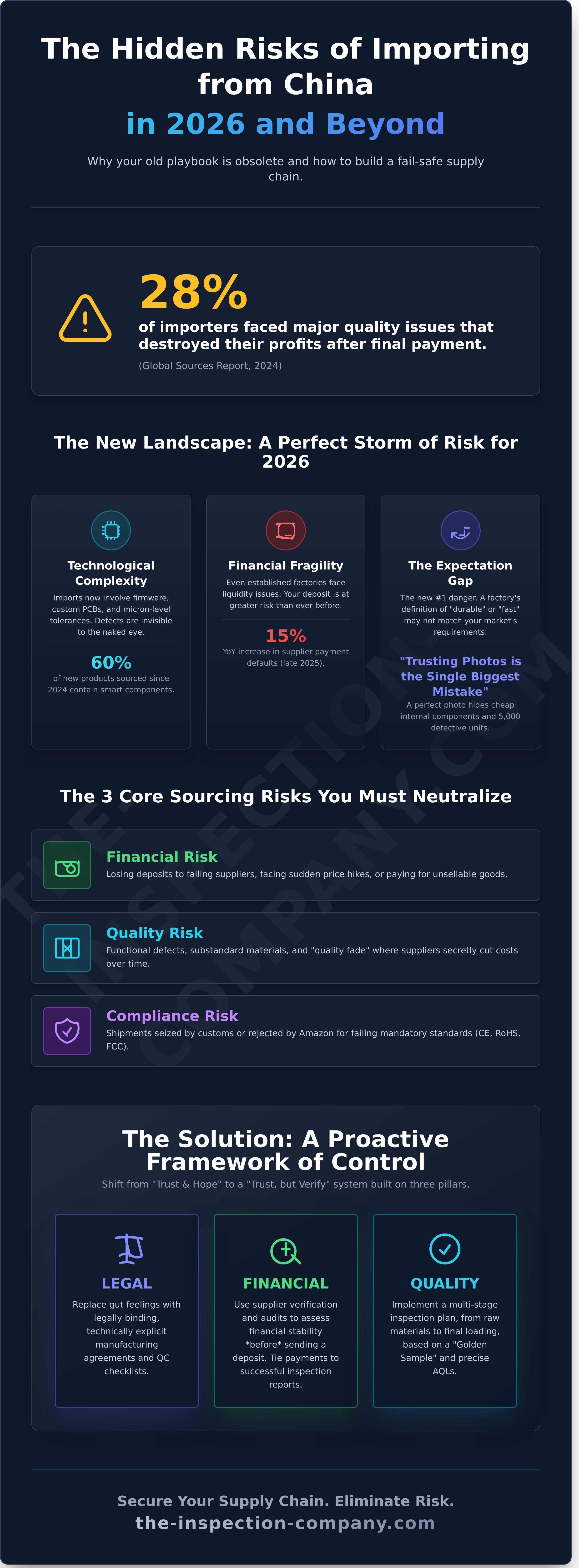
A 2024 Global Sources report revealed a sobering statistic: 28% of importers experienced a major quality control issue that directly impacted their profitability after making their final payment. It’s the moment every business owner sourcing from Asia dreads, turning a promising venture into a costly liability.
That feeling of uncertainty after wiring the final 70% is a significant business vulnerability. You can only hope the container arriving in 30 days holds the quality product you ordered, not a shipment of expensive defects that will damage your brand's reputation on Amazon. This guide provides your solution. It’s not about hope; it’s about control. Here, you will learn the exact framework needed to effectively reduce risk importing from China, safeguarding your capital and ensuring predictable product quality.
From advanced supplier verification to implementing a multi-stage inspection plan, we’ll outline the essential steps for building a truly fail-safe supply chain for 2026 and beyond.
Key Takeaways
- Discover why China's shift to technological complexity and new financial pressures in 2026 requires a different approach to risk management.
- Master the difference between factory audits and product inspections, and learn when to deploy each tool to effectively reduce risk importing from china.
- Implement a practical inspection strategy by defining a "Golden Sample" and setting precise Acceptable Quality Levels (AQLs) to eliminate defects.
- Integrate the three pillars of risk mitigation-Legal, Financial, and Quality-into your supplier lifecycle to avoid costly surprises before shipment.
Understanding the New Landscape of China Import Risks in 2026
The playbook for sourcing from China has fundamentally changed. What was once a strategy centered on leveraging low-cost labor for simple goods has evolved into a complex ecosystem of advanced manufacturing. By 2026, the primary risks aren't just about late shipments or poor stitching; they're about firmware failures, material non-compliance, and sudden factory insolvencies. To effectively reduce risk importing from china, you must first understand this new, more sophisticated environment.
China's manufacturing base has pivoted aggressively towards technological complexity. Where importers once worried about fabric colors, they now face challenges with custom PCB layouts and injection mold tolerances measured in microns. Since 2024, an estimated 60% of new consumer products sourced from the region contain smart components or integrated electronics. This shift introduces an entirely new class of potential defects that are impossible to spot with the naked eye, from incorrect chipset installations to software bugs that can render an entire shipment worthless.
This technological leap is happening against a backdrop of unprecedented financial fragility. The economic reverberations of the 2023-2025 global demand shifts mean that even factories with a decade of positive history are facing critical liquidity problems. Reports from major trade finance institutions showed a 15% year-over-year increase in supplier payment defaults in late 2025. This means your deposit is at greater risk than ever before. A factory can accept your order in May and be out of business by July.
Most importers focus on the "communication gap," hiring translators to ensure their instructions are understood. The real danger in 2026, however, is the "expectation gap." This occurs when a factory verbally agrees to a specification like "use a durable plastic," but their internal standard for "durable" doesn't match your product's use case or your market's regulatory requirements. Without a detailed, technically explicit Quality Control Checklist, you are relying on assumptions. Relying on factory-provided photos is the single biggest mistake modern importers make. A well-lit photo of a "golden sample" tells you nothing about the 5,000 units being packed into a container. It won't reveal a cheaper internal component or a subtle color mismatch that will trigger a wave of customer returns.
The 3 Main Categories of Sourcing Risk
Every import challenge can be traced back to one of three core risk categories. Understanding them is the first step toward effective mitigation.
- Financial Risk: The most immediate threat. This includes losing your 30-50% deposit to a failing supplier, being hit with non-negotiable price hikes mid-production, or paying for a shipment that is ultimately unsellable.
- Quality Risk: This covers everything from functional defects and substandard raw materials to "quality fade," where a supplier slowly degrades product quality after the first few successful orders to cut costs.
- Compliance Risk: A shipment that fails to meet mandatory standards for your market (like CE, RoHS, or FCC) can be seized by customs or rejected by major platforms like Amazon FBA, resulting in a total loss.
Why "Guanxi" is Not a Substitute for Quality Control
Many importers are told that building "Guanxi," or a strong personal relationship, with their supplier is the key to success. While relationships are important in Chinese business culture, they are not a safety net against technical failure. The cultural emphasis on maintaining harmony can lead to "polite agreement," where a factory manager says "yes" to a complex technical request to avoid confrontation, even if they don't fully understand the requirement.
This deference can inadvertently bypass essential quality control processes, leading to disastrous assumptions. A friendly dinner won't ensure your product's battery chemistry is stable or that its wireless radio frequency complies with Western regulations. In fact, professional, high-performing factories respect buyers who are diligent. Demanding an independent, third-party audit doesn't signal distrust; it signals that you are a serious, professional partner who leaves nothing to chance. It protects both you and the factory from costly mistakes rooted in ambiguity.
The 3 Pillars of Risk Mitigation: Legal, Financial, and Quality
Effective risk management isn't a reaction to a crisis; it's a proactive framework you build into your supplier relationship from the very first conversation. To truly reduce risk importing from china, you must shift your mindset from one of simple trust to one of "trust, but verify." This means replacing assumptions with data-driven reports and gut feelings with contractual obligations. It’s a disciplined approach, and as government bodies like the U.S. National Institute of Standards and Technology advocate, a structured supply chain risk management process is critical for operational security.
This entire strategy is built on a simple, powerful philosophy: one day of inspection can save months of trouble. Consider the math. A professional third-party inspection might cost around $300. A full 40-foot container of defective goods could represent a loss of over $50,000, not including reputational damage and lost sales. The return on investment for quality control isn't just positive; it's essential for survival.
Financial Safeguards and Payment Terms
Never pay 100% upfront. This is the single biggest financial mistake an importer can make, as it removes all your leverage. The industry standard is a 30/70 split: 30% deposit to begin production and the final 70% balance payment after the goods have passed a Pre-Shipment Inspection (PSI). For high-value orders, typically over $50,000, using a formal Letter of Credit (LC) or a reputable escrow service adds another layer of security. The critical link is making that final 70% payment conditional on receiving a "Passed" inspection report. This ensures your capital is only released when the product meets your documented standards.
The "China-Centric" Manufacturing Contract
Your standard domestic purchase agreement is a landmine in a Chinese court. It won't be recognized and offers you zero protection. You need a clear, bilingual manufacturing contract that is enforceable under Chinese law. This document is your primary legal tool and must be meticulously detailed. It should explicitly state:
- Specific Quality Standards: Vague terms like "good quality" are useless. Define materials, colors (using Pantone codes), dimensions, and functionality.
- AQL Limits: Define your Acceptable Quality Limits (AQL). For most consumer goods, an AQL of 2.5 for major defects is a common starting point.
- Penalties for Delays: Outline clear financial penalties for missed production or shipping deadlines, such as a 1% reduction in the total order value for each week of delay.
- Right of Access: The contract must grant your designated third-party inspection company unconditional access to the factory floor to perform quality control checks at any stage of production. This clause prevents a factory from blocking an inspection, giving you the visibility you need, backed by a comprehensive quality control report.
Factory Audits vs. Product Inspections: Choosing Your Defense
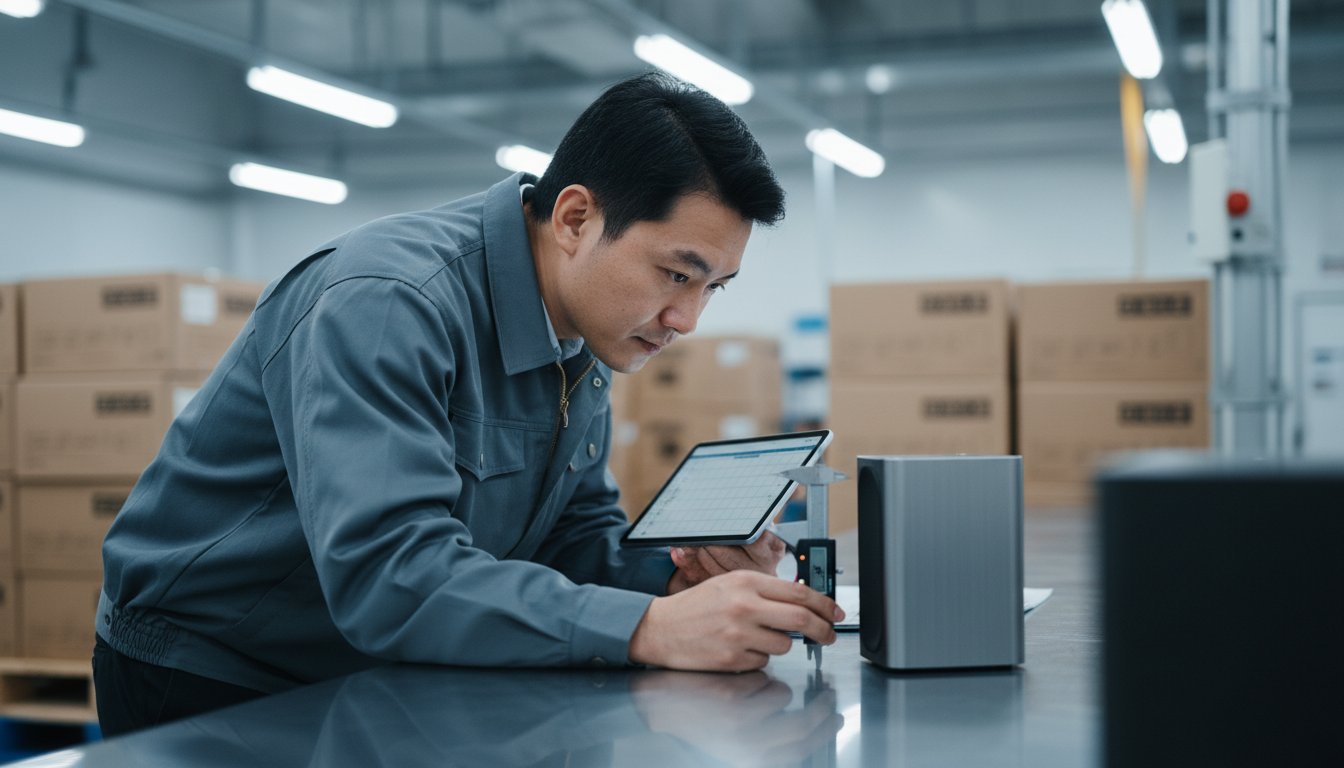
Understanding your quality control options is not about choosing one tool over another. It's about deploying the right defense at the right stage of your procurement cycle. A factory audit is your strategic reconnaissance, performed before you commit capital. A product inspection is your frontline gatekeeper, standing guard before your final payment is released. Using them incorrectly, or not at all, is a common source of costly surprises for importers.
An audit prevents problems by vetting the source; an inspection stops defective products from ever leaving the factory floor. Together, they form a powerful combination to reduce risk importing from China, shifting your strategy from reactive damage control to proactive quality assurance.
The Factory Audit: Vetting Legitimacy
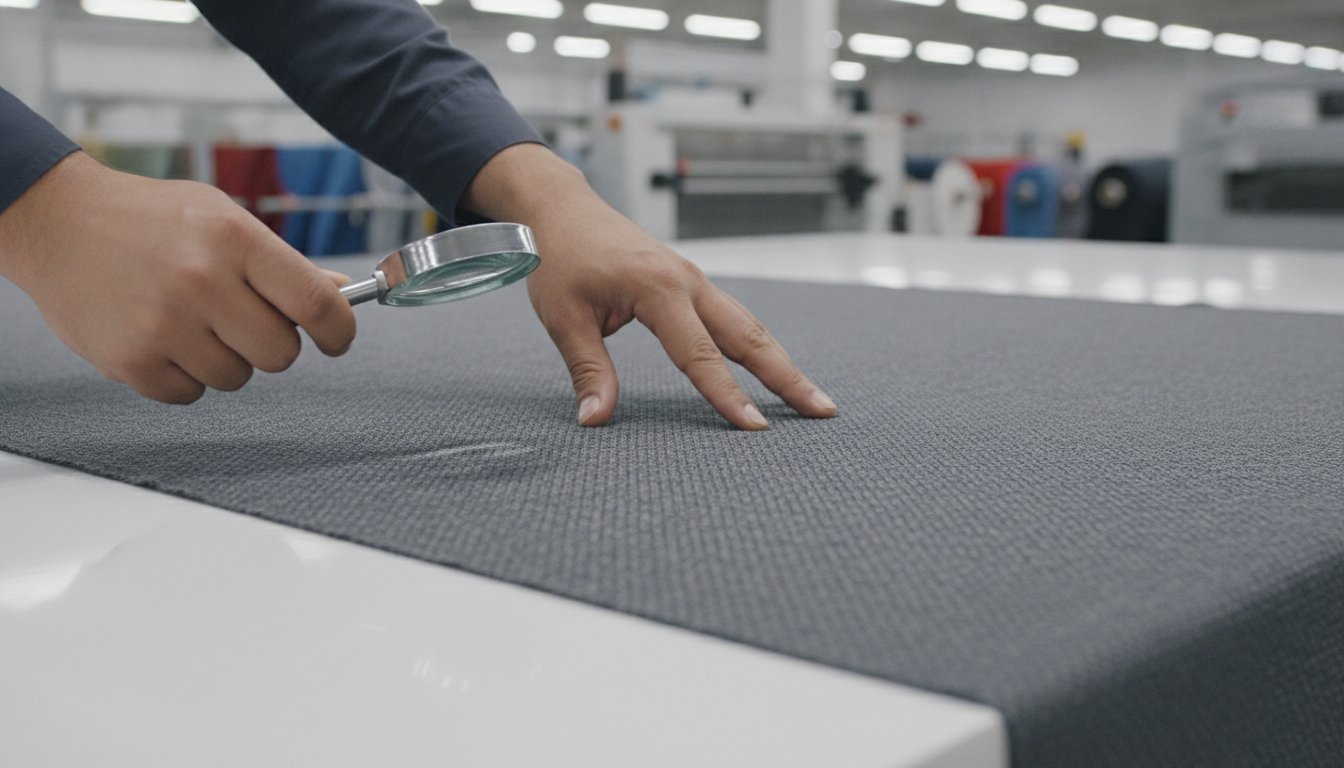
A factory audit is an investigation into your potential partner's capabilities, legitimacy, and ethical standards. It occurs before you sign a purchase order. Think of it as a background check for your supply chain. An on-site auditor verifies that the supplier isn't just a trading company with a convincing website. They confirm the existence of production lines, check machinery maintenance logs, and assess real output capacity against the supplier's claims. This process confirms critical details like:
- Quality Management Systems (QMS): Is their ISO 9001 certification genuine and actively implemented, or is it just a framed certificate on the wall? An auditor checks for documented quality procedures and records of internal checks.
- Social Compliance: An audit can assess adherence to SA8000 standards, ensuring your brand isn't inadvertently tied to unethical labor practices. This is a crucial step for brand protection and for meeting the complex legal responsibilities outlined in resources like the U.S. Customs and Border Protection Importing Guide.
- True Identity: In 2022, industry analysis showed that nearly 15% of online supplier listings were from trading companies masquerading as factories. An audit physically verifies the business license and factory footprint, ensuring you partner with a genuine manufacturer.
The PSI (Pre-Shipment Inspection): The Ultimate Fail-Safe
If an audit vets the supplier, the Pre-Shipment Inspection (PSI) vets the product. This is your final chance to identify quality issues before they become your expensive problem. A PSI is a systematic check of your finished goods, and its timing is critical.
We conduct a PSI when at least 80% of your order is produced and packed. This threshold is the industry standard for a reason: it provides a large, random sample for a statistically valid assessment (using AQL standards) while leaving a small window for the factory to perform rework on any identified defects without missing the shipping deadline. A detailed PSI report delivers objective evidence that a factory's email update simply can't. You'll see high-resolution photos of defects, results from on-site functional tests, and verification of packaging, labels, and barcodes.
What happens if your inspection "Fails"? It's not a disaster; it's a moment of leverage. A failed report doesn't mean you cancel the order and destroy the relationship. It means you now have an independent, fact-based tool to demand accountability. You can require the supplier to create a Corrective Action Plan and re-inspect the goods at their expense before you release your final payment. This simple step is one of the single most effective ways to reduce risk importing from China and ensure you get exactly what you paid for.
Practical Guidance: Creating a Risk-Proof Inspection Strategy
A proactive quality control plan is the single most effective tool you have to reduce risk importing from China. Simply hoping for the best is not a business strategy; it's a gamble with your capital. A structured inspection process gives you control, stopping costly defects before your products are loaded onto a container ship. Follow this five-step framework to protect your investment and your brand's reputation.
Your strategy begins before production even starts. It’s built on clarity and defined standards.
- Step 1: Define Your "Golden Sample" and Specifications. Before any inspection, you need a benchmark. The "Golden Sample" is the final, approved prototype that your factory must replicate. It's not enough on its own. It must be supported by a detailed technical specification sheet listing Pantone color codes, material composition (e.g., 304 stainless steel, 180 GSM cotton), critical dimensions, and weight tolerances. Without these objective criteria, quality becomes a subjective argument.
- Step 2: Set Your AQL (Acceptable Quality Level). You must decide your tolerance for defects. The AQL standard is a statistical method used globally to determine if a production order meets your quality requirements. It dictates how many units will be inspected and the maximum number of defects allowed before an entire shipment is rejected.
- Step 3: Book a Pre-Shipment Inspection (PSI). A PSI is your last chance to see the finished product in the factory. Schedule this inspection for when 100% of the goods are produced and at least 80% are packed. Crucially, book it at least two weeks before the scheduled container loading date. This buffer is non-negotiable; it gives the factory time to rework or replace defective units without derailing your shipping timeline.
- Step 4: Review the 24-Hour Report. A professional inspection company will deliver a detailed report with photos and findings within 24 hours. Our data from over 25 years of inspections shows that a PSI catches critical errors in 15% of initial production runs. Review this report immediately. If it fails, you can instruct the factory to fix the issues. You hold the power because you haven't yet made the final payment.
- Step 5: Supervise Container Loading. The final step is to ensure the exact goods you inspected are what get loaded. Container Loading Supervision (CLS) verifies quantities and checks for damage during loading. This simple check prevents a common "bait and switch" tactic where a perfect batch is presented for inspection, only for inferior goods to be loaded into the container.
The Amazon FBA Specific Checklist
Selling on Amazon adds another layer of compliance where mistakes lead to immediate rejection at the fulfillment center. Your inspection must verify FNSKU label accuracy and placement, carton labeling, and pallet requirements. Packaging must pass a 3-foot "drop test" on multiple corners and faces to simulate the harsh reality of transit. For products in regulated categories, the inspection must confirm the presence of required markings for CPC (Children's Product Certificate) or RoHS compliance on the product and its packaging.
Mastering the AQL Standard
AQL is the statistical threshold for shipment approval. Based on your order size and chosen inspection level (e.g., General Level II), the AQL chart tells an inspector the exact sample size to pull for a random inspection. Defects are then classified:
- Critical: Unsafe or hazardous (0% tolerance).
- Major: Renders the product unusable or unsellable.
- Minor: A small cosmetic flaw unlikely to cause a return.
Don't let these details overwhelm your efforts to reduce risk importing from China. A clear plan is your best defense. Let our experts help you build a custom inspection plan for your specific product today.
The Inspection Company Advantage: European Management, Asian Presence
The greatest challenge in overseas manufacturing isn't distance; it's the gap in expectations. Western quality standards often don't translate directly to the realities of a Chinese factory floor, creating a major source of risk for importers. This is where a specialized partner becomes your most valuable asset. Our unique structure of European management overseeing a vast network of local Asian inspectors provides the critical bridge for your business, ensuring your standards are understood, implemented, and verified.
Our team of over 700 local inspectors across Asia is your strategic advantage. These professionals are on the ground, fluent in the local language, and intimately familiar with regional manufacturing practices. This local expertise is coordinated by our Hong Kong-based European management team, who ensure every inspection adheres to rigorous ISO 9001 standards and your specific quality benchmarks. This dual approach is the most effective way to reduce risk importing from china, giving you local insight with global-standard oversight.
Information is only valuable when it's timely. You won't wait days for critical data. We guarantee a detailed, photo-rich report is in your inbox within 24 hours of an inspection's completion. This allows you to:
- Review product quality, dimensions, and functionality against your "golden sample."
- Verify packaging, labeling, and shipping marks are correct.
- Confirm order quantity before the container is sealed.
This rapid, transparent reporting gives you the power to approve or reject a shipment with confidence. It’s how we help you "Avoid costly surprises" before your shipment sails. Finding a 15% defect rate on a $50,000 order before it leaves the port saves not just the cost of goods, but also shipping fees, customs duties, and the immense reputational damage of selling faulty products.
Real-Time Risk Management in 2026
With over 25 years of experience, we've refined quality control into real-time risk management. A factory's internal QC serves the factory's interests. Our independent verification serves only yours. An external, unbiased assessment is the only reliable way to confirm your products meet spec before they leave the facility. It's your last, best chance to prevent defects from reaching your customers. Book your Pre-Shipment Inspection today.
Beyond China: Managing Risk Across Asia
As supply chains diversify, your quality control needs to scale. We help you manage risk not just in China, but across key manufacturing hubs like Vietnam, India, and Bangladesh. Our standardized processes ensure you receive consistent, easy-to-compare reports, no matter the sourcing location. This unified approach simplifies your operations and guarantees your quality standards are upheld everywhere. Get a Free Instant Inspection Quote and secure your entire Asian supply chain.
Secure Your Supply Chain: Your Final Step to Risk-Free Importing
The 2026 import landscape demands more than hope; it requires a proactive strategy. Your success hinges on mastering the three pillars of risk mitigation: legal diligence, financial foresight, and uncompromising quality control. A well-defined inspection plan isn't just a safety net; it’s the most direct way to reduce risk importing from china and protect your bottom line before costly problems arise.
Partnering with a specialist is the smartest move. As an ISO 9001 Certified and Sedex Member company, The Inspection Company puts a team of over 700 professional inspectors on the ground for you across Asia. You get actionable intelligence, complete with detailed photo evidence, in a comprehensive report delivered within 24 hours. We stop problems before your shipment sails.
Protect your investment-Schedule an inspection with The Inspection Company today.
Take control of your supply chain and build a more resilient, profitable business for 2026 and beyond.
Frequently Asked Questions About Importing from China
Is it really necessary to inspect every shipment from China?
Yes, inspecting every shipment is the most effective way to ensure consistent quality and avoid costly surprises. Even with trusted suppliers, our 2023 data shows a 15% rate of major quality deviations on repeat orders from the same factory. A Pre-Shipment Inspection (PSI) is your final, critical opportunity to identify and fix defects before you make the final payment. One day of inspection can save you months of trouble and protect your investment.
What happens if the inspection report shows a "Fail"?
A "Fail" result empowers you to negotiate with your supplier before the goods leave the factory. It's not a dead end; it's a crucial checkpoint. With our detailed report as objective evidence, you can demand specific actions like a 100% rework of defective items or negotiate a discount of up to 30% on the affected units. This ensures you don't pay for or ship products that fail to meet your standards.
How much does a professional product inspection service cost in 2026?
A standard Pre-Shipment Inspection in China's main industrial regions is projected to cost between $280 and $350 USD per man-day in 2026. This all-inclusive rate covers one inspector's full 8-hour day, all related travel, and the delivery of a comprehensive report within 24 hours. For most consumer goods, a single man-day is sufficient to complete a thorough inspection, making it a highly cost-effective quality control measure.
Can I rely on Alibaba Trade Assurance instead of a physical inspection?
No, you shouldn't rely on Trade Assurance as a substitute for a physical quality inspection. Trade Assurance is a payment protection tool that helps you recover funds *after* a problem has already occurred and your goods have shipped. This process can take over 60 days. A physical inspection is proactive; it identifies and stops defects *before* your shipment sails, saving you from the delays, disputes, and financial losses that Trade Assurance is designed to address later.
What is the difference between a factory audit and a quality inspection?
A factory audit evaluates the supplier, while a quality inspection evaluates the product. Think of an audit as a background check on the factory itself, assessing its legitimacy, production capacity, and ethical compliance through our SA8000-certified auditors. An inspection, on the other hand, is a hands-on examination of your specific order, verifying that the products meet your exact quality specifications before they are shipped.
How do I know if a factory in China is actually a middleman?
A comprehensive factory audit is the only certain method to confirm you're dealing directly with a manufacturer. Our auditors verify official business licenses to ensure they list "manufacturing" and not "trading." They also conduct an on-site assessment to confirm the presence of production lines and machinery relevant to your product. Our findings show that over 20% of suppliers presented as factories are, in fact, trading companies without their own production facilities.
Does The Inspection Company provide services for Amazon FBA sellers?
Yes, we offer specialized inspection services tailored for the strict requirements of Amazon FBA. Our inspectors verify FNSKU labeling, packaging compliance, carton weight limits, and perform drop tests based on Amazon's latest standards published in Q4 2023. These checks are essential to reduce risk importing from china for FBA, as a single packaging error can cause Amazon to reject an entire shipment at the fulfillment center, leading to significant costs.
Can a PSI prevent my goods from being withheld by the factory?
A Pre-Shipment Inspection (PSI) provides powerful leverage that significantly deters factories from withholding goods. While it isn't a legal guarantee, a supplier knows that an independent third party has documented the shipment's quality with photographic evidence. This impartial report strengthens your negotiating position immensely, ensuring you only release final payment for goods that verifiably meet your standards and making it very difficult for a factory to justify holding a conforming order hostage.