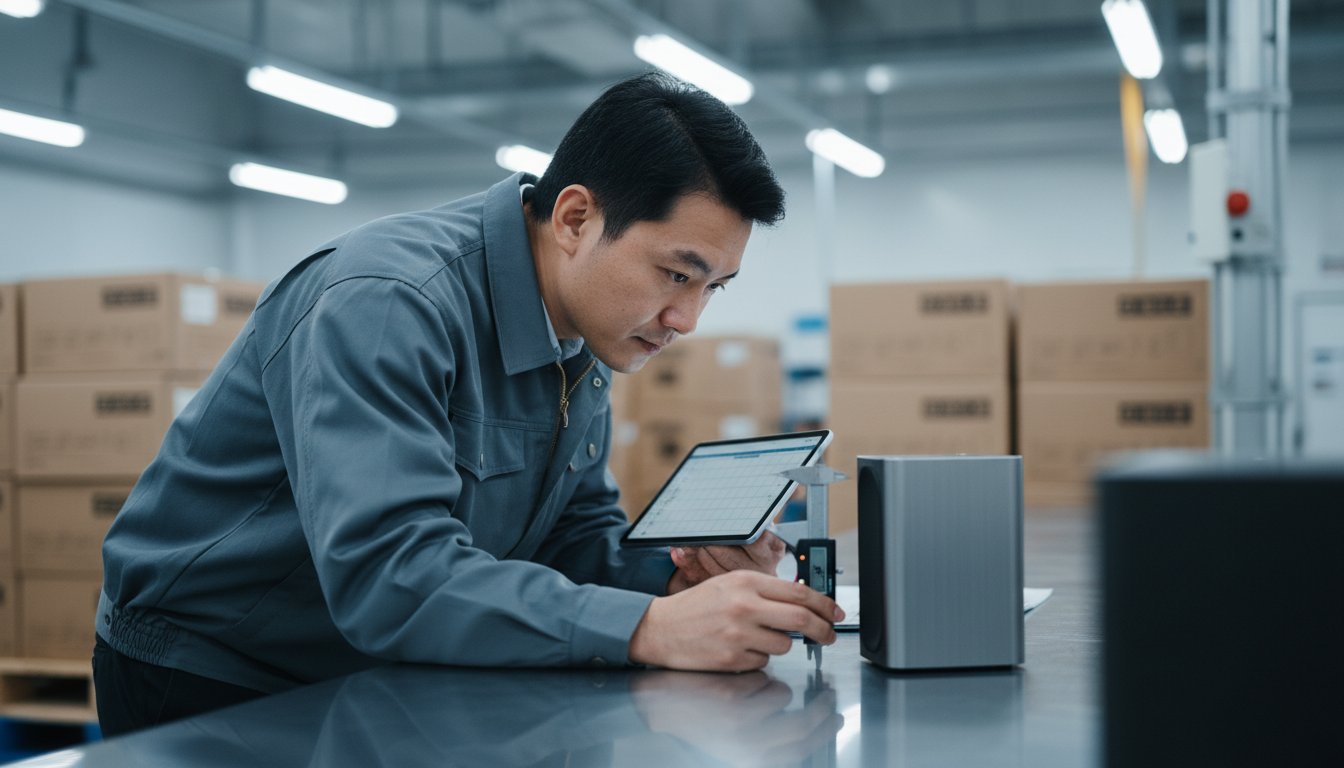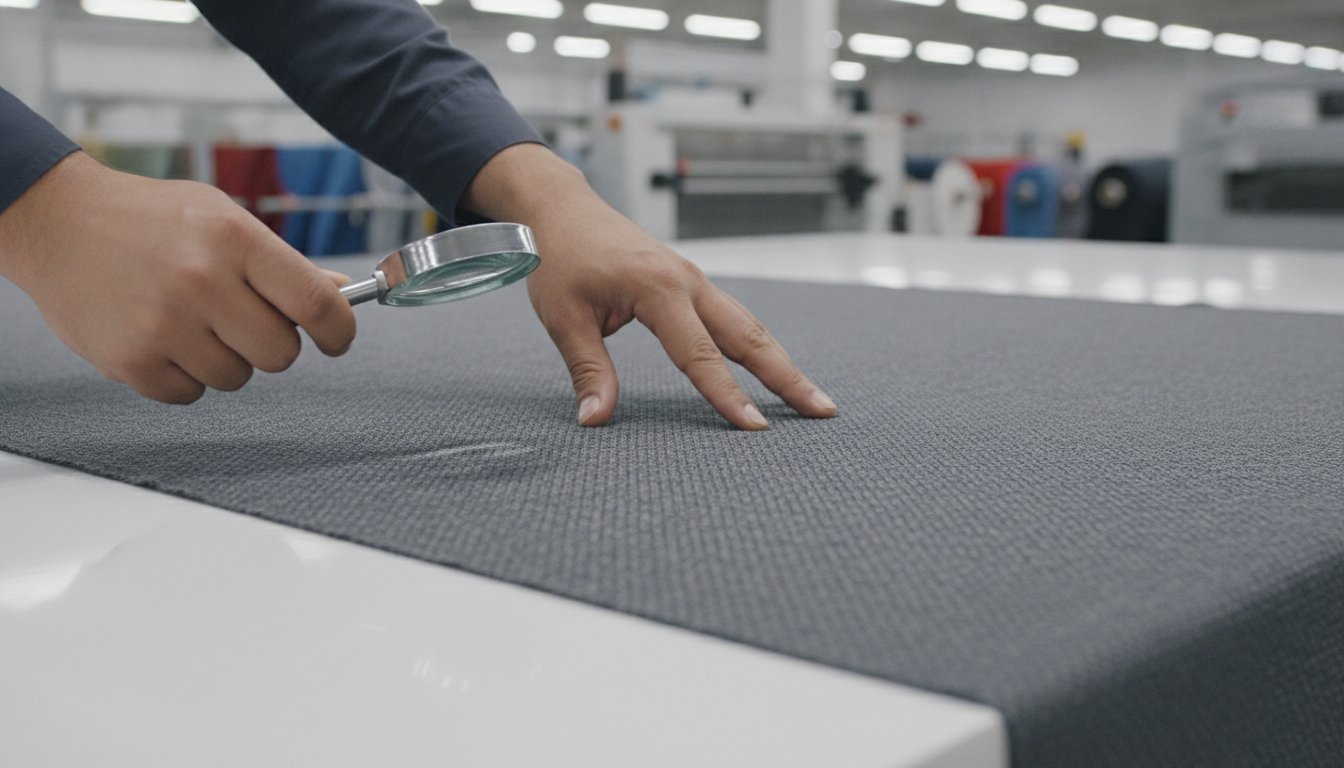

What if the most expensive part of your supply chain isn't the rising cost of freight, but the final 70% wire transfer you send for a container of unsellable defects? You already know that shipping costs are eating into your margins, making every dollar count. When budgets get tight, it's tempting to view quality control as an optional expense. However, learning how to justify the cost of inspections is the only way to ensure your capital isn't wasted on goods that arrive damaged or non-compliant. One day of professional inspection can save months of financial trouble and prevent your Amazon account from facing a permanent suspension due to a 3% defect rate.
We understand the anxiety of sending thousands of dollars across the globe and hoping for the best. This guide transforms quality control from a perceived "sunk cost" into a high-return investment that protects your brand reputation. You'll discover a clear framework to calculate the ROI of your QC efforts and gain data-backed arguments to present to your stakeholders. We'll show you how to stop problems before your shipment sails, giving you the confidence to authorize that final payment with total transparency.
Key Takeaways
- Learn to quantify the "Total Cost of Quality" to identify the hidden financial risks of relying on supplier self-inspections.
- Master a data-driven ROI formula that provides the financial evidence needed for how to justify the cost of inspections to your stakeholders.
- Compare the minimal cost of a professional man-day against the catastrophic expenses of air-freight replacements and peak-season stockouts.
- Follow a strategic two-step framework to budget for quality control based on product complexity and supplier risk profiles.
- Discover how an independent, on-the-ground presence in Asian manufacturing hubs transforms quality management into a high-return investment.
The Hidden Financial Risks of Skipping Product Inspections
Many importers view inspection fees as an optional line item rather than a protective barrier. This perspective ignores the Total Cost of Quality (TCQ), a metric that combines prevention, appraisal, and failure costs. When you calculate how to justify the cost of inspections, you aren't just looking at the price of a man-day. You're calculating the massive financial weight of potential failure. Prevention and appraisal costs represent a controlled investment, while failure costs are unpredictable and often catastrophic.
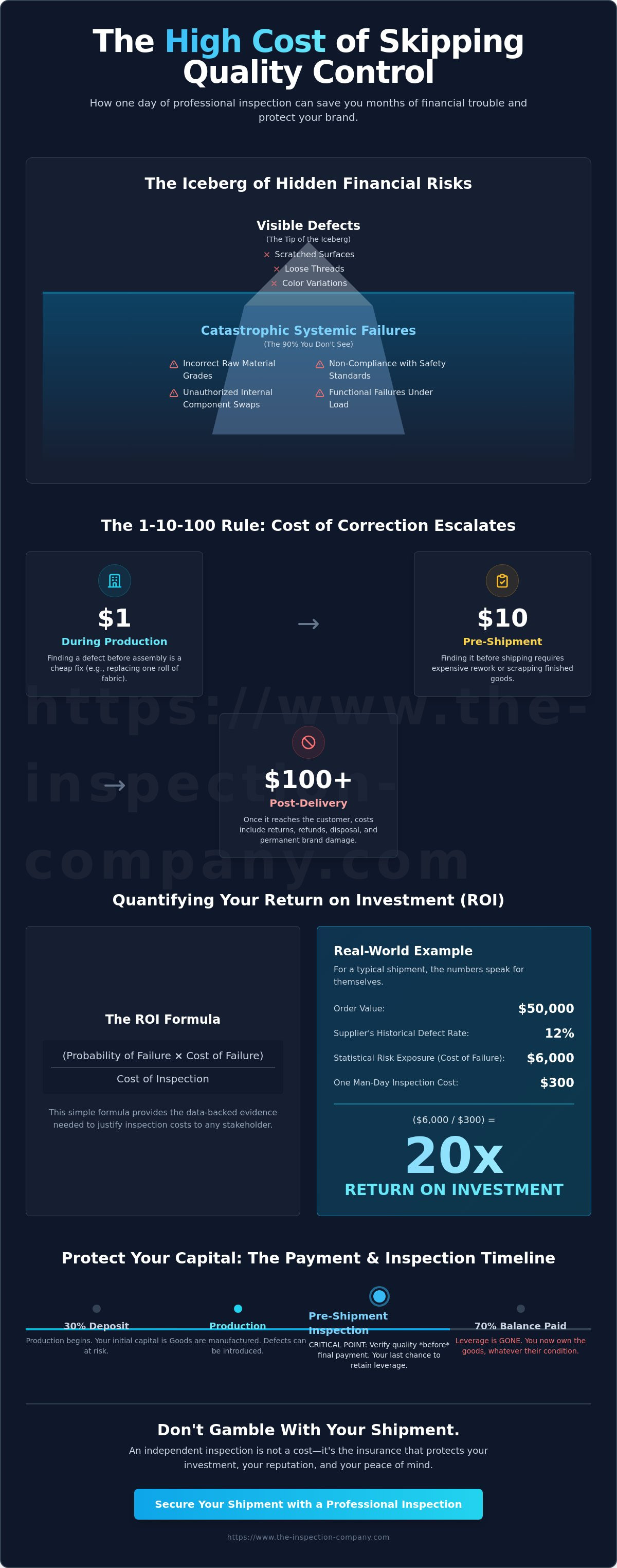
The "Tip of the Iceberg" effect is a reality in global sourcing. Visible defects, like a scratched surface or a loose thread, are only the small portion of risk you can see. Beneath the surface lie systemic shipment failures: incorrect raw material grades, non-compliance with safety standards, or internal component swaps. These issues rarely appear in a factory-sent sample. They only emerge when the full shipment is scrutinized by an independent eye.
Leverage is your only currency in manufacturing. Most agreements require a 30% deposit and a 70% balance payment before the goods leave the port. Once that 70% balance is paid, your leverage is gone. If the container arrives at your warehouse filled with unsellable goods, the factory has already moved on to the next client. Third-party oversight is the only way to ensure the goods meet your standards before the final payment is released.
Why Internal Factory QC Is Not Enough
Factories exist to produce volume at speed. This creates a structural conflict of interest. Internal quality control staff often report directly to production managers whose bonuses depend on meeting shipping deadlines, not on rejecting faulty units. This pressure leads to "minor" defects being ignored to keep the line moving. Utilizing professional Quality Inspection Services provides the unbiased oversight necessary to stop biased reporting. An independent inspector doesn't care about the factory's production schedule; they only care about your specifications.
The Escalation of Costs: The 1-10-100 Rule
The 1-10-100 rule is a fundamental principle in quality management that explains how to justify the cost of inspections through simple math. It costs $1 to fix a problem during production, $10 to fix it during a pre-shipment check, and $100 (or more) to fix it after it reaches the customer.
- Production Stage ($1): Finding a dye lot variance in fabric before it's cut. You simply replace the roll of fabric.
- Pre-Shipment Stage ($10): Finding the same defect after 5,000 shirts are sewn. You now face labor costs for re-work or the loss of the entire batch.
- Post-Delivery Stage ($100): The customer receives a discolored shirt. You pay for the return shipping, the refund, the disposal, and the permanent loss of brand trust.
By inspecting at the source, you catch errors at the $1 or $10 stage. This prevents the exponential surge in costs that occurs once a shipment clears customs and enters your distribution network.
Quantifying the ROI: How to Justify the Cost of Inspections
Many importers view quality control as a line-item expense rather than a strategic investment. To understand how to justify the cost of inspections, you must look at the mathematical probability of loss. A single man-day of inspection typically costs a fraction of the total shipment value, yet it protects goods worth tens of thousands of dollars. We operate on the principle that one day of inspection can save months of trouble.
The standard framework for calculating this return involves a simple formula: (Probability of Failure x Cost of Failure) / Cost of Inspection. If a supplier has a 12% historical defect rate on a $50,000 order, your statistical risk exposure is $6,000. Spending $300 to $600 on a professional onsite check to eliminate that risk yields an ROI that exceeds 1,000%. We use Acceptable Quality Level (AQL) standards, specifically the ISO 2859-1 tables, to provide the statistical justification for these checks. By setting an AQL of 2.5 for major defects, you ensure that the sample size is large enough to identify systemic issues before the balance payment is made.
The "Brand Equity" multiplier adds another layer of value. In a digital economy, the cost of a viral negative review is nearly impossible to recover. A 2023 study showed that 94% of consumers avoid a business after reading a negative review. Avoiding a single bad batch protects your conversion rates and long-term customer lifetime value.
Calculating Avoided Costs: Recalls and Chargebacks
The hard costs of a product recall are devastating for any balance sheet. You face return shipping fees that often exceed 300% of the original freight cost, alongside disposal fees and full refund processing. Big-box retailers frequently levy chargebacks ranging from 1% to 5% of the total invoice value for non-compliant deliveries or packaging errors. Cost of Non-Conformance is the total financial drain caused by failing to meet quality standards. By identifying these issues at the factory, you eliminate the risk of these late-stage penalties.
The Amazon Seller Perspective: Protecting Account Health
For e-commerce brands, the stakes are even higher. A single batch of defective goods can cause your Order Defect Rate (ODR) to spike above the 1% threshold, which triggers immediate account suspension. Amazon FBA warehouses will reject entire containers if labeling or packaging doesn't meet their strict 2024 compliance requirements. Justifying Amazon FBA Services is simple when you compare the inspection fee to the cost of removal orders and re-labeling in a US-based center. It's far more efficient to catch errors at the source through independent European management on the ground in Asia.
Comparing Inspection Fees to Potential Shipment Failure Costs
Understanding how to justify the cost of inspections requires a clear look at the math behind a failed shipment. A standard man-day rate in Asia typically costs around $300. This is a fixed, predictable expense. In contrast, the costs of a quality failure are variable and often catastrophic. If you discover defects after the goods arrive in your local warehouse, you're faced with air-freight replacement costs that can exceed $10,000 for a single pallet. You also face the massive "Opportunity Cost" of being out-of-stock. During a peak season like Q4, a two-week delay due to defective inventory can result in a 20% drop in annual revenue.
Manually sorting defective inventory at a warehouse in the US or Europe is another hidden drain. Labor rates for specialized QC sorting in these regions often reach $65 per hour. Sorting a full container could take 40 man-hours, costing you $2,600 just to identify what's sellable. Our European management team in Asia provides a layer of accountability that stops these costs before they start. We apply Western quality standards directly at the source. This ensures you don't pay to ship air or trash across the ocean.
Scenario A: The $300 Investment
A typical Pre-Shipment Inspection covers an intensive 24-hour cycle of testing and verification. The inspector checks the quantity, workmanship, and function of your goods against your specific requirements. You receive a detailed report containing high-resolution photos and videos within hours of the site visit. This documentation is vital for remote decision-making. It also serves as undeniable legal evidence if a supplier dispute arises. It's the difference between guessing and knowing your shipment's status.
Scenario B: The $30,000 Disaster
Consider a container of consumer electronics with a 1% defect rate. While 1% sounds low, if those defects involve safety issues or critical failures, the entire batch is unsellable. The financial loss isn't just the $15,000 product cost. You must add $8,500 for sea freight and $3,000 in import duties. When you include the labor for customer service handling returns and the warehouse fees for disposal, a 1% factory error quickly becomes a 100% financial loss of $30,000 or more. This is exactly how to justify the cost of inspections; you spend $300 to protect a $30,000 asset.
- Direct Savings: Avoid paying for shipping and duties on defective goods.
- Brand Protection: Prevent faulty products from reaching your end customers.
- Supplier Accountability: Maintain a record of factory performance to negotiate future terms.
A Manager’s Guide to Budgeting for Quality Control
Allocating funds for quality assurance isn't a drain on resources; it's a strategic shield for your bottom line. To understand how to justify the cost of inspections to your executive team, you need a structured budgeting approach that balances potential risk against expenditure. The first step involves determining the risk profile of your product. High-complexity items, such as lithium-ion powered electronics or medical equipment, require intensive oversight. The cost of failure for these products includes legal liability and total recalls, making a higher QC spend necessary compared to simple textiles.
Next, assess the "newness" of your supplier. An established partner with a three-year history of compliance might only require periodic spot checks. A new factory requires a heavy presence to align expectations and verify manufacturing capabilities. A reliable industry benchmark is the 1% threshold. Your total quality control budget should generally sit around 1% of your total Cost of Goods Sold (COGS). If you're managing a $500,000 procurement project, a $5,000 investment in inspections is a minor premium to protect half a million dollars in capital.
The final step is to allocate that budget across the production cycle. Smart managers don't dump their entire budget into a final check. They divide the spend between early, mid, and late-stage interventions to ensure errors don't compound over time.
When to Use Different Inspection Types
Strategic allocation depends on where the risk is highest. Use a First Article Inspection (FAI) for every new product launch or design change. Catching a tooling error on the first 50 units prevents 5,000 units of scrap. For high-volume orders with lead times exceeding 45 days, the ROI of a During Production (DuPro) inspection is high because it allows for mid-course corrections. Container Loading Inspections serve as your final barrier. They stop "short-shipping" and theft during the loading process, ensuring the quantity on the invoice matches what's inside the box.
Risk-Based Inspection Frequency
You shouldn't inspect 100% of shipments from every vendor indefinitely. Use the Quality Platform to track supplier trends and defect rates over time. If a factory maintains a defect rate below 0.8% over ten consecutive shipments, you can transition to a reduced inspection schedule. If the data shows a spike in major defects, you increase oversight immediately. Consistent data collection is the only way to move from reactive to proactive quality management. This data-driven approach is how to justify the cost of inspections during budget reviews; you're presenting a dynamic risk-mitigation strategy instead of a fixed, arbitrary cost.
Stop guessing and start protecting your margins with professional oversight. Explore our tailored inspection services.
Strategic Quality Management with The Inspection Company
Understanding how to justify the cost of inspections requires looking beyond the immediate invoice and focusing on the long-term health of your business. The Inspection Company brings over 25 years of experience to the factory floor, a factor that significantly reduces the "cost of the inspector" through sheer efficiency. An experienced inspector identifies 30% more critical defects in half the time compared to an unseasoned team. This expertise ensures you aren't paying for wasted hours, but for precise, high-impact results that protect your investment.
Our permanent, on-the-ground presence in major Asian manufacturing hubs like China, Vietnam, and India eliminates the high travel costs and logistical delays that often plague international buyers. Local expertise means our teams understand regional production nuances and can be on-site within 24 to 48 hours. This proximity is a vital component of a lean supply chain. It allows for immediate intervention when production deviates from your specifications.
Transparency acts as a direct cost-saver in global trade. We deliver detailed digital reports within 24 hours of the inspection. In an industry where a missed shipping window can result in thousands of dollars in port storage fees or air freight surcharges, speed is essential. Rapid reporting keeps your supply chain moving without sacrificing oversight. It's a simple calculation: one day of inspection saves months of trouble, preventing the catastrophic brand damage and legal costs that follow a product recall or a shipment of unsellable goods.
The Advantage of European Management in Asia
Communication breakdowns are a primary source of manufacturing errors. We bridge the cultural and linguistic gap between Western buyers and Asian factories to ensure nothing is lost in translation. Our European management team applies strict Western quality standards directly to the factory floor, holding suppliers accountable to your specific requirements. This dual-layered approach combines local presence with international expectations. You can learn more about our mission and how our leadership structure maintains these high standards across every project.
Next Steps: Securing Your Next Shipment
Integrating professional quality control into your procurement workflow is a seamless process. You can book an inspection quickly, allowing our team to coordinate directly with your supplier. Beyond the financial ROI, there's a significant psychological benefit; you'll sleep better knowing your goods meet every specification before they leave the port. Don't leave your brand reputation to chance. Protect your margins and your customers by making independent inspection a mandatory part of your procurement strategy. Contact us today to secure your next shipment and eliminate the risk of costly surprises.
Secure Your Supply Chain ROI Today
Skipping quality control is a gamble that rarely pays off. When you look at the math, the question isn't whether you can afford an inspection; it's whether you can afford a total shipment rejection. Understanding how to justify the cost of inspections starts with recognizing that a single day of oversight prevents months of logistical nightmares. By catching defects at the source, you eliminate the potential for 100% loss associated with shipping unsellable goods across the ocean.
The Inspection Company provides the boots on the ground you need to protect your bottom line. With over 700 certified inspectors across Asia, we ensure your products meet every specification before they leave the factory floor. Our European management team maintains strict ISO 9001 standards, giving you Western quality benchmarks with local expertise. You'll receive detailed reports within 24 hours, allowing you to make fast, data-driven decisions. Don't leave your brand's reputation to chance.
Avoid costly surprises; book your inspection with The Inspection Company today
Take control of your quality standards and build a more resilient importing business starting now.
Frequently Asked Questions
How much does a typical product inspection in China cost?
A standard product inspection in China typically costs between $200 and $300 per man-day. This flat rate covers the inspector's travel to the factory, a full day of onsite testing, and a detailed digital report delivered within 24 hours. While some remote provinces carry extra travel surcharges, 90% of major manufacturing hubs in Guangdong and Zhejiang fall within this standard pricing bracket.
Can I justify the cost of inspection for small orders under $5,000?
You can justify the cost of inspections for small orders because a $300 fee represents only 6% of a $5,000 investment. If you skip this step and receive 100% defective goods, you lose the full $5,000 plus shipping costs and import duties. Learning how to justify the cost of inspections involves weighing this small insurance premium against the total loss of your inventory and brand reputation.
What happens if the inspector misses a defect?
If an inspector misses a defect, professional agencies typically offer a liability limit of up to 3 times the service fee paid. While no inspection guarantees 100% perfection, using an ISO 9001 certified company ensures that the AQL sampling plan is followed strictly. This systematic approach reduces the statistical risk of major defects to less than 2.5% based on international quality standards.
Is it cheaper to hire a local freelance inspector instead of a company?
Hiring a local freelancer might save you $50 upfront, but it often leads to higher long-term costs due to a lack of professional indemnity insurance. Freelancers don't have a supervisor to review reports for accuracy or integrity. Statistics show that established companies have a 40% lower rate of integrity issues compared to unmanaged freelancers who often face pressure or bribes from factory managers.
How do I explain the need for an inspection budget to my boss?
Explain the need for an inspection budget by comparing the $300 fee to the $1,500 cost of a single customer return shipment. You can show how to justify the cost of inspections by highlighting that 15% of first-time shipments from new suppliers contain major defects. Frame the budget as a quality insurance policy that protects the company's bottom line and prevents costly logistical nightmares.
Does the factory pay for the inspection if the goods fail?
The factory pays for the re-inspection fee in 75% of professional sourcing contracts if the first inspection results in a "fail" status. You must include a specific failed inspection clause in your Purchase Order to enforce this. This clause ensures the supplier bears the $300 cost for any subsequent visits required to verify that they've corrected the identified defects before the shipment sails.
How much time should I budget for the inspection process?
You should budget 5 to 7 working days for the entire inspection process from start to finish. This timeline includes 2 days for the agency to coordinate with the factory, 1 day for the onsite visit, and 24 hours for the final report delivery. Planning this one-week buffer into your production schedule prevents shipping delays and ensures you have time to review findings before sending the final payment.
Can an inspection help me negotiate better terms with my supplier?
An inspection report provides the objective data needed to negotiate a 10% to 20% discount if the inspector finds minor defects. Without a professional report, your claims are just opinions that suppliers can easily ignore. Having a documented failure rate of 12% gives you the leverage to demand that the factory pays for sorting the goods or replaces the defective units at their own expense.