

What if the most expensive line item in your 2026 operational plan isn't your inspection fees, but the $1.5 million your firm loses when a single defective shipment reaches the market? Most executives still view Quality Control as a sunk cost rather than a strategic investment. You likely agree that it's difficult to quantify the value of things that didn't go wrong, especially when getting management buy-in for QC budget feels impossible during a 15% company-wide expense cut. However, one day of inspection can save months of trouble; failing to act now leaves your supply chain vulnerable to errors that are far more costly than the price of prevention.
This guide shows you exactly how to bridge that gap. You'll learn the specific steps for translating technical quality metrics into a high-impact business case that resonates with the C-suite. We'll provide a clear framework for presenting QC ROI using the 1:10:100 rule of quality costs. Drawing on our 25 years of experience and European management standards, we'll give you the specific data points needed to secure executive approval for a recurring inspection budget that stops problems and avoids costly surprises before your shipment sails.
Key Takeaways
- Reframe quality control from an optional "cost center" into a strategic investment that safeguards your brand's market share and scalability.
- Learn to quantify the hidden Cost of Poor Quality (COPQ), comparing inspection fees against the high price of air freight, disposal, and lost customer lifetime value.
- Utilize a proven 5-step framework for getting management buy-in for QC budget by presenting historical data that highlights the financial impact of previous quality disasters.
- Protect your e-commerce success by aligning quality metrics with the CEO’s top priorities, ensuring every shipment meets the high standards required for digital storefronts.
- Select a QC partner that utilizes advanced technology and transparent dashboards to provide the high-level data needed to justify your 2026 budget request.
Why Management Rejects QC Budgets (and How to Reframe the Conversation)
Securing a budget for quality control often feels like an uphill battle. Executives frequently view inspections as an optional expense rather than a strategic necessity. This "Cost Center" trap occurs because finance teams focus on immediate cash outflow. They overlook the hidden costs of defective goods. When you're getting management buy-in for QC budget approvals, you must address the misconception that inspections are a luxury. In reality, they are a form of risk mitigation insurance. One day of inspection can save months of trouble and thousands of dollars in lost revenue.
The 2026 supply chain landscape is more volatile than ever. Statistics from late 2024 indicate that supply chain disruptions increased by 18% year-over-year. You can't rely on legacy relationships alone. Many leaders fall into the "Trust vs. Verification" dilemma. They believe a long-term supplier relationship replaces the need for QC. This logic is flawed. Even the best factories face labor turnover or raw material shortages. Independent verification ensures your standards remain consistent regardless of external pressures. It's about data, not personal feelings.
The Perception Gap: Operations vs. Finance
Operations teams see inspections as a safety net. Finance teams often see them as unnecessary fees. This disconnect stems from the "it hasn't happened yet" bias. If a company hasn't faced a major recall in the last 36 months, leadership may feel invincible. They don't see the near-misses that professional QC caught. To bridge this gap, you must speak the language of finance. A robust QC budget is a non-negotiable component of the Total Cost of Ownership (TCO) that protects against the 10x cost of fixing defects after they reach the customer.
Applying established quality management principles helps shift the focus from spending to investing. These frameworks prove that preventing errors is always cheaper than correcting them. By using an objective, third-party partner, you ensure that the report you receive is transparent and free from factory bias.
Reframing QC as a Competitive Advantage
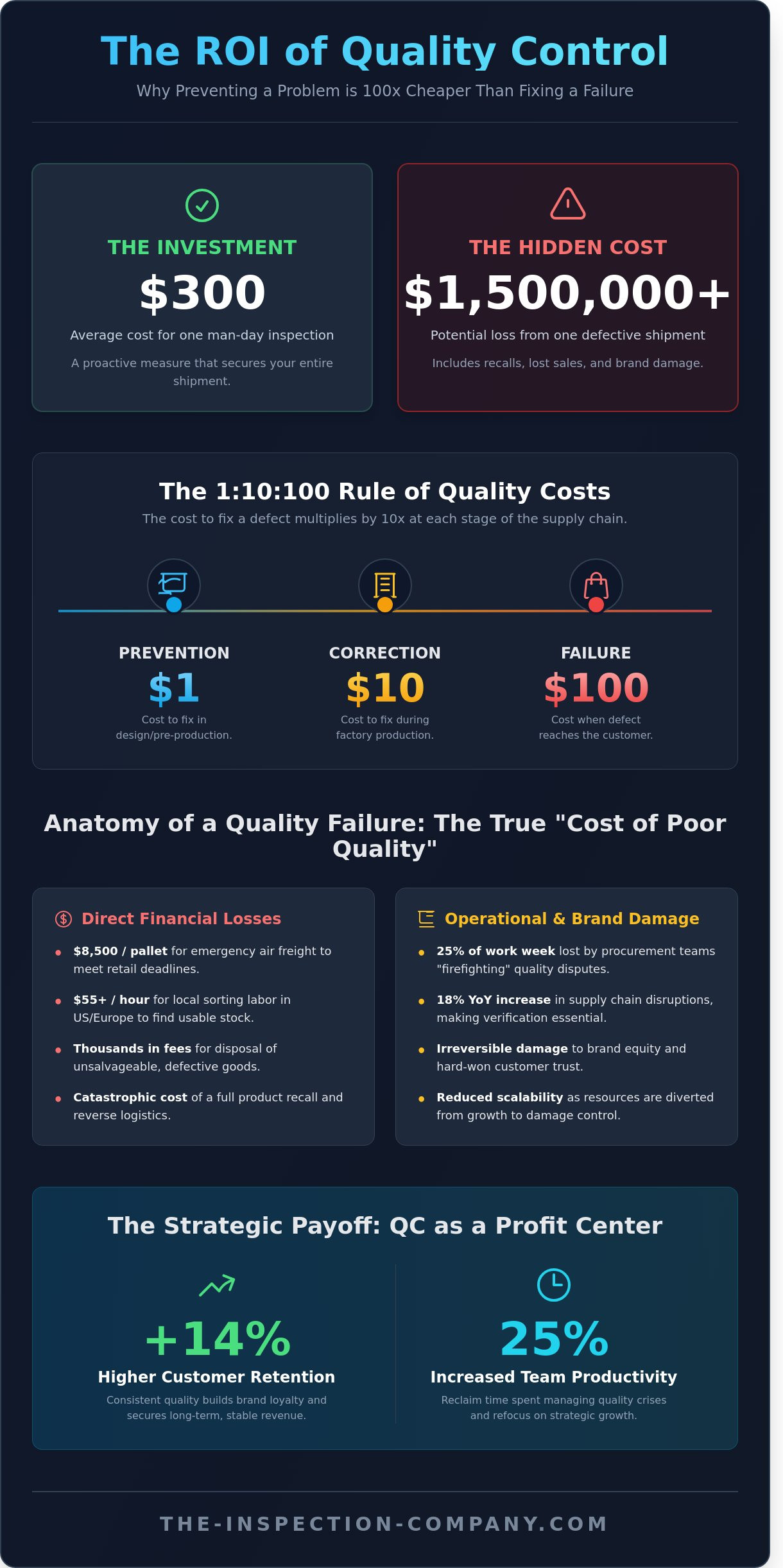
Quality isn't just about avoiding failure; it's about winning the market. In a saturated 2026 economy, brand equity is your most valuable asset. Consistent quality allows for premium pricing and fosters deep customer loyalty. When you're getting management buy-in for QC budget allocations, highlight how verification reduces "firefighting" time. Procurement teams currently spend roughly 25% of their work week managing quality disputes or returns. Professional inspection services reclaim this time, allowing your team to focus on growth rather than damage control. High-quality shipments lead to a 14% higher customer retention rate, which directly impacts the bottom line and stabilizes long-term revenue.
Calculating the ROI: The Cost of Poor Quality (COPQ) vs. Inspection Fees
Management often views Quality Control as a line-item expense rather than a profit-protection strategy. To succeed in getting management buy-in for QC budget allocations, you must speak the language of the CFO. This means shifting the focus from the price of a $300 man-day inspection to the catastrophic $30,000 loss associated with a rejected shipment or a total product recall.
The Cost of Poor Quality (COPQ) isn't just about defective items. It's an accumulation of tangible and intangible failures that erode your margin. Tangible costs are easy to track. Air freighting replacements to meet a retail deadline can cost $8,500 for a single pallet, while local sorting labor in the US or Europe often exceeds $55 per hour. When you add disposal fees for unsalvageable goods, the "savings" from skipping an inspection vanish instantly.
The 1:10:100 rule provides a clear framework for this ROI. Finding a defect during the design phase costs $1. If that defect reaches the factory floor, it costs $10 to fix. If it reaches the customer's door, the cost skyrockets to $100. By investing in professional inspections, you're choosing the $10 solution over the $100 disaster. This logic is a cornerstone of getting management buy-in for QC budget requests because it frames QC as a risk mitigation tool with a 10x return.
Direct Costs of Failure
A 3.5% increase in your refund rate can slash annual net profits by up to 18% when you account for lost shipping fees and the total loss of inventory. Beyond the math, your procurement team loses approximately 28 hours of administrative time per supplier dispute, time that should be spent on sourcing or growth. Starting with Sample Testing offers a low-cost proof of concept to show leadership how early detection prevents these administrative drains.
Indirect Costs and Long-term Erosion
In 2026, a single bad batch doesn't just result in a return; it triggers the "Viral Negative Review" effect. One TikTok video or a 1-star Amazon review with photos can tank a product's conversion rate by 45% within 48 hours. For those selling to major retailers, a single failed shipment can destroy a 5-year relationship, leading to permanent de-listing and lost shelf space. Saving $5,000 on QC often leads to spending $50,000 on legal compliance or PR damage control later. You can view our full range of inspection services to determine which level of protection best fits your current risk profile.
Aligning Quality Control with Strategic Business Goals
Getting management buy-in for QC budget requires shifting the conversation from "cost" to "strategic asset." Executives focus on market share and scalability; they need to know that quality isn't just a hurdle. If your defect rate stays at 4 percent, you aren't just losing product. You're losing the 33 percent of customers who refuse to return after a bad experience. By 2026, quality is the primary driver of profitability. Poor quality creates a "hidden factory" of rework and administrative waste that often consumes 25 percent of an importer's operating budget.
Regulatory landscapes are shifting rapidly. New international standards, such as the EU Corporate Sustainability Due Diligence Directive, make supply chain oversight mandatory. Non-compliance can result in fines reaching 5 percent of global turnover. QC is no longer an optional line item. It's a legal shield for the C-suite. Proactive audits ensure your partners can actually deliver during a crisis, protecting your supply chain resilience when competitors are facing stockouts.
Amazon FBA and E-commerce Health
The digital storefront is unforgiving. Amazon's strict Order Defect Rate (ODR) threshold of 1 percent means a single batch of mislabeled items can shut down your entire revenue stream overnight. Utilizing professional Amazon FBA Services prevents these costly surprises by catching labeling and packaging errors at the source. Consistent product excellence is the only way to protect your "Buy Box" status. Data shows that 4.5-star listings see a 20 percent higher conversion rate than 4-star counterparts, making QC the most effective marketing spend you have.
Supplier Performance and Risk Management
Don't wait for a shipment crisis to learn your partner can't deliver. Use Factory Audits to vet new suppliers before you send the first deposit. This proactive approach identifies technical gaps and capacity issues that lead to 15 percent of mid-season production delays. By implementing a "Supplier Scorecard," you reward partners who meet your 98 percent quality threshold. Real-time transparency through a Quality Platform reduces executive anxiety by providing a single source of truth for every shipment. One day of inspection saves months of trouble.
The 5-Step Pitch: How to Present Your QC Budget Request
Successfully getting management buy-in for QC budget requires a shift from talking about broken parts to talking about financial protection. Executives don't want to hear about minor scratches; they want to hear how you'll prevent a $50,000 loss. Follow this structured five-step approach to secure the resources you need for 2026.
Step 1: Gather Historical Data. Start by quantifying the cost of your last quality disaster. If a 2024 shipment of faulty components resulted in a $35,000 air-freight bill for replacements and a 12% dip in customer satisfaction scores, put those numbers front and center. Hard data removes emotion from the decision.
Step 2: Define the Scope. Don't ask for a blanket budget for every SKU. Focus your request on high-risk products and new suppliers where the failure rate is historically 15% higher. Narrowing the scope shows you're being surgical with company capital.
Step 3: Present the Pre-Shipment Solution. Explain that catching errors at the source in Asia is the only logical path. Once a container hits the water, your cost to fix an error triples. Pre-shipment inspections act as a final gate that keeps defective inventory out of your warehouse.
Step 4: Use Visual Reporting. Show a sample inspection report from a professional firm. When management sees the depth of oversight, including photos of packaging, drop tests, and AQL tables, they realize they aren't just buying a "check-up." They're buying a comprehensive insurance policy for their supply chain.
Step 5: Propose a Pilot Program. Lower the barrier to entry by suggesting a 90-day trial on a single product line. A pilot program is often the final nudge needed when getting management buy-in for QC budget because it limits initial financial exposure while proving the ROI through reduced return rates.
Speaking the Language of the CFO
To win over the finance department, stop using technical jargon. Focus on EBITDA protection. Explain how every dollar spent on inspection avoids three dollars in "Cost of Poor Quality" (COPQ). Use terms like Risk Mitigation and Cost Avoidance to frame the discussion. Quality control is a scalable variable cost, not a fixed overhead. It scales with your production volume, ensuring that your margins remain protected even as you grow.
Leveraging Third-Party Expertise
Relying on factory self-reporting is a conflict of interest that leads to 20% higher defect rates on average. Partnering with an independent Inspection Company provides the objective data your board requires. Choosing a firm with European Management ensures that Western quality standards are enforced on the ground without cultural miscommunications. Speed is also critical. A 24-hour reporting turnaround keeps your supply chain moving, ensuring that quality checks never become a bottleneck for your logistics team.
Ready to protect your margins? Explore our range of inspection services to build a data-backed case for your budget.
Choosing a QC Partner that Justifies the Investment
Securing approval for your 2026 operations requires moving beyond a "check the box" mentality. You must demonstrate a maturity model where quality control isn't just a cost center but a strategic asset. Traditional inspection focuses on catching a single bad batch; strategic quality management uses historical data to prevent those batches from ever being produced. This shift is critical when getting management buy-in for QC budget because it turns a variable expense into a predictable protector of your bottom line. The Inspection Company acts as your eyes and ears on the factory floor, ensuring every dollar spent on production results in sellable goods.
Evaluating the total value of a partner involves looking at their footprint, technical expertise, and ethical standing. A partner with ISO 9001 certification and a 25-year track record provides the reassurance that your supply chain is in professional hands. We focus on risk mitigation. We stop problems before your shipment sails, which avoids the 30% to 50% loss in margins often associated with product recalls or customer returns. One day of inspection can save months of trouble, making the investment a clear financial win.
The Technology Advantage
Executive teams in 2026 demand immediate visibility. A centralized Quality Platform provides the hard data management needs for ROI reporting. Rather than digging through individual PDF reports, your team can access a dashboard of real-time photos and video. This is the difference between a simple pass or fail result and a deep business insight. For example, if data trends show a 12% increase in cosmetic defects at a specific facility, you can use those metrics to negotiate better terms or enforce stricter compliance. This transparency makes getting management buy-in for QC budget easier because the results are quantifiable and accessible at any time.
Local Presence, Global Standards
Managing travel costs is a major hurdle for any budget proposal. With over 700 inspectors stationed across Asia, we eliminate the need for expensive flights and long lead times. Our European management team ensures that high quality standards are applied at the local level, blending Western expectations with on-the-ground expertise. This structure allows for 24-hour turnaround on reports, which can reduce production delays by 5 days on average. It's a reliable way to maintain ethical standards and product integrity without the overhead of an in-house team. Contact us today for a custom quote to support your budget proposal.
Secure Your Supply Chain for 2026 and Beyond
Securing a quality control budget isn't just about spending money. It's about protecting your bottom line from the high costs of poor quality. By calculating the Cost of Poor Quality (COPQ) and aligning your request with 2026 strategic goals, you transform a line item into a vital risk management asset. A successful pitch relies on hard data and proving how one day of inspection saves months of logistical trouble. Successfully getting management buy-in for QC budget requests requires a partner that delivers transparency and speed.
The Inspection Company brings over 25 years of experience in Asian manufacturing hubs to your corner. We're ISO 9001 certified and a Sedex member, ensuring your supply chain meets global standards. You won't wait weeks for answers. We deliver detailed reports within 24 hours of inspection so you can make informed decisions in real-time. Stop reacting to defects and start preventing them before your shipment sails.
Request a Free Consultation to Build Your QC Business Case
Frequently Asked Questions
How do I calculate the ROI of quality control?
You calculate the ROI of quality control by subtracting the total cost of inspections from the total financial losses avoided through defect detection. Avoided costs include $5,000 in return shipping fees, $12,000 in unsalvageable inventory, and potential $20,000 marketplace penalties for non-compliance. If a $600 Pre-Shipment Inspection (PSI) prevents a $15,000 batch failure, your ROI is 2,400%. Focus on hard numbers like scrap rates and air freight charges for replacements to show immediate financial recovery to your stakeholders.
What is the "Cost of Poor Quality" (COPQ) and why does it matter?
The Cost of Poor Quality (COPQ) represents the total financial drain a company suffers because its products don't meet specific standards. It matters because internal and external failures often consume 20% of annual revenue for manufacturing firms according to 2024 industry benchmarks. These costs include $150 hourly rates for manual rework and $2,500 shipping fees for replacement units sent to unhappy clients. Tracking COPQ allows you to identify exactly where profit leaks occur before they impact your 2026 bottom line.
Is it better to have an in-house QC team or use a third-party agency?
Using a third-party agency is generally more cost-effective and objective than maintaining an internal team for international sourcing. A third-party inspector costs approximately $300 per man-day, whereas a full-time in-house inspector requires a $65,000 annual salary plus extensive travel expenses. Independent agencies provide unbiased reports and local expertise in manufacturing hubs like Vietnam or China. This prevents the "familiarity bias" that often leads in-house staff to overlook minor defects in long-term supplier relationships.
How can I convince management to invest in QC when we have a "trusted" supplier?
Remind management that even a 10 year partnership cannot prevent staff turnover or raw material fluctuations at the factory level. Statistics show that 70% of quality issues arise when a "trusted" supplier switches sub-vendors without notice to save costs. Getting management buy-in for QC budget becomes easier when you present a case study of a single $30,000 shipment lost to a simple technical misunderstanding. Trust is a vital business value, but independent verification is a mandatory financial safeguard.
Will adding a QC step slow down our shipping and lead times?
A standard Pre-Shipment Inspection (PSI) adds only 24 to 48 hours to your timeline, which is negligible compared to the three months required for a product recall. It's much faster to catch a 5% defect rate at the factory than to process 500 individual returns from customers. Professional agencies deliver digital reports within 24 hours of the site visit. This speed ensures your 2026 shipping schedule remains on track while eliminating the risk of transit delays caused by customs rejections or quality disputes.
What are the risks of skipping pre-shipment inspections for Amazon FBA?
Skipping inspections for Amazon FBA risks permanent account suspension if your Order Defect Rate (ODR) exceeds the 1% threshold. Amazon's 2025 policy updates prioritize customer experience, meaning a single batch of 200 defective units can trigger a "Product Safety" flag that halts all sales. You'll face $3.50 per unit removal fees and lost "Buy Box" revenue during the weeks your listing remains offline. One $300 inspection protects thousands of dollars in potential sales and your hard-earned seller reputation.
Can I start with a small QC budget and scale up?
You can start by allocating funds to your highest-risk shipments and scaling the program as you demonstrate measurable results. Begin by inspecting 100% of new product launches and 20% of repeat orders from established factories. As you demonstrate how these checks prevented $15,000 in losses over a six month period, getting management buy-in for QC budget for the rest of your catalog becomes a data-driven decision. This incremental approach proves the value of the service without requiring a massive initial capital investment.
What should be included in a formal QC budget proposal?
Your proposal should include a detailed breakdown of inspection costs per unit, a log of the $45,000 lost to defects over the last 24 months, and a clear 12 month inspection schedule. Use concrete data to show how a $10,000 investment will protect $500,000 in total inventory value. Include specific service types like DuPro (During Production) and PSI to show a methodical approach to risk management. This level of detail transforms a perceived "cost" into a strategic plan for profit protection.