
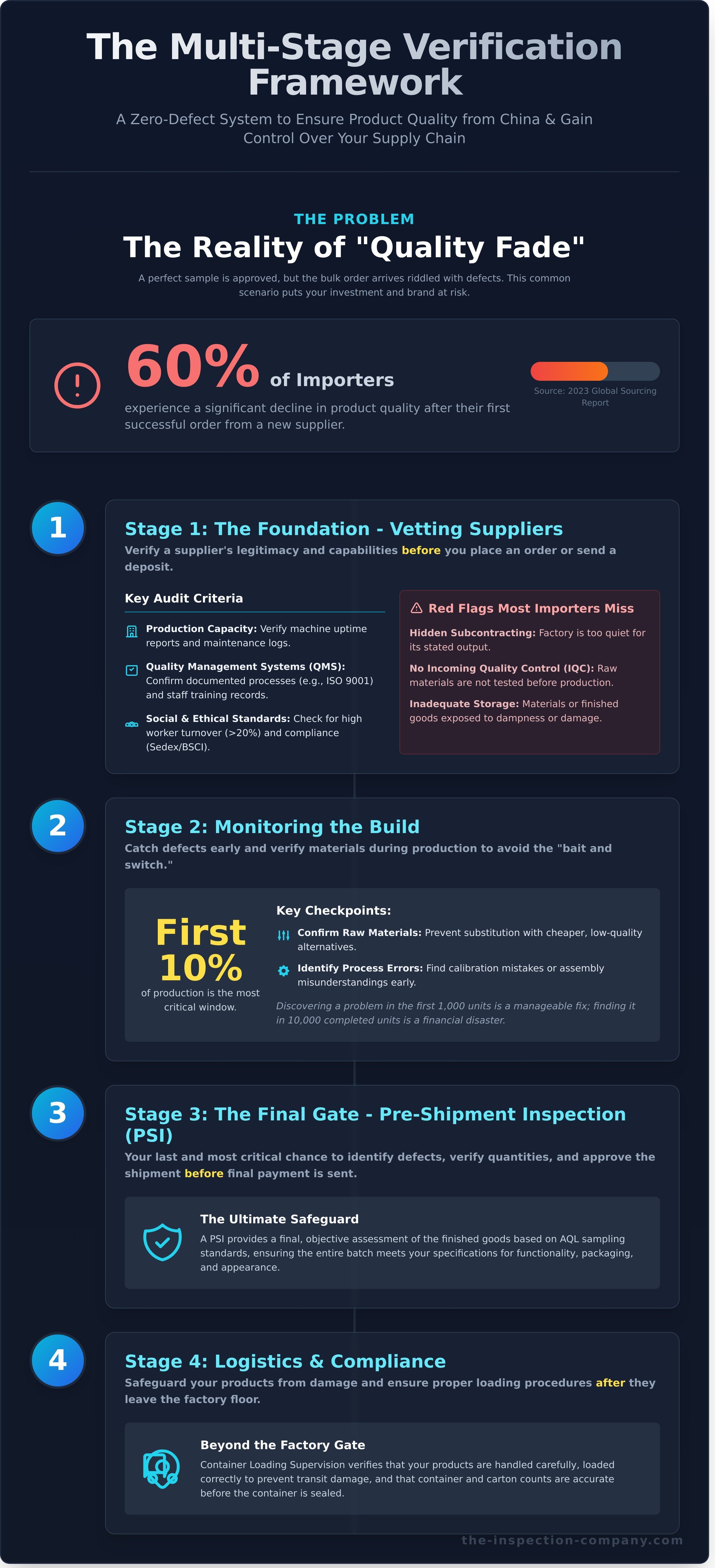
According to a 2023 Global Sourcing report, over 60% of importers experience a significant decline in product quality after their first successful order from a Chinese supplier. It's a frustratingly common scenario known as "quality fade." You approve a perfect sample, place a bulk order, and then the final shipment arrives riddled with defects, leaving you with unsellable inventory and a major financial loss. The anxiety of sending that final payment without knowing what's truly in the container is a risk no business can afford to take.
This guide eliminates that risk. We're not offering vague tips; we are providing the exact multi-stage verification framework used by top global retailers to achieve zero-defect shipments. You will learn a repeatable system for how to ensure product quality from china and gain complete control over your supply chain. From initial supplier audits to final pre-shipment inspections, you'll discover how to stop problems at the source and secure your investment long before your products are on the water.
Key Takeaways
- Discover how to properly vet suppliers with a factory audit, the crucial first step in preventing costly quality problems before production begins.
- Master the in-production checkpoints that allow you to confirm raw materials and catch defects early, avoiding the common "bait and switch."
- Learn the framework for a Pre-Shipment Inspection (PSI), the most critical step in how to ensure product quality from china and your final chance to stop defective goods from shipping.
- Uncover the hidden risks during logistics and learn how to safeguard your products from damage even after they leave the factory floor.
The Foundation: Vetting Suppliers via Factory Audits
Most importers believe quality control starts when production begins. They are wrong. The single most critical step in how to ensure product quality from china is verifying your supplier's legitimacy and capabilities before you place an order. A slick website or a low price means nothing if the facility is incapable of meeting your standards. Many first-time importers, upwards of 30%, inadvertently partner with trading companies masquerading as manufacturers, losing control over where their products are actually made. A comprehensive factory audit is the only professional tool to confirm you are dealing with a legitimate manufacturer equipped for a long-term partnership.
A factory audit identifies systemic risks that a simple product inspection will never reveal. It assesses the factory's entire operational health, from financial stability to its internal management systems. This isn't just about today's order; it's about protecting your business for years to come. For instance, a valid ISO 9001:2015 certification demonstrates a commitment to a documented Quality Management System (QMS). Looking ahead, social compliance is no longer optional. With regulations like the EU's Corporate Sustainability Due Diligence Directive taking full effect by 2026, verifying ethical labor practices through a Sedex or BSCI framework is essential for market access and brand protection.
Key Criteria for a Professional Factory Audit
A thorough audit moves beyond a simple walkthrough. It's a data-driven verification process that scrutinizes the factory's core capabilities. Auditors focus on objective evidence to validate claims, including:
- Production Capacity and Machinery: Auditors don't just take the factory's word. They verify a claimed capacity of 50,000 units per month by reviewing machine uptime reports and maintenance logs from the past 12 months to ensure equipment is reliable and can handle your volume without breaking down.
- Internal Quality Management Systems (QMS): A reliable factory operates on proven quality control principles. We assess their internal QMS for documented work instructions, records of staff training on critical assembly tasks, and a clear, traceable process for quarantining and handling defective materials.
- Social and Ethical Standards: We check for adherence to international labor standards. A factory with high worker turnover, for example, a rate exceeding 20% annually, is a major risk as it cannot maintain consistent skill levels on the production line.
The Red Flags Most Importers Miss
Without professional on-site verification, it's easy to miss critical warning signs that expose your business to costly defects and delays. Our auditors are trained to spot subtle but significant red flags, such as:
- Hidden Subcontracting: A factory floor that appears too clean or unusually quiet for its stated output is a classic indicator. The supplier may pass the audit themselves but then subcontract your order to a cheaper, unvetted workshop to boost their profit margin.
- Lack of Incoming Material Inspection: A shocking number of factories lack a formal Incoming Quality Control (IQC) process. Without a dedicated station to test raw materials before they enter the production line, you risk your entire order being built with substandard components.
- Inadequate Storage Conditions: We frequently find raw materials and even finished goods stored in damp, disorganized, or outdoor environments. This negligence can introduce defects like mold, rust, and physical damage before your shipment ever leaves the factory.
Monitoring the Build: Pre-Production and During Production Inspection
Once you’ve selected a supplier and finalized your product specifications, the real risk begins. A signed contract and a golden sample don’t guarantee a flawless production run. Many importers fall victim to the "bait and switch," where a factory substitutes specified raw materials for cheaper, lower-quality alternatives to increase their profit margin by 5-10%. This is where active monitoring becomes non-negotiable. Without on-site verification, you are trusting your entire investment to a factory motivated by its own bottom line.
The first 10% of any production run is the most critical window for learning how to ensure product quality from china. This initial batch is the first true test of the factory's ability to execute your specifications at scale. It reveals whether their workers, machinery, and processes can consistently meet your standards. Identifying a calibration error or a misunderstanding of an assembly step within the first 1,000 units of a 10,000-unit order is a manageable problem. Discovering it after the entire order is complete is a financial disaster.
Pre-Production Inspection (PPI): Checking the Inputs
Before the assembly lines start, a Pre-Production Inspection (PPI) verifies all the inputs that will go into your product. This includes confirming the quality and specifications of raw materials, checking key components against your approved samples, and ensuring the factory has correctly interpreted your technical drawings and understands the official import requirements for your target market. A Pre-Production Inspection is the ultimate preventative measure against mass-defects.
During Production (DuPro): Catching Defects Early
A During Production Inspection, or DuPro, takes place when 15-20% of your products are finished. Inspectors go to the factory floor to monitor workmanship, check for defects on semi-finished and finished goods, and identify any "quality fade" that may occur as production volume increases. This real-time check allows for immediate corrective action, instructing the factory on necessary changes to prevent the same defect from appearing in thousands of subsequent units and avoiding costly rework.
Active oversight identifies systemic issues before they become terminal. A minor deviation in a CNC machine's settings or an incorrect stitching pattern can compromise an entire batch if left uncorrected. On-site inspections catch these process errors and production bottlenecks early, providing the factory with actionable data to resolve them. This constant vigilance also maintains pressure on the factory to adhere to the agreed-upon production timeline. When a supplier knows their work will be checked, delays and excuses become far less common. For importers wondering how to ensure product quality from china, the most reliable strategy is having an independent team on the ground. This consistent presence transforms your quality control from a hopeful guess into a managed process, safeguarding your investment and preventing surprises that can delay a shipment for months.
The Final Gate: Pre-Shipment Inspection (PSI) and AQL Sampling
After weeks or months of production, your goods are finally packed and ready. This is the single most critical moment for your business. The Pre-Shipment Inspection (PSI) is your final opportunity to verify quality before the container is sealed and full payment is released. It’s a non-negotiable step for any serious importer. Think of it as the ultimate gatekeeper; this is your last chance to stop defects, errors, and costly surprises before they leave the factory. Once a shipment is on the water, your leverage with the supplier drops by over 90%, and the cost to fix problems multiplies exponentially.
A factory's internal quality control team has its own priorities. An independent inspector works for only one person: you. This unbiased view is essential for anyone figuring out how to ensure product quality from china effectively. Instead of relying on the supplier's word, you get a factual, on-the-ground assessment. The real power lies in the speed of this information. A detailed inspection report, complete with high-resolution photos and objective data, should arrive in your inbox within 24 hours. This allows you to make a clear-headed decision based on facts, not promises. You can confidently approve the shipment, demand immediate rework, or renegotiate terms before a single dollar of your final payment is sent.
Understanding AQL: The Industry Standard for Quality
Acceptable Quality Limits (AQL) is the statistical sampling method used globally (ISO 2859-1) to determine if a production order meets your standards. An inspector doesn't check every single unit. Instead, they pull a random sample size based on your total order quantity and inspect it against your criteria. Based on the number and type of defects found, the entire shipment receives a clear "Pass" or "Fail". You define the tolerance for defects in three categories:
- Critical Defects: A single one means failure. These are issues that could harm a user, such as a sharp metal edge on a children's toy or faulty wiring in an electronic device.
- Major Defects: Product failures that would likely cause a customer to return the item, like a non-functional power button or a deep scratch on a visible surface.
- Minor Defects: Small imperfections that don't affect the product's use, such as a loose thread or a tiny paint blemish.
For a typical order of 3,000 units, an inspector using General Inspection Level II might pull a sample of 125 units to check. Your AQL might be set to allow 0 Critical, 5 Major, and 7 Minor defects. If the inspector finds 6 Major defects, the shipment fails.
What a Comprehensive PSI Report Includes
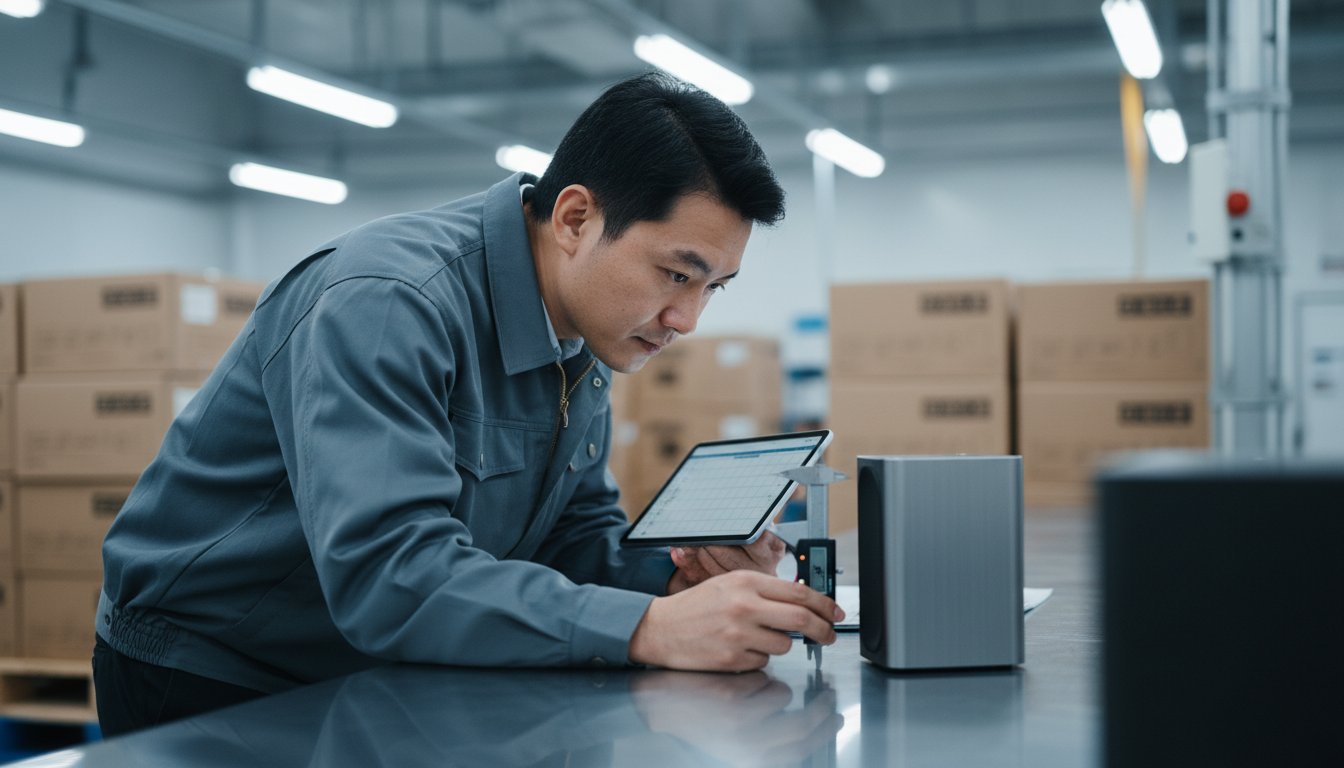
A professional PSI is far more than a quick look. It's a systematic process that verifies every critical aspect of your order. A reliable report provides objective evidence covering these key areas:
- Quantity Verification: Is the number of cartons and units per carton correct? The inspector conducts a full count to prevent short-shipping.
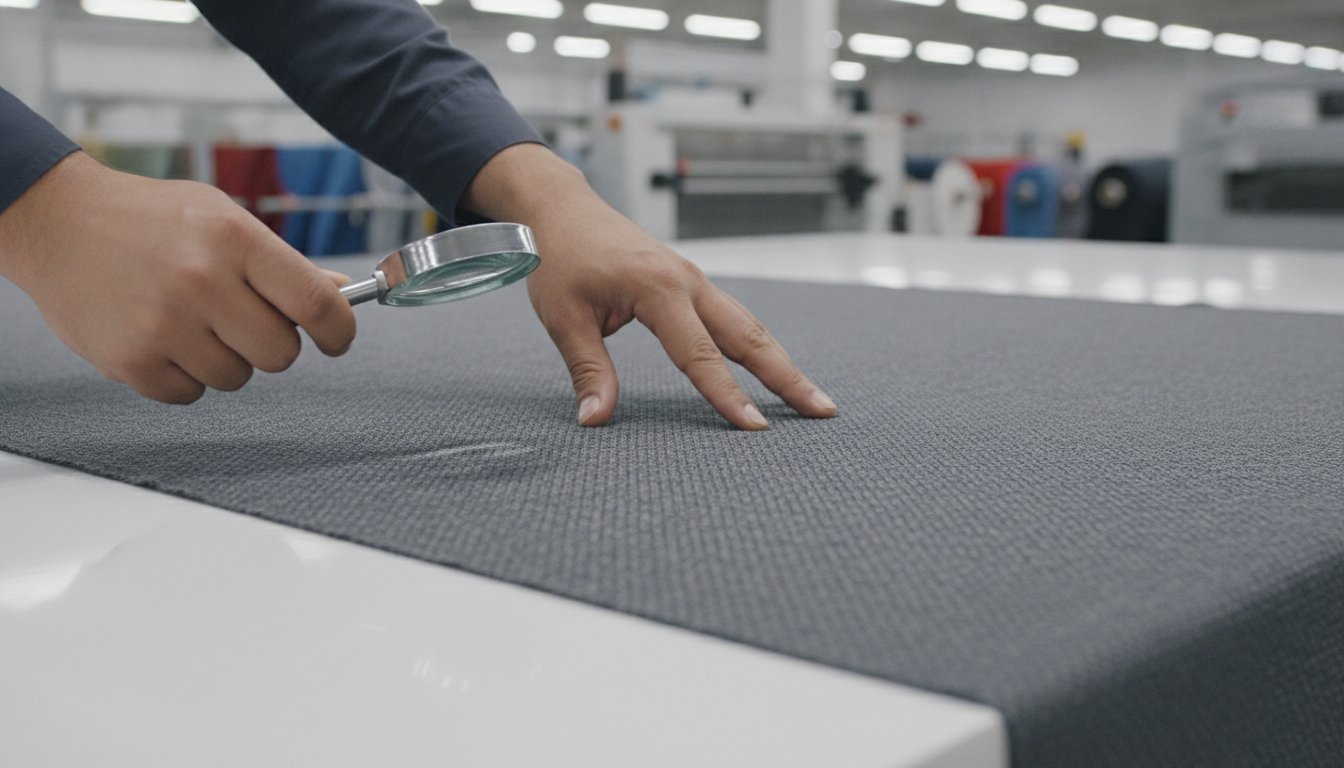
- Visual and Workmanship Check: A close examination for aesthetic issues, using your approved sample as the benchmark. This covers colors, materials, finishing, and overall build quality.
- Functional and Safety Testing: On-site tests to ensure the product works as intended. This could involve assembling a piece of furniture, testing the cycles on an appliance, or conducting a load test on a chair.
- Packaging and Labeling Accuracy: Verification that shipping marks, barcodes, warning labels, and packaging materials match your specifications to avoid costly issues with customs or fulfillment centers like Amazon FBA.
Logistics and Compliance: Ensuring Your Goods Reach the Market
Your product has passed its final inspection. The factory has confirmed production is complete. For many importers, this feels like the finish line, but it’s a critical error to relax your vigilance now. Quality control doesn’t end at the factory gate. The journey from your supplier's warehouse to your customer's hands is filled with risks that can turn a profitable order into a catastrophic loss. According to a 2023 report from the Transported Asset Protection Association (TAPA), cargo theft incidents in the EMEA region resulted in losses exceeding €180 million. Damage from improper handling adds millions more to that total.
For businesses asking how to ensure product quality from china all the way to their warehouse, these post-production checks are non-negotiable. What happens inside the shipping container and at the port of entry is just as important as what happened on the assembly line. Ignoring this final stage can lead to damaged goods, rejected shipments, and severe financial penalties.
Container Loading Inspection (CLI): Preventing Theft and Damage
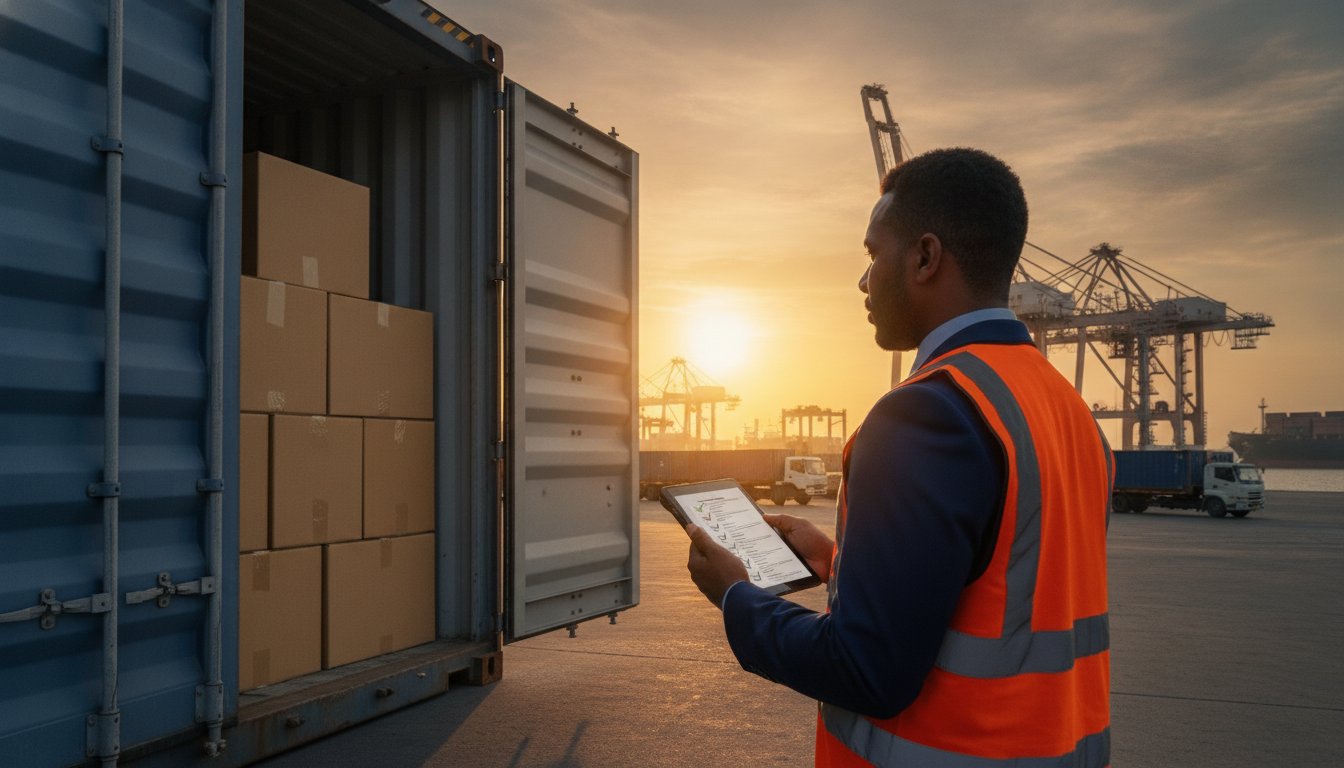
A Container Loading Inspection (CLI), or container stuffing check, is your final opportunity to verify your order on Chinese soil. It's a systematic check that confirms the right products, in the right quantity, are loaded correctly into a secure container. An inspector supervises the entire process to mitigate risks of damage, theft, and incorrect shipments. Key verification points include:
- Quantity Verification: The inspector counts the shipping cartons as they are loaded to ensure the number matches your packing list, preventing short-shipping.
- Container Condition: The container is checked for physical damage like holes or leaks, as well as for moisture or strong odors from previous cargo that could damage your products. A container that fails this check is rejected before your goods are ever loaded.
- Proper Stacking: Cartons are monitored to ensure they are stacked securely, often in an interlocking pattern, to prevent them from shifting and crushing one another during a sea transit that can last over 30 days. Heavy items must be on the bottom, with lighter items on top.
Amazon FBA and Retail-Specific Requirements
Selling through major channels like Amazon FBA or big-box retailers introduces another layer of stringent logistical requirements. A simple labeling error can cause Amazon to reject an entire shipment, leading to costly re-labeling and storage fees that can reach $22.50 per cubic foot during Q4. Our pre-shipment checks verify that your goods meet these precise standards, ensuring FNSKU barcodes are scannable and carton labels are correctly placed. We also verify packaging durability against standards like Amazon's "Ships in Own Container" (SIOC) to prevent product damage and customer complaints.
Finally, a critical part of how to ensure product quality from china involves navigating a complex web of international compliance standards. Regulations are constantly evolving. As of 2024, electronics destined for the EU must comply with RoHS 3 (Directive 2015/863), which restricts 10 specific hazardous substances. Products for children under 12 sold in the US require a Children's Product Certificate (CPC) based on testing from a CPSC-accepted lab. Failing to provide this documentation doesn't just stop your shipment; it can lead to fines and legal action. Verifying these certifications before payment and shipment is an essential step in risk management. Secure your shipment from factory to fulfillment center. Book a Container Loading Inspection today and stop problems before they sail.
The Strategic Advantage: Why Professional Third-Party Inspection Wins
After navigating supplier selection, contract negotiations, and production timelines, the final, critical question remains: is the product you paid for the product that will be shipped? Trust is essential, but verification is non-negotiable. The most effective answer to how to ensure product quality from china is not found in hopeful emails or factory photos; it's secured through independent, on-site verification. This isn't just another box to check. It's a strategic decision that separates successful importers from those who face costly, brand-damaging disasters. One day of professional inspection truly can save you months of trouble.
An independent inspector acts as your unbiased "eyes and ears" on the factory floor. Their sole objective is to protect your interests by systematically checking your products against your exact specifications. This is where our unique structure provides a decisive edge: we combine strict European management standards with a vast, on-the-ground presence of local Asian experts. You get the meticulous, process-driven approach demanded by Western markets, executed by professionals who understand the local culture and manufacturing landscape. This hybrid model moves your quality control from a reactive problem to a proactive, managed process, allowing you to move from anxiety to confidence in your 2026 sourcing strategy.
The Cost of "No Inspection" vs. Professional QC
Skipping a professional inspection to save a few hundred dollars is a gamble against disproportionately large risks. The real costs of poor quality are not line items on an invoice; they are hidden liabilities that can cripple your business. Consider the financial impact:
- Direct Financial Loss: A 5% defect rate on a $50,000 order means an immediate $2,500 loss on product alone. Factoring in return shipping, labor for sorting, and disposal fees, that figure can easily double to over $5,000.
- Irreversible Brand Damage: According to a 2023 Zendesk report, 61% of consumers will switch to a competitor after just one bad experience. A single shipment of defective goods can undo years of brand building.
- Legal and Regulatory Penalties: Shipping non-compliant products can result in forced recalls, substantial fines from bodies like the CPSC in the US or EU authorities, and potential legal action.
Relying on a factory's "self-inspection" report is a fundamental conflict of interest. A factory's primary incentive is to ship the goods and get paid. Your incentive is to receive flawless products. These two goals don't always align. Professional inspection is not a cost, but an insurance policy for your profit margins.
Partnering with The Inspection Company
Choosing the right inspection partner is the final step in securing your supply chain. With The Inspection Company, you gain immediate access to a network of over 700 trained, full-time inspectors strategically located across all major Asian manufacturing hubs, including China, Vietnam, and India. Our European management team oversees our rigorous, ISO 9001 certified processes, ensuring every report you receive is clear, reliable, and actionable. We don't just find problems; we provide the data you need to solve them before they impact your business. Don't leave your investment to chance. Book your inspection today to avoid costly surprises before shipment.
Take Control of Your China Sourcing Quality
Successfully sourcing from China in 2026 isn't about luck; it's about a systematic approach to quality control. This guide has shown that a robust strategy involves more than just a final check. It begins with rigorous factory audits and continues with in-process monitoring to catch errors before they escalate. Ultimately, a professional Pre-Shipment Inspection is the final, critical step in how to ensure product quality from china, protecting your investment and your brand's reputation before the goods ever leave the port.
Partnering with an expert provides the on-the-ground intelligence you need. Our team, under European management with over 25 years of Asian experience, gives you that control. With a network of more than 700 certified inspectors across Asia, we deliver detailed inspection reports to your inbox within 24 hours, stopping problems before your shipment sails.
Don't let distance dictate your success. Avoid costly surprises-book your professional inspection today and build your business with confidence.
Frequently Asked Questions
Is it really necessary to inspect every shipment from China?
Yes, inspecting every shipment is a fundamental step in how to ensure product quality from China. Even trusted suppliers can face unexpected issues with raw materials or use subcontractors without your knowledge, leading to costly defects. A single shipment with a 15% defect rate can negate the profit from five previous orders. Consistent pre-shipment inspections are not an expense; they are an essential investment to protect your business, brand reputation, and bottom line from avoidable risks.
How much does a professional product inspection service cost in 2026?
A standard, all-inclusive product inspection in China will cost between $250 and $350 USD per man-day in 2026. This fee typically covers one inspector's full day of on-site work, their travel expenses, and the creation of a comprehensive report delivered within 24 hours. Compared to the potential cost of an entire defective shipment, which can run into tens of thousands of dollars, a professional inspection is a highly effective, low-cost risk management tool.
Can I perform quality control myself without traveling to China?
While you can attempt to manage QC remotely through photos and videos, it's extremely difficult and carries significant risk. Suppliers may only show you the best samples, and you can't perform physical tests or verify materials from thousands of miles away. An independent, on-site inspector acts as your eyes and ears in the factory. They verify random production units, not just hand-picked "golden samples," providing an unbiased assessment of your entire order's quality before it ships.
What happens if the inspection report shows a "Fail" result?
A "Fail" result provides you with the documented evidence and leverage needed to act before making your final payment. You can immediately send the detailed report to your supplier and require them to address the issues. Common resolutions include having the factory rework all defective units, sorting the goods to remove faulty products, or negotiating a discount on your final invoice to compensate for the defects. This step stops the problem before it leaves the factory floor.
How do I choose the right AQL level for my products?
The right AQL (Acceptable Quality Limit) depends on your product's market and function. For most general consumer goods, the industry standard is AQL 2.5 for major defects and 4.0 for minor defects. However, for products with higher safety or functional requirements, like electronics or children's toys, a more stringent level of AQL 1.0 for major defects is recommended. Your inspection partner can help you define the most appropriate standard for your specific product category.
What is the difference between a factory audit and a product inspection?
A factory audit assesses the supplier, while a product inspection assesses your goods. An audit is typically performed once, before you place an order, to verify the factory's legitimacy, quality management systems (like ISO 9001), and production capacity. In contrast, an inspection happens during or after production for a specific order. It checks your products against your specifications for workmanship, functionality, and packaging to ensure they meet your standards before shipment.
How long does it take to get the results of an inspection?
You will receive a complete, detailed inspection report within 24 hours of the service's completion. We understand that time is critical when deciding whether to approve a shipment for departure. Our reports are delivered promptly via email and include high-resolution photos, clear descriptions of any defects found, and a conclusive pass or fail result. This allows you to make a fast, informed decision without delaying your supply chain and logistics timeline.
Can an inspection company help with Amazon FBA labeling requirements?
Yes, verifying Amazon FBA compliance is a critical part of our pre-shipment inspection service. Our inspectors are trained to check all FBA requirements on-site at the factory. This includes confirming correct FNSKU barcode placement and scannability, proper suffocation warning labels on all poly bags over 5 inches, and ensuring carton labels meet Amazon's strict guidelines. This check prevents your inventory from being rejected or incurring costly relabeling fees at an Amazon fulfillment center.