
If you wired a 30% deposit to an overseas factory this morning, would you feel confident or just lucky? Most importers treat international sourcing like a gamble, constantly worrying about communication barriers or the inevitable quality fade that happens after the first few successful orders. It’s a stressful way to do business, especially when 65% of supply chain managers cite quality consistency as their primary concern. You deserve a strategy that replaces blind faith with professional oversight and control.
In this guide, you’ll learn how to build trust with suppliers by moving from risky, hope-based sourcing to a high-performance partnership. We’ll show you how to apply the "Trust but Verify" model, an approach rooted in our 25 years of experience managing quality in Asia. This method stops costly surprises before your shipment sails and ensures you aren't just another order number in a crowded production queue. We will explore the specific audit and inspection steps required to secure priority status at the factory, lower your defect rates, and maintain transparent communication even during unexpected production delays.
Key Takeaways
- Learn why shifting from "hope" to a "Trust but Verify" model is essential for reducing lead times and ensuring accountability.
- Discover how to build trust with suppliers by replacing vague emails with a formal "Golden Sample" and a detailed Quality Requirement Document (QRD).
- Understand how independent third-party inspections remove emotion from the relationship and provide the objective data needed to strengthen long-term bonds.
- Shift from a penalty-driven mindset to a reward-based partnership that prioritizes fair dispute resolution and manufacturing excellence.
- Leverage European management standards and local expertise to act as your eyes and ears on the ground, preventing costly surprises before they ship.
What Does it Mean to Build Trust with Suppliers in 2026?
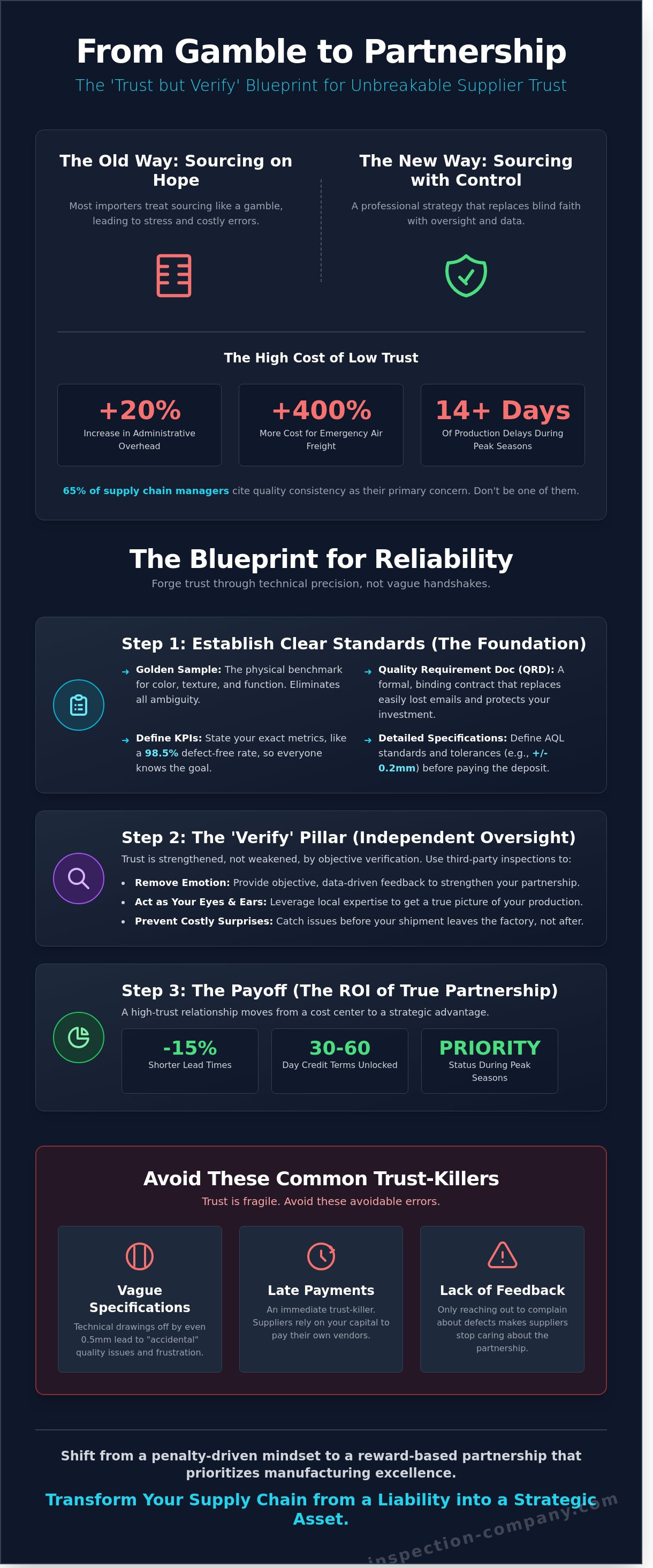
In 2026, knowing how to build trust with suppliers is no longer a soft skill for procurement teams; it's a financial necessity. We define supplier trust as the precise intersection of transparency, technical capability, and mutual accountability. It's the invisible thread that holds a supply chain together. When this thread is strong, lead times often drop by 15% because you aren't wasting weeks on redundant verification or administrative bureaucracy. Trust acts as a lubricant for global trade, allowing for faster decision-making and fewer bottlenecks.
The post-pandemic landscape shifted the power dynamic from transactional buying to strategic partnership. Modern Supplier relationship management focuses on long-term resilience rather than short-term price squeezing. Low-trust relationships carry heavy "hidden costs" that don't appear on a proforma invoice. These include a 20% increase in administrative overhead and the frequent need for emergency air freight. Since air freight can cost 400% more than standard ocean shipping, a lack of trust directly erodes your bottom line. We've seen that a single day of inspection can save months of trouble, but that inspection is more effective when built on a foundation of mutual respect.
The ROI of a Trusted Partnership
A trusted partnership reduces the "risk premium" in your supply chain. This is the extra capital you're forced to hold to cover potential failures. When a factory trusts your payment consistency and clear communication, you receive priority during peak seasons. During the four-week rush before Chinese New Year, trusted clients move to the front of the production line while others face delays of 14 days or more. Over time, this reliability allows you to negotiate 30-day or 60-day credit terms, significantly improving your company's cash flow.
Common Trust-Killers in International Trade
Trust is fragile and easily broken by avoidable errors. Vague product specifications are a primary culprit. If your technical drawings are off by even 0.5mm, it leads to "accidental" quality issues that frustrate the factory and cost you money. Late payments are another immediate trust-killer. Suppliers operate on thin margins and rely on your capital to pay their own sub-vendors. Finally, a lack of feedback is damaging. When buyers only reach out to complain about defects, suppliers stop caring about the partnership. Providing consistent, data-driven feedback ensures the factory stays aligned with your quality standards and feels invested in your success.
Establishing Clear Standards: The Blueprint for Reliability
Trust isn't built through vague handshakes or casual email chains; it's forged through technical precision. A professional relationship must begin with a 'Golden Sample' that serves as the physical benchmark for every unit produced. This sample eliminates ambiguity, ensuring both parties have an identical reference point for color, texture, and functionality. Learning how to build trust with suppliers requires a shift from verbal promises to a formal Quality Requirement Document (QRD). While emails are easily lost or misinterpreted, a stamped and signed QRD acts as a binding contract that protects your investment.
Setting realistic Key Performance Indicators (KPIs) is the next step in this blueprint. If you expect a 98.5% defect-free rate, state it clearly. Suppliers appreciate knowing the exact metrics used to evaluate their performance. You should also be transparent about your own business trajectory. If your 2024 strategy involves expanding into 15 new international markets, share that vision. When a manufacturer understands your growth goals, they're more likely to reserve production capacity for you during peak seasons. This level of openness is highlighted in the CIPS guide on 10 Ways To Improve Supplier Relationships, which emphasizes that strategic alignment is a cornerstone of procurement success.
The Power of the Detailed Specification
Defining exact tolerances, such as a +/- 0.2mm variance on a mechanical part, prevents the incremental quality fade that often occurs over three or four production cycles. You must define your Acceptable Quality Levels (AQL) based on ISO 2859-1 standards before the first 30% deposit is paid. Don't overlook the "boring" details; ensure that pallet dimensions, moisture-wicking silica gel requirements, and barcode scannability are written into the initial trust agreement. To ensure these standards are met on the ground, many importers use professional third-party audits to verify factory capabilities before production begins.
Cultural Competence in Communication
Bridging the gap between Western management expectations and Asian manufacturing realities is a skill that saves thousands of dollars. In many regions, the concept of "Face" is paramount; critiquing a factory manager's work in front of their staff can cause a permanent breakdown in the relationship. Instead, use objective, professional terminology to signal your expertise. Referencing specific stages like a DuPro (During Production Inspection) or a PSI (Pre-Shipment Inspection) shows you understand the industry's technical landscape. This approach removes the personal element from quality disputes and focuses the conversation on data and results, which is the most effective way to maintain long-term reliability.
The 'Trust but Verify' Strategy: Why Oversight Strengthens Bonds
Trust isn't a feeling; it's a result of consistent, documented performance. Many importers mistake silence from a factory for success, only to face a 22% defect rate once the shipment arrives at their warehouse. You must reframe third-party inspections as a collaborative service rather than a policing action. When you send an independent team into a factory, you're providing the supplier with a professional mirror. This data-driven approach removes the emotional "blame game" that often destroys international partnerships. Instead of arguing over subjective quality, both parties review an objective report based on AQL (Acceptable Quality Level) standards.
The presence of an on-site expert changes the factory's internal priority. Knowing that European management is overseeing the floor ensures your order doesn't get pushed aside for a larger client. It's about establishing a standard of excellence from the first day of the contract. Using factory audits to validate a supplier's claims and ISO 9001 certifications before the first deposit is sent is a fundamental step in learning how to build trust with suppliers. You aren't questioning their honesty; you're verifying their actual production capability.
Faith vs. Verification: A Comparison
Blind trust is a high-risk gamble that leads to 35% more shipping delays on average. Professional trust relies on verified data points. Sharing detailed inspection reports with your supplier helps them identify specific bottlenecks in their own production line. It's a win-win scenario. By providing this feedback, you become a partner in their operational growth. This transparency creates a low-risk environment where errors are caught before they become expensive liabilities for either party.
Managing the First Production Run
Don't wait for the final shipment to check for errors. A During Production (DuPro) inspection, typically conducted when 15% to 20% of the order is finished, is the most effective way to secure your investment. Correcting a technical error on the first 200 units is simple; fixing it on 2,000 finished units is a catastrophe that could bankrupt a smaller factory. Professional reporting provides the "proof of performance" a factory needs to earn your long-term confidence. This proactive oversight is a core component of how to build trust with suppliers because it prevents the friction of rework and the financial loss of rejected shipments.
Incentivising Excellence and Long-Term Resilience
Shifting from a penalty-based mindset to a reward-focused strategy is essential for effective risk mitigation. Many importers focus strictly on chargebacks for late shipments or product defects. While accountability is necessary, constant financial punishment often leads to "quality fade" as suppliers hide errors to avoid fines. Learning how to build trust with suppliers involves creating a framework where they're motivated to succeed, not just afraid to fail.
Fair dispute resolution is the cornerstone of this transition. When a production mistake occurs, don't immediately reach for the contract's penalty clause. Analyze the root cause together. A 2022 study by the World Commerce & Contracting association found that collaborative problem-solving reduces the time spent on disputes by 40%. It's about protecting your investment by helping the factory improve its internal processes. This approach stops problems before your shipment sails.
- Conduct quarterly supplier reviews to discuss 2025 capacity planning and growth, not just past failures.
- Invest in supplier development; helping a factory achieve ISO 9001 compliance secures your own quality standards.
- Use transparent communication to address market volatility, such as the 12% increase in raw material costs seen in early 2024.
Fair Pricing and Sustainable Partnerships
Aggressive price negotiation can be counterproductive. Squeezing a supplier's margin until it's razor-thin often forces them to cut corners on materials or labor. If a factory's net profit margin falls below 5%, the risk of non-compliance with quality standards increases by approximately 18%. Fair pricing ensures the supplier can afford the skilled labor and rigorous quality checks required to meet your specifications. It's a direct investment in your brand's long-term safety.
Rewarding High Performance
High-performing partners deserve tangible benefits. Granting "Preferred Supplier" status gives them the first right of refusal on new product lines. This stability allows them to plan production cycles more efficiently. Longer-term contracts, such as 24-month agreements, encourage suppliers to invest in specialized machinery that can lower your per-unit costs by 10% or more over time. When a supplier suggests a cost-saving innovation, share the benefits. A 50/50 split of the savings incentivizes them to keep looking for ways to improve your product. To ensure your partners are meeting these high standards, book a factory audit to verify their current capabilities and compliance levels.
Scaling Your Supplier Trust with The Inspection Company
Trust isn't just a feeling; it's a verifiable asset. When you're managing production across continents, you can't rely on hope or vague promises. The Inspection Company provides a physical presence with over 700 inspectors across Asia, acting as your eyes and ears on the ground. We bridge the gap between Western quality expectations and local manufacturing realities. By combining European management standards with 25 years of on-the-ground expertise, we ensure your specifications are met to the letter, every single time.
One of the biggest hurdles in learning how to build trust with suppliers is the "Anxiety Gap." This is the period between placing an order and receiving the goods when communication often slows down. We eliminate this stress by delivering comprehensive inspection reports within 24 hours of the site visit. You'll receive high-resolution photos, defect classifications, and clear pass/fail results based on AQL standards. This transparency doesn't just protect your money; it positions your business as a professional entity. High-quality factories prefer working with clients who have clear standards and professional oversight. It shows them you're serious about quality, which often leads to better pricing and priority production slots.
Our Suite of Trust-Building Services
We offer specialized tools to verify every stage of your supply chain. Our Factory Audits allow you to start a relationship with 100% confidence in a partner's legal standing and technical capabilities. For ongoing orders, the Pre-Shipment Inspection (PSI) serves as the final safeguard. It's your last chance to catch errors before the container is sealed. We also provide specialized Amazon FBA checks. These inspections ensure your products meet strict warehouse requirements, protecting your seller account health from 100% of avoidable labeling or packaging rejections.
Ready to Secure Your Supply Chain?
Investing in professional oversight is the most direct way to understand how to build trust with suppliers without risking your capital. A single day of inspection can save you six months of legal trouble or inventory loss. It's a strategic move that transforms a risky transaction into a reliable partnership. Professional oversight is accessible and scales with your business, fitting into your budget while preventing the costly surprises that sink smaller brands.
Secure Your Supply Chain for 2026 and Beyond
Mastering how to build trust with suppliers requires a strategic balance of clear standards and consistent verification. You can't rely on hope when global logistics are this complex. By setting rigid benchmarks and using a "trust but verify" model, you eliminate the ambiguity that leads to costly defects. One day of inspection often prevents months of financial trouble and legal disputes.
The Inspection Company brings over 25 years of quality control experience to your doorstep. With European management and a network of 700+ inspectors across Asia, we provide the ground-level data you need to scale safely. As an ISO 9001 certified firm and Sedex member, we ensure your products meet every international requirement. Protecting your brand starts with knowing exactly what's in your shipping container before it leaves the dock.
Secure your shipment and build supplier trust; book an inspection now
Reliable partnerships are built on transparency, and we're here to help you achieve it.
Frequently Asked Questions
Is it offensive to ask for a factory audit before placing an order?
No, asking for a factory audit isn't offensive; it's a standard business practice that professional manufacturers expect. In fact, 95% of high-quality suppliers in Asia view an audit request as a sign that you're a serious, long-term partner rather than a one-time buyer. This step establishes transparency from day one. It helps you avoid costly surprises by verifying the factory's actual capacity and compliance standards before any capital is at risk.
How do I tell my supplier I am hiring a third-party inspection company?
You should inform your supplier during the initial negotiation phase by including a third-party inspection clause in your Purchase Order. Frame the inspection as a standard operating procedure designed to support their team and ensure the final shipment meets all specifications. This approach reduces friction. By making it a non-negotiable part of your workflow, you demonstrate that quality control is a professional requirement rather than a personal lack of trust.
What should I do if a trusted supplier fails an inspection for the first time?
Stop the shipment immediately and review the specific failure points in the inspection report. Even a partner you've worked with for 3 years can have an off day or a new staff member who misses a detail. Data shows that 15% of initial inspection failures stem from simple communication gaps. Work with the factory to implement a corrective action plan. This process is actually how to build trust with suppliers because it shows you value quality over speed.
Can building trust with a supplier actually lower my product costs?
Yes, a high level of trust can lead to a 10% to 15% reduction in total landed costs over a 24 month period. When a supplier trusts your payment consistency and clear specifications, they're more likely to offer better raw material pricing and prioritize your production line. This reliability eliminates the risk premium many factories add to quotes for difficult clients. Learning how to build trust with suppliers eventually turns your supply chain into a competitive financial advantage.
How often should I visit my supplier in person to maintain trust?
You should aim for at least one in-person visit every 12 months to maintain a strong relationship. While digital communication handles daily tasks, a face-to-face meeting at the factory site allows you to see 100% of the production environment and build rapport with floor managers. These visits often uncover hidden efficiencies or potential risks that a video call would miss. If you can't travel, hiring an independent local representative to visit quarterly provides similar oversight.
What are the early warning signs that a supplier is losing my trust?
Watch for communication delays exceeding 48 hours or a 3% increase in minor defects across consecutive shipments. These shifts often signal that the factory is subcontracting your orders or facing internal financial instability. If a supplier starts dodging specific questions about raw material sources, it's a red flag. One day of inspection can save months of trouble when these patterns emerge. Address these anomalies immediately with a formal audit to protect your investment.
Does 'Trust but Verify' work for small Amazon FBA sellers?
The 'Trust but Verify' model is vital for Amazon FBA sellers because a single batch with a 5% defect rate can lead to permanent account suspension. Small sellers don't have the margin to absorb the cost of a full return shipment from an Amazon fulfillment center. Using a Pre-Shipment Inspection (PSI) ensures that your goods are retail-ready before they leave the factory. It's the only way to guarantee your brand's reputation on a platform where customer reviews are everything.