
Your container of new products is en route, but with it comes a wave of uncertainty. Will the construction be sound? Will the product function as promised? Will the packaging withstand the long journey? These are the critical questions every importer faces when dealing with hard goods, where a single flaw can lead to costly returns and damage your brand's reputation. This is precisely where a comprehensive hard goods inspection becomes your most valuable tool for risk mitigation, stopping problems before your shipment ever sails.
In this complete guide, we demystify the process. You will learn exactly what hard goods are, what a quality inspection covers, and how to create a robust checklist tailored to your specific product. We'll show you how to identify and prevent common structural and functional defects before they become your problem, ensuring your investment is protected and your customers receive the quality they expect. Consider this your roadmap to confidently securing your supply chain and protecting your bottom line.
Key Takeaways
- Understand the critical differences between hard goods and soft goods to ensure your quality control plan addresses the correct risks.
- Learn why hard goods failures often relate to safety and durability, making a specialized inspection essential to avoid costly returns.
- A professional hard goods inspection uses a customized checklist to verify product construction, function, safety, and packaging before shipment.
- Follow a simple, step-by-step process to book your inspection and receive a detailed report, effectively stopping defects before they leave the factory.
What Are Hard Goods? Defining the Scope of Your Inspection
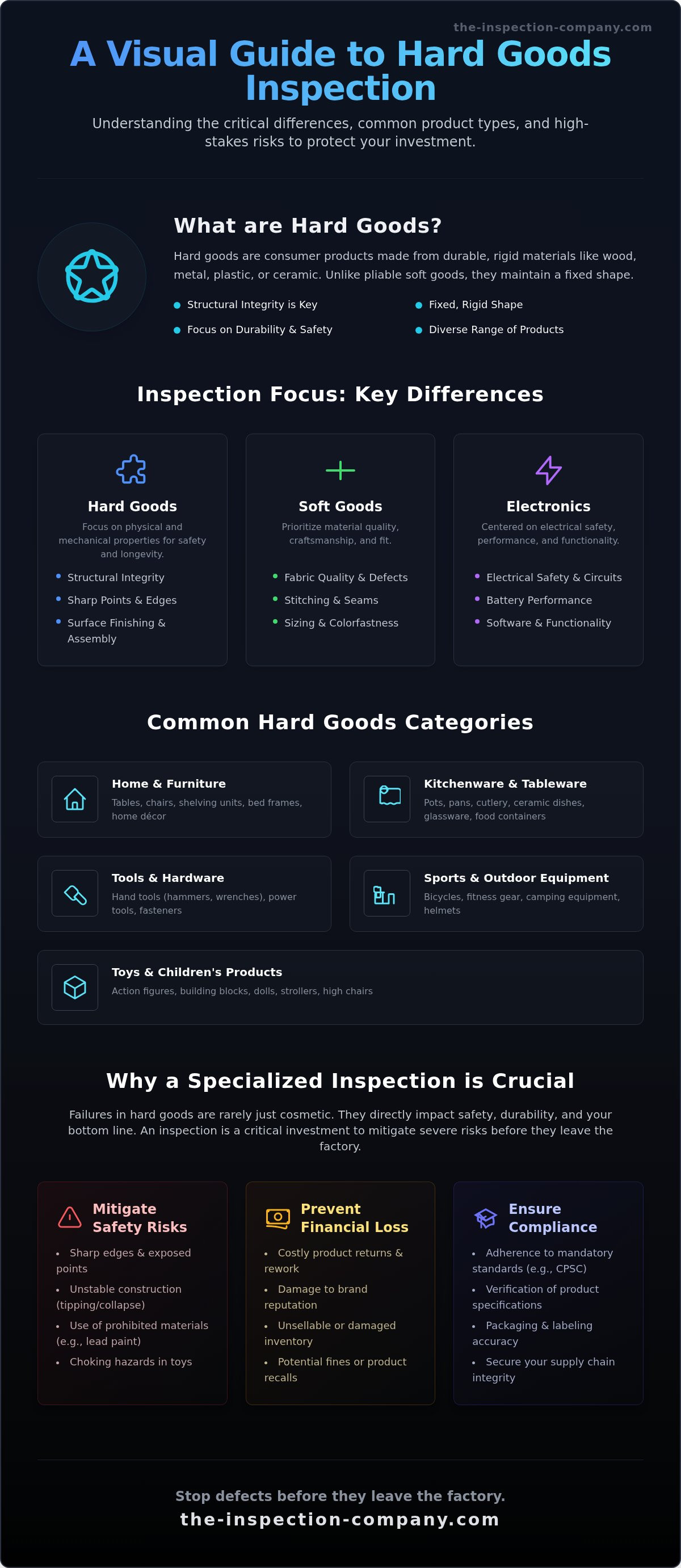
In the world of quality control, "hard goods" refer to consumer products made from durable materials like wood, metal, plastic, or ceramic. This category is defined by what it is not: soft goods. Unlike apparel, footwear, or textiles which are pliable, hard goods are rigid and maintain a fixed shape. This broad category encompasses an immense range of products, from children's toys and kitchenware to furniture and power tools.
Because of this diversity, a one-size-fits-all approach to quality control is ineffective and risky. The safety standards for a baby crib are vastly different from those for a hammer, and the functional tests for a bicycle bear no resemblance to those for a dinner plate. A successful hard goods inspection protocol must be meticulously tailored to the specific product's materials, intended use, construction, and regulatory requirements. Neglecting this specificity can lead to costly defects, product recalls, and damage to your brand's reputation.
To clarify the scope, here are some of the most common categories of hard goods we inspect:
| Category | Product Examples |
|---|---|
| Home & Furniture | Tables, chairs, shelving units, bed frames, picture frames, home décor |
| Kitchenware & Tableware | Pots and pans, cutlery, ceramic dishes, glassware, food containers |
| Tools & Hardware | Hand tools (hammers, wrenches), power tools (drills, saws), fasteners (screws, nails) |
| Sports & Outdoor Equipment | Bicycles, fitness gear, camping equipment, helmets, skateboards |
| Toys & Children's Products | Action figures, building blocks, dolls, strollers, high chairs |
Distinguishing Hard Goods from Other Product Types
Understanding the key differences between product categories is fundamental to establishing effective quality standards. The inspection process for each is unique, focusing on entirely different risks and potential failures.
-
Hard Goods vs. Soft Goods: The primary distinction is material. Hard goods inspections focus on structural integrity, sharp points or edges, surface finishing, and assembly. Soft goods inspections, conversely, prioritize fabric quality, stitching, sizing, and colorfastness.
-
Hard Goods vs. Electronics: While some hard goods may have electronic components, a standard hard goods inspection focuses on mechanical and physical properties. Electronics inspections are centered on electrical safety, circuit board quality, battery performance, and software functionality.
This distinction is critical because it dictates the entire quality assurance strategy, from defining defect classifications to selecting the appropriate on-site tests. Setting the correct Acceptable Quality Limits (AQL) for a shipment of wooden chairs versus a shipment of t-shirts requires different criteria. These standards are verified on-site by inspectors using established statistical sampling methods to provide an objective assessment of the entire production lot, ensuring your quality standards are met before the shipment leaves the factory.
Why a Specialized Hard Goods Inspection is Crucial for Importers
Unlike textiles or electronics, hard goods like furniture and toys carry distinct and often more severe risks. Failures are rarely just cosmetic; they directly impact safety, structural integrity, and durability. Receiving a shipment of unsellable, damaged, or non-compliant goods can have a devastating financial impact. For this reason, a professional hard goods inspection should be viewed as a critical investment in your supply chain, not an operational expense. It is your primary tool to stop problems before your shipment sails.
Mitigating Safety and Compliance Risks
The most significant risk with hard goods is consumer safety. A faulty toy can become a choking hazard, and an unstable piece of furniture can cause serious injury. An independent inspection is essential to verify that your products are free from manufacturing defects that create unacceptable risks. Inspectors are trained to identify:
-
Sharp edges, exposed points, and potential pinch points.
-
Unstable construction that could lead to tipping or collapse.
-
Use of prohibited materials, such as lead-based paints or non-food-grade plastics.
Verifying that your products adhere to mandatory standards, such as the Consumer Product Safety Commission regulations in the U.S. or CE marking requirements in Europe, is non-negotiable for market access and liability protection.
Ensuring Functionality and Durability
Functional failures lead directly to negative reviews, costly returns, and damage to your brand's reputation. A customer who receives a wobbly chair, a table with misaligned screw holes, or a toy with ill-fitting parts will not become a repeat buyer. A thorough hard goods inspection includes functional and durability checks to prevent these mass-production errors. On-site testing can verify load-bearing capacity, check for stability on flat surfaces, and ensure all components assemble correctly, guaranteeing a positive end-user experience.
Preventing Costly Shipping Damage
Hard goods are often heavy, bulky, and awkwardly shaped, making them highly susceptible to damage during transit. Inadequate packaging is a common but entirely avoidable defect. An inspector can verify that your supplier is using appropriate packaging protocols, including correct carton thickness, sufficient internal protective material like foam or corner guards, and secure strapping. Performing a carton drop test on-site simulates the rough handling of international shipping, providing confidence that your products will arrive at their destination in sellable condition.
The Hard Goods Inspection Checklist: What Inspectors Actually Check
A comprehensive hard goods inspection is not a matter of guesswork; it is a meticulous, on-site process guided by a detailed checklist. This process forms the backbone of effective product verification, it is essential for maintaining standards and client satisfaction. While every inspection follows a standard framework, the most effective ones are customized to your specific product's risks and requirements. A clear checklist provided by you, the client, is the single most important tool to ensure our inspectors verify what matters most to your business and your customers.
Below are the core sections of a typical inspection report, designed to give you a transparent view of your product's quality before it ships.
Visual & Workmanship Quality Assessment
Our inspectors begin with a thorough visual check, scrutinizing a statistical sample of units based on AQL standards. The goal is to identify any aesthetic or manufacturing flaws that could lead to customer complaints or returns. Key checkpoints include:
-
Surface Defects: Checking for scratches, dents, chips, bubbles, poor finishing, or glue marks.
-
Specification Verification: Ensuring color (against Pantone or samples), materials, and dimensions match your approved specifications.
-
Production Consistency: Verifying uniformity across the entire production batch to avoid unacceptable variations.
On-Site Functional and Assembly Tests
Beyond looking good, a product must work as intended. Inspectors act as the end-user to uncover functional issues before they reach your customers. This hands-on phase involves:
-
Assembly Check: Assembling at least one unit to verify fit, alignment, and clarity of instructions.
-
Functional Tests: Opening and closing drawers, testing hinges, checking the stability of moving parts, and verifying mechanisms.
-
Component Verification: Ensuring all hardware (screws, bolts, tools) and components are included as per the bill of materials and manual.
Safety and Performance Testing
For furniture, toys, and other load-bearing items, safety is non-negotiable. A specialized hard goods inspection includes critical on-site tests to verify structural integrity and compliance with safety norms. These often include:
-
Stability Tests: Applying force to furniture like bookshelves and dressers to check for tipping risks.
-
Load Tests: Applying static weight to chairs, tables, and shelves to ensure they can support their intended load without breaking or deforming.
-
Adhesion Tests: Using specialized tape (e.g., 3M) to test coatings, prints, and logos for peeling or flaking.
Packaging and Labeling Verification
A product is only as good as its ability to arrive safely. We verify that all packaging and labeling meet your specifications to prevent logistical nightmares and shipping damage. This includes the essential carton drop test to simulate the rigors of transit.
-
Marking & Barcode Check: Verifying shipping mark accuracy and scanning barcodes to ensure readability.
-
Packaging Assessment: Checking that inner packaging (foam, dividers, bags) provides sufficient protection.
-
Carton Drop Test: Dropping the master carton from various heights and on different corners/edges to assess its transit-worthiness.
Common Defects in Hard Goods (with Real-World Examples)
Not all product flaws are created equal. A successful hard goods inspection hinges on a clear system for classifying defects based on their severity. The industry-standard framework for this is the Acceptable Quality Limit (AQL), which categorizes defects into three distinct levels. Understanding these classifications is the first step in creating a robust quality control checklist and protecting your investment.
-
Critical Defect: A defect that fails to meet mandatory safety regulations or poses a direct risk of harm to the user. A single critical defect typically results in the failure of an entire inspection.
-
Major Defect: A defect that would likely cause the product to fail, reduce its usability, or lead to customer returns. These are significant issues that affect the product's function, performance, or appearance.
-
Minor Defect: A small discrepancy from the specifications that does not affect the product's usability or function. Most customers would not notice a minor defect or be prompted to return the item because of it.
To provide clarity, here are practical examples of defects across common hard goods categories.
Defects in Furniture & Wood Products
Quality issues in furniture can range from cosmetic blemishes to severe structural failures that create significant safety liabilities. A thorough inspection verifies everything from stability to finish quality.
-
Critical: Unstable construction that could cause the item to collapse under normal use; sharp edges or points on children's furniture.
-
Major: Deep scratches or gouges on primary surfaces; incorrect product dimensions; misaligned drill holes preventing proper assembly.
-
Minor: Small blemishes on non-visible surfaces (e.g., the underside of a table); slight, acceptable color variations between parts.
Defects in Kitchenware & Ceramics
For items that come into contact with food, a hard goods inspection must prioritize safety and compliance above all else. Functional defects that affect performance are also a primary concern.
-
Critical: Sharp chips or edges on glassware or ceramics; presence of lead, cadmium, or other toxic materials in glaze or paint.
-
Major: Cracks that compromise the item's integrity; poor seals on lids for food storage containers; uneven or wobbly bases on pots or pans.
-
Minor: Small, enclosed bubbles in glass; slight imperfections in paintwork or printed logos; minor surface scratches.
Defects in Tools & Metal Products
Safety and functionality are paramount when inspecting tools. A defect can not only prevent the tool from working correctly but can also create a serious hazard for the end-user.
-
Critical: A malfunctioning safety guard on a power tool; faulty wiring that could cause an electric shock.
-
Major: Visible rust or corrosion; parts that do not fit together as intended; poor or incomplete welding joints.
-
Minor: Light surface scratches that don't affect function; messy or slightly misaligned logos and markings.
Building a comprehensive checklist is essential for protecting your brand and avoiding costly problems. Not sure how to classify defects for your specific product? Our reports provide the clarity you need. Download our sample inspection report.
How to Arrange Your Hard Goods Inspection: A Step-by-Step Process
Understanding potential defects is the first step; taking action is the next. Arranging a professional hard goods inspection is a straightforward process designed to give you maximum control over your product quality before it leaves the factory. This simple guide demystifies the process, from booking your service to making a final shipment decision.
Step 1: Booking and Providing Key Information
Timing is critical. We recommend scheduling your inspection when production is 80-100% complete and at least 80% of the goods are packed for export. This ensures our inspectors have a representative sample to evaluate while leaving a small window for any last-minute corrections.
To ensure a thorough and accurate inspection, you will need to provide:
-
Your supplier’s factory name, address, and contact information.
-
Your Purchase Order (PO) and a detailed list of product specifications.
-
A comprehensive quality checklist outlining your standards for appearance, function, and packaging.
-
Approved reference samples (if available) to serve as a benchmark for our inspectors.
The more detailed your information, the more effectively we can verify that your standards have been met.
Step 2: Understanding the Inspection Report
Within 24 hours of the inspection, you will receive a detailed report in PDF format. This document is your eyes and ears in the factory, filled with high-resolution photos and clear descriptions of our findings. The report provides a conclusive result: Pass, Fail, or On-Hold. This is based on the number and type of defects found, measured against established AQL (Acceptable Quality Limit) standards. Pay close attention to the inspector’s comments and photographic evidence, which provide objective proof of any non-compliance issues.
Step 3: Making a Shipment Decision
Armed with the inspection report, you can make an informed decision with confidence. A "Pass" result means you can approve the shipment, knowing your quality standards have been verified. If the report is "Fail" or "On-Hold," it becomes powerful leverage. You can use the clear evidence to negotiate with your supplier to rework defective items, replace faulty units, or issue a credit. This document holds your supplier accountable and prevents defective products from ever reaching your customers. One day of inspection can save you from months of costly problems.
Ready to protect your shipment and ensure your products meet your standards? Get your instant quote now .
Your Next Step to Flawless Hard Goods Shipments
Navigating the complexities of sourcing manufactured products demands a meticulous approach. As we've covered, the unique materials, construction, and safety requirements of these items make a specialized hard goods inspection a non-negotiable step in your quality control process. A comprehensive checklist isn't just a suggestion; it's your frontline defense against costly defects and shipment rejections, protecting both your investment and your brand's reputation.
Don't leave your shipment's success to chance. With a network of over 700 inspectors across Asia, guided by European management to ensure international standards, we provide the on-the-ground expertise you need. You'll receive a detailed report with photos within 24 hours, giving you the clarity and confidence to approve your shipment and avoid costly surprises.
Take control of your supply chain and stop problems before they start. Secure your quality. Get an instant inspection quote in minutes. Make your next shipment your best one yet.
Frequently Asked Questions About Hard Goods Inspection
What is the difference between a hard goods inspection and a soft goods inspection?
The primary difference lies in the product's material and construction. A hard goods inspection focuses on rigid items like furniture, toys, and electronics, checking for structural integrity, safety hazards, function, and assembly. In contrast, a soft goods inspection deals with textiles and apparel, focusing on fabric quality, stitching, measurements, and color consistency. Each requires specialized checklists and testing procedures to effectively identify potential defects and minimize risks before shipment.
How much does a hard goods inspection typically cost?
The cost for a professional inspection is typically a flat, all-inclusive daily rate, often starting from around $309 USD. This fee covers the inspector's time, travel, and the generation of a comprehensive report. When you consider the potential cost of a rejected shipment, customer returns, or product recalls, this one-day investment is a critical step to save your business from significant financial loss and protect your brand's reputation.
What is an AQL and how do I set it for my hard goods product?
AQL stands for Acceptable Quality Limit, a statistical standard used to determine the maximum number of defective units acceptable in a production batch. You set AQL levels for three defect types: Critical (0%), Major, and Minor. For most hard goods, a standard AQL of 2.5% for major defects and 4.0% for minor defects is common. However, for high-risk items like children's toys, you should set a stricter AQL to ensure higher safety and quality standards.
Can you inspect oversized items like furniture or large sports equipment?
Absolutely. Our inspectors are equipped to conduct a thorough hard goods inspection on oversized items directly at your supplier's factory. For products like furniture or large sports equipment, we perform specific on-site tests to verify structural integrity, stability, correct assembly, and compliance with weight-bearing specifications. We ensure even the largest products meet your quality and safety standards before they are packed and shipped, preventing costly surprises upon arrival.
What happens if my products fail the inspection?
If a shipment fails inspection, you will receive a detailed report with photographic evidence within 24 hours, outlining all identified defects. This report gives you the leverage to negotiate with your supplier before making the final payment. Your options typically include requesting the factory to rework the defective items, sort the entire batch to remove faulty units, or rejecting the shipment outright. This process ensures you don't pay for and ship substandard products.
Do I need an inspection for every shipment?
We strongly recommend an inspection for every shipment, particularly when working with a new supplier. Production quality can fluctuate from one batch to the next due to changes in materials, staff, or processes. Consistent pre-shipment inspections are the most reliable way to ensure your quality standards are met every time. This vigilance is a cornerstone of a successful sourcing strategy, protecting your investment and brand reputation on an ongoing basis.