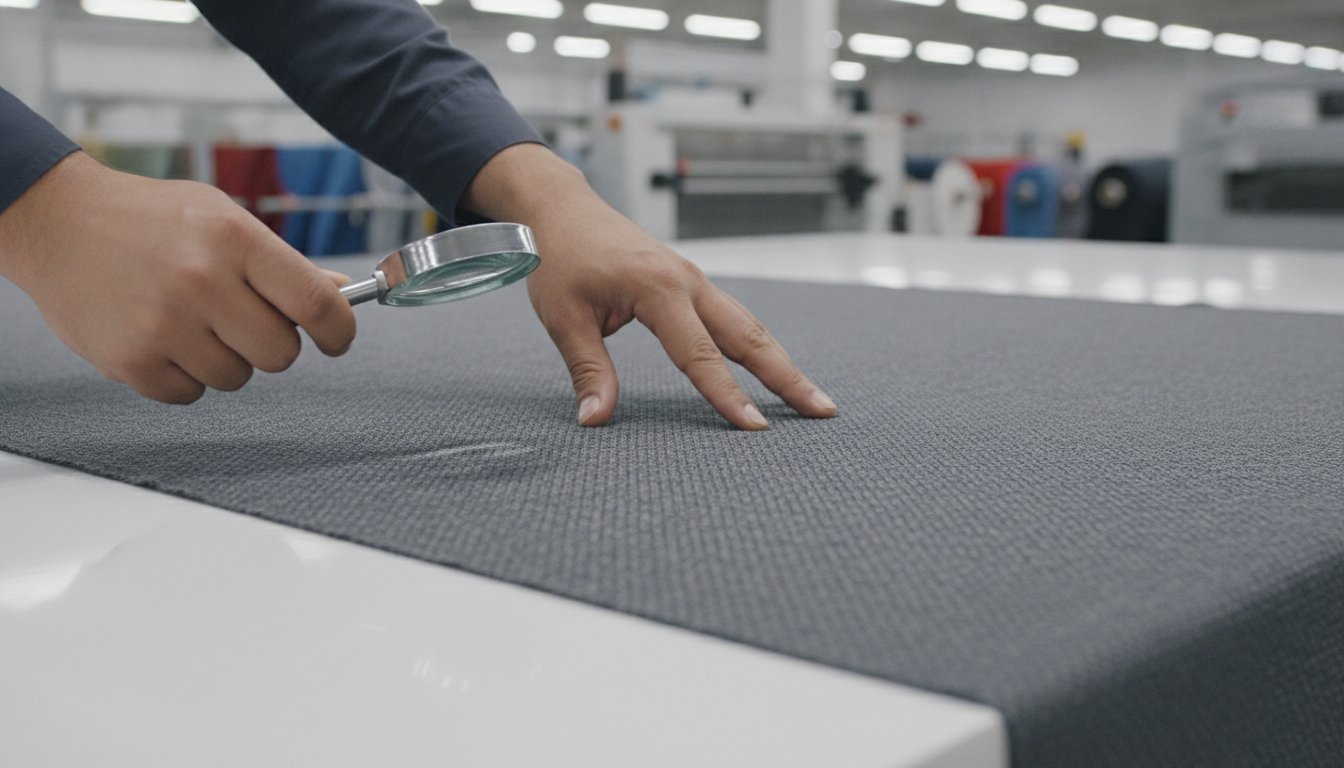

The wait for a finished production run is often filled with uncertainty. Will the quality meet your standards? Is the timeline on track? Discovering widespread defects upon delivery is a costly nightmare, but by then, it's often too late for an easy fix. The most effective way to prevent this scenario is with a during production inspection (DUPRO), your essential tool for gaining visibility and mitigating risk while your goods are still on the assembly line. This proactive step stops problems before they multiply across your entire order.
In this comprehensive guide, we will show you exactly how a DUPRO identifies and resolves quality issues mid-production, preventing costly delays and ensuring your final product meets every specification. You will learn how to verify your product standards are being met, keep your timeline on track, and build a more transparent, accountable partnership with your factory. It's time to stop reacting to problems and start ensuring quality from the inside out.
Key Takeaways
- Identify and correct production issues before they impact your entire order by intervening at the critical 20-60% completion stage.
- Understand the specific business cases-like new suppliers or complex products-that make a during production inspection a critical investment to protect your shipment.
- Discover the detailed on-site checks inspectors perform to verify your product's quality, materials, and workmanship against your approved specifications.
- Learn how to translate inspection findings into a clear corrective action plan, ensuring your factory resolves issues promptly and avoids costly delays.
What is a During Production Inspection (DUPRO)?
A During Production Inspection, often abbreviated as DUPRO, is a quality control (QC) check performed on-site at the factory while your products are actively being manufactured. This inspection typically occurs when 10-20% of your total order has been produced and initially packed. Its core purpose is to identify any deviations from your quality standards in real-time, long before the entire order is complete. This type of in-process evaluation is a fundamental part of a comprehensive inspection in manufacturing strategy, allowing for immediate corrective action.
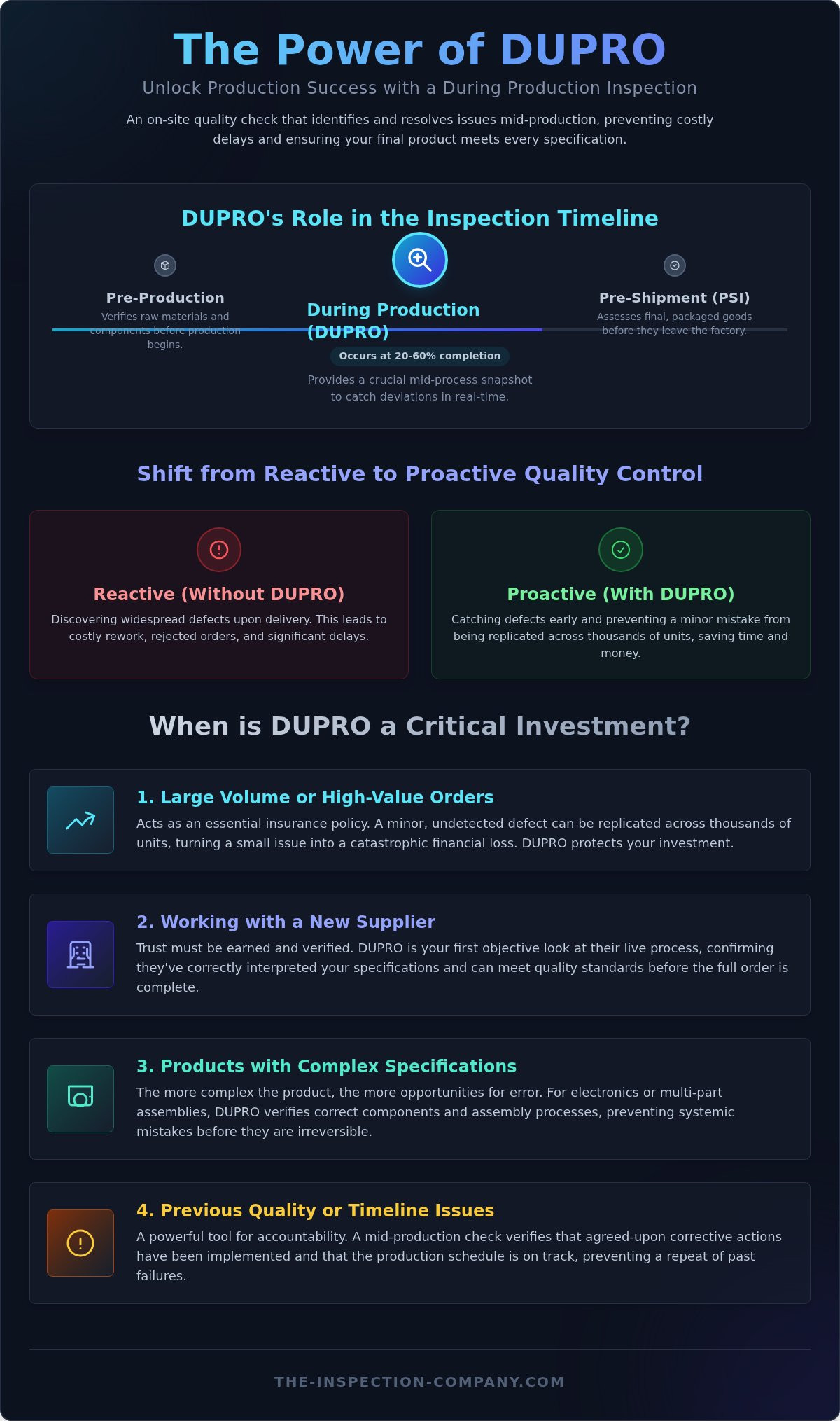
Think of it as checking the ingredients and tasting the sauce while you're cooking-not waiting until the final dish is served to find out something is wrong. Unlike a Pre-Production Inspection, which verifies raw materials before production begins, or a Pre-Shipment Inspection (PSI), which assesses the final, packaged goods, a DUPRO provides a crucial mid-process snapshot. It verifies that the initial production units meet your specifications and that the factory's internal QC processes are effective.
The Core Objective: Proactive vs. Reactive Quality Control
The primary goal of a DUPRO is to shift your quality control from reactive to proactive. By catching defects early, you prevent a minor mistake on one unit from being replicated across thousands. This proactive approach saves significant time and money by addressing issues at their source, avoiding the costly scenarios of having to rework or discard an entire production run after it's already completed.
DUPRO's Unique Role in the Inspection Timeline
A during production inspection sits strategically between initial material checks and the final assessment. It does not replace the need for a final Pre-Shipment Inspection (PSI); instead, it complements it. A DUPRO offers invaluable assurance that your production is on track, both in terms of quality and schedule. It serves as an early warning system, giving you the visibility needed to steer the production process back on course before it's too late.
When is a DUPRO Inspection a Critical Investment?
While a final pre-shipment inspection is a standard safety net, a During Production (DUPRO) Inspection is a strategic tool for high-risk scenarios. Deciding to invest in this mid-process check isn't about adding costs; it's about making an informed financial decision to mitigate specific, significant threats to your supply chain. Understanding when to deploy this check is rooted in fundamental In-Process Quality Control principles, which prioritize proactive risk management over reactive problem-solving. The following scenarios highlight when a DUPRO moves from a "nice-to-have" to a critical investment.
Scenario 1: Large Volume or High-Value Orders
The financial stakes escalate with order size. A minor, undetected defect on a continuous production line can be replicated across thousands of units, turning a small issue into a catastrophic loss. For large or high-value shipments, a DUPRO acts as an essential insurance policy. The small cost of an inspection is insignificant compared to the expense of reworking, replacing, or writing off an entire defective order. It ensures quality is maintained from the first unit to the last.
Scenario 2: Working with a New Supplier
Trust must be earned and verified. When engaging a new factory, you are dealing with unknown variables in their capabilities, communication, and consistency. A DUPRO inspection is your first objective look at their live production process. It confirms they have correctly interpreted your technical specifications and are capable of meeting your quality standards before the full order is complete. This check serves as a vital early warning system for any potential long-term partnership issues.
Scenario 3: Products with Complex Specifications or Multiple Components
The more complex the product, the more opportunities for error. For items like electronics, multi-part assemblies, or technical garments, a final inspection may be too late to correct fundamental mistakes. A during production inspection verifies that the correct components are being used and assembly processes are followed correctly. It prevents systemic errors, like using the wrong color thread on 10,000 shirts or installing an incorrect chipset in a batch of devices, before they become irreversible.
Scenario 4: You've Had Previous Quality or Timeline Issues
If a supplier has failed to meet quality standards or deadlines in the past, a DUPRO becomes a powerful tool for enforcement. Scheduling a mid-production check demonstrates that you are serious about monitoring progress and holding the factory accountable. It allows you to verify that previously agreed-upon corrective actions have been successfully implemented and that the production schedule is on track, preventing a repeat of past failures and costly delays.
The DUPRO Checklist: What Inspectors Verify on the Factory Floor
A During Production (DUPRO) inspection is far more than a casual walkthrough. It is a systematic, on-site audit designed to give you a transparent and unbiased snapshot of your production status. Our inspectors follow a comprehensive checklist to verify that your quality standards are being met and that your project is on schedule. This crucial intervention allows for corrective actions before minor issues escalate into major financial losses.
Production Status and Timeline Verification
One of the first tasks is to verify the factory’s claimed progress. Our inspector independently confirms the actual percentage of goods that are finished, semi-finished, and packaged. This real-time data helps you identify potential production bottlenecks and manage shipment schedules accurately, preventing costly delays and ensuring your deadlines are met.
Assessment of Semi-Finished and Finished Products
The core of any during production inspection involves a hands-on evaluation of the products themselves. Using the internationally recognized AQL (Acceptable Quality Limit) standard for random sampling, our inspector meticulously checks for:
-
Workmanship Defects: Identifying cosmetic and functional flaws such as poor stitching on garments, scratches on metal surfaces, or improper assembly of electronic components.
-
Specification Conformance: Ensuring every detail matches your approved specifications, from precise dimensions and weight to correct color matching (verified against Pantone codes) and proper labeling.
Review of In-House Quality Control Processes
A reliable factory should be your first line of defense against defects. We assess the effectiveness of the factory's own internal QC team. Our inspector observes their methods, checks if they are correctly identifying and segregating defective units, and ensures they are taking ownership of quality throughout the manufacturing process.
Raw Materials and Component Check (Follow-Up)
To protect your product’s integrity and safety, we re-verify the raw materials and components being used. This follow-up check ensures the factory has not substituted the approved materials with cheaper, substandard alternatives to cut costs-a practice that can compromise durability, safety, and compliance.
By examining these critical areas, a DUPRO provides the actionable intelligence you need to keep your production on track. Contact us to see how an on-site inspection can safeguard your investment.
From Report to Resolution: Taking Action on DUPRO Findings
Receiving your during production inspection report is a critical milestone, but it is not the final step. The true value of a DUPRO lies in the action you take based on its findings. This report is your roadmap to resolving issues mid-production, saving you from costly defects in your final shipment. Swift, clear, and decisive action is what transforms an inspection report into a powerful risk mitigation tool.
Understanding Your DUPRO Inspection Report
Your report is designed for clarity and immediate comprehension. It typically includes an executive summary of the findings, detailed measurements against your specifications, and, most importantly, high-resolution photos of any identified issues. Defects are classified to help you prioritize:
-
Minor: Small imperfections unlikely to affect product usability.
-
Major: Defects that could impact function, performance, or appearance.
-
Critical: Issues that render the product unsafe or non-compliant.
The photographic evidence is non-negotiable proof, eliminating ambiguity when discussing corrections with your supplier.
Communicating a Corrective Action Plan (CAP) to Your Supplier
Time is of the essence. Send the inspection report to your factory contact immediately and propose a clear Corrective Action Plan (CAP). A collaborative yet firm approach yields the best results. Your CAP should precisely outline the necessary steps to rectify the problems found during the inspection.
A successful CAP includes:
-
A list of each specific defect found.
-
The required corrective action for each defect (e.g., "re-stitch all seams," "replace incorrect component").
-
A request for the root cause to prevent recurrence.
-
A firm deadline for implementing the fixes.
Effectively managing this process is crucial for maintaining production timelines and quality standards. Need help managing supplier communication? Our experts can guide you.
The Follow-Up: Verifying the Fixes
A supplier's promise to correct issues is a good start, but it must be verified. Never assume problems have been solved without independent confirmation. The issues identified in your during production inspection become a specific checklist for your final Pre-Shipment Inspection (PSI). Our inspectors will pay special attention to these items to ensure the fixes are complete and correct.
For major or critical failures, a follow-up DUPRO may be necessary to confirm corrections before the entire production run is completed. This proactive verification is the ultimate guarantee that your quality standards are met before the shipment leaves the factory.
Secure Your Production and Protect Your Investment
As we've explored, waiting for a final inspection can be a costly gamble. A strategic during production inspection provides a critical mid-production snapshot, identifying non-conformities and process deviations while there is still time for corrective action. By verifying quality and progress on the factory floor, you transform a reactive process into a proactive strategy, safeguarding your timeline and budget against expensive delays, rework, or rejections.
Don't leave your product quality to chance. Partner with an expert who can be your eyes and ears on the ground. With a network of over 700 inspectors across key Asian manufacturing hubs and European management ensuring international quality standards, we provide the assurance you need. You'll receive a detailed report with photos within 24 hours, giving you the data to make informed decisions swiftly.
Don't wait for final inspection to find problems. Secure your production line today.
Take control of your supply chain and ship with confidence.
Frequently Asked Questions About During Production Inspection
Can a During Production Inspection replace a final Pre-Shipment Inspection?
No, a During Production Inspection (DUPRO) complements but does not replace a Pre-Shipment Inspection (PSI). A DUPRO is designed to catch issues with processes and early-run products. The PSI is your final opportunity to verify the quality, quantity, and packaging of the entire completed order before it ships. Skipping the final PSI exposes your shipment to significant risks, as defects can still emerge in the later stages of production after the DUPRO is complete.
What is the ideal production percentage to schedule a DUPRO?
The optimal time to conduct a DUPRO is when 20-30% of your order has been produced and at least some products are fully packed. This provides a large enough sample of finished goods to identify potential systemic issues. More importantly, it is early enough in the manufacturing cycle to implement corrective actions without causing major delays or scrapping a significant portion of the order, thereby protecting your timeline and investment from costly rework.
How much does a During Production Inspection typically cost?
The cost is typically a flat, all-inclusive daily rate per inspector, which provides a full day of on-site quality verification. While this is an added operational expense, it is a minor investment compared to the potential financial losses from a rejected order, shipping delays, or product returns. One day of inspection can save you from months of trouble and protect your bottom line. We advise you to request a quote for precise, location-specific pricing.
What happens if my inspector finds critical defects during a DUPRO?
If critical defects are found, we immediately alert you with a detailed report, including clear photographic evidence. This allows you to instruct the factory to halt production and implement a corrective action plan immediately. Identifying and resolving these major issues mid-process is the primary benefit of a during production inspection. It prevents the defect from affecting your entire order, saving you from a potentially catastrophic quality failure before it's too late to fix.
How quickly will I receive my DUPRO report after the inspection?
We deliver your comprehensive, detailed inspection report within 24 hours of the service's completion. We understand that time is critical when production is active. This rapid delivery ensures you have the necessary data-including photos, defect classifications, and inspector comments-to make informed decisions and communicate effectively with your supplier. This prevents any unnecessary delays while ensuring quality standards are being met and enforced on the factory floor.
Is a DUPRO necessary for every order I place with a supplier?
A DUPRO is most crucial for large volume orders, products with complex manufacturing processes, or when working with a new supplier. For smaller, repeat orders with a highly trusted factory, it may be optional. However, if an order is of high value or you have experienced quality fade with a supplier in the past, a DUPRO provides an invaluable layer of risk mitigation to ensure your standards are being consistently met throughout the entire production run.