
What if the money you save by skipping an independent audit actually costs you your entire quarterly profit in unsellable inventory? You've worked hard to build your supply chain, and it's tempting to rely on factory photos or a quick video call to keep overhead low. Yet, the reality of diy product inspection vs professional oversight is that one relies on hope while the other relies on verifiable data. One day of inspection can save months of trouble, especially when dealing with international suppliers where "quality fade" remains a documented risk for 25% of long-term manufacturing partnerships.
You already know that receiving a defective shipment is a nightmare that often ends in a total financial loss. This article explains how the choice between a DIY approach and professional third-party services determines whether your shipment is a success or a costly liability. We'll break down how independent verification secures zero-defect shipments and prevents the common packaging errors that lead to Amazon FBA rejections. You'll learn how to establish verifiable proof of quality before you pay the final invoice, ensuring your ROI remains protected against hidden factory scams and costly surprises.
Key Takeaways
- Identify the hidden risks of "quality fade" and why relying on factory-provided media often leads to costly shipment failures and liability.
- Learn how to leverage the AQL framework and professional reporting to make objective, data-driven decisions before your goods leave the factory.
- Evaluate the true ROI of diy product inspection vs professional services by calculating the long-term impact of shipping duties, lost sales, and rejected stock.
- Discover why one day of independent inspection is a critical investment that prevents months of logistical trouble and protects your brand reputation.
- Transition from a startup mindset to a professional procurement operation that enables confident global scaling through independent third-party verification.
The Reality of DIY vs. Professional Product Inspection in 2026
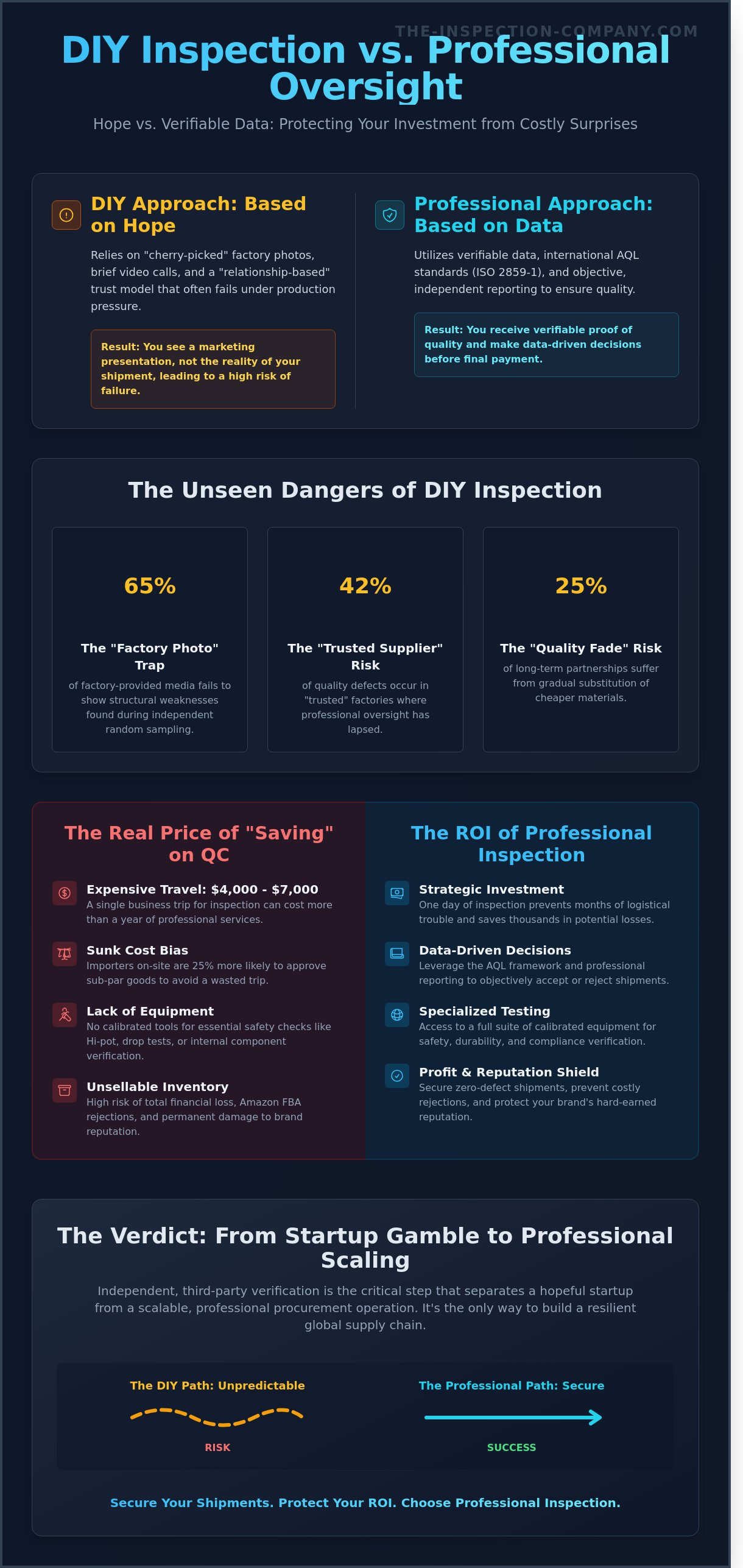
The debate of diy product inspection vs professional services is no longer just about saving a few dollars; it's about survival in a volatile market. DIY inspection involves an importer visiting a factory personally or, more commonly, relying on videos and photos sent by the supplier. Professional inspection utilizes an independent third-party to verify goods against international standards like ISO 2859-1 (AQL). While many buyers rely on long-term relationships, data from 2025 shows that 42 percent of quality defects occur in "trusted" factories where oversight has lapsed. By 2026, the rise of multi-tiered supply chains makes it impossible for small and medium enterprises (SMEs) to track every component without local, professional boots on the ground.
Relying on a "relationship-based" trust model is a significant risk. In high-volume manufacturing, your contact person is often a sales representative, not the floor manager. They don't see the daily production errors. Professional quality control services act as your eyes and ears, removing the emotional layer of the partnership to focus strictly on the technical specifications of the product.
The "Factory Photo" Trap
Suppliers often send high-resolution images that look perfect. These photos are almost always "cherry-picked" samples, which are items specifically chosen because they lack defects. A 2024 industry report found that 65 percent of factory-provided media failed to show structural weaknesses found during independent random sampling. Without a professional to perform a truly random selection from the mass production lot, you aren't seeing the reality of your shipment. You are seeing a marketing presentation. Professional inspectors use a mathematical approach to ensure the samples they test represent the entire batch, not just the best pieces.
The Hidden Costs of the DIY Approach
Choosing the DIY route creates immediate financial drains that many importers overlook. A single business trip to a manufacturing hub in Asia often costs between $4,000 and $7,000 when accounting for last-minute flights, hotels, and visa fees. Beyond the cash, there is the "sunk cost bias." When a buyer is physically at the factory, they are 25 percent more likely to approve sub-par goods just to avoid the hassle of a return trip. DIY checks also lack technical depth. Most importers don't carry calibrated equipment for specialized tasks:
- Hi-pot tests: Essential for electrical safety and compliance.
- Carton drop tests: To ensure packaging survives 2026 logistics pressures.
- Internal checks: Verifying battery capacities or PCB soldering quality.
Professional inspectors arrive with the necessary tools and a checklist tailored to your specific product. This objective approach is the only way to avoid costly surprises before your shipment sails. In the context of diy product inspection vs professional oversight, the professional route is an investment that prevents much larger financial losses.
Evaluating the DIY Approach: When (and Why) It Fails
Importers often assume they can manage quality control alone to reduce overhead. It's a gamble that frequently ends in "quality fade." This is a process where a supplier gradually substitutes cheaper materials or components over several production cycles. A non-expert eye won't catch these subtle shifts until customer returns start spiking. When comparing diy product inspection vs professional oversight, the lack of statistical methodology is the most dangerous gap. Most DIYers don't use Acceptable Quality Level (AQL) tables or ISO 2859-1 standards. They might check 5% of the order at random, but they lack the mathematical framework to confirm if the remaining 95% is actually safe to ship.
Factories also apply significant pressure to individual buyers on the factory floor. We've seen suppliers hide defective lots in the back of a dark warehouse or rush the buyer through a "representative" sample they've pre-selected. Without the clinical detachment of a third-party expert, it's easy to be swayed by a friendly factory manager. The stakes are high. In 2022, a mid-sized kitchenware brand faced a total Amazon account suspension because of a 0.7% defect rate in silicone handles. The owner performed a DIY check but missed that the internal adhesive failed at 350°F, despite the packaging claiming resistance up to 450°F. One small oversight led to a permanent loss of their primary sales channel.
Technical Gaps in DIY Inspections
Checking a product's appearance is simple; verifying its internal integrity is not. DIYers typically focus on aesthetic "out of box" checks. They miss functional failures that only appear during stress tests. You can't verify raw material origins or chemical compliance like REACH or RoHS standards without specialized equipment. Additionally, packaging often fails during a 30-day sea voyage. Professional inspectors perform standardized carton drop tests to ensure your goods survive the rough handling of international logistics, a step most DIYers skip entirely.
The Problem of Legal Recourse
If you receive a container of defective goods, your smartphone photos and handwritten notes provide zero legal leverage. Suppliers easily dismiss DIY reports as biased or "unprofessional." An independent inspection company serves as a neutral third-party witness. Their reports follow international quality standards, making them admissible in trade disputes or insurance claims. These documents provide the necessary leverage to demand re-work or refunds before you release the final 70% payment. If you want to secure your supply chain, it's best to book a professional inspection before the goods leave the factory floor.
The Professional Advantage: Beyond the Visual Check
Professional services eliminate the logistical nightmare and high costs of personal travel. With a network of over 700 inspectors positioned across Asia, you avoid spending thousands on flights and hotels. You receive a comprehensive PDF report within 24 hours of the site visit. This speed is a decisive factor when weighing diy product inspection vs professional options; it keeps your supply chain moving without unnecessary delays. All data integrates directly into our digital quality management platforms, providing real-time visibility into your production status from any location.
Statistical Certainty vs. Guesswork
Professional inspection relies on ISO 2859-1 standards, commonly known as AQL (Acceptable Quality Limit) tables. These tables remove emotion from the process by dictating exactly how many units to pull from a lot of 3,200 or 10,000 pieces to ensure statistical validity. We categorize every finding into three distinct tiers:
- Critical Defects: Issues that could harm a user or result in legal regulations being breached.
- Major Defects: Problems that reduce the usability or salability of the product.
- Minor Defects: Deviations from specifications that don't reduce the product's function.
Our inspectors operate under strict European management protocols. This structure ensures they remain independent and immune to factory "hospitality" or bribes that often compromise DIY attempts. You get an objective pass or fail result based on math, not a gut feeling.
Specialized Equipment and On-Site Testing
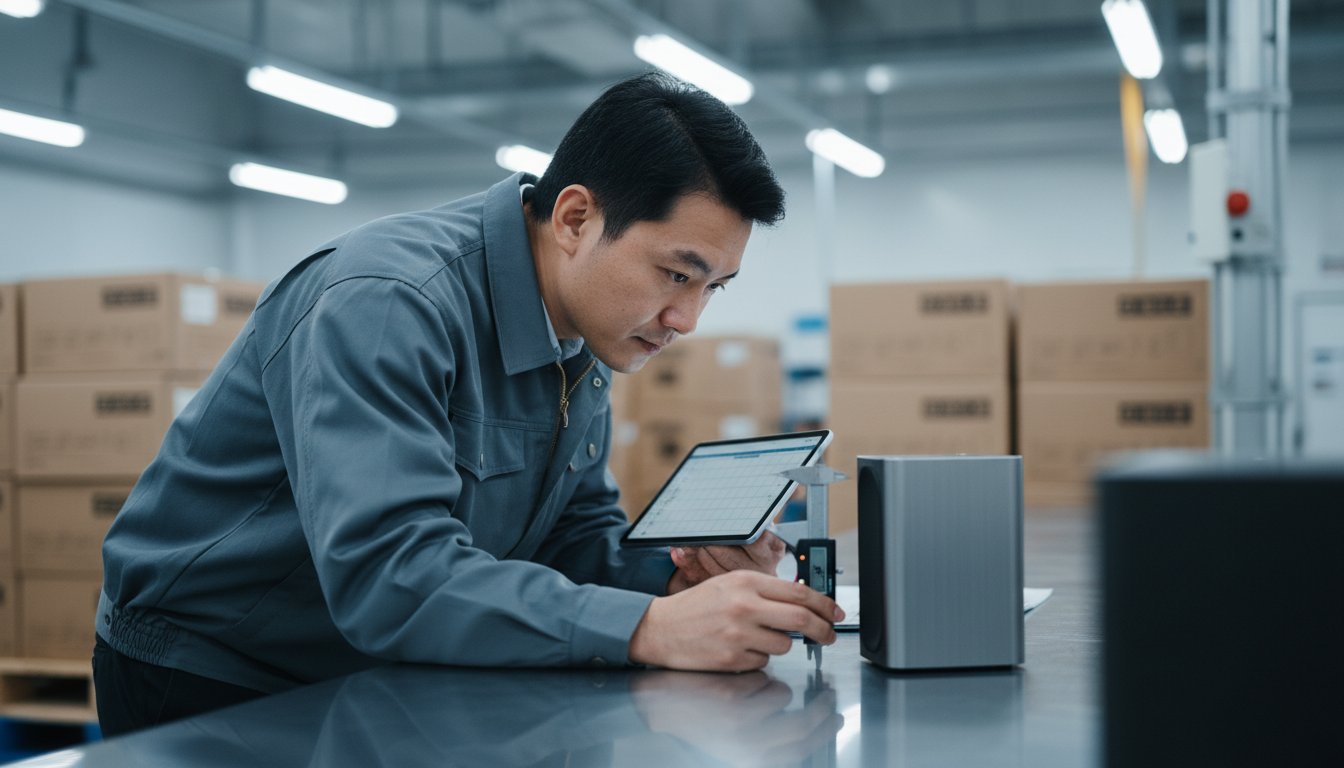
A simple visual check isn't enough to secure your ROI. Our teams perform rigorous on-site testing using specialized tools to simulate real-world use and transit stress. We conduct 90cm carton drop tests to ensure your packaging survives the rough handling of international logistics. We also perform rub tests to verify logo durability and function tests to check internal components.
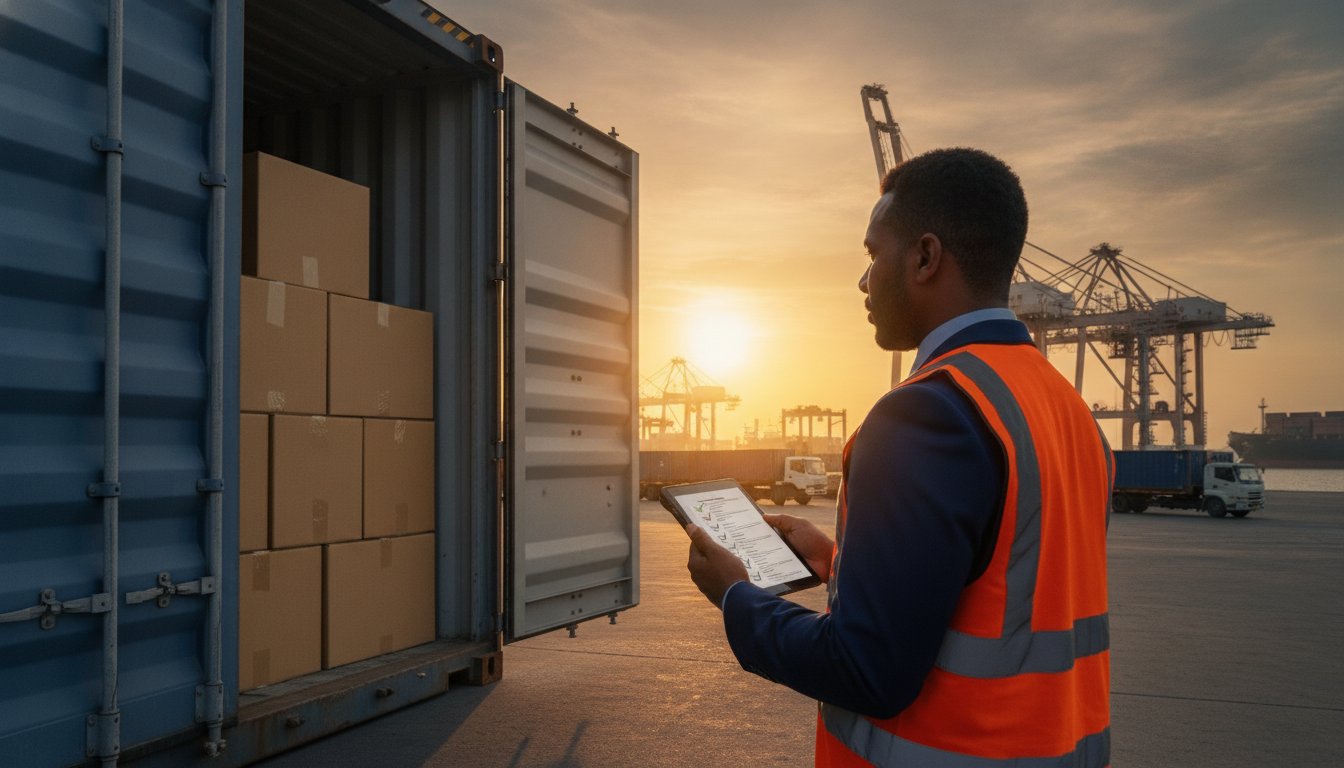
For e-commerce sellers, we prioritize Amazon FBA compliance by verifying barcode scanability and carton weight accuracy before the goods leave the floor. We also inspect container conditions before loading. Checking for holes or high moisture levels prevents mold growth during a 30-day sea voyage. These technical steps are the only way to avoid costly surprises once the shipment arrives at your warehouse.
Cost-Benefit Analysis: The Real Price of "Saving" on QC
Choosing between diy product inspection vs professional services often comes down to a misunderstanding of the actual costs involved. Many importers view quality control as an added expense rather than a form of insurance. However, the price of a single day of professional inspection is negligible compared to the financial catastrophe of a rejected shipment. When defects aren't caught at the factory, you're not just losing the product; you're losing your entire investment in that production cycle. One day of inspection can save months of trouble.
Step 1: Calculate Your Potential Loss
The Cost of Poor Quality (COPQ) extends far beyond the factory gates. To understand your exposure, you must calculate your Total Risk Value. Total Risk Value is the sum of your product cost, international shipping fees, non-refundable import duties, and the marketing budget allocated to those goods.
- Disposal Costs: If goods arrive defective, you'll pay local warehouses to dispose of them. This often costs between $1.50 and $5.00 per unit depending on size and material.
- Lost Sales: Stockouts caused by rejected shipments lead to lost Amazon rankings or broken retail contracts. A 14-day stockout can reduce organic search visibility by 30% or more.
- Customer Returns: High return rates can lead to account suspensions. Professional inspection reduces these returns, protecting your brand reputation and seller health.
Step 2: Compare Travel vs. Service Fees
A DIY approach requires a physical presence. A typical business trip to Asia costs upwards of $2,000 when factoring in last-minute flights, visas, and accommodation. This is four to six times the cost of a standard $300-$500 professional inspection fee. Local inspectors live near the manufacturing hubs. They speak the local language and understand regional business nuances that a visitor will miss. Our European management team bridges the communication gap; we ensure that Western quality standards are strictly enforced on the factory floor.
Scalability is where the professional model truly outperforms the DIY method. A single business owner cannot be in Ningbo, Shenzhen, and Ho Chi Minh City simultaneously. Professional agencies allow you to manage 10 or more suppliers at once without leaving your office. This infrastructure lets you scale your brand without increasing your travel budget or personal workload. We stop problems before your shipment sails, protecting your bottom line from costly surprises.
Don't leave your investment to chance. Explore our full range of professional quality control services to secure your next shipment.
Scaling with Confidence: Why Professional Inspection Wins
Scaling a business requires a shift from a reactive startup mindset to a disciplined procurement strategy. While checking a few samples yourself might work for a small trial, the diy product inspection vs professional debate ends as soon as you move to commercial volumes. Relying on your own eyes or the factory's internal QC is a gamble that risks your entire profit margin. Professional oversight provides the structural support needed for global expansion.
Utilizing comprehensive quality control services allows you to manage multiple suppliers across different regions simultaneously. You can't be in three factories in three different provinces at once, but a professional team can. This presence stops problems before the shipment sails, ensuring that your capital isn't tied up in unsellable inventory. It's the difference between being a hobbyist and a professional importer.
For commercial shipments, DIY is almost never appropriate. Use DIY methods for initial prototype reviews or personal samples. For anything destined for a customer or a warehouse, professional inspection is the only way to protect your ROI. One day of professional inspection can save months of logistical trouble and thousands in lost revenue.
Building a Long-Term Quality Strategy
Professional inspections generate data that you can't get from a casual DIY check. By using standardized reporting, you can rank and vet your suppliers based on their actual performance over time. Data from the past 25 years shows that factories subjected to regular third-party audits improve their compliance rates by an average of 15% within the first year. The Pre-Shipment Inspection (PSI) serves as your last line of defense. It's the final gatekeeper that ensures the goods in the box match the specifications in your contract. Without this objective verification, you're flying blind.
Next Steps: Booking Your First Inspection
Integrating third-party quality control into your workflow is straightforward. Start by inserting a clear clause into your Purchase Order (PO) that makes final payment contingent on a passed inspection report. This sets clear quality expectations with your supplier from day one. You aren't just asking for quality; you're requiring it through a verified process. Setting these boundaries early reduces the likelihood of "quality fade" during long production runs. It signals to the factory that you follow international standards, such as ISO 9001, and won't accept sub-par work.
Ready to secure your supply chain and eliminate the stress of importing? Contact The Inspection Company today for a risk-free quote and see how our European management and local expertise can safeguard your business.
Secure Your Supply Chain and Protect Your Bottom Line
Choosing between diy product inspection vs professional services is a decision that defines your brand's reliability in a competitive market. Relying on internal checks often results in overlooked defects that lead to expensive product recalls or total shipment loss. The reality of 2026 manufacturing requires a more rigorous approach to quality assurance than a simple visual check. Professional inspections provide the technical depth and independent verification necessary to stop problems before your shipment sails.
The Inspection Company leverages over 25 years of experience across major Asian manufacturing hubs to safeguard your investments. Our ISO 9001 certified European management team applies strict quality standards to every audit, ensuring total transparency and compliance. We deliver detailed, actionable reports within 24 hours, so you don't have to wait to make critical shipping decisions. One day of professional inspection can save months of logistical trouble and financial recovery. It's the most effective way to scale your business with absolute confidence in your product quality.
Avoid costly surprises; book your professional inspection today.
Your path to a defect-free supply chain and a protected ROI is just one inspection away.
Frequently Asked Questions
Can I trust my supplier to do their own internal quality control?
You shouldn't rely solely on a supplier's internal quality control because their priority is meeting production deadlines rather than identifying errors. Independent data shows that 28% of shipments fail initial inspections when conducted by a third party. A factory's internal team often overlooks minor defects to keep the line moving. Using an independent eye ensures your standards are met before the balance payment is made.
Is a professional inspection worth it for small orders under $5,000?
Professional inspection is essential for small orders because the cost of a total loss outweighs the service fee. When comparing diy product inspection vs professional services, a $300 inspection protects a $5,000 investment from being completely unsellable. If you receive 500 defective units, your shipping costs and disposal fees will quickly double your initial loss. One day of inspection can save months of trouble.
What happens if the professional inspector misses a defect?
Professional firms operate under strict ISO 2859-1 standards to minimize the risk of missed defects. If an inspector fails to identify issues within the agreed AQL levels, reputable companies provide a re-inspection at no cost or offer limited liability compensation. This accountability is a primary reason why the diy product inspection vs professional choice favors third-party experts who stand by their detailed reports.
How much does a professional product inspection cost in 2026?
Industry data from 2024 indicates that professional inspection rates typically range between $200 and $350 per man-day in major Asian manufacturing hubs. While 2026 exact pricing depends on global inflation and labor laws, these service costs have remained stable for over 10 years. You'll find that most reputable firms offer flat-rate pricing that includes travel and reporting to keep your budget predictable and transparent.
Can an inspector check for Amazon FBA labeling requirements?
Inspectors can and should check for specific Amazon FBA labeling requirements to prevent costly warehouse rejections. They verify that each unit has a legible FNSKU barcode and that master cartons meet Amazon's 50-pound weight limit and dimensional standards. Since Amazon's 2024 policy updates, incorrect labeling can lead to account suspension or inventory disposal, making this verification step critical for your ROI.
What is the difference between a factory audit and a product inspection?
A factory audit evaluates the manufacturer's systems and capacity, while a product inspection focuses on the physical goods. Think of an audit as a background check on the facility's ISO 9001 compliance and machinery. An inspection is a deep dive into your specific order to find scratches, functional failures, or packaging errors before the shipment sails. Both services work together to mitigate risk.
How long does it take to get the inspection report back?
You will typically receive a comprehensive inspection report within 24 hours of the site visit. This fast turnaround allows you to make an informed decision without delaying your logistics schedule. The report includes high-resolution photos, video clips of functional tests, and a detailed breakdown of all major and minor defects found. It's a reliable tool for negotiating repairs with your supplier immediately.
Do I need to be present during a professional inspection?
You don't need to be present at the factory because the inspector acts as your independent eyes and ears on the ground. Professional teams use standardized checklists and mobile reporting apps to capture every detail of the production run. This independence eliminates the need for expensive international travel and ensures the inspection remains objective and free from any supplier influence or pressure.