Does the thought of opening a shipping container to find damaged, incorrect, or missing products cause you serious concern? For any business importing goods, these aren't just fears-they are costly realities. The final, critical moments before your container is sealed are fraught with risk, from improper loading that causes damage in transit to incorrect quantities that lead to stock shortages. A professional container loading inspection is your last and most important opportunity to prevent these shipping disasters before they happen.
This comprehensive guide is designed to eliminate that uncertainty. We are providing you with the ultimate checklist to walk through every step of a successful inspection, giving you proof of condition and quantity before the container is sealed. You’ll gain the exact process for verifying product counts, documenting packaging integrity, and ensuring your shipment is securely loaded to minimize damage. Consider this your playbook for achieving complete peace of mind, guaranteeing your products arrive safely and exactly as ordered.
Key Takeaways
- Learn why the final check before shipment is your ultimate safeguard against receiving incorrect quantities or damaged goods.
- Discover the critical pre-loading checks for the container itself to prevent moisture, pests, and structural damage from ruining your shipment.
- A professional container loading inspection involves more than counting cartons; it ensures proper handling and strategic placement to prevent damage in transit.
- Master the final steps of the process, including how to properly document the container seal number to secure your cargo and prevent tampering.
What is a Container Loading Inspection (and Why It's Your Final Shield)
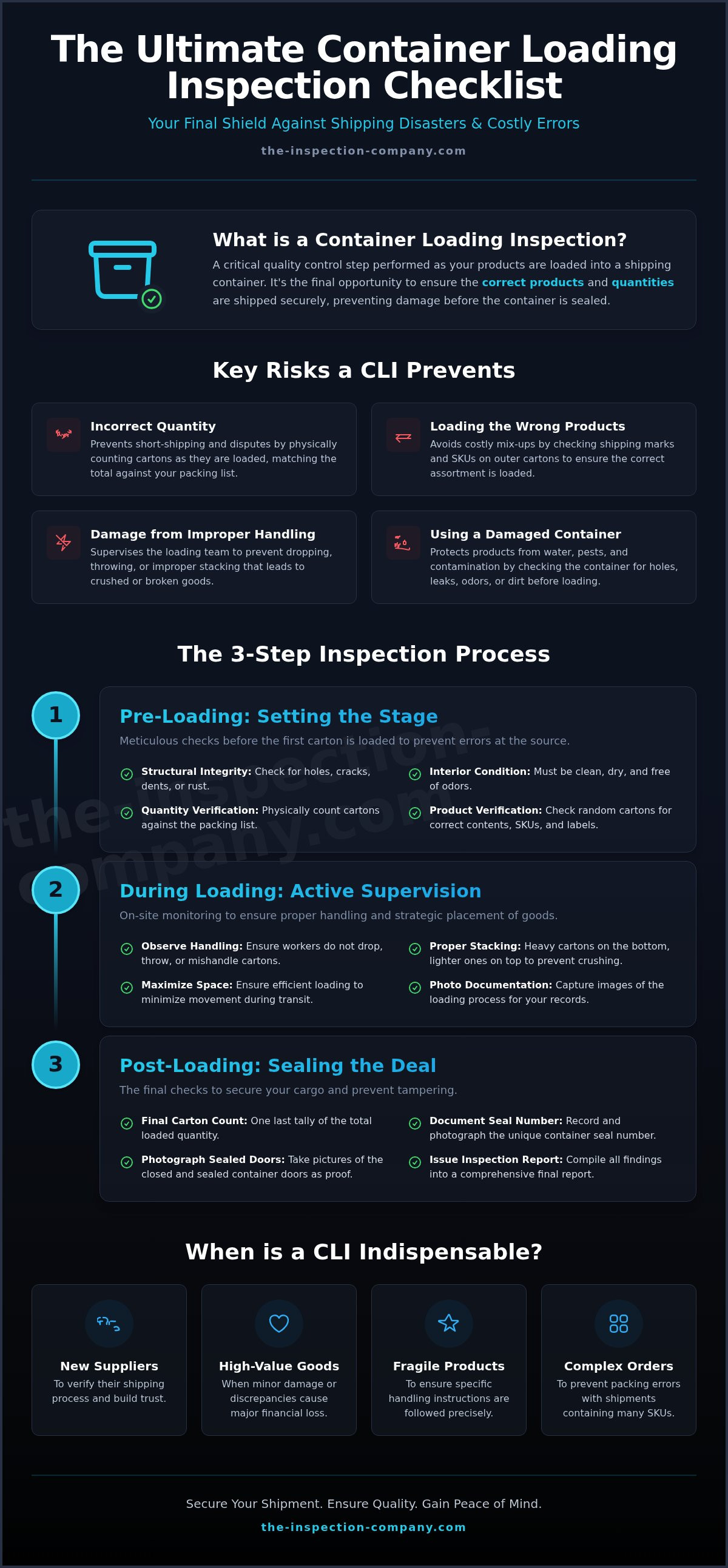
A Container Loading Inspection (CLI), also known as Container Loading Supervision (CLS), is a critical quality control step performed at the factory or forwarder's warehouse as your products are being loaded into their shipping container. While a Pre-Shipment Inspection (PSI) verifies product quality before packing, the CLI is your final opportunity to ensure the correct products and quantities are shipped in a secure, damage-free manner. It is the last line of defense before your goods enter the complex global network of intermodal freight transport. Once that container is sealed and locked, any errors-from short-shipping to transit damage-become your costly problem to solve upon arrival.
The Key Risks a CLI Prevents
A professional CLI directly mitigates several expensive and frustrating risks that can occur at the very last moment of the production cycle. An inspector on-site will verify and supervise the process to prevent:
- Incorrect Quantity: Physically counting the cartons as they are loaded to confirm the total quantity matches your packing list, preventing short-shipping and future disputes.
- Loading the Wrong Products: Ensuring the correct SKUs and assortments are loaded by checking the shipping marks on outer cartons, avoiding costly mix-ups that disappoint your end customers.
- Damage from Improper Handling: Supervising the loading process to stop workers from mishandling, dropping, or improperly stacking your cartons, which can lead to crushed or broken goods.
- Using a Damaged Container: Checking the shipping container’s condition for holes, leaks, strong odors, or dirt to ensure your products are not damaged by water or contamination during transit.
When is a Container Loading Inspection Essential?
While beneficial for any shipment, a container loading inspection is indispensable in several high-stakes scenarios where the margin for error is zero:
- When working with a new supplier: It builds trust and verifies their shipping processes are as reliable as their production quality.
- For high-value goods: When even minor damage or quantity discrepancies result in a significant financial loss.
- For fragile products: Supervision is crucial to ensure specific handling and stacking instructions are followed precisely to prevent breakage.
- When the order has many SKUs: For complex shipments with numerous product types, colors, or sizes, a CLI is the best way to prevent packing errors and ensure the correct assortment is loaded.
The Pre-Loading Checklist: Setting the Stage for Success
A successful container loading inspection does not begin when the first carton is loaded. It starts with a meticulous series of checks designed to prevent costly errors before your shipment is sealed. This foundational stage is your final opportunity to verify that the container, the products, and the packaging meet your exact standards. Neglecting these steps can lead to damaged goods, customs delays, and significant financial loss.
Step 1: Container Condition Verification
The shipping container is your product's home for weeks or months. Its integrity is non-negotiable. Before any goods are brought near, our inspectors conduct a thorough assessment to prevent damage during transit. This includes checking for compliance with safety protocols, such as the OSHA container handling standards, to ensure a secure environment. Key checkpoints include:
- Structural Integrity: We inspect for holes, cracks, dents, or significant rust that could compromise the container and expose goods to the elements.
- Interior Condition: The inside must be clean, completely dry, and free from strong odors or chemical residue that could taint your products.
- Security: Locking mechanisms and door seals are tested to ensure they function correctly and can be securely locked.
- Pest Control: A visual check is performed to confirm the container is free of insects, rodents, or other pests.
Step 2: Product and Quantity Verification
This is the critical moment to confirm you are shipping what you ordered. Our inspectors cross-reference the physical goods against your packing list to ensure complete accuracy. This process involves randomly selecting cartons to check that the contents, shipping marks, barcodes, and labels match your specifications. We perform an accurate carton count to validate the total quantity and, most importantly, confirm that the products being loaded are from the exact batch that passed any prior Pre-Shipment Inspection (PSI).
Step 3: Packaging and Packing Material Inspection
Your products can be flawless, but if the packaging fails, they will arrive damaged. The final pre-loading check focuses on the protective materials safeguarding your order. We verify that the export cartons are in good condition-not crushed, wet, or previously damaged. We also ensure that any specified inner packaging, such as foam inserts, dividers, or protective wrapping, is present and correctly used. For shipments requiring them, we confirm pallets are structurally sound and properly fumigated according to international regulations.
Supervising the Loading Process: A Step-by-Step Walkthrough
A successful container loading inspection goes beyond simply verifying carton counts. It involves active, on-site supervision to ensure your products are loaded with the care and precision they require. This is the final opportunity to prevent damage caused by improper handling, poor stacking, or an unbalanced load-costly errors that can compromise your entire shipment before it even leaves the port. Our inspectors act as your eyes and ears, enforcing best practices throughout the entire process.
Observing Handling and Stacking Procedures
The physical loading of goods is where most transit-related damage originates. Our inspector’s primary role is to ensure the factory’s loading team adheres to a strict protocol that protects your investment. This includes:
- Proper Handling: Confirming that workers are carefully placing cartons, not throwing or dropping them, which can cause immediate and hidden damage.
- Correct Stacking Plan: Verifying that heavier cartons are placed at the bottom and lighter ones on top to prevent crushing and product compression.
- Load Stability: Ensuring cartons are interlocked in a "brick pattern" whenever possible. This technique, aligned with principles found in official guidelines like the FMCSA Cargo Securement Rules, significantly reduces the risk of shifting during transit.
- Space Optimization: Maximizing container space to reduce per-unit shipping costs while ensuring the load is balanced and secure, with no wasted volume.
Documenting the Loading in Real-Time
Transparency and verification are critical. A detailed photographic record provides irrefutable evidence of how your container was loaded. Our inspectors document every key stage, creating a comprehensive visual report that gives you complete peace of mind. This documentation includes:
- Photos of the empty container to show its initial condition (cleanliness and structural integrity).
- Progress shots of the load at approximately 25%, 50%, and 100% full.
- Immediate photographic evidence of any damaged cartons or poor handling practices observed.
- A record of the weather conditions (e.g., rain, extreme heat), which could impact product integrity.
- Final photos of the fully loaded container with the right-side door closed, left-side door closed, and the container seal in place.
This meticulous supervision and documentation are core components of a professional container loading service. It transforms the process from a potential liability into a verified, secure final step in your supply chain, helping you avoid costly surprises upon arrival.
Sealing the Deal: Final Checks, Documentation, and Reporting
Once the last carton is loaded, the work is not yet complete. The final steps of the container loading inspection are the most critical for security and verification. This is where the entire process is locked down, providing you with the irrefutable proof and peace of mind that your order was shipped exactly as specified, preventing costly surprises upon arrival.
The Container Sealing Process
This is a crucial security measure that cannot be overlooked. Our inspector witnesses the closing and locking of the container doors and ensures a high-security bolt seal is applied in their presence. This critical step prevents tampering and unauthorized access after the inspection is complete. The inspector meticulously records the unique container number and the seal number, taking clear photographs of the sealed doors as final, objective evidence for your records.
What to Expect in Your CLI Report
A professional report is your final verification before authorizing shipment and releasing payment. It provides objective, actionable data, not just opinions. Your comprehensive report will include:
- A Detailed Summary: A clear overview of all findings, noting any deviations from the packing list or loading plan.
- Verified Data: An exact record of the container and seal numbers, along with a final, verified count of all loaded cartons.
- Photographic Evidence: An extensive gallery of high-resolution images documenting the container's condition, the loading process, product packaging, and the final sealed doors.
- A Clear Conclusion: A definitive statement on whether the loading was completed successfully according to your requirements.
What Happens if Problems are Found?
Identifying issues at this stage is precisely why a container loading inspection is so valuable. If the inspector finds incorrect carton quantities, damaged goods, or improper loading, they immediately notify you and the factory. This allows for instant corrective action, such as removing and replacing wrong or damaged cartons before the container is sealed. You are empowered with real-time information to make a critical decision: approve the shipment or hold it until all issues are resolved to your satisfaction.
This final verification transforms uncertainty into control, ensuring what you ordered is what gets shipped. Avoid costly surprises. Book a Container Loading Inspection.
Secure Your Shipment: Your Final Line of Defense
The journey from factory to port is filled with risks, but the final moments before sealing the container are the most critical. This checklist has shown that success hinges on key actions: verifying the container's integrity before loading begins, systematically supervising the count and handling of your products, and ensuring all documentation is flawless before the final seal is applied. Ultimately, a professional container loading inspection is not just a quality check; it is your final shield against costly errors, damaged goods, and supply chain disasters.
Don't leave this last, crucial step to chance. Our team of over 700 inspectors across Asia, operating under high European management standards, provides the on-the-ground diligence you need. You'll receive a detailed report complete with photos within 24 hours, giving you complete transparency and final approval. Secure Your Shipment. Get a Free Quote for Your Container Loading Inspection. Ship with confidence, knowing your investment is protected from dock to destination.
Frequently Asked Questions
What is the difference between a Container Loading Inspection and a Pre-Shipment Inspection?
A Pre-Shipment Inspection (PSI) verifies the quality, specifications, and quantity of your finished products before they are packed for export. It is your final opportunity to identify defects. In contrast, a Container Loading Inspection (CLI) occurs as your goods are being loaded. It ensures the correct products and quantities are loaded securely into the container, preventing damage during transit and confirming that your specific order is shipped correctly and safely.
How much does a Container Loading Inspection cost?
The cost for a Container Loading Inspection is a fixed, all-inclusive rate, typically starting from $309 USD per inspector-day. This price covers all inspector travel and expenses, ensuring there are no hidden fees. This small investment is critical for protecting the value of your entire shipment, preventing far more significant financial losses that can arise from damaged goods, incorrect quantities, or improper handling during the loading process.
Can I book a CLI without having done a Pre-Shipment Inspection first?
Yes, you can book a Container Loading Inspection independently. However, we strongly advise against this approach. A CLI verifies the loading process but does not check for underlying product defects. Skipping the Pre-Shipment Inspection (PSI) means you risk loading faulty or non-compliant goods, which a CLI is not designed to detect. For complete quality assurance and to avoid costly surprises upon arrival, a PSI should always precede the CLI.
What happens if the inspector finds problems during the loading process?
If our inspector identifies any issues, such as incorrect quantities, damaged cartons, or unsafe loading methods, we immediately contact you with photographic evidence. The loading is paused, giving you full control over the situation. You can then instruct the factory to correct the errors on the spot-such as repacking damaged goods or loading the correct items. This real-time intervention stops problems before your shipment sails, saving you significant trouble later.
How soon after the inspection will I receive the report?
You will receive a comprehensive, detailed inspection report on the same day the inspection is completed. Our commitment to fast and transparent communication ensures you have all the necessary information, including photos and a summary of findings, to make a timely shipping decision. This allows you to approve the shipment with confidence, knowing exactly what was loaded and how it was handled, without introducing delays to your supply chain.
Do I need an inspection for every shipment?
While not mandatory, we highly recommend an inspection for every shipment, especially when dealing with new suppliers or high-value goods. Production quality can vary between batches, and even reliable suppliers can make mistakes. A regular container loading inspection is a low-cost, effective risk management tool that provides consistent oversight. It ensures your quality standards are met every time, protecting your investment and brand reputation with each order you place.