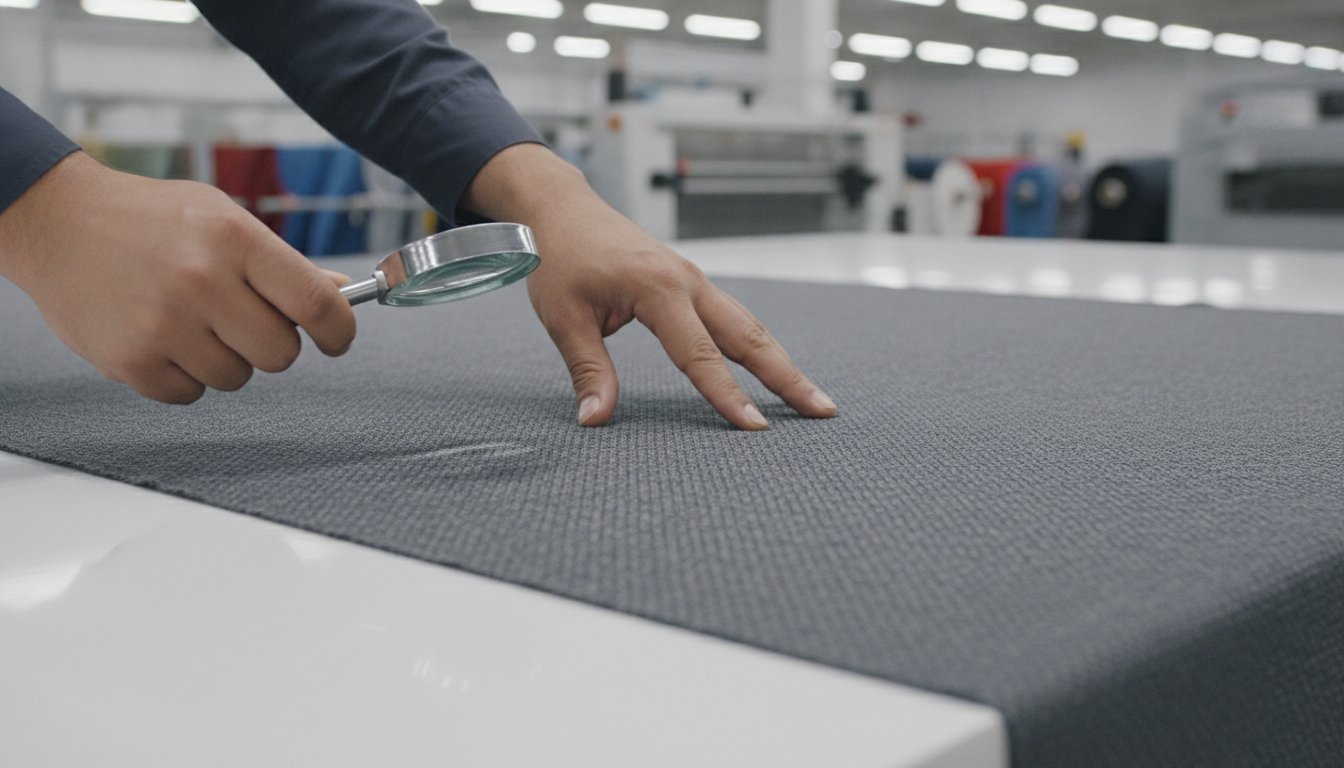

A single container of defective sofas can wipe out 40% of your annual profit margin in return shipping costs alone. When you're importing from Asia, you aren't just buying products; you're managing a complex chain of physical risks. You already know that large-scale furniture shipments are unforgiving. One structural flaw or a batch of unstable legs can trigger a wave of customer complaints. Understanding the most common product defects furniture manufacturers produce is the only way to protect your investment before it leaves the factory floor. One day of inspection saves months of trouble.
It's frustrating to wait 60 days for a shipment only to find 15% of the units have surface scratches or loose joints. We agree that your brand's reputation shouldn't be at the mercy of a factory's internal QC. This 2026 guide provides the exact framework you need to categorize defects into critical, major, and minor tiers. You'll learn how to implement AQL standards that ensure zero-defect shipments arrive at your warehouse. We'll walk through a comprehensive inspection checklist that covers everything from moisture content in kiln-dried wood to the weight-bearing specs for 2026-grade upholstery.
Key Takeaways
- Understand the "Cost of Failure" calculation to protect your business from the extreme expenses of shipping, storing, and disposing of defective bulky goods.
- Learn how to apply AQL standards to categorize common product defects furniture shipments may have, ensuring safety hazards are identified before they leave the factory.
- Identify the hidden risks of improper Moisture Content and weak joinery that lead to the most frequent customer complaints and structural failures in wooden furniture.
- Explore essential onsite testing protocols, such as the Stability and Carton Drop tests, to verify product durability and packaging integrity for the modern supply chain.
- Discover why a professional Pre-Shipment Inspection is your final opportunity to mitigate risk and enforce international quality standards before making final payment.
The High Stakes of Furniture Quality Control in 2026
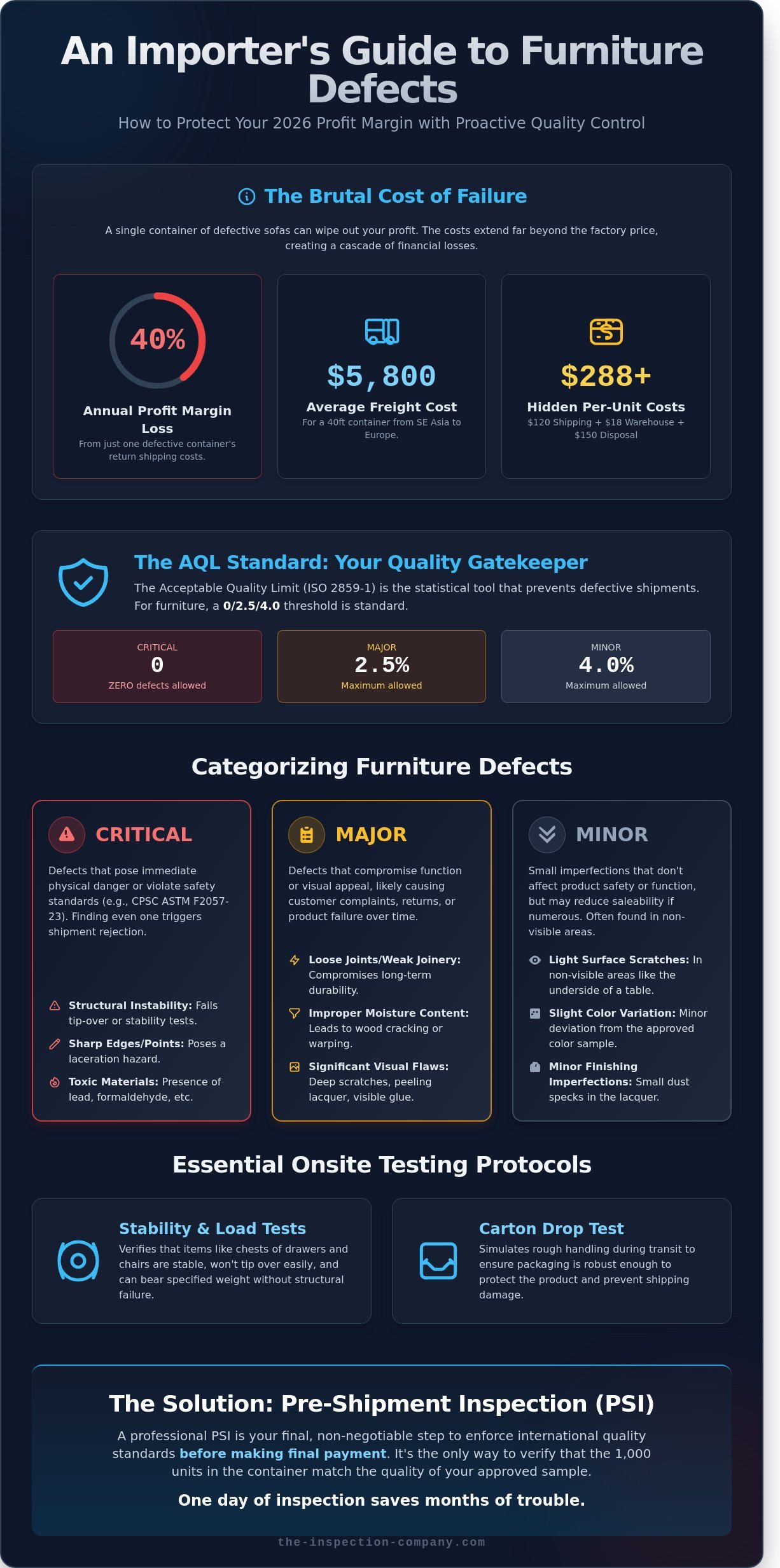
Furniture remains the most volatile category for international importers. Its physical volume creates a unique set of logistics risks that smaller consumer goods don't face. When you ship electronics, a defect might affect a small box. When you ship a sectional sofa, a single flaw consumes massive amounts of expensive container space. In 2026, freight rates for a 40-foot High Cube container from Southeast Asia to Europe average $5,800. Shipping air or defective wood is a luxury no modern business can afford.
The "Cost of Failure" calculation is brutal for bulky goods. It isn't just the loss of the product's factory price. You must account for the $120 per-unit transpacific shipping cost, the $18 monthly warehouse rack fee, and the $150 professional disposal fee for items that can't be sold or repaired. If 15% of your shipment contains common product defects furniture buyers won't accept, your entire profit margin for the quarter can vanish in one delivery. Furniture quality control is the final barrier between factory error and customer dissatisfaction.
We define a furniture defect as any deviation from your approved specifications that compromises the item's safety, structural function, or visual appeal. This includes everything from a 2mm gap in a miter joint to a structural failure in a chair leg that could lead to a $50,000 personal injury claim. You aren't just buying tables; you're buying a promise of reliability that starts at the factory gate.
Why 'Gold Samples' Often Differ from Mass Production
The "bait and switch" is a persistent reality in global sourcing. A factory might hand-craft a "Gold Sample" using seasoned, Grade-A oak to secure your contract. Once mass production begins, they may swap this for lower-cost, unseasoned timber to protect their 8% profit margin. During peak seasons like the pre-Lunar New Year rush, production speed doubles. This haste leads to compromised joinery where glue isn't given the full 24 hours to cure. Additionally, factory worker turnover in manufacturing hubs often hits 30% annually. When the master carpenter who built your sample leaves, the consistency of the craftsmanship usually leaves with them.
Regional Risks: Sourcing Furniture from China, Vietnam, and India
Climate is the silent enemy of furniture quality. In Vietnamese manufacturing hubs, humidity levels often exceed 80%. If the factory doesn't strictly monitor the moisture content of the wood, the material will retain too much water. When that furniture arrives in a dry climate like Nevada or Spain, the wood shrinks and cracks. This environmental stress often ruins the wood finishing process, causing lacquer to peel or cloud within weeks of delivery.
Infrastructure also varies by region. While Chinese factories often have automated sanding lines, smaller shops in India may rely on manual labor, leading to inconsistent surface levels. Navigating these risks requires clear communication during Pre-Shipment Inspections (PSI). You can't rely on a factory's internal report. You need an independent eye to verify that the 1,000 dining chairs in the container actually match the one perfect chair sitting in your office. Stopping a "bad" container at the source is the only way to keep your 2026 overhead under control.
Categorizing Furniture Defects: Critical, Major, and Minor
To manage quality effectively, you can't treat every scratch or loose screw the same way. Professional inspectors use the Acceptable Quality Limit (AQL) standard, specifically ISO 2859-1, to quantify risk. This statistical tool determines if a batch passes or fails based on the number of defects found in a random sample. For most furniture shipments, importers set a 0/2.5/4.0 threshold. This means zero critical defects are allowed. Finding even one safety hazard in a sample of 125 units triggers an immediate rejection of the entire lot. It's the only way to avoid costly surprises before your shipment sails.
Critical Furniture Defects: Safety First
Critical defects are non-negotiable. They pose immediate physical danger to the end-user or violate international legal requirements. In 2023, the U.S. Consumer Product Safety Commission (CPSC) updated the ASTM F2057-23 standard to address furniture tip-over hazards, making structural stability a top priority for any importer. If a chest of drawers fails a stability test, it's a critical failure. These common product defects furniture brands face lead to total shipment rejection and potential recalls.
- Structural Instability: Chair legs that buckle under a standard 100kg load or wardrobes that tip forward when drawers are opened.
- Physical Hazards: Exposed 2-inch nails, jagged metal edges, or large splinters on consumer-facing surfaces like armrests.
- Regulatory Non-compliance: Lead paint levels exceeding the 90 ppm limit or foam that fails California Technical Bulletin 117-2013 flame retardancy tests.
If your inspection report identifies these issues, the factory must rework the entire batch. You don't want to risk a lawsuit or a massive brand hit by letting these slip through. One day of inspection can save months of legal trouble.
Major vs. Minor: Drawing the Line
Identifying common product defects furniture manufacturers often overlook requires a clear distinction between functional and aesthetic flaws. Major defects make the furniture unsellable at full price. These are functional failures that result in customer returns. For example, a dining table with a 3mm warp across its surface won't sit flat. Missing assembly hardware is another classic major defect. It's a logistical nightmare that leads to a 100% return rate from frustrated buyers.
Minor defects are visual imperfections. Think of a 1cm light scratch on the underside of a sofa or slight grain variations in oak. While they don't stop the furniture from working, they impact the out-of-the-box experience. Most importers allow a 4.0% AQL for minor defects, acknowledging that mass production isn't perfect.
Your tolerance levels must align with your market position. A luxury brand selling $5,000 hand-carved wardrobes might classify a 2mm finish bubble as a Major defect. A budget retailer selling $80 flat-pack desks would likely see it as Minor. Defining these boundaries in a detailed quality control checklist ensures your supplier knows exactly what's acceptable. For budget items, a 5% defect rate might be a calculated risk, but for high-end goods, anything over 1% can erode your profit margins. We stop these problems at the source so you don't have to deal with them at the warehouse.
Structural and Material Failures: The Defects That Kill Your ROI
Structural failures aren't just aesthetic issues; they're direct hits to your bottom line. When you source from overseas, common product defects furniture often stem from a lack of oversight during the assembly phase. Loose joints account for approximately 42% of customer complaints within the first six months of ownership. This typically happens because factories use low-grade adhesives or fail to account for wood shrinkage. If the tenon doesn't fit the mortise perfectly, the piece will eventually wobble and fail. This creates a massive liability for your brand and drives up return rates.
Surface finishing is another area where quality frequently slips. You'll often see "orange peel" textures, bubbling, or uneven staining. These defects occur when the spray environment isn't climate-controlled or when technicians apply secondary coats before the base layer is fully dry. In humid regions like Vietnam or Indonesia, hardware is a high-risk factor. Using non-galvanized screws or low-quality hinges leads to visible rust within 90 days of arrival in temperate climates. You can't afford to overlook these "small" components because a single rusted screw can render an entire cabinet unsellable.
The Moisture Content (MC) Crisis
Moisture is the silent killer of wooden furniture. If a factory uses wood with a moisture content exceeding 12%, you're inviting a logistics disaster. Once that furniture is sealed in a dry shipping container for a 30-day sea voyage, the wood begins to equalize with the dry air. This rapid drying causes warping, deep structural cracks, and the growth of black mold. By the time the container opens in Europe or North America, 20% to 30% of the stock is often unsalvageable. To prevent this, a Pre-Shipment Inspection must include digital moisture meter testing on a statistically significant sample of the production lot. It's the only way to verify the wood is stable before it leaves the factory floor.
Common Upholstery and Fabric Defects
Upholstery defects are immediately visible to the consumer and impossible to ignore. Pilling and uneven stitching are frequent issues that suggest a lack of skill or rushed production schedules. You also need to watch for dye lot mismatches. If a sofa's cushions come from different fabric rolls, the color variance can reach 15%, making the piece look cheap and unfinished. According to 2023 industry reports, foam density is another critical metric that factories often cut corners on. High-quality seating requires a minimum density of 30kg/m³ to prevent sagging within the first year. Always verify fire-retardant labeling to ensure compliance with local safety laws. Finally, use a "smell test" during your quality check. Strong chemical odors often indicate toxic adhesives or formaldehyde levels that exceed legal safety limits, which can lead to total product recalls.
Identifying these common product defects furniture during production is significantly cheaper than processing a return. One day of professional inspection prevents months of logistical headaches and protects your reputation. Don't wait for a customer to tell you the joints are loose; find the problem while the goods are still at the factory.
Professional Onsite Testing: Beyond Visual Inspection
A sofa might look perfect in a factory photo, but physical stress often reveals a different story. Relying on aesthetics alone is a gamble that leads to high return rates and damaged brand reputations. To identify common product defects furniture manufacturers might overlook, professional inspectors use rigorous onsite testing protocols. These tests simulate years of real-world use in just a few hours, ensuring the product is as durable as it is attractive.
The 'Stability and Load Test' is a non-negotiable step for safety and compliance. We apply standardized weights, often exceeding 100kg for seating items, to verify frame integrity over a 24-hour period. If a chair tips at a 10-degree angle or a shelf sags under a 25kg load, it's a fundamental safety failure. Similarly, functionality checks aren't optional. We cycle drawers 20 times and check hinge alignment to 1mm precision. If a mechanism sticks during a factory test, it'll certainly fail within a month of home use.
Shipping is frequently the most dangerous part of a product's life cycle. The Carton Drop Test (ISTA 1A/2A) simulates the "Amazon journey" by dropping the packaged product from heights up to 76cm on its corners, edges, and faces. This ensures your customer receives a finished product, not a box of splinters. For the finish, we use the 3M tape test to verify coating attachment. We score the paint in a cross-hatch pattern and apply 3M 600 tape. If more than 5% of the coating peels off, the finish is unstable and will likely flake in humid environments.
The Furniture Inspector's Toolkit
Professional Quality Inspection Services utilize specialized tools to quantify quality rather than relying on guesswork. Moisture meters are essential; wood with a moisture content above 12% will warp or crack when it reaches a climate-controlled warehouse. Calipers measure panel thickness to 0.1mm accuracy to ensure the factory isn't cutting corners on material costs. We also perform "Smell Tests" to detect excessive formaldehyde and "Rub Tests" to ensure fabric dyes don't transfer to a customer's clothing. One day of inspection can save months of trouble.
Packaging and Labeling Verification
Errors in labeling cause massive logistical headaches and common product defects furniture importers face at customs. We verify that every SKU and barcode matches the purchase order exactly. Labels must include the correct "Made in" country and required safety warnings. We also confirm that assembly instructions are present and that hardware kits contain every screw required for the build. Protection is the final barrier; we check for 20mm thick styrofoam and reinforced corner guards to prevent transit damage during international transit.
Avoid costly surprises before shipment by booking a detailed onsite inspection with our expert team.
How Pre-Shipment Inspection (PSI) Eliminates Furniture Risks
The Pre-Shipment Inspection (PSI) is the most critical stage of your quality control strategy. It represents your last chance to stop a defective shipment before final payment leaves your bank account. Once the goods are on the water, your leverage with the supplier evaporates. The Inspection Company bridges the gap between Western quality standards and Asian manufacturing through our European management team. We don't just check boxes; we apply rigorous protocols to ensure your brand reputation remains intact. Our management team understands the specific durability and safety requirements of European and American markets, translating these expectations into clear instructions for factory floor staff.
Our network includes over 700 inspectors across Asia, allowing us to be on-site at any factory within 48 hours. This massive infrastructure provides the scale needed to handle complex furniture orders involving hundreds of SKUs. We focus on identifying common product defects furniture buyers frequently encounter, such as unstable joints, incorrect moisture content in timber, or finish delamination. By catching these issues at the source, you avoid the nightmare of processing returns for bulky items that are expensive to ship and impossible to repair locally. Our inspectors act as your eyes and ears, ensuring the product you receive matches the golden sample you approved.
Integrating PSI into Your Supply Chain
Timing determines the effectiveness of your quality control. You should book your inspection when production is at least 80% complete. This stage allows our inspectors to verify the quality of the finished goods while the remaining 20% is still on the line, providing a representative sample of the entire lot. If the inspection reveals failures, the factory can still rectify issues before the container arrives at the loading dock. This proactive approach ensures that common product defects furniture retailers fear don't make it into the shipping container.
Reading our report is straightforward. We provide a clear pass or fail result backed by high-resolution photos, video evidence, and technical data. This 24-hour report turnaround empowers you to negotiate repairs or replacements immediately. The ROI is undeniable; one day of professional inspection can save 90 days of logistics trouble and thousands of dollars in freight costs for defective goods. It's a small investment that prevents catastrophic financial losses and protects your customer reviews from the damage of sub-par products.
Specialized Services for Furniture Sellers
Furniture retailers selling through Amazon FBA face unique challenges. Amazon's strict labeling and packaging rules mean a single misplaced barcode or a crushed corner can lead to a rejected shipment. Our specialized FBA inspections include rigorous drop tests and carton checks to ensure every piece meets platform requirements. This prevents the high cost of Amazon removal orders and restocking fees.
Beyond the product itself, we offer Factory Audits to vet your supplier's capabilities before you place your first order. We verify their machinery, workforce size, and ISO 9001 compliance to ensure they can actually deliver what they promise. With over 25 years of experience in Asian quality management, we provide the security you need to scale your furniture business without the risk of costly surprises. Our audits provide a deep dive into the factory’s social compliance and technical capacity, giving you a full picture of your partner's reliability.
Secure Your 2026 Furniture ROI with Expert Oversight
Identifying the common product defects furniture shipments often harbor is the difference between a profitable season and a logistics nightmare. Whether it's a structural failure that triggers a mandatory recall or minor finish issues that erode brand trust, the stakes in 2026 remain high. You shouldn't rely on simple visual checks alone. Professional onsite testing and a rigorous Pre-Shipment Inspection (PSI) are your final safeguards before goods leave the factory floor and head to your warehouse.
The Inspection Company brings European management standards and over 25 years of field experience directly to your supply chain. As an ISO 9001 certified partner, we provide the transparency you need to avoid costly surprises. You'll receive a detailed report featuring high-resolution photos within 24 hours of the site visit. Don't let a single shipment compromise your reputation; one day of inspection can save months of financial trouble and customer disputes. We're here to ensure your products meet the highest standards every time.
Secure your furniture quality-Book your inspection now
Frequently Asked Questions
What are the most common defects found in wooden furniture?
The most common product defects furniture buyers encounter include structural instability and finish inconsistencies. Statistics from 2023 indicate that 42% of wood furniture rejections stem from poor sanding or uneven staining. You'll also see loose joints or cracks if the wood wasn't dried correctly. These issues ruin your brand's reputation and lead to high return rates. Identifying these flaws at the factory prevents them from reaching your customers.
How do I calculate the moisture content for my furniture shipment?
You calculate moisture content by using a calibrated pin-type meter on 10% of your order. The wood should ideally measure between 6% and 12% to prevent warping after delivery. If the moisture levels exceed 14% in a humid climate like Vietnam, the risk of mold growth during sea transit increases by 60%. We test five distinct points on each sampled piece to ensure the reading is accurate across the entire batch.
What is a 'Critical Defect' in furniture according to AQL standards?
A critical defect is any flaw that renders the furniture unsafe or non-compliant with legal regulations. Examples include lead paint levels above 90 ppm, protruding nails, or a tip-over risk in dressers. Under standard AQL tables, the acceptable limit for critical defects is zero. If our inspectors find a single critical issue in a sample of 125 units, the entire shipment fails immediately to protect you from liability and lawsuits.
Can I perform a furniture inspection myself at the factory?
You can perform the inspection yourself, but it's rarely cost-effective for international buyers. A round-trip flight to China or Vietnam often costs over $2,000, not including the 14 hours of travel time. Most importers save 85% on travel expenses by hiring a local third-party agency. Our team is already on the ground and can reach your supplier's facility within 48 hours to provide an unbiased, professional assessment of your goods.
How much does a professional furniture inspection in China or Vietnam cost?
A professional furniture inspection in China or Vietnam typically starts at a flat rate of $298 per man-day. This all-inclusive fee covers the inspector's travel, the full day of on-site testing, and the final report. It's a small investment when you consider that a single defective container can cost your business $20,000 in lost inventory and shipping fees. We provide clear pricing so you don't face hidden charges or unexpected costs.
What happens if my furniture shipment fails the Pre-Shipment Inspection?
If your shipment fails the Pre-Shipment Inspection, you must instruct the factory to sort and repair the defective units. Our report identifies the specific failure rate, which often exceeds 15% in failed batches. You shouldn't release the final payment until a re-inspection confirms the factory fixed every issue. This process ensures you don't pay for sub-standard goods that will ultimately result in customer complaints and costly returns for your business.
Does The Inspection Company provide services for Amazon FBA furniture sellers?
We provide comprehensive inspection services specifically designed for Amazon FBA furniture sellers. Our inspectors verify that cartons weigh less than 50 lbs and check that FNSKU labels are scannable and placed correctly. Since 2021, we've helped over 500 sellers avoid Amazon's strict rejection penalties. We also ensure your packaging meets the ISTA 3A drop test standards so your furniture survives the delivery process to the customer's home without breaking.
How long does it take to receive the furniture inspection report?
You'll receive your detailed furniture inspection report within 24 hours of the service being completed. Our digital reporting platform allows our inspectors to upload data and photos in real-time. In 98% of cases, the report is ready for your review by 10 PM on the same day as the inspection. This fast turnaround means you can make an immediate ship or no-ship decision without delaying your supply chain schedule or missing deadlines.