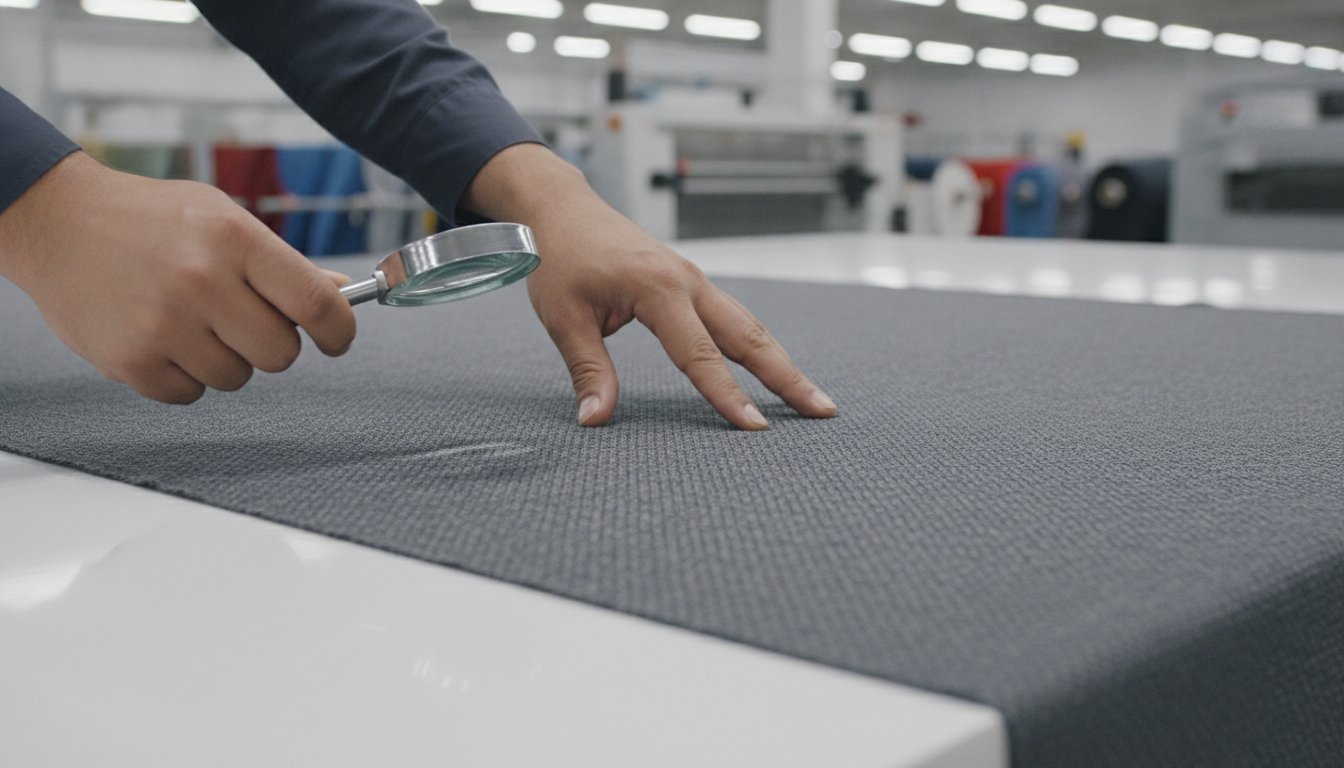

Last quarter, a mid-sized electronics importer lost $92,500 in landed costs because their factory substituted a lower-grade internal component without notice. You likely already understand that international trade is a high-stakes environment where a single oversight leads to brand damage or total capital loss. It's a common anxiety for business owners; paying that final invoice only to receive a container full of defects or facing unexpected customs fines can erase your margins instantly. Mastering the process of avoiding costly mistakes when importing isn't just about luck; it's about implementing rigorous, fact-based oversight before your goods leave the supplier's warehouse.
We've compiled the ultimate 2026 Quality & Compliance Checklist to help you secure zero-defect shipments and maintain a predictable supply chain. You'll discover how to identify hidden production errors and ensure every product meets the latest regulatory standards. We'll walk you through the essential pre-shipment inspection steps and documentation audits that turn high-risk procurement into a smooth, reliable operation. One day of professional inspection can save you months of financial trouble and protect your reputation in a competitive market.
Key Takeaways
- Learn why the legal burden of compliance falls solely on the importer and how to spot documentation errors before they lead to expensive customs delays.
- Master the essential strategies for avoiding costly mistakes when importing by recognizing the "Golden Sample" trap and preventing material quality fade.
- Discover the hidden costs of international trade and why 2026 supply chains require heightened vigilance due to evolving global regulations.
- Implement a 5-point Pre-Shipment Inspection (PSI) checklist to verify order quantities and aesthetic standards while goods are still at the factory.
- Find out how independent, European-managed inspections across Asia can protect your reputation and ensure every shipment meets Western standards.
The High Price of 'Cheap' Imports: Why Mistakes Happen
Importing goods in 2026 isn't the same game it was five years ago. Many importers look only at the unit price and freight costs, but this surface-level math leads to disaster. True profitability depends on avoiding costly mistakes when importing, such as failing to account for shifting environmental regulations or unexpected tax liabilities. For instance, understanding customs valuation is essential to ensure you aren't hit with back-dated duties that can wipe out your 20% margin instantly. If you get your valuation wrong, customs authorities in 2026 are increasingly likely to impose fines that can reach 300% of the original goods' value.
The "honeymoon phase" with a new supplier often blinds buyers to red flags. During the first two orders, a factory might produce perfect samples to secure your trust. Once that trust is established, "quality fade" begins. This is where materials are subtly swapped for cheaper alternatives to increase the factory's profit. Without independent oversight, you won't notice until the 40ft container arrives at your warehouse. We stop problems before your shipment sails because catching a defect at the port is already too late.
Financial Impact vs. Reputational Damage
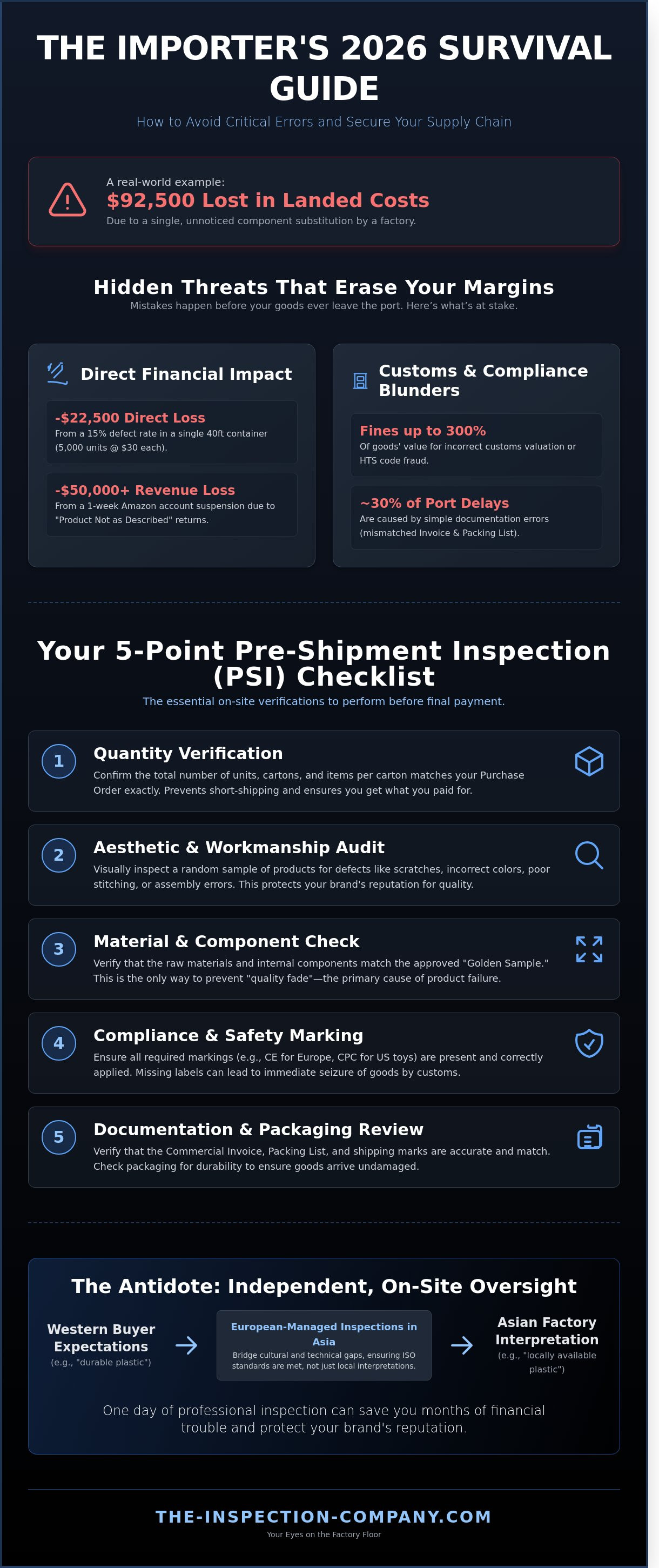
A 15% defect rate in a 40ft container holding 5,000 units of a $30 product results in a direct $22,500 loss. That's just the start. You'll also pay for the disposal of unsellable stock and the shipping costs for air-freighted replacements. The "Amazon Effect" makes this even more dangerous. A sudden spike in "Product Not as Described" returns can trigger an automatic account suspension within 48 hours. Losing the Buy Box for just one week can cost a high-volume seller upwards of $50,000 in lost revenue. We believe one day of inspection can save months of trouble. It's the only way to maintain control and avoid costly surprises before shipment.
The Complexity of Modern Sourcing in Asia
Cultural and language barriers remain the primary cause of production errors. When a Western buyer specifies "durable plastic," a factory in Ningbo might interpret that based on local availability rather than international ISO standards. These small misunderstandings snowball into catastrophic financial losses by the time goods reach the port. This is why European management on the ground in Asia is vital. It bridges the gap between Western expectations and Asian manufacturing realities. Avoiding costly mistakes when importing requires an independent pair of eyes that understands both worlds and can identify risks that a factory salesperson will never disclose.
Administrative Red Flags: Avoiding Customs and Compliance Blunders
Many importers mistakenly believe their supplier holds the liability for paperwork errors. Under international trade law, the burden of "reasonable care" rests solely on the importer of record. If your Commercial Invoice or Bill of Lading contains inaccuracies, customs authorities won't penalize the factory in Shenzhen; they'll penalize you. Mastering these administrative details is a core part of avoiding costly mistakes when importing in 2026.
Documentation errors are the leading cause of port delays. Data from 2024 indicates that roughly 30% of shipment hold-ups resulted from missing or mismatched information between the Packing List and the Commercial Invoice. Beyond simple clerical errors, you must ensure your products meet regional safety standards. Missing a CE mark for Europe or a Children’s Product Certificate (CPC) for US toy imports can lead to immediate seizure of goods. For a foundational understanding of these shared responsibilities, consult CBP's Basic Importing and Exporting guide to ensure your business remains compliant with federal law.
Tariff Classification and HTS Codes
A single digit error in your Harmonized Tariff Schedule (HTS) code can be the difference between a 0% duty rate and a 25% "Section 301" tariff. Misclassifying goods to save money is considered fraud, not a mistake. If your product is innovative or complex, apply for a binding ruling from customs before shipping. This provides legal certainty that protects your margins. Also, remember that you must maintain all import records for five years. Failure to produce these files during a spot audit can result in fines exceeding the value of the original shipment. Utilizing a professional audit service helps verify that your supplier's documentation matches the physical cargo before it leaves the dock.
Country of Origin and Marking Requirements
Incorrect "Made in" labeling is a fast track to financial loss. Under 19 U.S. Code § 1304, every article of foreign origin must be marked in a conspicuous place. If your goods arrive without proper marking, you'll face "re-work" costs at the port. In late 2024, some US ports charged upwards of $5 per unit for manual re-labeling. EU markets have similarly strict requirements regarding the country of origin and importer details. Avoiding costly mistakes when importing requires verifying these markings during the pre-shipment phase. Fixing them once they reach Los Angeles or Rotterdam is ten times more expensive than fixing them at the factory floor.
The Quality Gap: Why 'Good Samples' Don't Guarantee Success
One of the most frequent traps in international trade is the "Golden Sample." This is a hand-crafted prototype built by a factory's senior engineers to secure your initial deposit. It rarely represents the reality of a 10,000-unit production run where speed often trumps precision. Relying on this single perfect item to predict the quality of a full container is a primary reason why many businesses fail. Avoiding costly mistakes when importing requires moving past the sample phase and implementing rigorous controls on the actual production line.
Quality Fade is a silent profit killer. Data from 2024 supply chain audits shows that material quality often drops by 12% to 18% between the first and fourth orders. Suppliers may subtly swap components for cheaper alternatives to reclaim their margins as raw material costs rise. If you aren't testing every batch, you won't notice the decline until your customers start returning products. Relying on factory-provided photos to verify quality is equally dangerous. These images are often staged under professional lighting or, in 22% of documented cases, show products from an entirely different production line. You need independent, third-party verification on the ground before you release the final 70% payment.
While following SBA guidance on import/export laws helps you manage the legal framework of your business, it won't protect you from receiving a shipment of defective goods. Professional inspection is an investment that prevents the much larger financial loss of a total inventory write-off.
The Limitation of Factory Self-Inspection
A factory's internal QC team reports to the production manager, not to you. This creates an inherent conflict of interest. They'll often overlook "minor" defects like slight color deviations or 2mm stitching variances that actually violate your brand standards. Our internal metrics indicate that 85% of factory self-inspections fail to flag major structural defects that an independent auditor would catch. You need an unbiased report with a 24-hour turnaround to make an informed "ship or no-ship" decision. One day of inspection can save months of trouble.
Supplier Vetting and Factory Audits
It's a common error to assume your contact is the manufacturer. Approximately 30% of "factories" on major B2B platforms are actually middleman trading companies. They have zero control over the production floor. An on-site audit is the only way to verify a supplier's Quality Management System (QMS) against ISO 9001 standards. Beyond technical capability, you must monitor social compliance. With the 2022 implementation of the Uyghur Forced Labor Prevention Act (UFLPA), failing to identify forced labor red flags can lead to your entire shipment being seized by customs. This is a critical step in avoiding costly mistakes when importing in the current regulatory environment.
Your 5-Point Pre-Shipment Inspection (PSI) Checklist
The Pre-Shipment Inspection (PSI) is your final line of defense. It's the most effective tool for avoiding costly mistakes when importing from overseas suppliers. By the time goods reach your warehouse, it's too late to fix manufacturing errors. You need a boots-on-the-ground approach before the balance payment is released. This process ensures that what you paid for is exactly what's being loaded onto the vessel.
- Verify Quantity: We ensure the factory didn't short-ship your order. A 3% discrepancy might seem small, but on a 20,000-unit order, that's 600 lost sales and a significant hit to your margins.
- Visual Inspection: Our inspectors check for aesthetic defects, color mismatches, and finishing issues. We use Pantone matching and Delta E tolerances to ensure brand consistency across every batch.
- Functional Testing: Does the product actually work? We perform stress tests and cycle testing to simulate real-world use. If a electronic component fails after 2 hours of continuous operation, it's a systemic risk.
- Packaging & Labeling: We verify FBA barcodes and legal compliance markings like CE or FCC. We also conduct ISTA 1A drop tests from a height of 30 inches to ensure your packaging survives the rough handling of international logistics.
- AQL Sampling: We use the ISO 2859-1 standard to pull a statistically significant sample. This data tells us whether to accept or reject the entire lot based on your specific risk tolerance.
The Critical Role of Container Loading Supervision
The risk doesn't end when the inspection report is signed. Container Loading Supervision prevents the "bait and switch" where a factory replaces inspected goods with inferior stock at the last minute. We verify the weight distribution to prevent damage during sea transit and check for moisture levels above 15% to avoid mold growth. Finally, we witness the fixing of the heavy-duty bolt seal to prevent theft, which remains a threat in 12% of global shipping routes.
Defining Your Quality Standard (AQL)
Acceptable Quality Limit (AQL) is the industry standard for determining if a batch is 'market-ready'. You must categorize defects into critical (0%), major (2.5%), and minor (4.0%) categories to provide clear boundaries. Avoiding costly mistakes when importing requires communicating these standards to the factory at least 30 days before production starts. Without these benchmarks, you have no leverage to demand a rework if the quality dips below your expectations.
Protect your brand reputation and your bottom line. Schedule your Pre-Shipment Inspection now to ensure your next shipment is defect-free.
Securing Your Supply Chain with The Inspection Company
Buying from Asia involves inherent risks that can't be ignored. The Inspection Company eliminates these variables through a European management structure that enforces Western quality standards directly in Asian manufacturing hubs. Our team of 700+ full-time inspectors provides boots-on-the-ground coverage across China, Vietnam, and India. This scale ensures we can reach your supplier's factory in as little as 24 to 48 hours, providing a level of responsiveness that smaller agencies can't match.
Moving away from hope-based importing is essential for long-term growth. When you rely on factory-provided photos, you're only seeing what the supplier wants you to see. Our data-driven procurement model gives you the full, objective picture. If an inspection reveals a 4.2% failure rate in a 5,000-unit electronics order, you have the documented proof required to halt the shipment. Using these detailed reports is the most effective strategy for avoiding costly mistakes when importing and holding suppliers accountable for their output. It transforms a difficult conversation into a professional, evidence-based negotiation.
Tailored Solutions for Amazon FBA Sellers
Amazon FBA sellers face unique pressures. A minor defect rate might be acceptable in some retail environments, but on Amazon, it leads to negative reviews and account suspensions. Our Amazon FBA Service includes rigorous checks for FNSKU labels, carton markings, and pallet requirements. This is a critical step in avoiding costly mistakes when importing because it protects your seller rating and prevents shipment rejections. We've seen sellers lose $20,000 in shipping fees alone because of rejected inventory. We stop those problems before the goods ever reach the port.
Getting Started: One Day of Inspection
Our process is built for speed and efficiency. It starts with a simple Request where you provide your product specifications. We then move to Booking and coordination, where we contact your supplier directly to schedule the visit. Within 24 hours of the site visit, you receive a comprehensive digital Report. This rapid turnaround ensures your supply chain keeps moving without unnecessary delays.
- Request: Submit your order details and specific requirements.
- Booking: We coordinate the logistics with your factory in China, Vietnam, or India.
- Report: You receive a detailed pass/fail report within one business day.
One day of inspection can save months of trouble. It's not an overhead cost; it's a strategic investment in your profit margin. A single failed shipment often costs 10 times more than a professional inspection. Avoid costly surprises, book your professional inspection today.
Secure Your Shipments and Scale Your Business
International trade in 2026 demands more than just finding a supplier; it requires a bulletproof strategy for quality control. Relying on initial samples is a gamble. It rarely pays off once mass production begins. By implementing a rigorous 5-point Pre-Shipment Inspection (PSI) and addressing administrative compliance before goods leave the factory, you protect your bottom line from unexpected customs delays and defective inventory. You've worked hard to build your brand, and a single shipment of sub-standard goods can erase years of progress.
Success in global sourcing depends on avoiding costly mistakes when importing by partnering with experts who understand the ground reality. The Inspection Company brings over 25 years of quality control experience to your supply chain. With European management and a network of 700+ on-the-ground inspectors, we provide the transparency you need. Our ISO 9001 certification and Sedex membership ensure every audit meets strict international standards. Don't leave your reputation to chance. One day of inspection can save months of financial trouble.
Stop problems before your shipment sails; Get an Instant Quote
Frequently Asked Questions
What are the most common mistakes when importing from China?
The most common mistakes include vague product specifications and failing to conduct independent quality checks on-site. Data shows that 35% of importers experience financial loss because they didn't define "acceptable quality" in their contracts. Avoiding costly mistakes when importing starts with a detailed technical sheet. This document ensures the factory understands your requirements before they start the machines; it's your first line of defense.
Is a pre-shipment inspection really necessary if I trust my supplier?
Trust isn't a substitute for quality control because even gold-rated suppliers can have a 4% defect rate due to staff turnover. A Pre-Shipment Inspection (PSI) acts as your final safety net. It's the only way to confirm your order is correct before you pay the final balance. One day of inspection saves months of legal trouble and lost sales. Don't risk your reputation on a handshake.
How much does a professional product inspection service cost?
A professional on-site inspection typically costs $250 to $350 per man-day in major Asian manufacturing hubs. This transparent fee covers a full day of testing, measuring, and reporting by a certified engineer. When compared to a $50,000 shipment, this 0.5% investment is the most cost-effective way to manage risk. You receive a comprehensive PDF report with high-resolution photos and video evidence within one business day.
What happens if the inspection report shows major defects?
If a report shows "Fail" results, you must halt the shipment and instruct the factory to perform a 100% sorting or rework. You shouldn't accept goods that exceed your pre-defined AQL limits, such as a 1.5% limit for major defects. Once the factory claims the issues are fixed, schedule a re-inspection at their expense. This process ensures you only pay for products that meet your brand standards.
Can an inspection company help with Amazon FBA labeling requirements?
Inspection companies provide specific FBA checklists to ensure your goods comply with Amazon's strict 2026 packaging standards. Inspectors verify that every FNSKU barcode is scannable and that "Made in China" labels are visible on every unit. They also check carton weight and dimensions to avoid $500 penalties per pallet. This service is essential for avoiding costly mistakes when importing for e-commerce brands.
How do I verify if a supplier on Alibaba is a real manufacturer?
You verify a supplier's status by reviewing their business license and conducting a physical Factory Audit. 42% of entities on B2B platforms are intermediaries rather than direct manufacturers. An auditor checks the factory's production lines, employee headcount, and machinery ownership. This verification stops you from paying middleman markups. It gives you direct control over the production process and ensures you're dealing with the source.
What is the difference between a factory audit and a product inspection?
A factory audit assesses the facility's long-term reliability, while a product inspection focuses on a specific batch of goods. Think of an audit as a background check on the company's ISO 9001 compliance and 50-point safety standards. An inspection is a physical exam of your items against your approved sample. You need both to ensure your supply chain remains stable and your products stay defect-free.
How long does it take to get an inspection report?
We deliver your comprehensive inspection report within 24 hours of the inspector leaving the factory. Our digital platform allows for same-day data syncing so you don't lose precious transit time. This 1-day turnaround gives you the speed needed to approve shipments or demand immediate corrections. Efficient reporting keeps your supply chain moving while maintaining the strict European quality standards your customers expect.