

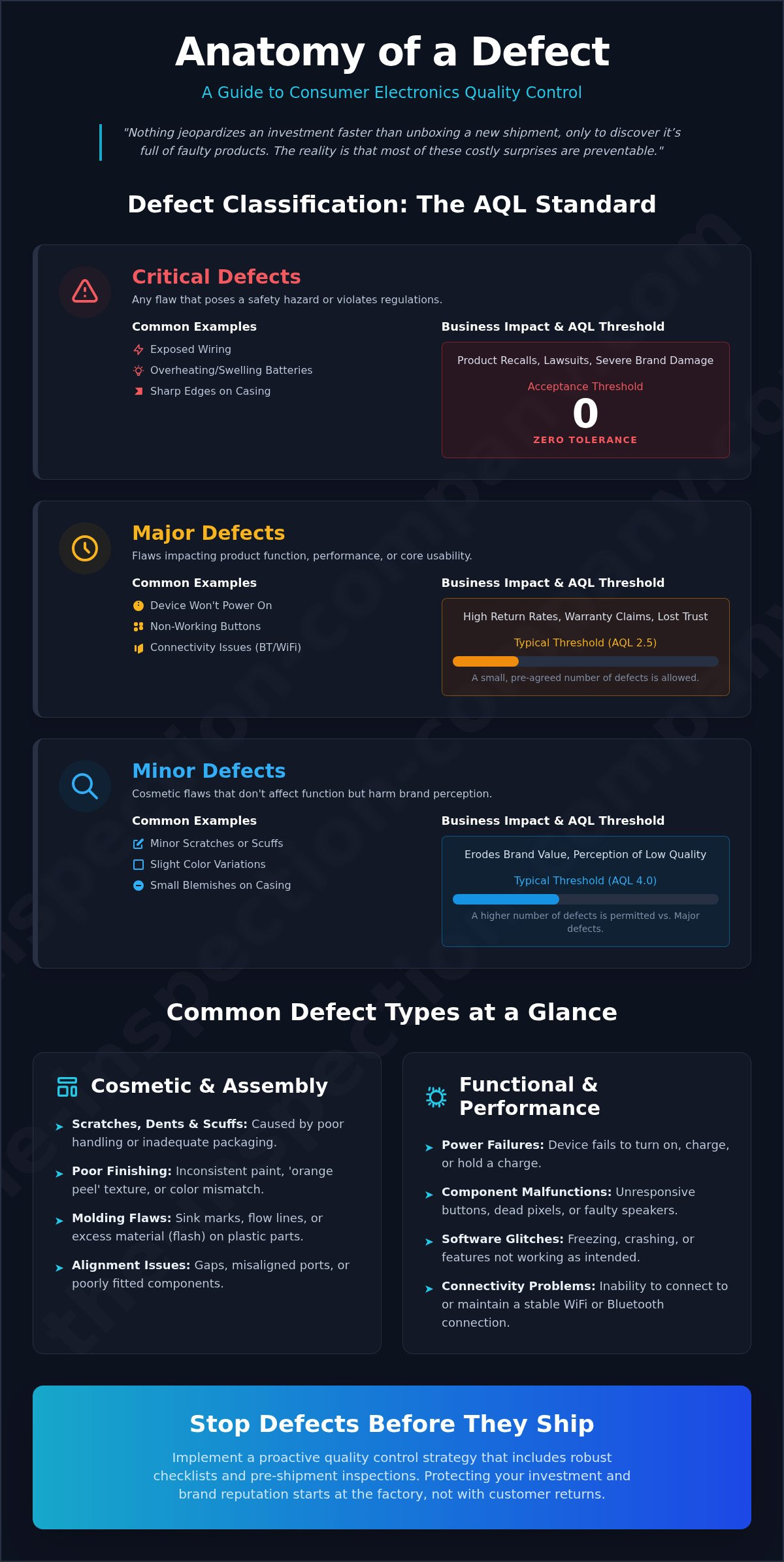
Nothing jeopardizes an investment faster than unboxing a new shipment, only to discover it’s full of faulty products. Each malfunctioning unit represents more than just a return; it's a direct hit to your bottom line and a crack in your brand's reputation. The reality is that most of these costly surprises are preventable. The key is to proactively identify and manage common consumer electronics defects before they ever leave the factory.
This guide provides the critical knowledge you need to protect your business. We will break down the most prevalent and costly defects-from cosmetic flaws to critical functional failures. You will learn how to classify these issues, what to include in a robust quality control checklist, and how to implement a system that stops problems before your shipment sails. Read on to gain the confidence you need to source from Asia, protect your investment, and ensure every product that carries your name meets the standard your customers expect.
Key Takeaways
- Learn to classify product flaws as Critical, Major, or Minor using the AQL standard to make objective decisions about shipment quality.
- Understand how different types of consumer electronics defects, from cosmetic blemishes to functional failures, directly impact your brand reputation and profitability.
- Identify the non-negotiable safety defects that can lead to product recalls, user harm, and significant legal liability for your business.
- Discover how to implement a proactive quality control strategy that prevents defects before your products ever leave the factory.
Defect Classification: Understanding Critical, Major, and Minor Flaws
Not all product flaws are created equal. In professional quality control, identifying defects is only the first step; the critical next step is classifying their severity. The industry-standard framework for this is the Acceptable Quality Limit (AQL), a statistical method that defines the maximum number of defective units tolerable in a production batch. This systematic approach removes subjectivity from the inspection of consumer electronics defects, allowing importers to make clear, data-driven decisions to either accept or reject a shipment and stop major problems before they leave the factory.
Critical Defects: The Absolute Deal-Breakers
A critical defect is any flaw that poses a potential safety hazard to the user or violates mandatory regulations. These are non-negotiable failures that can lead to catastrophic business consequences.
- Definition: A defect that can cause harm, injury, or unsafe conditions.
- Common Examples: Exposed wiring, batteries that overheat or swell, and sharp edges on a product's casing.
- Business Impact: Immediate product recalls, potential lawsuits, severe brand damage, and the complete rejection of an entire production run.
- Acceptance Threshold: Zero tolerance. A single critical defect found during an AQL inspection results in an automatic failure of the entire batch.
Major Defects: Functionality Failures and Customer Dissatisfaction
Major defects are flaws that will likely cause the product to fail, reduce its usability, or result in a customer return. These types of consumer electronics defects often stem from failures in core components and are a primary cause of the common failure modes in electronics that drive negative reviews.
- Definition: A defect impacting the product's function, performance, or key aesthetic features.
- Common Examples: A device that won't turn on, non-working buttons, dead pixels on a display, or Bluetooth connectivity issues.
- Business Impact: High product return rates, costly warranty claims, and a rapid decline in customer trust.
- Acceptance Threshold: A small, pre-agreed number of defects is allowed based on the AQL standard (e.g., AQL 2.5).
Minor Defects: Small Imperfections That Tarnish Your Brand
While not affecting the product's core function, minor defects are cosmetic imperfections that detract from its overall quality and finish. An accumulation of these small flaws can make a premium product feel cheap.
- Definition: A small cosmetic flaw unlikely to affect function or cause a customer to return the product.
- Common Examples: Minor scratches or scuffs, slight color variations between units, or small blemishes on the casing.
- Business Impact: Erodes long-term brand value and perception of quality.
- Acceptance Threshold: A higher number of defects is permitted compared to major defects (e.g., AQL 4.0).
Common Cosmetic & Assembly Defects in Electronics
Before a customer ever powers on a device, they judge it by its appearance and feel. Cosmetic and assembly flaws are the first thing a user sees, and they directly impact the perceived quality and value of your product. Even if the internal components are perfect, a shoddy exterior suggests a lack of attention to detail and can lead to customer returns and damage to your brand's reputation. These types of consumer electronics defects almost always stem from poor handling, uncontrolled molding processes, or a lack of precision on the assembly line.
Identifying these issues during a pre-shipment inspection is critical to avoid costly rejections and protect your investment. One day of inspection can save you from a shipment of visually flawed products.
Surface and Casing Imperfections
The main body or casing of an electronic device is its most visible feature. Flaws here are immediately obvious and unacceptable to most consumers. Our inspectors are trained to meticulously check for:
- Scratches, Dents, and Scuffs: Often caused by improper handling during assembly or inadequate protective packaging for shipment.
- Poor Finishing: This includes inconsistent paint application, visible brush strokes, "orange peel" texture, or a clear color mismatch between different plastic or metal parts.
- Molding Flaws: Low-quality plastic injection molding can leave behind sink marks (depressions), flow lines (streaks), or flash (excess material on the edges of a part).
Assembly and Alignment Issues
How a product is put together speaks volumes about its manufacturing quality. Poor assembly not only looks unprofessional but can also hint at more serious internal structural problems. Key indicators include:
- Gaps and Misalignment: Noticeable or uneven gaps between seams where different parts of the casing should meet flush.
- Incorrectly Installed Components: Logos, brand labels, or functional buttons that are crooked, poorly adhered, or not centered correctly.
- Loose or Rattling Parts: A clear sign of poor internal assembly where screws, brackets, or other components have not been properly secured.
Printing and Labeling Errors
Printing and labeling errors go beyond aesthetics; they can represent a significant compliance risk. Illegible or incorrect information can lead to product recalls or customs rejection. These defects include blurry regulatory symbols (like CE or FCC), which can imply a failure to meet mandatory standards such as the CPSC safety regulations, creating a serious liability for importers. Watch for:
- Poor Print Quality: Smeared, blurry, or faded text, logos, and symbols on the device or its rating label.
- Label Adhesion and Placement: Labels that are peeling at the corners, applied crookedly, or can be easily removed.
- Incorrect Information: The wrong model number, voltage/power rating, or country of origin printed on a rating label.
Functional & Performance Defects That Lead to Returns
Unlike cosmetic flaws, functional and performance defects are invisible to a superficial check. These issues prevent a product from working as intended and are the primary driver of customer complaints, negative reviews, and costly warranty claims. Identifying these hidden consumer electronics defects requires more than a visual scan; it demands a systematic and rigorous functional testing protocol during a pre-shipment inspection.
A detailed inspection checklist is essential to verify every feature and function. This process should be built on established best practices, referencing benchmarks like the IEEE quality control standards to ensure comprehensive coverage. Without this level of scrutiny, you risk shipping products that are fundamentally broken, leading to significant financial loss and damage to your brand's reputation.
Power, Battery, and Charging Failures
The most basic expectation for any electronic device is that it turns on and stays on. Failures in this category are critical and immediately render a product useless. An inspector must verify power-related functions, checking for common points of failure such as:
- The device failing to power on or shutting down randomly during operation.
- The battery not holding a charge, draining excessively fast, or overheating.
- A loose or damaged charging port that prevents a secure connection.
- Incorrect or low-quality power adapters and cables that fail under stress testing.
Display and Audio/Visual Problems
For modern electronics, the user interface is everything. Defects in displays and audio components severely degrade the customer experience. Thorough testing must identify issues that may not be obvious at first glance, including dead pixels, screen burn-in, or inconsistent backlighting. Other common problems include unresponsive touch screens, distorted audio from speakers, or non-working microphones-flaws that guarantee a customer return.
Connectivity and Software Glitches
In today's connected world, software and connectivity are as important as hardware. These complex systems are a frequent source of frustrating consumer electronics defects. An inspection must test a device’s ability to reliably connect to Wi-Fi, Bluetooth, and cellular networks. Inspectors should also run the device through its key functions to detect software that freezes, crashes, or has features that do not work as described in the user manual. A single software bug can make an otherwise perfect product unusable.
One day of inspection can save you from months of trouble and protect your bottom line. Ensure your product works perfectly before it ships. Get a quote.
Critical Safety Defects: Protecting Users and Your Business
While functional and cosmetic issues impact your bottom line, safety defects can destroy it. When it comes to consumer electronics defects, those that compromise user safety are in a class of their own. These issues are non-negotiable, as they can lead to severe injury, property damage, brand-destroying recalls, and significant legal action. For importers, ensuring product safety isn't just good practice-it's a legal requirement for market access in regions like the EU (CE) and the US (UL/FCC).
A comprehensive Pre-Shipment Inspection (PSI) is your final and most crucial opportunity to verify that these safety standards have been met. An inspector's checklist includes rigorous tests designed to catch these high-risk faults before your shipment sails.
Electrical Safety Hazards
The most immediate dangers in electronics stem from electrical failures. These defects often result from cost-cutting on components or poor assembly, creating unacceptable risks for the end-user. Key checks include:
- Overheating: Verifying the unit does not exceed safe temperatures during normal operation to prevent fire hazards.
- Insulation and Wiring: Checking for poor insulation or exposed wires that could cause a life-threatening electric shock.
- Plugs and Cords: Ensuring power cords and plugs meet strict regional standards and are free from damage.
- Circuit Protection: Confirming the presence of proper grounding and short-circuit protection mechanisms.
Battery Safety Risks
With the prevalence of lithium-ion batteries, battery safety has become a paramount concern. A faulty battery can lead to catastrophic failure, including fires and explosions. Inspections focus on identifying:
- Uncertified Batteries: Use of low-quality or uncertified cells that are prone to failure.
- Physical Defects: Signs of swelling, leaking, or overheating during charge and discharge tests.
- Missing Safety Circuits: Lack of essential overcharge or over-discharge protection that prevents thermal runaway.
Mechanical and Material Hazards
Not all critical consumer electronics defects are electrical. The physical construction and materials used in a product can also pose significant risks. This is especially true for products intended for children.
- Physical Injury Risks: Identifying sharp edges, pinch points, or unstable designs that could cause cuts or other injuries.
- Hazardous Materials: Verifying compliance with regulations like RoHS, which restrict the use of lead, mercury, and other toxic substances.
- Choking Hazards: For children's electronics, ensuring small parts cannot easily detach and become a choking risk.
Identifying these safety defects requires expert oversight. One day of professional inspection can prevent a catastrophe and save your business from devastating consequences. Ensure your products are safe, compliant, and ready for market before they leave the factory.
How to Prevent Defects: A Proactive Quality Control Strategy
Identifying defects after production is a reactive, costly process. The most effective strategy is to prevent them from occurring in the first place. A proactive quality control (QC) plan is not an expense; it is an investment that safeguards your brand, saves money, and avoids significant production delays. While quality is a shared responsibility between you and your supplier, you cannot afford to rely on their internal reports alone. Independent verification is essential to ensure your standards are met.
Implementing a robust QC framework is the key to minimizing the risk of consumer electronics defects. Follow these essential steps to protect your investment.
Step 1: Create a 'Golden Sample' and Detailed Spec Sheet
Your 'golden sample' is the physical, approved version of your product that serves as the ultimate benchmark for mass production. Every unit coming off the line must match it. This sample should be supported by a comprehensive specification sheet that leaves no room for interpretation. It must explicitly detail:
- All approved materials, finishes, and Pantone colors.
- Key components, including chipsets, batteries, and connectors.
- Requirements for packaging, labeling, barcodes, and user manuals.
Step 2: Vet Your Supplier with a Factory Audit
Before placing a significant order, you must verify your supplier’s capabilities. A factory audit is a professional assessment of a manufacturer's quality management systems, production capacity, and social compliance. It confirms whether they have the processes in place to consistently produce your product to the required standard. This crucial step mitigates your risk and builds a foundation for a reliable partnership.
Step 3: Implement Pre-Shipment Inspections (PSI)
A Pre-Shipment Inspection is your final opportunity to identify and address quality issues before the products leave the factory and you make your final payment. An independent inspector visits the factory and checks a statistically significant random sample of your finished goods against your approved sample and spec sheet. This process is critical for catching cosmetic, functional, and safety-related consumer electronics defects before they become your problem. One day of inspection can save you from a disastrous shipment. Book yours today.
Safeguard Your Investment and Reputation
Understanding the distinction between critical, major, and minor flaws is the first step toward protecting your business. However, knowledge alone is not enough. A proactive quality control strategy is the only reliable way to prevent costly consumer electronics defects from eroding your profits and damaging your brand's reputation before they ever leave the factory.
You do not have to navigate this complex process alone. With a network of over 700 inspectors across Asia and European management ensuring international standards, we act as your eyes and ears on the ground. We stop problems before they ship, delivering detailed inspection reports with photos and data within 24 hours. This gives you the power to make critical, data-driven decisions with confidence.
Don't risk your investment. Get a free, instant quote for your product inspection.
Take decisive action today to secure your supply chain and build a brand that customers trust for its unwavering quality.
Frequently Asked Questions
What is a normal defect rate for consumer electronics?
There is no single "normal" rate; it is defined by the Acceptable Quality Limit (AQL) you agree upon with your supplier. For consumer electronics, a common AQL standard is 2.5% for major defects and 4.0% for minor defects. This means that if the percentage of units with major consumer electronics defects exceeds 2.5% in the sampled batch, the inspection fails. Setting a clear AQL is a critical step in managing your product quality and supplier expectations.
Can I perform a product inspection myself instead of hiring a company?
While possible, performing an inspection yourself often involves significant travel costs, time away from your business, and potential language barriers. A professional third-party inspection company provides a cost-effective alternative with local, trained experts who use specialized equipment. This ensures an unbiased and thorough assessment based on established industry standards, removing guesswork and saving you valuable resources. One day of professional inspection can save you months of trouble.
What happens if an inspection fails? Do I have to reject the whole order?
A failed inspection does not automatically require rejecting the entire shipment. It provides you with the leverage and detailed data needed to make an informed decision. You can use the inspection report to negotiate with your supplier for specific corrective actions, such as reworking the defective items, replacing the failed units, or securing a discount on the order. This empowers you to resolve quality issues before the goods ever leave the factory.
How do I create a good quality inspection checklist for my electronic product?
A robust checklist should be highly specific and cover all critical aspects of your product. Key sections to include are packaging and labeling requirements, visual and workmanship checks (for scratches, assembly errors), and functional testing (power on/off, button responsiveness, connectivity). Also, include safety verification like hi-pot tests and checks for required certification marks (e.g., CE, FCC, UL). The more detailed your checklist, the lower the risk of misinterpretation by the factory or inspector.
Are inspections only for large companies, or can small businesses use them?
Quality control inspections are essential for businesses of all sizes. For a small or medium-sized business, the financial impact of a shipment of defective products can be devastating, leading to lost capital and reputational damage. Using a third-party inspection service is a scalable and affordable way for smaller importers to access the same level of quality assurance as large corporations, protecting their investment and ensuring customer satisfaction without high overhead costs.
How much does a pre-shipment inspection for electronics typically cost?
The cost for a professional pre-shipment inspection is surprisingly affordable and is usually a flat, all-inclusive fee. Typically, you can expect to pay between $300 and $500 per inspector-day. This fee covers one inspector's full day of work, including their travel and the generation of a detailed report. When weighed against the potential cost of receiving an entire shipment of faulty goods, a pre-shipment inspection provides an exceptional return on investment.