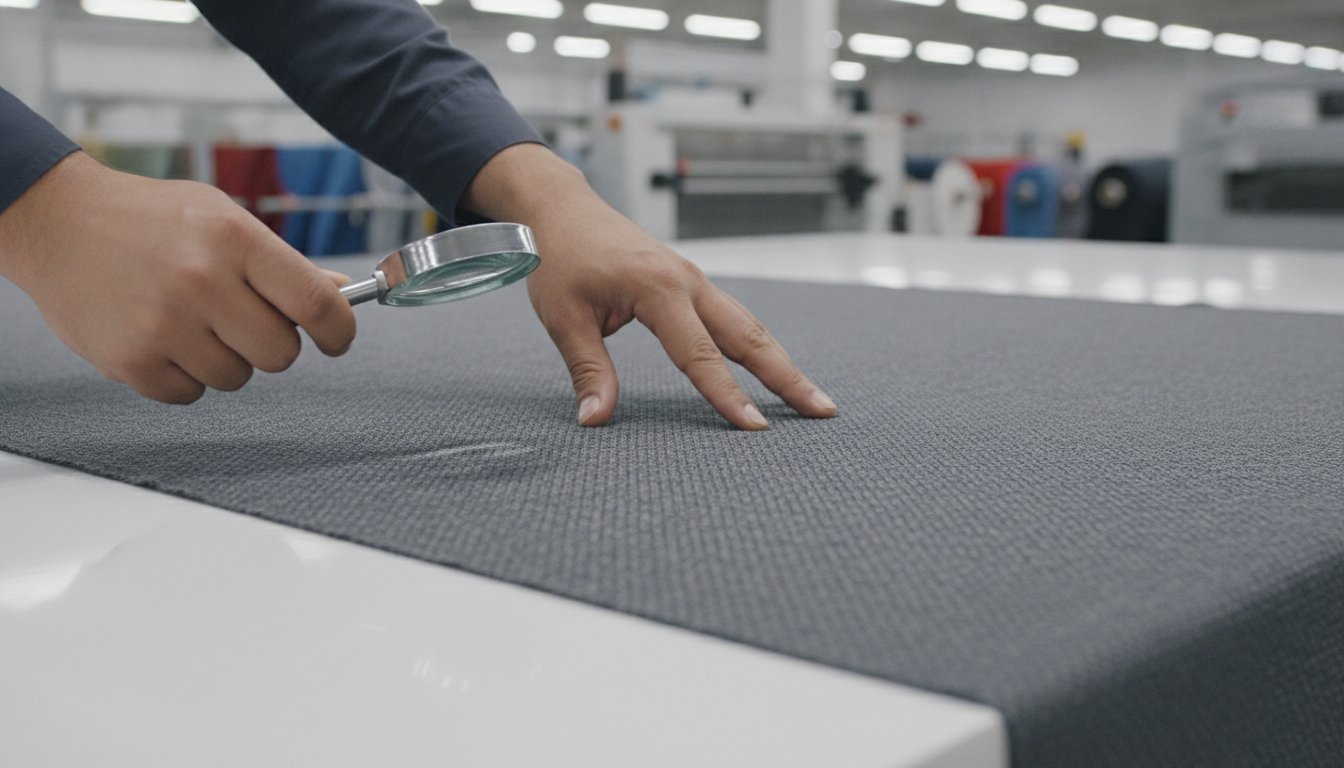

There are few things more damaging to a business than unboxing a long-awaited shipment only to discover it’s unsellable. The financial loss from pulls, stains, or inconsistent coloring is immediate, but the long-term harm to your brand's reputation can be even more severe. These critical quality failures almost always begin with undetected defects in fabric. Without a clear system for identifying these flaws early in the production process, you are leaving your investment and your customers' trust entirely at risk.
This guide provides the expert knowledge you need to take control. We will equip you to identify, classify, and prevent the most common and costly fabric defects that jeopardize your shipments. You will learn how to communicate precise quality standards to your suppliers and understand how a professional inspection acts as your essential line of defense, ensuring problems are stopped long before your products are shipped. It’s time to eliminate uncertainty, protect your investment, and ensure every shipment meets the standard your brand represents.
Key Takeaways
- Understand the difference between Critical, Major, and Minor defects to set clear, objective Acceptable Quality Limits (AQLs) for your products.
- Learn to identify the most common structural and aesthetic defects in fabric, from weaving flaws to dyeing inconsistencies, before they ruin your goods.
- Recognize why relying on your factory's internal QC alone is a high-risk strategy that can lead to costly surprises upon delivery.
- Implement a systematic third-party inspection process to verify quality, enforce your standards, and prevent defective products from ever shipping.
Understanding Fabric Defects: The Three Tiers of Quality Issues
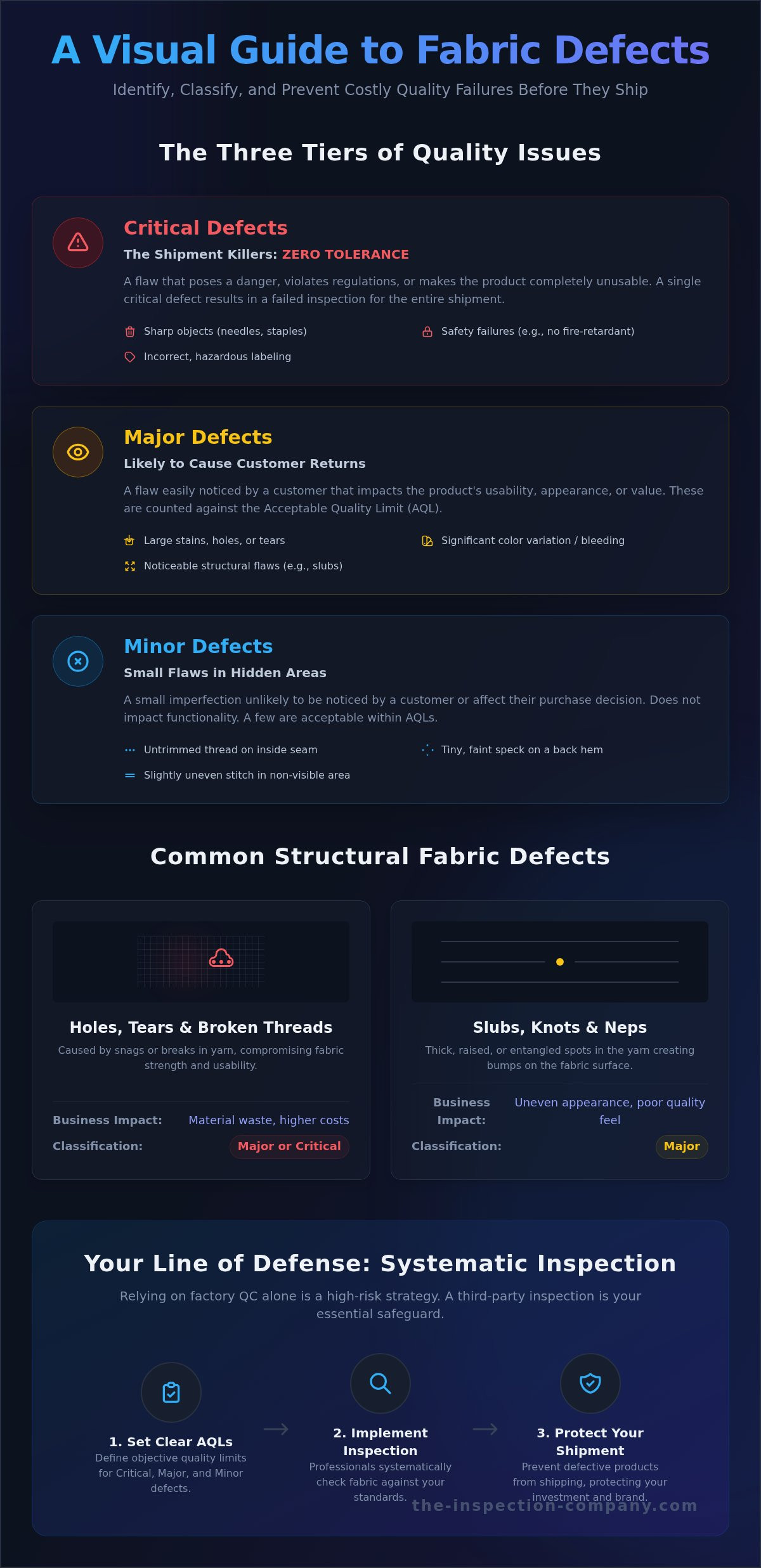
When assessing product quality, not all flaws are created equal. To make objective, data-driven decisions and avoid costly disputes with suppliers, professional inspectors classify defects into a standardized three-tier system: Critical, Major, and Minor. This classification is the bedrock of quality control, allowing you to set precise Acceptable Quality Limits (AQLs) for your shipment. By turning subjective opinions ("this looks bad") into a clear, actionable framework, this system provides a universal language for evaluating the true quality of your products and identifying serious defects in fabric before they reach your customers.
Critical Defects: The Shipment Killers
A critical defect is the most severe type of quality issue. It is defined as a flaw that poses a danger to the user, violates mandatory regulations, or renders the product completely unusable. There is zero tolerance for critical defects; the discovery of even a single one will result in an immediate failed inspection for the entire shipment.
-
Hazardous materials: A sharp object like a needle or staple left in a garment.
-
Safety failures: Incorrect or missing fire-retardant treatment on children's sleepwear.
-
Incorrect labeling: Mislabeled fiber content or care instructions that could damage the product.
Major Defects: Likely to Cause Customer Returns
A major defect is a flaw that would be easily noticed by an end-user and would likely cause them to return the product, leave a negative review, or file a complaint. These issues significantly impact the garment's usability, aesthetic appeal, or perceived value. During a professional fabric inspection, these are the types of flaws that are carefully counted against the AQL allowance.
-
Noticeable blemishes: Large stains, holes, or tears in a prominent area.
-
Color and dye issues: Significant color variation between panels or dye bleeding.
-
Structural flaws: Long, thick slubs (yarn imperfections) on the front of a shirt.
Minor Defects: Small Flaws in Hidden Areas
A minor defect is a small imperfection that is unlikely to be noticed by the average customer or affect their decision to purchase and keep the product. These flaws do not impact the garment's functionality and are typically located in inconspicuous areas. While a few minor defects are generally acceptable within AQL standards, an excessive number can indicate larger issues with the supplier's overall quality control.
-
Small cosmetic issues: A single untrimmed thread on an inside seam.
-
Tiny blemishes: A very small, faint speck on the back hem of a garment.
-
Minor stitching variance: A slightly uneven stitch in a non-visible area.
Common Weaving & Knitting Defects That Compromise Fabric Integrity
Unlike issues that arise during cutting or sewing, these defects in fabric are embedded during the weaving or knitting process itself. They are structural flaws-part of the material's DNA-making them difficult or impossible to repair later. When these flaws are present in a roll of fabric, they can lead to significant material waste at the garment factory, as large sections may need to be discarded. Professional inspectors meticulously examine fabric rolls over a light table, which illuminates the material from behind to make even the smallest structural issue clearly visible.
Holes, Tears, and Broken Threads
These are some of the most critical flaws, caused by snags or breaks in the yarn during the manufacturing process. They directly compromise the fabric's strength and usability.
-
Business Impact: Creates obvious weak spots and renders entire sections of a fabric roll unusable, directly impacting production yield and costs.
-
Classification: Almost always classified as a Major defect. If the hole is large or in a critical location, it can be escalated to a Critical defect, potentially leading to the rejection of an entire shipment.
-
Detection: Easily identified during a visual check, especially when backlit on an inspection table.
Slubs, Knots, and Neps
These defects manifest as thick, raised, or entangled spots in the yarn that create unwanted bumps on the fabric surface. While they may seem minor, they can have a significant cumulative effect on the final garment's quality.
-
Business Impact: Results in an uneven, low-quality appearance and can interfere with subsequent processes like printing or dyeing, causing inconsistencies in the final product.
-
Classification: The severity depends on size and frequency. According to industry guidelines for Fabric Defects Classification, small, infrequent neps may be a Minor defect, while large, numerous slubs are considered a Major defect.
-
Detection: Inspectors assess the size, quantity, and distribution of these flaws against an approved quality sample to determine if they fall within acceptable limits.
Dropped Stitches or Lines
Particularly common in knit fabrics, a dropped stitch occurs when a knitting needle fails to form a loop, creating a visible line or "run" in the material. This is a fundamental structural failure.
-
Business Impact: This defect can quickly unravel, creating "ladders" that destroy the fabric's integrity. It is a highly visible flaw that makes the final garment unsellable.
-
Classification: Due to its obvious nature and high risk of worsening, a dropped stitch is always classified as a Major defect.
Don't let weaving flaws ruin your order. Get an instant quote for an inspection.
Critical Dyeing, Printing & Finishing Defects That Ruin Appearance
After the base fabric is woven or knit, it undergoes dyeing, printing, and finishing processes to achieve its final look and feel. It is during these critical aesthetic stages that some of the most frustrating defects in fabric can emerge. These flaws directly impact the product's visual appeal, consumer perception, and ultimately, your brand's reputation. For this reason, professional inspectors meticulously compare production batches against an approved 'golden sample' to ensure absolute consistency.
Shade Variation & Color Mismatch
This occurs when there is an inconsistent color between different fabric rolls, or even within different sections of the same roll. The business impact is severe, leading to mismatched garment panels, unsellable inventory, and brand inconsistency. This is classified as a Major defect, a critical issue that, according to industry standards like the Fabric Defect Classification System, renders a product unfit for sale. Inspectors use a controlled lightbox to accurately compare shades against the approved standard.
Stains, Dirt, and Oil Marks
Unintended marks from machinery oil, improper handling, or contaminated dyestuffs immediately devalue a garment. These stains make a new product look used, dirty, and cheap, directly eroding customer trust. Unless the mark is minuscule and located in a hidden area (like an inner seam allowance), it is always considered a Major defect. During an inspection, the fabric surface is scanned methodically under proper lighting to identify any such blemishes before they reach your customers.
Printing Errors (Misprints & Off-Register)
For patterned fabrics, printing errors like misprints or off-register alignment can destroy the product's intended design. This happens when patterns are not aligned correctly across the fabric width, colors bleed into one another, or parts of the print are missing. This type of flaw is non-negotiable and is always classified as a Major defect. Quality control inspectors verify pattern alignment and color accuracy against the approved design file and golden sample to prevent these costly mistakes.
Crease Marks and Wrinkles
Unlike temporary wrinkles from shipping, these are permanent creases that have been set into the fabric due to improper finishing, heat setting, or prolonged storage under pressure. These marks cannot be ironed out and leave permanent, unsightly lines on the final garment. If prominent, these crease marks are considered Major defects in fabric that make the product look flawed and poorly made. Inspectors check for these lines as the fabric is unrolled and relaxed.
How a Pre-Shipment Inspection Systematically Catches Fabric Defects
Identifying potential fabric issues is one thing; systematically preventing them from reaching your customers is another. Relying solely on a factory's internal quality control introduces significant risk, as their interests may not align with yours. The most effective way to protect your investment and brand reputation is through an independent, third-party Pre-Shipment Inspection (PSI).
This systematic process is designed to find and quantify defects in fabric before you make the final payment and the goods are shipped. It replaces guesswork with objective data, giving you ultimate control over the quality you accept.
The 4-Point System: An Industry Standard
The most widely used method for fabric inspection is the 4-Point System. This provides an objective, mathematical basis for accepting or rejecting a roll of fabric. Defects are assigned penalty points based on their size and severity.
-
1 Point: Defects 3 inches or less.
-
2 Points: Defects over 3 inches but not exceeding 6 inches.
-
3 Points: Defects over 6 inches but not exceeding 9 inches.
-
4 Points: Defects over 9 inches.
A roll "passes" or "fails" based on the total number of penalty points calculated per 100 square yards. This standardized approach ensures consistency and provides clear grounds for discussion with your supplier.
AQL Sampling: How Much Fabric to Inspect?
Inspecting 100% of a fabric shipment is rarely feasible or cost-effective. Instead, professional inspectors use the AQL (Acceptable Quality Limit) standard. AQL is a statistical sampling method that determines the number of rolls to inspect from your total order. As the importer, you set your tolerance for Minor and Major defects, creating a quality standard that balances robust assurance with efficiency.
The Inspection Report: Your Eyes in the Factory
Within 24 hours of the inspection, you receive a comprehensive report that acts as your eyes and ears in the factory. This detailed document includes high-resolution photos of all found defects, their classification under the 4-Point System, and an overall assessment of the shipment's quality. Most importantly, it provides a clear "Pass" or "Fail" recommendation based on the AQL standard you set. This empowers you to approve the shipment or reject it with confidence, backed by impartial evidence. See how it works. Request a sample inspection report.
Secure Your Investment and Eliminate Fabric Quality Risks
Understanding the spectrum of fabric flaws, from weaving errors to finishing inconsistencies, is the first step toward quality assurance. But knowledge alone is not enough to protect your bottom line. The most critical takeaway is that a systematic, professional inspection is the only reliable way to catch issues before they escalate into costly problems. A proactive strategy is the most effective way to manage and prevent costly defects in fabric that can damage your products and brand reputation.
One day of inspection can save you from months of trouble. With a network of over 700 inspectors across Asia and European management upholding international standards, we provide the certainty you need. You receive a detailed report with high-resolution photos within 24 hours, empowering you to approve shipments with total confidence.
Protect your brand and your bottom line. Don't risk your investment. Book a Pre-Shipment Inspection today.
Frequently Asked Questions About Fabric Defects
What is the difference between a Major and a Minor defect in fabric?
A Major defect is a critical flaw that will make a garment unsellable or lead to a customer return, such as a large hole, incorrect color, or a significant tear. A Minor defect is a small imperfection that does not affect the product's usability or overall aesthetic and is unlikely to be noticed by the end consumer. For example, a single loose thread or a very small slub would be considered a minor flaw in most cases.
What is the 4-point system for fabric inspection and how does it work?
The 4-point system is an industry-standard method used to objectively quantify fabric quality. Inspectors assign penalty points to defects based on their size: 1 point for defects up to 3 inches, 2 points for 3-6 inches, 3 points for 6-9 inches, and 4 points for defects over 9 inches. The total points per 100 square yards are calculated. If the total exceeds the pre-agreed threshold, the fabric roll fails the inspection.
Can I reject a whole shipment if too many fabric defects are found?
Yes, you have the right to reject a shipment if the defect rate exceeds the pre-defined Acceptable Quality Limit (AQL) established in your agreement with the supplier. The AQL specifies the maximum number of defects allowed in a batch. Without a clear, contractually agreed-upon AQL, rejecting a shipment becomes subjective and can lead to significant disputes. Setting these terms beforehand is a critical step in risk management and quality assurance.
How do I communicate my quality standards for fabric to my supplier?
The most effective method is to provide a detailed technical specification sheet and approved physical samples before production begins. This document must clearly define your AQL, list specific unacceptable defects in fabric with visual examples, and specify inspection methods like the 4-point system. Providing this clear, written standard removes ambiguity and gives you an enforceable benchmark to hold your supplier accountable, minimizing the risk of costly surprises upon delivery.
How much does a professional fabric inspection typically cost?
A professional third-party fabric inspection typically costs between $250 and $400 USD per inspector-day. An "inspector-day" represents one inspector working for a standard 8-hour day. The final price depends on the factory's location and the total volume of fabric that needs to be assessed. This investment is a crucial risk mitigation tool, saving you from the much greater cost of receiving unusable raw materials for your production.
What should I include in my fabric inspection checklist?
A robust fabric inspection checklist should cover all critical quality attributes. Be sure to include: verification of fabric weight (GSM), weave, and composition; precise color matching against your approved Pantone or lab-dip standards; measurement of usable fabric width; and a check for any odors. It must also detail your defect classification system and specify packaging requirements to protect the rolls during shipment. A thorough checklist is essential for consistent quality control.